Thank you for visiting SNEWPapers!
Sign up free
New Hampshire Statesman And State Journal
Concord, Merrimack County, New Hampshire
What is this article about?
Biographical sketch of Commodore William Bainbridge's naval career, from apprenticeship and mutiny suppression at age 18, through merchant commands, U.S. Navy service, capture by French and Tripolitans, diplomatic mission to Algiers and Constantinople, and victory over HMS Java in 1812, up to his later roles and declining health.
Clipping
OCR Quality
Full Text
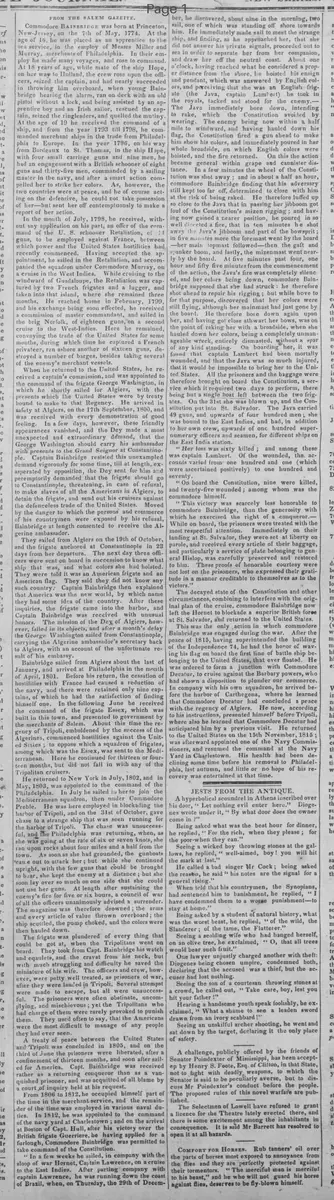
Commodore Bainbridge was born at Princeton, New Jersey, on the 7th of May, 1774. At the age of 16, he was placed as an apprentice to the sea service, in the employ of Messrs Miller and Murray, merchants of Philadelphia. In their employ he made many voyages, and rose to command.
At 18 years of age, while mate of the ship Hope, on her way to Holland, the crew rose upon the officers, seized the captain, and had nearly succeeded in throwing him overboard, when young Bainbridge hearing the alarm, ran on deck with an old pistol without a lock, and being assisted by an apprentice boy and an Irish sailor, rescued the captain, seized the ringleaders, and quelled the mutiny.
At the age of 19 he received the command of a ship, and from the year 1793 till 1798, he commanded merchant ships in the trade from Philadelphia to Europe. In the year 1796, on his way from Bordeaux to St. Thomas, in the ship Hope, with four small carriage guns and nine men, he had an engagement with a British schooner of eight guns and thirty-five men, commanded by a sailing master in the navy, and after a smart action compelled her to strike her colors. As, however, the two countries were at peace, and he of course acting on the defensive, he could not take possession of her—but sent her off contemptuously to make a report of her action.
In the month of July, 1798, he received, without any application on his part, an offer of the command of the U. S. schooner Retaliation, of 14 guns, to be employed against France, between which power and the United States hostilities had recently commenced. Having accepted the appointment, he sailed in the Retaliation, and accompanied the squadron under Commodore Murray, on a cruise in the West Indies. While cruising to the windward of Guadaloupe, the Retaliation was captured by two French frigates and a lugger, and taken into that island, where she remained three months. He reached home in February, 1799, and his exchange being soon effected, he received a commission of master commandant, and sailed in the brig Norfolk, of eighteen guns, on a second cruise to the West-Indies. Here he remained, convoying the trade of the United States for some months, during which time he captured a French privateer, ran ashore another of sixteen guns, destroyed a number of barges, besides taking several of the enemy's merchant vessels.
When he returned to the United States, he received a captain's commission, and was appointed to the command of the frigate George Washington, in which he shortly sailed for Algiers, with the presents which the United States were by treaty bound to make to that Regency. He arrived in safety at Algiers, on the 17th September, 1800, and was received with every demonstration of good feeling. In a few days, however, these friendly appearances vanished, and the Dey made a most unexpected and extraordinary demand, that the George Washington should carry his ambassador with presents to the Grand Seignor at Constantinople. Captain Bainbridge resisted this unexampled demand vigorously for some time, till at length, exasperated by opposition, the Dey sent for him and peremptorily demanded that the frigate should go to Constantinople, threatening, in case of refusal, to make slaves of all the Americans in Algiers, to detain the frigate, and send out his cruisers against the defenceless trade of the United States. Moved by the danger to which the persons and commerce of his countrymen were exposed by his refusal, Bainbridge at length consented to receive the Algerine ambassador.
They sailed from Algiers on the 19th of October, and the frigate anchored at Constantinople in 23 days from her departure. The next day three officers were sent on board in succession to know what ship that was, and what colors she had hoisted. They were told it was an American frigate and an American flag. They said they did not know any such country. Captain Bainbridge then explained that America was the new world, by which name they had some idea of the country. After these inquiries, the frigate came into the harbor, and Captain Bainbridge was received with unusual honors. The mission of the Dey of Algiers, however, failed in its objects, and after a month's delay the George Washington sailed from Constantinople, carrying the Algerine ambassador's secretary back to Algiers, with an account of the unfortunate result of his embassy.
Bainbridge sailed from Algiers about the last of January, and arrived at Philadelphia in the month of April, 1801. Before his return, the cessation of hostilities with France had caused a reduction of the navy, and there were retained only nine captains, of which he had the satisfaction of finding himself one. In the following June he received the command of the frigate Essex, which was built in this town, and presented to government by the merchants of Salem. About this time the regency of Tripoli, emboldened by the success of the Algerines, commenced hostilities against the United States; to oppose which a squadron of frigates, among which was the Essex, was sent to the Mediterranean. Here he continued for thirteen or fourteen months, but did not fall in with any of the Tripolitan cruisers.
He returned to New York in July, 1802, and in May, 1803, was appointed to the command of the Philadelphia. In July he sailed in her to join the Mediterranean squadron, then under Commodore Preble. He was here employed in blockading the harbor of Tripoli, and on the 31st of October, gave chase to a strange ship that was seen running for the harbor of Tripoli. The chase was unsuccessful, and the Philadelphia was returning, when, as she was going at the rate of six or seven knots, she ran upon rocks about four miles and a half from the town. As soon as she had grounded, the gunboats came out to attack her; but while she continued upright, with the few guns that could be brought to bear, she kept the enemy at a distance; but she soon lay over so much on one side that she could not use her guns. At length after sustaining the enemy's fire for five or six hours, a council of war of all the officers unanimously advised a surrender. The magazine was therefore drowned; the arms and every article of value thrown overboard: the ship scuttled, the pump choked, and the colors were then hauled down.
The frigate was plundered of every thing that could be got at, when the Tripolitans went on board. They took from Capt. Bainbridge his watch and epaulets, and the cravat from his neck, but with much struggling and difficulty he saved the miniature of his wife. The officers and crew, however, were pretty well treated, as prisoners of war, after they were landed in Tripoli. Several attempts were made to escape, but all were unsuccessful. The prisoners were often obstinate, uncomplying, and mischievous; yet the Tripolitans who had charge of them were rarely provoked to punish them. They used often to say, that the Americans were the most difficult to manage of any people they had ever seen.
A treaty of peace between the United States and Tripoli was concluded in 1805, and on the third of June the prisoners were liberated, after a confinement of thirteen months, and soon after sailed for America. Capt. Bainbridge was received rather as a returning conqueror than as a vanquished prisoner, and was acquitted of all blame by a court of inquiry held at his request.
From 1806 to 1812, he occupied himself part of the time in the merchant service, and the remainder of the time was employed in various naval duties. In 1812, he was appointed to the command of the navy yard at Charlestown; and on the arrival at Boston of Capt. Hull, after his victory over the British frigate Guerriere, he having applied for a furlough, Commodore Bainbridge was permitted to take command of the Constitution.
In a few weeks he sailed, in company with the sloop of war Hornet, Captain Lawrence, on a cruise to the East Indies. After parting company with captain Lawrence, he was running down the coast of Brazil, when, on Thursday, the 29th of December, he discovered, about nine in the morning, two sail, one of which was standing off shore towards him. He immediately made sail to meet the strange ship, and finding, as he approached her, that she did not answer his private signals, proceeded out to sea in order to separate her from her companion, and draw her off the neutral coast. About one o'clock, having reached what he considered a proper distance from the shore, he hoisted his ensign and pendant, which was answered by English colors, and perceiving that she was an English frigate (the Java, captain Lambert) he took in the royals, tacked and stood for the enemy. The Java immediately bore down, intending to rake, which the Constitution avoided by wearing. The enemy being now within a half mile to windward, and having hauled down his flag, the Constitution fired a gun ahead to make him show his colors, and immediately poured in her whole broadside, on which English colors were hoisted, and the fire returned. On this the action became general within grape and cannister distance. In a few minutes the wheel of the Constitution was shot away; and in about a half an hour, commodore Bainbridge finding that his adversary still kept too far off, determined to close with him at the risk of being raked. He therefore luffed up so close to the Java that in passing her jibboom got foul of the Constitution's mizen rigging; and having now gained a nearer position, he poured in so well directed a fire, that in ten minutes he shot away the Java's jibboom and part of the bowsprit; in five minutes more the foremast went by the board—her main topmast followed—then the gaff and spanker boom, and lastly, the mizenmast went nearly by the board. At five minutes past four, one hour and fifty five minutes from the commencement of the action, the Java's fire was completely silenced, and her colors being down, commodore Bainbridge supposed that she had struck: he therefore shot ahead to repair his rigging; but while hove to for that purpose, discovered that her colors were still flying, although her mainmast had just gone by the board. He therefore bore down again upon her, and having got close athwart her bows, was on the point of raking her with a broadside, when she hauled down her colors, being a completely unmanageable wreck, entirely dismasted, without a spar of any kind standing. On boarding her, it was found that captain Lambert had been mortally wounded, and that the Java was so much injured, that it would be impossible to bring her to the United States. All the prisoners and the baggage were therefore brought on board the Constitution, a service which it required two days to perform, there being but a single boat left between the two frigates. On the 31st she was blown up, and the Constitution put into St. Salvador. The Java carried 49 guns, and upwards of four hundred men; she was bound to the East Indies, and had, in addition to her own crew, upwards of one hundred supernumerary officers and seamen, for different ships on the East India station.
Her loss was sixty killed; and among these was captain Lambert. Of the wounded, the accounts varied from one hundred and one (which were ascertained positively) to one hundred and seventy.
On board the Constitution, nine were killed, and twenty-five wounded; among whom was the commodore himself.
This victory was scarcely less honorable to commodore Bainbridge, than the generosity with which he exercised the right of a conqueror. While on board, the prisoners were treated with the most respectful attention. Immediately on their landing at St. Salvador, they were set at liberty on parole, and received every article of their baggage, and particularly a service of plate belonging to general Hislop, was carefully preserved and restored to him. These proofs of honorable courtesy were not lost on the prisoners, who expressed their gratitude in a manner creditable to themselves as to the victors.
The decayed state of the Constitution and other circumstances, combining to interfere with the original plan of the cruise, commodore Bainbridge now left the Hornet to blockade a superior British force at St. Salvador, and returned to the United States.
This was the only action in which commodore Bainbridge was engaged during the war. After the peace of 1815, having superintended the building of the Independence 74, he had the honor of waving his flag on board the first line of battle ship belonging to the United States, that ever floated. He was ordered to form a junction with Commodore Decatur, to cruise against the Barbary powers, who had shown a disposition to plunder our commerce. In company with his own squadron, he arrived before the harbor of Cartagena, where he learned that Commodore Decatur had concluded a peace with the regency of Algiers. He now, according to his instructions, presented himself before Tripoli, where also he learned that Commodore Decatur had anticipated him by a previous visit. He returned to the United States on the 15th November, 1815; was afterward appointed one of the Navy Commissioners, and resumed the command at the Navy Yard in Charlestown. His health had been declining some time before his removal to Philadelphia, last autumn, and little or no hope of his recovery was entertained at that time.
What sub-type of article is it?
What themes does it cover?
What keywords are associated?
What entities or persons were involved?
Where did it happen?
Story Details
Key Persons
Location
Various: Princeton, Philadelphia, Atlantic Ocean, West Indies, Mediterranean Sea, Algiers, Constantinople, Tripoli, Brazil, St. Salvador
Event Date
1774 To 1815
Story Details
Life and naval career of Commodore Bainbridge, including quelling a mutiny at 18, capturing a British schooner, service in Quasi-War with France, forced diplomatic mission to Constantinople, grounding and capture of USS Philadelphia off Tripoli, and command of USS Constitution defeating HMS Java in 1812.