Thank you for visiting SNEWPapers!
Sign up free
Poem
December 25, 1851
Green Mountain Freeman
Montpelier, Washington County, Vermont
What is this article about?
A dirge lamenting the passage of the seasons as emblems of human life's transience, from spring's bloom to winter's decay, reflecting on mortality, lost hopes, and renewal through time.
Clipping
OCR Quality
75%
Good
Full Text
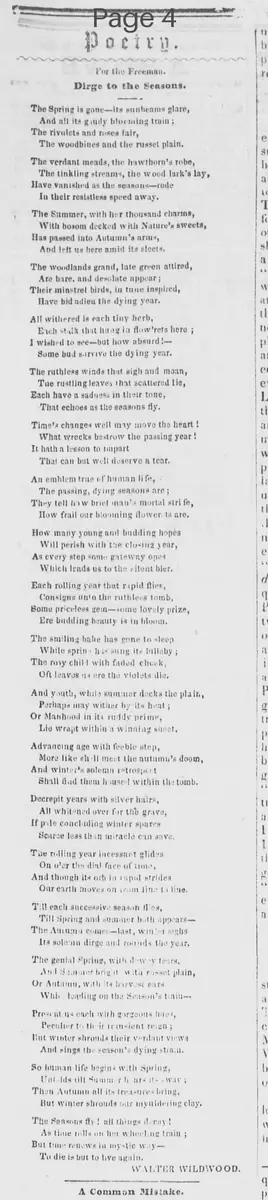
Poetry.
For the Freeman:
Dirge to the Seasons
The Spring is gone—its sunbeams glare,
And all its gaudy blooming train;
The rivulets and roses fair,
The woodbines and the russet plain.
The verdant meads, the hawthorn's robe,
The tinkling streams, the wood lark's lay
Have vanished as the seasons rode
In their resistless speed away.
The Summer, with her thousand charms,
With bosom decked with Nature's sweets.
Has passed into Autumn's arms,
And left us here amid its sleets.
The woodlands grand, late green attired,
Are bare, and desolate appear;
Their minstrel birds, in tune inspired.
Have bid adieu the dying year.
All withered is each tiny herb.
Each stalk that hung in flow'rets here;
I wished to see—but how absurd!-
Some bud survive the dying year.
The ruthless winds that sigh and moan,
The rustling leaves that scattered lie,
Each have a sadness in their tone,
That echoes as the seasons fly.
Time's changes well may move the heart!
What wrecks bestrow the passing year!
It hath a lesson to impart
That can but well deserve a tear.
An emblem true of human life,
The passing, dying seasons are;
They tell how brief man's mortal strife,
How frail our blooming flowers are.
How many young and budding hopes
Will perish with the closing year,
As every step some gateway opes
Which leads us to the silent bier.
Each rolling year that rapid sweeps,
Conveying unto endless tomb,
Some priceless gem—some lovely prize,
But budding beauty is in bloom,
The smiling babe has gone to sleep
While parents sing its lullaby;
The rosy child with faded cheek,
On leaves is where the violets die.
And youth, while summer decks the plain,
Perhaps may wither by its heat;
Or manhood in its midday prime,
He wraps within a winding sheet.
Advancing age with feeble step,
More has still met the autumn's doom.
And winter's tolerating frost
Shall clad them in its last cold tomb.
Decrepit years with silver hairs,
All whitened over for the grave,
In pile concluding winter's storm
Securely long in mockery caves.
The rolling year increases glides
On o'er this dry bed of man.
And though at times in rapid miles
Our earth destroyed on him relies.
Till each successive, rebel dies,
Till Spring will usher in her power—
The running comet—last, weary sighs
In mortal direst all the year.
The genial spring, with dewy tears,
And winter drove to heart again,
Or Autumn, with its merry capar
Well: bid adieu on the sun's train.
Fresh as an each with genial bliss,
Peculiar to his humid reign;
But winter driven, their weird in vogue
And rings the season's dying stand.
So human life begins with Spring,
Not lads of Summer are its way
Then Autumn all its treasures bring,
But winter shrouds our mouldering clay.
The Seasons fly! all things decay!
As time tolls on its whirling train:
But time renews in mystic way—
To die is but to live again.
WALTER WILDWOOD.
For the Freeman:
Dirge to the Seasons
The Spring is gone—its sunbeams glare,
And all its gaudy blooming train;
The rivulets and roses fair,
The woodbines and the russet plain.
The verdant meads, the hawthorn's robe,
The tinkling streams, the wood lark's lay
Have vanished as the seasons rode
In their resistless speed away.
The Summer, with her thousand charms,
With bosom decked with Nature's sweets.
Has passed into Autumn's arms,
And left us here amid its sleets.
The woodlands grand, late green attired,
Are bare, and desolate appear;
Their minstrel birds, in tune inspired.
Have bid adieu the dying year.
All withered is each tiny herb.
Each stalk that hung in flow'rets here;
I wished to see—but how absurd!-
Some bud survive the dying year.
The ruthless winds that sigh and moan,
The rustling leaves that scattered lie,
Each have a sadness in their tone,
That echoes as the seasons fly.
Time's changes well may move the heart!
What wrecks bestrow the passing year!
It hath a lesson to impart
That can but well deserve a tear.
An emblem true of human life,
The passing, dying seasons are;
They tell how brief man's mortal strife,
How frail our blooming flowers are.
How many young and budding hopes
Will perish with the closing year,
As every step some gateway opes
Which leads us to the silent bier.
Each rolling year that rapid sweeps,
Conveying unto endless tomb,
Some priceless gem—some lovely prize,
But budding beauty is in bloom,
The smiling babe has gone to sleep
While parents sing its lullaby;
The rosy child with faded cheek,
On leaves is where the violets die.
And youth, while summer decks the plain,
Perhaps may wither by its heat;
Or manhood in its midday prime,
He wraps within a winding sheet.
Advancing age with feeble step,
More has still met the autumn's doom.
And winter's tolerating frost
Shall clad them in its last cold tomb.
Decrepit years with silver hairs,
All whitened over for the grave,
In pile concluding winter's storm
Securely long in mockery caves.
The rolling year increases glides
On o'er this dry bed of man.
And though at times in rapid miles
Our earth destroyed on him relies.
Till each successive, rebel dies,
Till Spring will usher in her power—
The running comet—last, weary sighs
In mortal direst all the year.
The genial spring, with dewy tears,
And winter drove to heart again,
Or Autumn, with its merry capar
Well: bid adieu on the sun's train.
Fresh as an each with genial bliss,
Peculiar to his humid reign;
But winter driven, their weird in vogue
And rings the season's dying stand.
So human life begins with Spring,
Not lads of Summer are its way
Then Autumn all its treasures bring,
But winter shrouds our mouldering clay.
The Seasons fly! all things decay!
As time tolls on its whirling train:
But time renews in mystic way—
To die is but to live again.
WALTER WILDWOOD.
What sub-type of article is it?
Elegy
Pastoral
What themes does it cover?
Nature Seasons
Death Mourning
Moral Virtue
What keywords are associated?
Seasons Dirge
Human Life
Mortality
Nature Decay
Time Passage
Renewal
What entities or persons were involved?
Walter Wildwood.
Poem Details
Title
Dirge To The Seasons
Author
Walter Wildwood.
Subject
Dirge To The Seasons
Form / Style
Rhymed Quatrains
Key Lines
The Spring Is Gone—Its Sunbeams Glare,
And All Its Gaudy Blooming Train;
The Rivulets And Roses Fair,
The Woodbines And The Russet Plain.
An Emblem True Of Human Life,
The Passing, Dying Seasons Are;
They Tell How Brief Man's Mortal Strife,
How Frail Our Blooming Flowers Are.
The Seasons Fly! All Things Decay!
As Time Tolls On Its Whirling Train:
But Time Renews In Mystic Way—
To Die Is But To Live Again.