Thank you for visiting SNEWPapers!
Sign up free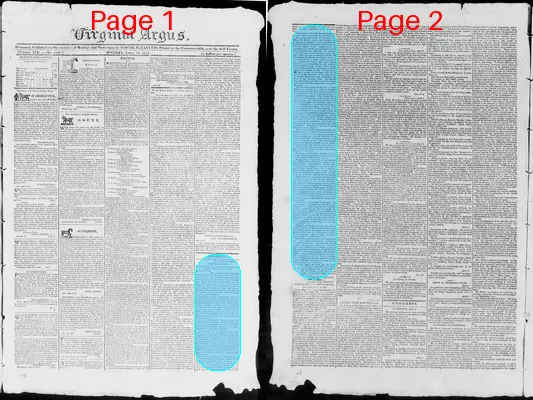
Virginia Argus
Richmond, Virginia
What is this article about?
New York Governor Daniel D. Tompkins issues a message proroguing the state legislature until May 21, 1812, due to suspicions of bribery in the proposed incorporation of the Bank of America and past banking corruption scandals, amid fears of war with Britain.
Merged-components note: Continuation of the New-York prorogation message across pages.
Clippings
1 of 2
OCR Quality
Full Text
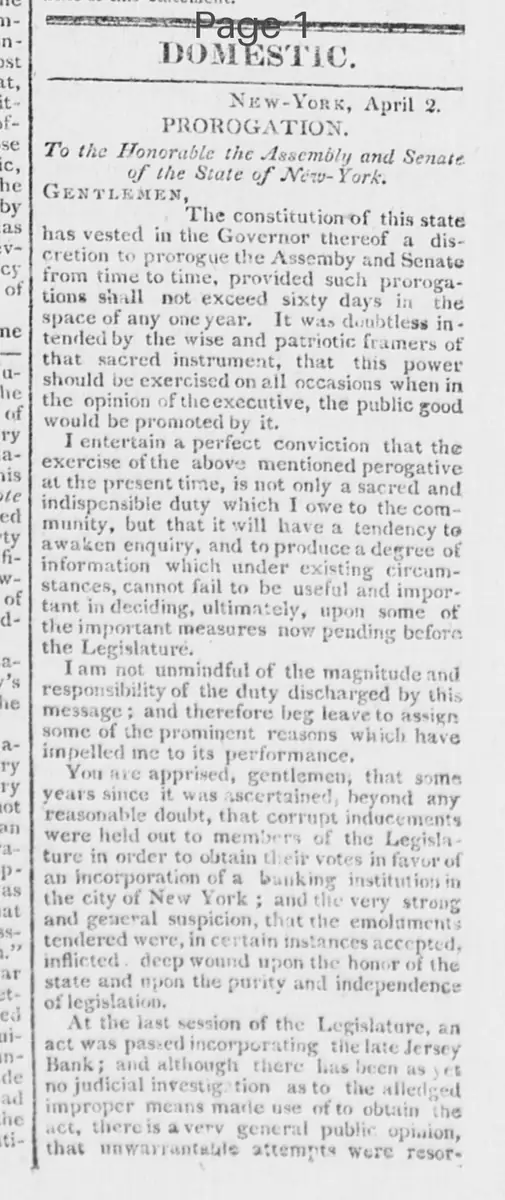
NEW-YORK, April 2.
PROROGATION.
To the Honorable the Assembly and Senate
of the State of New-York.
GENTLEMEN,
The constitution of this state
has vested in the Governor thereof a discretion
to prorogue the Assembly and Senate
from time to time, provided such prorogations
shall not exceed sixty days in the
space of any one year. It was doubtless intended
by the wise and patriotic framers of
that sacred instrument, that this power
should be exercised on all occasions when in
the opinion of the executive, the public good
would be promoted by it.
I entertain a perfect conviction that the
exercise of the above mentioned prerogative
at the present time, is not only a sacred and
indispensable duty which I owe to the community,
but that it will have a tendency to
awaken enquiry, and to produce a degree of
information which under existing circumstances,
cannot fail to be useful and important in deciding,
ultimately, upon some of
the important measures now pending before
the Legislature.
I am not unmindful of the magnitude and
responsibility of the duty discharged by this
message; and therefore beg leave to assign
some of the prominent reasons which have
impelled me to its performance.
You are apprised, gentlemen, that some
years since it was ascertained, beyond any
reasonable doubt, that corrupt inducements
were held out to members of the Legislature in order to obtain their votes in favor of
an incorporation of a banking institution in
the city of New York; and the very strong
and general suspicion, that the emoluments
tendered were, in certain instances accepted,
inflicted deep wound upon the honor of the
state and upon the purity and independence
of legislation.
At the last session of the Legislature, an
act was passed incorporating the late Jersey
Bank; and although there has been as yet
no judicial investigation as to the alleged
improper means made use of to obtain the
act, there is a very general public opinion,
that unwarrantable attempts were resorted
to for that purpose.
Attempted on that occasion to influence, unduly, the then members of the Legislature.
With respect to the bill for the incorporation of another bank in the city of New-York, by the name of the Bank of America, now before the Senate, many, and forcible objections exist against it; and I cherished the hope that the considerations which I had the honor to suggest to the Legislature at the commencement of the present session, would have had their due influence. In corroboration of these considerations, I avail myself of this occasion to remark, that the bill now before the Senate establishes, in the city of New-York, a bank with a capital of six millions of dollars: that five millions thereof may be subscribed by the stockholders, of the late Bank of the United States, without any provision which gives a preference to the citizens of the United States; and thus foreign stockholders may be admitted, in the discretion of the directors to monopolize the stock, and consequent control, of the intended bank, and thereby acquire a dangerous influence in the monied operations and other important concerns of the state.
The banking capital in the city of New-York now exceeds nine millions of dollars. This capital, in the most flourishing state of our commerce, has been found adequate to commercial purposes. The United States, we have much reason to apprehend, are on the verge of a war with Great Britain, in defence of our rights, our national honor, and our independence; and commerce is consequently nearly suspended. Can it be wise, then, to increase our banking capital in an unprecedented manner, at a time when we have only a very limited and restricted commerce left? Can it be prudent or safe at such a time, to employ British capital, and subject ourselves to its deleterious influence in thwarting the operations of our own government, in a just and necessary war with G. Britain? It appears to me that it would be unwise and impolitic.
When I contemplate the creation of a new bank in the city of New York with so enormous a capital; when I perceive the resuscitation within this state of half the whole capital of the late United States Bank; and which I view the power which that bank is to concentrate in the hands of a few individuals, I cannot but feel the most lively apprehensions for the safety of all other banking institutions, and of our most inestimable political institutions.
But these considerations become less important when compared with others, to which it is my painful duty here to advert.
It appears by the journals of the Assembly, that attempts have been made to corrupt, by bribes, four members of that body, to vote for the passage of the bill to incorporate the aforesaid bank; and it also appears by the journals of the Senate, that an improper attempt has been made to influence one of the Senators to vote for the bill.
Far be it from me to insinuate that improper considerations have induced any member of the Legislature to vote for the said bill; yet, should its final passage now take place, before the persons implicated in holding out the beforementioned inducements shall have been judiciously tried, & without consulting the feelings and opinion of the community at large upon the subject, public sentiment will, I fear, however unjustly, attribute its passage, in some degree, to the influence of such inducements.
Under such persuasion, I entertain the most fearful apprehensions, that the confidence of the people, in the purity and independence of legislation, will be fatally impaired; our representative system, which has been devised for us by our sages, and wisest jurists as a safe guard for our security, our property and our liberty, ultimately destroyed; and this great and populous state lose her just importance and influence in the destinies of the U.S.
It gives me sincere anxiety and pain to reflect, that many individual inconveniences will result from a prorogation of the Legislature at this time; yet these inconveniences do not compare with the public considerations which induce this measure.
Solemnly impressed with the importance of the preceding considerations, and feeling that the morals, the honor, and the dignity of the state require it—and in order that time may be afforded for reflection, and for the complete ascertainment of public sentiment upon a measure fraught with such important consequences, I have deemed it proper to prorogue, and I do hereby prorogue the Assembly and Senate until the twenty-first day of May next, then to meet in the Capitol in the city of Albany.
Given under my hand and the privy seal of the state of New York, at the city of Albany, this twenty-seventh day of March, in the year of our Lord, one thousand eight hundred and twelve.
DANIEL D. TOMPKINS.
What sub-type of article is it?
What keywords are associated?
What entities or persons were involved?
Where did it happen?
Domestic News Details
Primary Location
State Of New York
Event Date
March 27, 1812
Key Persons
Outcome
prorogation of the assembly and senate until may 21, 1812, to allow time for public reflection on the bank of america incorporation bill amid bribery concerns.
Event Details
Governor Daniel D. Tompkins exercises his constitutional prerogative to prorogue the New York legislature, citing past and present suspicions of corruption and bribery in banking incorporation efforts, particularly the Bank of America bill, and concerns over foreign influence and impending war with Britain.