Thank you for visiting SNEWPapers!
Sign up free
Alexandria Advertiser And Commercial Intelligencer
Alexandria, Virginia
What is this article about?
Transcript of U.S. House debate on February 16-17, 1802, on Senate bill to repeal acts organizing federal courts. Mr. Hemphill argues for judicial independence during good behavior, against abolishing judgeships. Mr. Thompson defends Congress's power to modify and repeal judicial laws for public welfare.
Merged-components note: This is a continuation of the congressional debate story across pages 2 and 3, as indicated by the sequential reading order and the text flow ending with an incomplete sentence on page 2 and continuing on page 3.
Clippings
1 of 2
OCR Quality
Full Text
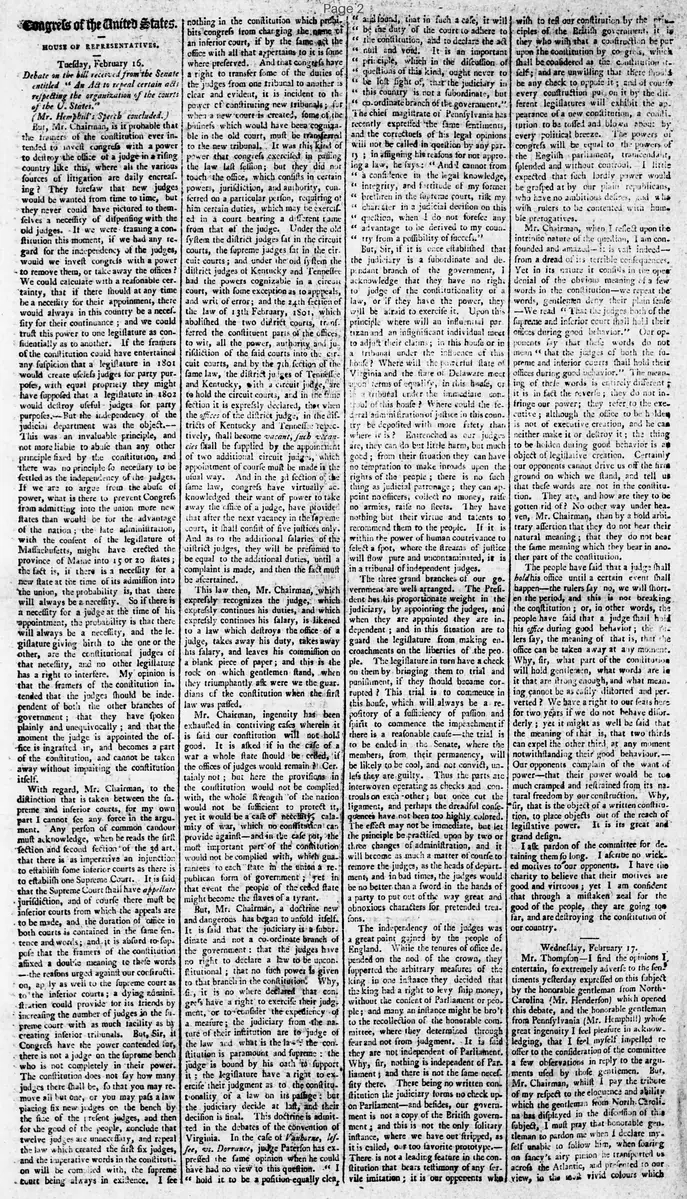
HOUSE OF REPRESENTATIVES
Tuesday, February 16.
Debate on the bill received from the Senate entitled "An Act to repeal certain acts respecting the organization of the courts of the U. States."
(Mr. Hemphill's Speech concluded.)
But, Mr. Chairman, is it probable that the framers of the constitution ever intended to invest congress with a power to destroy the office of a judge in a rising country like this, where all the various sources of litigation are daily increasing? They foresaw that new judges would be wanted from time to time, but they never could have pictured to themselves a necessity of dispensing with the old judges. If we were framing a constitution this moment, if we had any regard for the independency of the judges, would we invest congress with a power to remove them, or take away the offices? We could calculate with a reasonable certainty, that if there should at any time be a necessity for their appointment, there would always in this country be a necessity for their continuance; and we could trust this power to one legislature as confidentially as to another. If the framers of the constitution could have entertained any suspicion that a legislature in 1801 would create useless judges for party purposes, with equal propriety they might have supposed that a legislature in 1802 would destroy useful judges for party purposes. But the independency of the judicial department was the object. This was an invaluable principle, and not more liable to abuse than any other principle fixed by the constitution, and there was no principle so necessary to be settled as the independency of the judges. If we are to argue from the abuse of power, what is there to prevent Congress from admitting into the union more new states than would be for the advantage of the nation: the late administration, with the consent of the legislature of Massachusetts, might have erected the province of Maine into 15 or 20 states; the fact is, if there is a necessity for a new state at the time of its admission into the union, the probability is, that there will always be a necessity. So if there is a necessity for a judge at the time of his appointment, the probability is that there will always be a necessity, and the legislature giving birth to the one or the other, are the constitutional judges of that necessity, and no other legislature has a right to interfere. My opinion is that the framers of the constitution intended that the judges should be independent of both the other branches of government; that they have spoken plainly and unequivocally; and that the moment the judge is appointed the office is ingrafted in, and becomes a part of the constitution, and cannot be taken away without impairing the constitution itself.
With regard, Mr. Chairman, to the distinction that is taken between the supreme and inferior courts, for my own part I cannot see any force in the argument. Any person of common candor must acknowledge, when he reads the first and second section of the 3d article, that there is as imperative an injunction to establish some inferior courts as there is to establish one Supreme Court. It is said that the Supreme Court shall have appellate jurisdiction, and of course there must be inferior courts from which the appeals are to be made, and the duration of office in both courts is contained in the same sentence and words; and it is absurd to suppose that the framers of the constitution affixed a double meaning to these words. The reasons urged against our construction, apply as well to the supreme court as to the inferior courts; a dying administration could provide for its friends by increasing the number of judges in the supreme court with as much facility as by creating inferior tribunals. But, Sir, if Congress have the power contended for, there is not a judge on the supreme bench who is not completely in their power. The constitution does not say how many judges there shall be, so that you may remove all but one, or you may pass a law placing six new judges on the bench by the side of the present judges, and then for the good of the people, conclude that twelve judges are unnecessary, and repeal the law which created the first six judges, and the imperative words in the constitution will be complied with, the supreme court being always in existence. I see nothing in the constitution which prohibits congress from changing the name of an inferior court, if by the same act the office with all that appertains to it is somewhere preserved. And that congress have a right to transfer some of the duties of the judges from one tribunal to another is clear and evident, it is incident to the power of constituting new tribunals; for when a new court is created, some of the business which would have been cognizable in the old court, must be transferred to the new tribunal. It was this kind of power that congress exercised in passing the law last session; but they did not touch the office, which consists in certain powers, jurisdiction, and authority, conferred on a particular person, requiring of him certain duties, which may be exercised in a court bearing a different name from that of the judge. Under the old system the district judges sat in the circuit courts, the supreme judges sat in the circuit courts; and under the old system the district judges of Kentucky and Tennessee had the powers cognizable in a circuit court, with some exception as to appeals, and writ of error; and the 28th section of the law of 13th February, 1801, which abolished the two district courts, transferred the constituent parts of the offices; to wit, all the power, authority and jurisdiction of the said courts into the circuit courts, and by the 2th section of the same law, the district judges of Tennessee and Kentucky, with a circuit judge, are to hold the circuit courts, and in the first section it is expressly declared, that when the offices of the district judge, in the districts of Kentucky and Tennessee respectively, shall become vacant, such vacancies shall be supplied by the appointment of two additional circuit judges, which appointment of course must be made in the usual way. And in the 3d section of the same law, congress have virtually acknowledged their want of power to take away the office of a judge, have provided that after the next vacancy in the supreme court, it shall consist of five justices only. And as to the additional salaries of the district judges, they will be presumed to be equal to the additional duties, until a complaint is made, and then the fact must be ascertained.
This law then, Mr. Chairman, which expressly recognizes the judge, which expressly continues his duties, and which expressly continues his salary, is likened to a law which destroys the office of a judge, takes away his duty, takes away his salary, and leaves his commission on a blank piece of paper; and this is the rock on which gentlemen stand, when they triumphantly ask were we the guardians of the constitution when the first law was passed.
Mr. Chairman, ingenuity has been exhausted in contriving cases wherein it is said our constitution will not hold good. It is asked if in the case of a war a whole state should be ceded if the offices of judges would remain. Certainly not; but here the provisions in the constitution would not be complied with, the whole strength of the nation would not be sufficient to protect it, yet it would be a case of necessity calamity of war, which no constitution can provide against—and in the case put, the most important part of the constitution would not be complied with, which guarantees to each state in the union a republican form of government; yet in that event the people of the ceded state might become the slaves of a tyrant.
But, Mr. Chairman, a doctrine new and dangerous has began to unfold itself. It is said that the judiciary is a subordinate and not a co-ordinate branch of the government: that the judges have no right to declare a law to be unconstitutional; that no such power is given to that branch in the constitution. Why, sir, it is no where declared that congress have a right to exercise their judgment, or to consider the expediency of a measure; the judiciary from the nature of their institution are to judge of the law and what is the law: the constitution is paramount and supreme: the judge is bound by his oath to support it; the legislature have a right to exercise their judgment as to the constitutionality of a law on its passage: but the judiciary decide at last, and their decision is final. This doctrine is admitted in the debates of the convention of Virginia. In the case of Van Horne's lessee, vs. Dorrance, judge Paterson has expressed the same opinion when he could have had no view to this question. "I hold it to be a position equally clear and sound, that in such a case, it will be the duty of the court to adhere to the constitution, and to declare the act null and void. It is an important principle, which in the discussion of questions of this kind, ought never to be lost sight of, that the judiciary in this country is not a subordinate, but co-ordinate branch of the government."
The chief magistrate of Pennsylvania has recently expressed the same sentiments, and the correctness of his legal opinions will not be called in question by any party; in assigning his reasons for not approving a law, he says: "And I cannot from a confidence in the legal knowledge, integrity, and fortitude of my former brethren in the supreme court, risk my character in a judicial decision on this question, when I do not foresee any advantage to be derived to my country from a possibility of success."
But, Sir, if it is once established that the judiciary is a subordinate and dependent branch of the government, I acknowledge that they have no right to judge of the constitutionality of a law, or if they have the power, they will be afraid to exercise it. Upon this principle where will an influential party and an insignificant individual meet to adjust their claims: in this house or in a tribunal under the influence of this house? Where will the powerful state of Virginia and the state of Delaware meet upon terms of equality, in this house, or in a tribunal under the immediate control of this house? Where could the federal administration of justice in this country be deposited with more safety than where it is? Entrenched as our judges are, they can do but little harm, but much good; from their situation they can have no temptation to make inroads upon the rights of the people; there is no such thing as judicial patronage; they can appoint no officers, collect no money, raise no armies, raise no fleets. They have nothing but their virtue and talents to recommend them to the people. If it is within the power of human contrivance to elect a spot, where the streams of justice will flow pure and uncontaminated, it is in a tribunal of independent judges.
The three grand branches of our government are well arranged. The President has his proportionate weight in the judiciary, by appointing the judges, and when they are appointed they are independent; and in this situation are to guard the legislature from making encroachments on the liberties of the people. The legislature in turn have a check on them by bringing them to trial and punishment, if they should become corrupted. This trial is to commence in this house, which will always be a repository of a sufficiency of passion and spirit to commence the impeachment if there is a reasonable cause—the trial is to be ended in the Senate, where the members, from their permanency, will be likely to be cool, and not convict, unless they are guilty. Thus the parts are interwoven operating as checks and controls on each other; but once cut the ligament, and perhaps the dreadful consequences have not been too highly colored. The effect may not be immediate, but let the principle be practiced upon by two or three changes of administration, and it will become as much a matter of course to remove the judges, as the heads of department, and in bad times, the judges would be no better than a sword in the hands of a party to put out of the way great and obnoxious characters for pretended reasons.
The independency of the judges was a great point gained by the people of England. While the tenures of office depended on the nod of the crown, they supported the arbitrary measures of the king in one instance they decided that the king had a right to levy ship money, without the consent of Parliament or people; and many an instance might be brought to the recollection of the honorable committee, where they determined through fear and not from judgment. It is said they are not independent of Parliament. Why, sir, nothing is independent of Parliament; and there is not the same necessity there. There being no written constitution the judiciary forms no check upon Parliament—and besides, our government is not a copy of the British government; and this is not the only solitary instance, where we have out tripped, as it is called, our too favorite prototype. There is not a leading feature in the constitution that bears testimony of any servile imitation; it is our opponents who wish to test our constitution by the principles of the British government, it is they who wish that a construction be put upon the constitution by congress, which shall be considered as the constitution itself: and are unwilling that there should be any check to oppose it; and of course every construction put on it by the different legislatures will exhibit the appearance of a new constitution, a constitution to be tossed and blown about by every political breeze. The powers of congress will be equal to the powers of the English parliament, transcendent, plenary and without control. I little expected that such lordly power would be grasped at by our plain republicans, who have no ambitious desires, and who wish rulers to be contented with humble prerogatives.
Mr. Chairman, when I reflect upon the intrinsic nature of the question, I am confounded and amazed—it is vast indeed—from a dread of its terrible consequences. Yet in its nature it consists in the open denial of the obvious meaning of a few words in the constitution—we repeat the words, gentlemen deny their plain sense—We read "That the judges both of the supreme and inferior court shall hold their offices during good behavior." Our opponents say that these words do not mean "that the judges of both the supreme and inferior courts shall hold their offices during good behavior." The meaning of these words is entirely different; it is in fact the reverse; they do not infringe our power; they refer to the executive; although the office to be holden is not of executive creation, and he can neither make it or destroy it; the thing to be holden during good behavior is an object of legislative creation. Certainly our opponents cannot drive us off the firm ground on which we stand, and tell us that these words are not in the constitution. They are, and how are they to be gotten rid of? No other way under heaven, Mr. Chairman, than by a bold arbitrary assertion that they do not bear their natural meaning; that they do not bear the same meaning which they bear in another part of the constitution.
The people have said that a judge shall hold his office until a certain event shall happen—the rulers say no, we will shorten the period, and this is not breaking the constitution: or, in other words, the people have said that a judge shall hold his office during good behavior; the rulers say, the meaning of that is, that the office can be taken away at any moment. Why, sir, what part of the constitution will hold gentlemen, what words are in it that are strong enough, and what meaning cannot be as easily distorted and perverted? We have a right to our seats here for two years if we do not behave disorderly; yet it might as well be said that the meaning of that is, that two thirds can expel the other third, at any moment notwithstanding their good behaviour.
Our opponents complain of the want of power—that their power would be too much cramped and restrained from its natural freedom by our construction. Why, sir, that is the object of a written constitution, to place objects out of the reach of legislative power. It is its great and grand design.
I ask pardon of the committee for detaining them so long. I ascribe no wicked motives to our opponents. I have that charity to believe that their motives are good and virtuous; yet I am confident that through a mistaken zeal for the good of the people, they are going too far, and are destroying the constitution of our country.
Wednesday, February 17.
Mr. Thompson—I find the opinions I entertain, so extremely adverse to the sentiments yesterday expressed on this subject by the honorable gentleman from North-Carolina (Mr. Henderson) which opened this debate, and the honorable gentleman from Pennsylvania (Mr. Hemphill) whose great ingenuity I feel pleasure in acknowledging, that I feel myself impelled to offer to the consideration of the committee a few observations in reply to the arguments used by those gentlemen. But, Mr. Chairman, whilst I pay the tribute of my respect to the eloquence and ability which the gentleman from North Carolina has displayed in the discussion of this subject, I must pray that honorable gentleman to pardon me when I declare myself unable to follow him, when soaring on fancy's airy pinion he transported us across the Atlantic, and presented to our view, in the most vivid colours which
Language can portray, the spirit of innovation weeping morality and good order from the earth. Nor will I pretend, Sir, that my humble genius will enable me to pursue him, when he forced this same spirit of innovation to mount the whirlwind and lash on the storm. But, Sir, with such talents as I am endowed with, I have no objection to going into the consideration of the question before the committee, or pursuing the order which the gentleman has had the goodness to suggest, as the most natural into which the subject can be divided—that is 1st—The power of the legislature to pass, and 2dly, The expediency under the existing state of things of passing the bill now upon your table.
Under these two heads I will endeavor to meet, as far as I shall be able to recollect them, the most impressive arguments which have been used by the gentlemen, and I will beg leave in the first place to call the attention of the committee to the 5th section of the first article of the constitution, which has been very slightly touched on by the gentleman from North Carolina, and which has been attended to, with much ingenuity by the gentleman from Pennsylvania. By this section the legislative powers of congress are defined. Congress shall have power, says the constitution, to levy taxes, to borrow money, to coin money, and, among a variety of other powers. "To constitute tribunals inferior to the supreme court." It is an axiom in politics that an ordaining power always embraces a repealing power; if congress have a right to constitute courts, they have the right to modify and to annul the courts constituted, this, like various others, is merely a discretionary power to be exercised, or not exercised, as congress shall find conducive to the public welfare; the granting a power does not oblige the exercise of that power: neither does the exercise of power make the laws resulting from that constitutional exercise of power, unchangeable and irrepealable. The same constitution, giving this power, gives various other powers as I have already shown; yet it has never been contended that the laws passed under these conceded powers are irrepealable. Still, by a parity of reason, and with a reference to this particular section of the constitution, 'if the laws relating to the judiciary establishment of the United States are irrepealable, so must the various laws passed under these granted powers, relating to your revenue, to your army, to your navy, to your mint, be irrepealable. But every gentleman knows that laws resulting from these powers have been passed, have been modified, and have been repealed: and so likewise has the law establishing the judiciary system. Without carrying you through the tedious detail of the 26 or 27 laws, which have been passed upon this subject, it will be quite sufficient for my purpose to notice the law of the last session of congress: the 27th section of which opens with these words: "And be it further enacted, that the circuit court of the United States heretofore established shall cease and be abolished." We travel not then in a wilderness, Mr. Chairman, untrodden by human footsteps; our immediate predecessors, it appears to me, are the pioneers who point out to us the path we should pursue for the benefit of our constituents: They have not only abolished the circuit courts, but reorganized the whole system; they have constituted new courts and new judges, and they have lessened the duties of the judges of the supreme courts. To say that a subsequent legislature have not a right to repeal a law of a precedent legislature is to proclaim such precedent legislature infallible. That they are more just, more wise, more competent to the exercise of their functions, than any legislature which shall follow them. It is a contradiction of the progress of knowledge, and of the improvements which may result from experience. It is a denial of the utility of frequent elections; because that legislature which had attained the acme of perfection ought to be permanent and unchangeable. The law however of the last session, which I have just now cited, having modified the courts of the United States, concedes the power of modification to be in the legislature. But, sir, even this concession, as it is, is now by the arguments of gentlemen, so clogged with appendages, so qualified by exceptions, that whilst with one breath the power of modification is admitted, with the very next that power is unnerved, is rendered useless; for
Says the gentleman from North-Carolina, a department of the government has been erected, called the judiciary, not holding their offices during pleasure, but during good behavior, and whatever power attempts to deprive them of their offices violates the constitution. It is admitted then that congress have power to modify the law; but it is denied that they have power to abolish the offices of the judges.
(To be continued.)
What sub-type of article is it?
What themes does it cover?
What keywords are associated?
What entities or persons were involved?
Where did it happen?
Story Details
Key Persons
Location
House Of Representatives, Congress Of The United States
Event Date
Tuesday, February 16; Wednesday, February 17
Story Details
Debate on bill to repeal federal court organization acts; Hemphill defends judicial independence and good behavior tenure against legislative repeal; Thompson argues Congress has power to constitute, modify, and repeal inferior courts as discretionary authority.