Thank you for visiting SNEWPapers!
Sign up free
Literary
July 26, 1878
Springfield Weekly Republican
Springfield, Hampden County, Massachusetts
What is this article about?
A Boston literary letter reviews August 1878 issues of Scribner's, Atlantic, and Harper's magazines, praising Scribner's engravings and Bryant's portrait, critiquing poems by Stedman, Harte, and others, prose stories, and illustrations, while discussing literary trends and authors.
Clipping
OCR Quality
98%
Excellent
Full Text
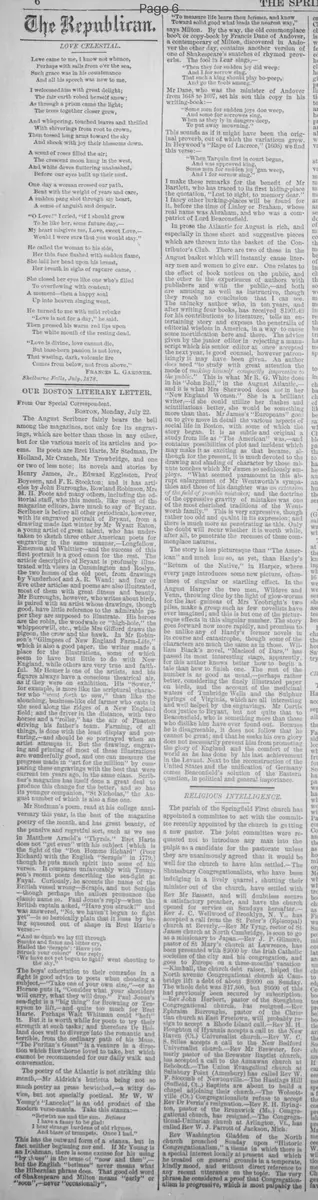
OUR BOSTON LITERARY LETTER.
From Our Special Correspondent.
BOSTON, Monday, July 22.
The August Scribner fairly bears the bell among the magazines, not only for its engravings, which are better than those in any other, but for the various merit of its articles and poems. Its poets are Bret Harte, Mr Stedman, Dr Holland, Mr Cranch, Mr Trowbridge, and one or two of less note; its novels and stories by Henry James, Jr., Edward Eggleston, Prof Boyesen, and F. R. Stockton; and it has articles by John Burroughs, Rowland Robinson, Mrs M. H. Foote and many others, including the editorial staff, who this month, like most of the magazine editors, have much to say of Bryant.
Scribner is before all other periodicals, however, with its engraved portrait of Bryant, from a drawing made last winter by Mr Wyatt Eaton, a young artist of great talent, who has undertaken to sketch three other American poets for engraving in the same manner,—Longfellow, Emerson and Whittier—and the success of this first portrait is a good omen for the rest. The article descriptive of Bryant is profusely illustrated with views in Cummington and Roslyn, the two homes of the old poet, from drawings by Vanderhoof and A. R. Waud: and four or five other articles and poems are also illustrated, most of them with great fitness and beauty.
Mr Burroughs, however, who writes about birds, is paired with an artist whose drawings, though good, have little reference to the admirable paper they are supposed to illustrate. His heroes are the robin, the woodwale or "high-hole," the whippoorwill, etc., while Mrs Gifford draws the pigeon, the crow and the hawk. In Mr Robinson's "Glimpses of New England Farm-Life," which is also a good paper, the writer made a place for the illustrations, some of which seem to have but little to do with New England, while others are very true and faithful. Mr Homer is one of the artists, and his figures always have a conscious theatrical air, as if they were on exhibition. His "Sower," for example, is more like the scriptural character who "went forth to sow," than like the slouching, business-like old farmer who casts in the seed along the ridges of a New England field; and the driver in the distance, with two horses and a "roller," has the air of Phaeton driving his father's team. Farming, of all things, is done with the least display and posturing,—and should be so portrayed when an artist attempts it. But the drawing, engraving and printing of most of these illustrations are wonderfully good, and one can measure the progress made in "art for the million" by comparing these engravings with the best that were current ten years ago, in the same class. Scribner's magazine has itself done a great deal to produce this change for the better, and so has its younger companion, "St. Nicholas," the August number of which is also a fine one.
Mr Stedman's poem, read at his college anniversary this year, is the best of the magazine poetry of the month, and has great beauty, of the pensive and regretful sort, such as we see in Matthew Arnold's "Thyrsis." Bret Harte does not "get even" with his subject [which is the fight of the "Bon Homme Richard" (Poor Richard) with the English "Serapis" in 1779,] though he puts much spirit into some of his verses. It compares unfavorably with Tennyson's recent poem describing the sea-fight at Faval. Curiously, he accents the name of the British vessel wrong—Serapis, and not Serapis—though perhaps the sailors pronounce the classic name so. Paul Jones's reply—when the British captain asked, "Have you struck?" and was answered, "No, we haven't begun to fight yet"—is so heroically plain that it loses by being squeezed out of shape in Bret Harte's verse:
"And as dumb we lay till through
Smoke and flame and bitter cry,
Hailed the 'Serapis'; 'Have you
Struck your colors?' Our reply,
'We have not yet begun to fight!' went shouting to the sky."
The boys' exhortation to their comrades in a fight is good advice to poets when choosing a subject,—"Take one of your own size,"—or as Horace puts it, Consider what your shoulders will carry, what they will drop. Paul Jones's sea-fight is a "big thing" for Browning or Tennyson to lift,—and quite too much for Bret Harte. Perhaps Walt Whitman could "heft" it. But it is worth while for poets to try their strength at such tasks; and therefore Dr Holland does well to diverge into the romantic and terrible, from the ordinary path of his Muse. "The Puritan's Guest" is a venture in a direction which Hawthorne loved to take, but which cannot be recommended for our daily walk and conversation.
The poetry of the Atlantic is not striking this month, Mr Aldrich's burletta being not so much poetry as prose bewitched,—a witty device, but not specially poetical. Mr W. W. Young's "Lancelot" is an odd product of the modern verse-mania. Take this stanza:-
"Betwixt me and the sun. Betimes
I have a fancy to be glad:
I hear strange burdens of old rhymes,
And blare of trumpets. Once I had."
This has the outward form of a stanza, but in fact neither beginning nor end. If Mr Young is an Irishman, there is some excuse for his using "by times" in the sense of "now and then",—but the English "betimes" never means what the Hibernian phrase does. That good old word of Shakespeare and Milton means "early" or "soon",—never "occasionally"
To measure life learn thou betimes,
And know
Toward solid good what leads the nearest way,
says Milton. By the way, the old commonplace book or copy-book by Francis Dane of Andover, a contemporary of Milton, discovered in Andover the other day, contains another version of one of Shakespeare's snatches of rhymed proverbs. The fool in Lear sings,-
"Then they for sudden joy did weep:
And I for sorrow sing,
That such a king should play bo-peep,
And go the fools among."
Mr Dane, who was the minister of Andover from 1649 to 1697, set his son this copy in his writing-book:-
"Some men for sudden joys doe weep,
And some for sorrowes sing,
When as they ly in dangers deep,
To put away mourning."
This sounds as if it might have been the original proverb, out of which the variations grew. In Heywood's "Rape of Lucrece," (1608) we find this verse:-
"When Tarquin first in court began,
And was approved king,
Some men for sudden joy 'gan weep,
And I for sorrow sing."
I make these remarks for the benefit of Mr Bartlett, who has traced to its first hiding-place the quotation, "Lost to sight, to memory dear." I fancy other lurking-places will be found for it, before the time of Linley or Braham, whose real name was Abraham, and who was a compatriot of Lord Beaconsfield.
In prose the Atlantic for August is rich, and especially in those short and suggestive pieces which are thrown into the basket of the Contributor's Club. There are two of these in the August basket which will instantly cause literary men and women to give ear. One relates to the effect of book notices on the public, and the other to the experiences of authors with publishers and with the public,—and both are amusing as well as instructive, though they reach no conclusion that I can see. The unlucky author who, in ten years, and after writing four books, has received $1901.40 for his contributions to literature, tells an entertaining story and exposes the penetralia of editorial wisdom in America, in a way to cause some mortification here and there. The advice given by the junior editor in rejecting a manuscript which his senior editor at once accepted the next year, is good counsel, however patronizingly it may have been given. An author does need "to study with great attention the mode of making himself compactly impressive to the public." This is what Mr R. G. White does in his "John Bull," in the August Atlantic,—and it is what Mrs Sherwood does not in her "New England Women." She is a brilliant writer,—if she could utilize her flashes and scintillations better, she would be something more than that. Mr James's "Europeans" goes on to give more in detail the various aspects of social life in Boston, with some of which the story began. It is as subtle and original a study from life as "The American" was,—and contains possibilities of plot and incident which may make it as exciting as that became, although for the present, it is much devoted to the drawing and shading of character by those minute touches which Mr James so sedulously employs. "What seemed paramount in this abrupt enlargement of Mr Wentworth's sympathies and those of his daughter was an extension of the field of possible mistakes; and the doctrine of the oppressive gravity of mistakes was one of the most cherished traditions of the Wentworth family." This is very expressive, though rather too odd and quaint in its expression: and there is much more as penetrating as this. Only the doubt will recur whether it is worth while, after all, to penetrate the recesses of these commonplace natures.
The story is less picturesque than "The American" and much less so, as yet, than Hardy's "Return of the Native," in Harper, where every page introduces some new picture, oftentimes of singular or startling effect. In the August Harper the two men, Wildeve and Venn, throwing dice by the light of glow-worms for the last guineas of Mrs Yeobright's two piles, make a group such as few novelists have ever imagined; and this is but one of the picturesque effects in this singular number. The story goes forward now more rapidly, and promises to be unlike any of Hardy's former novels in its course and catastrophe, though some of the characters are much the same as in those. William Black's novel, "Macleod of Dare," has passed its most interesting stage, apparently, for this author knows better how to begin a tale than how to finish one. The rest of the number is as good as usual,—perhaps rather better, considering the finely illustrated paper on birds, and the account of the medicinal waters of Tunbridge Wells and the Sulphur Springs of Virginia, which are all interesting and well helped by the engravings. Mr Curtis does justice to Bryant, but not quite that to Beaconsfield, who is something more than those who dislike him have ever found out. Because he is disagreeable, it does not follow that he cannot be great: and that he seeks his own glory does not necessarily prevent him from promoting the glory of England and the comfort of the world as he has done by his last achievement in the Levant. Next to the reconstruction of the United States and the unification of Germany comes Beaconsfield's solution of the Eastern question, in political and general importance.
From Our Special Correspondent.
BOSTON, Monday, July 22.
The August Scribner fairly bears the bell among the magazines, not only for its engravings, which are better than those in any other, but for the various merit of its articles and poems. Its poets are Bret Harte, Mr Stedman, Dr Holland, Mr Cranch, Mr Trowbridge, and one or two of less note; its novels and stories by Henry James, Jr., Edward Eggleston, Prof Boyesen, and F. R. Stockton; and it has articles by John Burroughs, Rowland Robinson, Mrs M. H. Foote and many others, including the editorial staff, who this month, like most of the magazine editors, have much to say of Bryant.
Scribner is before all other periodicals, however, with its engraved portrait of Bryant, from a drawing made last winter by Mr Wyatt Eaton, a young artist of great talent, who has undertaken to sketch three other American poets for engraving in the same manner,—Longfellow, Emerson and Whittier—and the success of this first portrait is a good omen for the rest. The article descriptive of Bryant is profusely illustrated with views in Cummington and Roslyn, the two homes of the old poet, from drawings by Vanderhoof and A. R. Waud: and four or five other articles and poems are also illustrated, most of them with great fitness and beauty.
Mr Burroughs, however, who writes about birds, is paired with an artist whose drawings, though good, have little reference to the admirable paper they are supposed to illustrate. His heroes are the robin, the woodwale or "high-hole," the whippoorwill, etc., while Mrs Gifford draws the pigeon, the crow and the hawk. In Mr Robinson's "Glimpses of New England Farm-Life," which is also a good paper, the writer made a place for the illustrations, some of which seem to have but little to do with New England, while others are very true and faithful. Mr Homer is one of the artists, and his figures always have a conscious theatrical air, as if they were on exhibition. His "Sower," for example, is more like the scriptural character who "went forth to sow," than like the slouching, business-like old farmer who casts in the seed along the ridges of a New England field; and the driver in the distance, with two horses and a "roller," has the air of Phaeton driving his father's team. Farming, of all things, is done with the least display and posturing,—and should be so portrayed when an artist attempts it. But the drawing, engraving and printing of most of these illustrations are wonderfully good, and one can measure the progress made in "art for the million" by comparing these engravings with the best that were current ten years ago, in the same class. Scribner's magazine has itself done a great deal to produce this change for the better, and so has its younger companion, "St. Nicholas," the August number of which is also a fine one.
Mr Stedman's poem, read at his college anniversary this year, is the best of the magazine poetry of the month, and has great beauty, of the pensive and regretful sort, such as we see in Matthew Arnold's "Thyrsis." Bret Harte does not "get even" with his subject [which is the fight of the "Bon Homme Richard" (Poor Richard) with the English "Serapis" in 1779,] though he puts much spirit into some of his verses. It compares unfavorably with Tennyson's recent poem describing the sea-fight at Faval. Curiously, he accents the name of the British vessel wrong—Serapis, and not Serapis—though perhaps the sailors pronounce the classic name so. Paul Jones's reply—when the British captain asked, "Have you struck?" and was answered, "No, we haven't begun to fight yet"—is so heroically plain that it loses by being squeezed out of shape in Bret Harte's verse:
"And as dumb we lay till through
Smoke and flame and bitter cry,
Hailed the 'Serapis'; 'Have you
Struck your colors?' Our reply,
'We have not yet begun to fight!' went shouting to the sky."
The boys' exhortation to their comrades in a fight is good advice to poets when choosing a subject,—"Take one of your own size,"—or as Horace puts it, Consider what your shoulders will carry, what they will drop. Paul Jones's sea-fight is a "big thing" for Browning or Tennyson to lift,—and quite too much for Bret Harte. Perhaps Walt Whitman could "heft" it. But it is worth while for poets to try their strength at such tasks; and therefore Dr Holland does well to diverge into the romantic and terrible, from the ordinary path of his Muse. "The Puritan's Guest" is a venture in a direction which Hawthorne loved to take, but which cannot be recommended for our daily walk and conversation.
The poetry of the Atlantic is not striking this month, Mr Aldrich's burletta being not so much poetry as prose bewitched,—a witty device, but not specially poetical. Mr W. W. Young's "Lancelot" is an odd product of the modern verse-mania. Take this stanza:-
"Betwixt me and the sun. Betimes
I have a fancy to be glad:
I hear strange burdens of old rhymes,
And blare of trumpets. Once I had."
This has the outward form of a stanza, but in fact neither beginning nor end. If Mr Young is an Irishman, there is some excuse for his using "by times" in the sense of "now and then",—but the English "betimes" never means what the Hibernian phrase does. That good old word of Shakespeare and Milton means "early" or "soon",—never "occasionally"
To measure life learn thou betimes,
And know
Toward solid good what leads the nearest way,
says Milton. By the way, the old commonplace book or copy-book by Francis Dane of Andover, a contemporary of Milton, discovered in Andover the other day, contains another version of one of Shakespeare's snatches of rhymed proverbs. The fool in Lear sings,-
"Then they for sudden joy did weep:
And I for sorrow sing,
That such a king should play bo-peep,
And go the fools among."
Mr Dane, who was the minister of Andover from 1649 to 1697, set his son this copy in his writing-book:-
"Some men for sudden joys doe weep,
And some for sorrowes sing,
When as they ly in dangers deep,
To put away mourning."
This sounds as if it might have been the original proverb, out of which the variations grew. In Heywood's "Rape of Lucrece," (1608) we find this verse:-
"When Tarquin first in court began,
And was approved king,
Some men for sudden joy 'gan weep,
And I for sorrow sing."
I make these remarks for the benefit of Mr Bartlett, who has traced to its first hiding-place the quotation, "Lost to sight, to memory dear." I fancy other lurking-places will be found for it, before the time of Linley or Braham, whose real name was Abraham, and who was a compatriot of Lord Beaconsfield.
In prose the Atlantic for August is rich, and especially in those short and suggestive pieces which are thrown into the basket of the Contributor's Club. There are two of these in the August basket which will instantly cause literary men and women to give ear. One relates to the effect of book notices on the public, and the other to the experiences of authors with publishers and with the public,—and both are amusing as well as instructive, though they reach no conclusion that I can see. The unlucky author who, in ten years, and after writing four books, has received $1901.40 for his contributions to literature, tells an entertaining story and exposes the penetralia of editorial wisdom in America, in a way to cause some mortification here and there. The advice given by the junior editor in rejecting a manuscript which his senior editor at once accepted the next year, is good counsel, however patronizingly it may have been given. An author does need "to study with great attention the mode of making himself compactly impressive to the public." This is what Mr R. G. White does in his "John Bull," in the August Atlantic,—and it is what Mrs Sherwood does not in her "New England Women." She is a brilliant writer,—if she could utilize her flashes and scintillations better, she would be something more than that. Mr James's "Europeans" goes on to give more in detail the various aspects of social life in Boston, with some of which the story began. It is as subtle and original a study from life as "The American" was,—and contains possibilities of plot and incident which may make it as exciting as that became, although for the present, it is much devoted to the drawing and shading of character by those minute touches which Mr James so sedulously employs. "What seemed paramount in this abrupt enlargement of Mr Wentworth's sympathies and those of his daughter was an extension of the field of possible mistakes; and the doctrine of the oppressive gravity of mistakes was one of the most cherished traditions of the Wentworth family." This is very expressive, though rather too odd and quaint in its expression: and there is much more as penetrating as this. Only the doubt will recur whether it is worth while, after all, to penetrate the recesses of these commonplace natures.
The story is less picturesque than "The American" and much less so, as yet, than Hardy's "Return of the Native," in Harper, where every page introduces some new picture, oftentimes of singular or startling effect. In the August Harper the two men, Wildeve and Venn, throwing dice by the light of glow-worms for the last guineas of Mrs Yeobright's two piles, make a group such as few novelists have ever imagined; and this is but one of the picturesque effects in this singular number. The story goes forward now more rapidly, and promises to be unlike any of Hardy's former novels in its course and catastrophe, though some of the characters are much the same as in those. William Black's novel, "Macleod of Dare," has passed its most interesting stage, apparently, for this author knows better how to begin a tale than how to finish one. The rest of the number is as good as usual,—perhaps rather better, considering the finely illustrated paper on birds, and the account of the medicinal waters of Tunbridge Wells and the Sulphur Springs of Virginia, which are all interesting and well helped by the engravings. Mr Curtis does justice to Bryant, but not quite that to Beaconsfield, who is something more than those who dislike him have ever found out. Because he is disagreeable, it does not follow that he cannot be great: and that he seeks his own glory does not necessarily prevent him from promoting the glory of England and the comfort of the world as he has done by his last achievement in the Levant. Next to the reconstruction of the United States and the unification of Germany comes Beaconsfield's solution of the Eastern question, in political and general importance.
What sub-type of article is it?
Essay
What keywords are associated?
Scribner Magazine
Atlantic Monthly
Harpers Magazine
William Cullen Bryant
Bret Harte
Edmund Clarence Stedman
Henry James
Thomas Hardy
Literary Criticism
Magazine Illustrations
What entities or persons were involved?
From Our Special Correspondent.
Literary Details
Title
Our Boston Literary Letter.
Author
From Our Special Correspondent.
Subject
Review Of August Magazines Including Scribner's, Atlantic, And Harper's, With Focus On Bryant Portrait And Various Poems And Stories.
Form / Style
Literary Correspondence And Critical Essay.
Key Lines
"And As Dumb We Lay Till Through
Smoke And Flame And Bitter Cry,
Hailed The 'Serapis'; 'Have You
Struck Your Colors?' Our Reply,
'We Have Not Yet Begun To Fight!' Went Shouting To The Sky."
"Betwixt Me And The Sun. Betimes
I Have A Fancy To Be Glad:
I Hear Strange Burdens Of Old Rhymes,
And Blare Of Trumpets. Once I Had."
"Then They For Sudden Joy Did Weep:
And I For Sorrow Sing,
That Such A King Should Play Bo Peep,
And Go The Fools Among."
"Some Men For Sudden Joys Doe Weep,
And Some For Sorrowes Sing,
When As They Ly In Dangers Deep,
To Put Away Mourning."
"What Seemed Paramount In This Abrupt Enlargement Of Mr Wentworth's Sympathies And Those Of His Daughter Was An Extension Of The Field Of Possible Mistakes; And The Doctrine Of The Oppressive Gravity Of Mistakes Was One Of The Most Cherished Traditions Of The Wentworth Family."