Thank you for visiting SNEWPapers!
Sign up free
The Sedalia Weekly Bazoo
Sedalia, Pettis County, Missouri
What is this article about?
In 1793-94 western Pennsylvania, opposition to federal excise laws on distilleries spawned the anonymous 'Tom the Tinker' persona, issuing threats and rallying resistance. The Mingo Creek Society formed to organize dissent, potentially fueling insurrection led by David Bradford. Notable opponents included Gallatin, Findley, and others.
Clipping
OCR Quality
Full Text
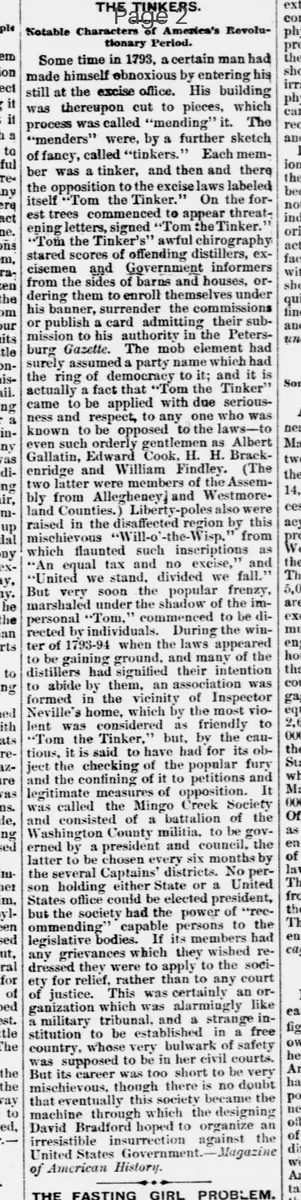
Some time in 1793, a certain man had made himself obnoxious by entering his still at the excise office. His building was thereupon cut to pieces, which process was called 'mending' it. The 'menders' were, by a further sketch of fancy, called 'tinkers.' Each member was a tinker, and then and there the opposition to the excise laws labeled itself 'Tom the Tinker.' On the forest trees commenced to appear threatening letters, signed 'Tom the Tinker.' 'Tom the Tinker's' awful chirography stared scores of offending distillers, excisemen and Government informers from the sides of barns and houses, ordering them to enroll themselves under his banner, surrender the commissions or publish a card admitting their submission to his authority in the Petersburg Gazette. The mob element had surely assumed a party name which had the ring of democracy to it; and it is actually a fact that 'Tom the Tinker' came to be applied with due seriousness and respect, to any one who was known to be opposed to the laws-to even such orderly gentlemen as Albert Gallatin, Edward Cook, H. H. Brackenridge and William Findley. (The two latter were members of the Assembly from Allegheny and Westmoreland Counties.) Liberty-poles also were raised in the disaffected region by this mischievous 'Will-o'-the-Wisp,' from which flaunted such inscriptions as 'An equal tax and no excise,' and 'United we stand, divided we fall.'
But very soon the popular frenzy, marshaled under the shadow of the impersonal 'Tom,' commenced to be directed by individuals. During the winter of 1793-94 when the laws appeared to be gaining ground, and many of the distillers had signified their intention to abide by them, an association was formed in the vicinity of Inspector Neville's home, which by the most violent was considered as friendly to 'Tom the Tinker,' but, by the cautious, it is said to have had for its object the checking of the popular fury and the confining of it to petitions and legitimate measures of opposition. It was called the Mingo Creek Society and consisted of a battalion of the Washington County militia, to be governed by a president and council, the latter to be chosen every six months by the several Captains' districts. No person holding either State or a United States office could be elected president, but the society had the power of 'recommending' capable persons to the legislative bodies. If its members had any grievances which they wished redressed they were to apply to the society for relief, rather than to any court of justice. This was certainly an organization which was alarmingly like a military tribunal, and a strange institution to be established in a free country, whose very bulwark of safety was supposed to be in her civil courts.
But its career was too short to be very mischievous, though there is no doubt that eventually this society became the machine through which the designing David Bradford hoped to organize an irresistible insurrection against the United States Government. -Magazine of American History.
What sub-type of article is it?
What themes does it cover?
What keywords are associated?
What entities or persons were involved?
Where did it happen?
Story Details
Key Persons
Location
Washington County, Pennsylvania
Event Date
1793 1794
Story Details
Opposition to excise laws on distilleries led to the anonymous persona 'Tom the Tinker' issuing threats via signed letters on trees and buildings, demanding submission from distillers, excisemen, and informers. Liberty poles with anti-excise slogans were raised. The Mingo Creek Society formed as a militia battalion to channel opposition through petitions, but it later served as a tool for organizing insurrection under David Bradford.