Thank you for visiting SNEWPapers!
Sign up free
Will Maupin's Weekly
Lincoln, Lancaster County, Nebraska
What is this article about?
Report on the ongoing 1910 coal strike in Westmoreland County, PA, between operators and United Mine Workers. Miners endured severe hardship, losing 20 lives and facing starvation, while fighting for union rights and better conditions. Strike nears end due to exhaustion.
Clipping
OCR Quality
Full Text
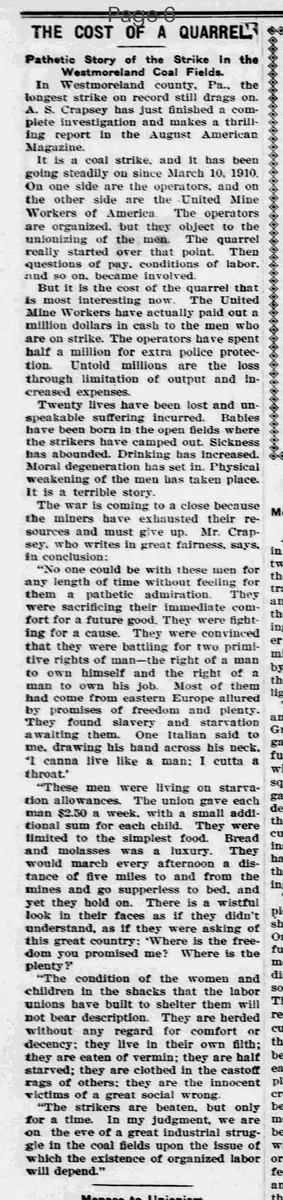
Pathetic Story of the Strike In the Westmoreland Coal Fields.
In Westmoreland county, Pa., the longest strike on record still drags on. A. S. Crapsey has just finished a complete investigation and makes a thrilling report in the August American Magazine.
It is a coal strike, and it has been going steadily on since March 10, 1910. On one side are the operators, and on the other side are the United Mine Workers of America. The operators are organized, but they object to the unionizing of the men. The quarrel really started over that point. Then questions of pay, conditions of labor, and so on, became involved.
But it is the cost of the quarrel that is most interesting now. The United Mine Workers have actually paid out a million dollars in cash to the men who are on strike. The operators have spent half a million for extra police protection. Untold millions are the loss through limitation of output and increased expenses.
Twenty lives have been lost and unspeakable suffering incurred. Babies have been born in the open fields where the strikers have camped out. Sickness has abounded. Drinking has increased. Moral degeneration has set in. Physical weakening of the men has taken place.
It is a terrible story.
The war is coming to a close because the miners have exhausted their resources and must give up. Mr. Crapsey, who writes in great fairness, says, in conclusion:
"No one could be with these men for any length of time without feeling for them a pathetic admiration. They were sacrificing their immediate comfort for a future good. They were fighting for a cause. They were convinced that they were battling for two primitive rights of man—the right of a man to own himself and the right of a man to own his job. Most of them had come from eastern Europe allured by promises of freedom and plenty. They found slavery and starvation awaiting them. One Italian said to me, drawing his hand across his neck, 'I can't live like a man; I cut my throat.'
These men were living on starvation allowances. The union gave each man $2.50 a week, with a small additional sum for each child. They were limited to the simplest food. Bread and molasses was a luxury. They would march every afternoon a distance of five miles to and from the mines and go supperless to bed, and yet they hold on. There is a wistful look in their faces as if they didn't understand, as if they were asking of this great country: Where is the freedom you promised me? Where is the plenty?
The condition of the women and children in the shacks that the labor unions have built to shelter them will not bear description. They are herded without any regard for comfort or decency; they live in their own filth; they are eaten of vermin; they are half starved; they are clothed in the cast-off rags of others; they are the innocent victims of a great social wrong.
The strikers are beaten, but only for a time. In my judgment, we are on the eve of a great industrial struggle in the coal fields upon the issue of which the existence of organized labor will depend."
What sub-type of article is it?
What themes does it cover?
What keywords are associated?
What entities or persons were involved?
Where did it happen?
Story Details
Key Persons
Location
Westmoreland County, Pa.
Event Date
Since March 10, 1910
Story Details
The 1910 coal strike in Westmoreland County pits organized operators against unionizing miners, leading to massive financial losses, 20 deaths, starvation, and moral decline among strikers from eastern Europe seeking freedom. Despite exhaustion, they fight for self-ownership and job rights; strike ends in temporary defeat but signals future labor struggles.