Thank you for visiting SNEWPapers!
Sign up free
The Litchfield County Post
Litchfield, Litchfield County, Connecticut
What is this article about?
Major Denham and fellow British explorers have penetrated Africa's interior, discovering Lake Tchad (200 miles long, 150 broad), confirming Ali Bey's theory of a central African sea. Detailed description includes location, rivers, islands, and wildlife impacts.
Clipping
OCR Quality
Full Text
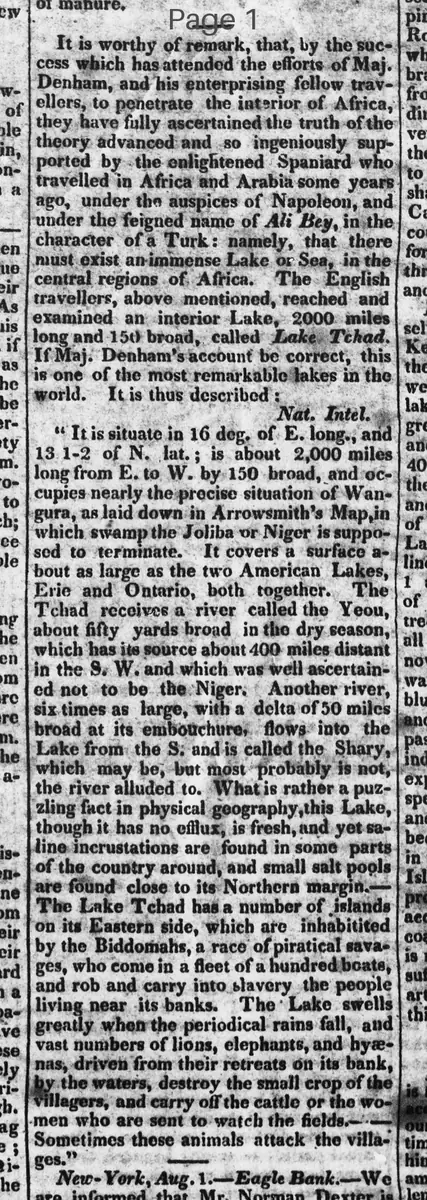
If Maj. Denham's account be correct, this is one of the most remarkable lakes in the world. It is thus described:
Nat. Intel.
"It is situate in 16 deg. of E. long., and 13 1/2 of N. lat.; is about 2,000 miles long from E. to W. by 150 broad, and occupies nearly the precise situation of Wangara, as laid down in Arrowsmith's Map, in which swamp the Joliba or Niger is supposed to terminate. It covers a surface about as large as the two American Lakes, Erie and Ontario, both together. The Tchad receives a river called the Yeou, about fifty yards broad in the dry season, which has its source about 400 miles distant in the S. W. and which was well ascertained not to be the Niger. Another river, six times as large, with a delta of 50 miles broad at its embouchure, flows into the Lake from the S. and is called the Shary, which may be, but most probably is not, the river alluded to. What is rather a puzzling fact in physical geography, this Lake, though it has no efflux, is fresh, and yet saline incrustations are found in some parts of the country around, and small salt pools are found close to its Northern margin. The Lake Tchad has a number of islands on its Eastern side, which are inhabited by the Biddomahs, a race of piratical savages, who come in a fleet of a hundred boats, and rob and carry into slavery the people living near its banks. The Lake swells greatly when the periodical rains fall, and vast numbers of lions, elephants, and hyenas, driven from their retreats on its banks by the waters, destroy the small crop of the villagers, and carry off the cattle or the women who are sent to watch the fields. Sometimes those animals attack the villages."
What sub-type of article is it?
What keywords are associated?
What entities or persons were involved?
Where did it happen?
Foreign News Details
Primary Location
Central Africa, Lake Tchad
Key Persons
Outcome
discovery confirms theory of immense central african lake; lake described with no efflux but fresh water, surrounded by saline areas, inhabited islands with piratical biddomahs, and wildlife threats during floods.
Event Details
British explorers led by Maj. Denham penetrated Africa's interior, reaching and examining Lake Tchad, 200 miles long and 150 broad, confirming Ali Bey's theory of a central sea. The lake is at 16° E. long., 13.5° N. lat., about 2000 miles E-W by 150 broad, comparable to Lakes Erie and Ontario combined. It receives Yeou River (not Niger) from SW and larger Shary from S. No outlet, yet fresh; saline nearby. Eastern islands home to piratical Biddomahs who raid in fleets. Floods drive lions, elephants, hyenas to attack villages and crops.