Thank you for visiting SNEWPapers!
Sign up free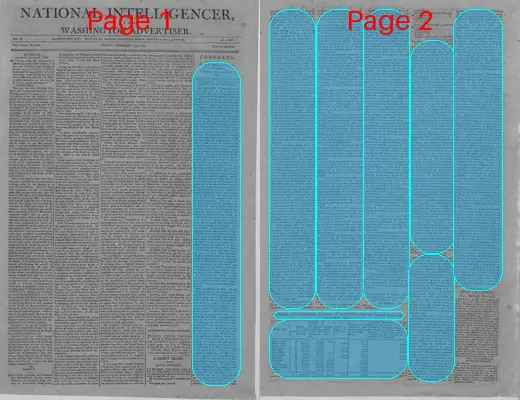
The National Intelligencer And Washington Advertiser
Washington, District Of Columbia
What is this article about?
In the U.S. House of Representatives on January 17, 1804, Mr. Rodney of Delaware argued for extinguishing balances owed by debtor states from Revolutionary War settlements, highlighting errors in past audits and Delaware's contributions, amid a debate on financial equity among states.
Merged-components note: These components together form a single coherent account of the House of Representatives debate on Mr. Rodney's motion for extinguishing state balances, with the text continuing across pages and the table providing illustrative data on state ratios and balances directly related to the discussion. The label is changed from 'story' to 'domestic_news' for the merged component to better reflect the legislative proceedings content.
Clippings

1 of 2
OCR Quality
Full Text
TUESDAY, Jan. 17, 1804.
Debate on Mr. Rodney's motion for the extinguishment of the Balances reported to be due by several states.
MR. RODNEY, I hope the committee will agree to the resolution as modified, and to the extinguishment of the balances reported against the several states. It is true, as has been remarked when the subject was before the House the time since, that it has been repeatedly under discussion; and that by this time it is probably perfectly understood and familiar to every member. It is true, that it has heretofore undergone an investigation more able, perhaps, than I am able to give it; I believe, however, every time it has been discussed; its friends have increased in number. I flatter myself, therefore; there can be no objection to enquiry into its merits at this period, Because, I believe that those who have heretofore voted one way, have sufficient magnanimity, if it shall be made clearly to appear, that these Balances ought to be extinguished; to think for themselves, without regard to any previous opinions they may have imbibed. It is honorable to any person to alter his opinion whenever he is convinced of his error. Besides, there are a great number of new members in this House who will not be disposed to pin their faith on the sleeves of the predecessors. It is well known the state I have the honor to represent is more affected by the heavy balance reported against her, hanging over her head, than any state in the union. It will be recollected agreeably to the report of the commissioners who settled the accounts between the United States and the respective states, that $612,000 dollars were reported to be due by her, this with interest from the year 1793 amounts to about one million of dollars. This is a very serious subject to the state of Delaware, one which she severely feels, which depreciates the price of her land and paralizes the industry of her citizens. I beg leave to say it is not my object to touch the settlement of the commissioners, so far as it regards the creditor states; like the ark of the covenant, I deem it too sacred to be touched with impure hands. I am likewise far from imputing to them any improper or unjust motives whatever, whilst I subscribe to this doctrine, and that the creditor states receive the balances reported in their favor: permit me to take a retrospective view of the business, to show so far as can be proved from the nature of the case that there may have been, nay, must have been some important mistake in the settlement, the commissioners having no standard to resort to, by which to determine with mathematical or arithmetical certainty what was due by the states; if the committee shall be of opinion, that some mistake may have occurred, when they consider that so far as relates to the claims of the creditor states, they have been provided for, I trust they will view with indulgence the claims now made by the debtor states.
When in consequence of the acts of a flagitious ministry, who attempted to forge chains for our free country, America rose as one man to assert her rights & destroy the tyranny of that government which wished to enslave her, she was understood as one nation engaged in a common cause: certain articles of union were proposed, one of which stipulated that the proportion in which each state should contribute to the general defence, should be according to the value of lands in the respective states, it will be recollected that the articles of confederation were not agreed to, until the war had nearly terminated, and that this ratio was not uniformly acted upon by Congress, as the basis on which requisitions were made; it was nor relied on in all cases and on all occasions: if it had been agreed upon, Congress would have still been at a loss how to proceed, that the good of the revenue, and the happiness of the people, are better promoted Every apportionment must, therefore, have necessarily been arbitrary. In this embarrassing situation with a view to relieve themselves from the difficulties which surrounded them, congress in the month of April in the year 1785, recommended to the several states, the adoption of that rule of apportionment which is to be found in the federal constitution. This rule, however, was not adopted by the states until it was incor
| STATE. | Ratio. | Balances due to the states respectively. | Proportion of each state of the aggregate of those balances according to the ratio. | Balances against certain states. | Balances in favor of certain states. | Proportion of each state in the aggregate of the balances against certain states. | Ultimate balance in favor of certain states upon the principle of an extinguishment of the balances owing by the debtor states, and a proportional allowance to the other states, adjusted according to the ratio given, and to be paid by the United States |
| New Hampshire, | 3 | 57.50 | 60,000 | 2,500 | 20,000 | 3,000 | 500 |
| Massachusetts, | 3 | 180,000 | 160,000 | 8,000 | |||
| Rhode Island, | 1 | 20,000 | 20,000 | 1,000 | 28,000 | ||
| Connecticut. | 5 | 110,000 | 100,000 | 10,000 | 5,000 | 1,000 | |
| New York, | 6 | 135,000 | 110,000 | 15,000 | 6,000 | 15,000 | |
| New Jersey, | 4 | 72,500 | 80,000 | 7,500 | 10,000 | 4,000 | 21,000 |
| Pennsylvania, | 8 | 170,000 | 160,000 | 10,000 | 8,000 | 18,000 | |
| Delaware, | 1 | 30,000 | 20,000 | 10,000 | 1,000 | 11,000 | |
| Maryland, | 6 | 110,000 | 120,000 | 10,000 | 10,000 | 6,000 | |
| Virginia, | 10 | 187,500 | 200,000 | 12,500 | 10,000 | 10,000 | |
| North Carolina, | 5 | 90,000 | 100,000 | 10,000 | 5,000 | 5,000 | |
| South Carolina, | 5 | 87,500 | 100,000 | 12,500 | 5,000 | 5,000 | |
| Georgia, | 3 | 50,000 | 60,000 | 10,000 | 3,000 | 3,000 | |
| 65 | 1,300,000 | 1,300,000 | 65,000 | 65,000 | 65,000 | 94,500 |
Incorporated in that instrument. I mention these acts to show that there was no permanent universal and unerring foundation, on which the ratio of taxation rested. If each member of the board of commissioners, had possessed the fiscal talents and financial knowledge of the present Secretary of the Treasury, and instead of the comparatively short time they were occupied in the settlement, had consumed a series of years, it is scarcely within the compass of possibility and much less of probability, that they should have attained in every case substantial justice.
It will be recollected, what was the nature and extent of the accounts which they had to adjust. Rudis indigestaque moles. They were not accounts kept with the regularity of those of a merchant's counting house, they were not confined to the transactions of a single voyage, nor to the business of one company, but comprehended the complicated transactions of independent states, the multiplied and intricate accounts of entire sovereignties, and those too, not in times of peace, but during the stormy period of a revolution, in which we were contending against one of the most powerful nations in Europe for our liberties and independence. I believe them to have done the best they could, and to have attempted faithfully to bring about a settlement important to be settled, and which Congress as early as 1787. attempted to make.
Congress in that year passed a resolution by which the states were directed, and commissioners appointed to go through the several states to receive accounts ; but all those accounts were warranted by acts of Congress themselves, at the same time they constituted a board, to audit accounts for particular defense, and such as were not authorized by the resolutions of Congress, considering what a state did for herself, she did for the union.
Thus the business rested, when the federal constitution was brought about; that constitution the state of Delaware had the honor first to adopt, and was, I believe, the only state whose legislature adopted it unanimously ; when Congress met under the Constitution the general principle on which the settlement of the accounts of the several states should take place was not much disputed ; no man pretended to say, when South Carolina was over run with internal foes and subject to civil war, the United States were not benefited in proportion to the efforts she made to crush those enemies, every thing she did was for the general good, and every man acquiesced in the justice of the principle, that the state should bring forward her accounts for particular, as well as general defense, and it was seen that the United States would all in debt from this circumstance to every state in the union; every state had to contend with the external enemy, or with the internal foe in the shape of insurrections. It may be proper at this place, to advert to the report of the Secretary of the Treasury, which laid the foundation of the assumption of the state debts. I am not about to enquire into the policy of the measure, or, whether it was best to be effected in this way. in that, or the other; I take it as I find it, when examined, it will be found, that the then Secretary thought the ratio or rule of apportionment adopted by the commissioners under the act of Congress, passed in the year 1790 would not be the correct one, as will appear from the report, & suppositious statement made by him of the relative situation of the different states, as debtor, and creditor. Delaware, so far from being considered at that time as a debtor state. was contemplated in the light of a creditor state, and in proportion to her ability more so than any in the union. I will read a passage or two from the report, and advert to the statement ; the Secretary, after concluding that a discrimination ought not to be made between original holders, and subsequent purchasers, proceeds to examine "whether a difference ought to be permitted, to remain between them, and another description of public creditors-Those of the states individually."
"The Secretary, after mature reflection on this point, entertains a full conviction, that an assumption of the debts of the particular states by the union, and a like provision for them, as for those of the union, will be a measure of sound policy and substantial justice."
"It would. in the opinion of the Secretary, contribute, in an eminent degree, to an orderly, stable, & satisfactory arrangement of the national finances."
"Admitting, as ought to be the case, that a provision must be made in some way or other, for the entire debt ; it will follow, that no greater revenues will be required, whether this provision be made wholly by the United States, or partly by them, and partly by the states separately."
"There is an objection, however, to an assumption of the state debts, which deserves particular notice. It may be supposed, that it would increase the difficulty of an equitable settlement between them and the United States. The principles of that settlement, whenever they shall be discussed, will require all the moderation and wisdom of the government. In the opinion of the Secretary, that discussion, till further lights are obtained, would be premature."
"All, therefore, which he would now think advisable on the point in question, would be, that the amount of the debts assumed and provided for, should be charged to the respective states, to abide an eventual arrangement. This the United States, as assignees to the creditors, should have an indisputable right to do."
"But as it might be a satisfaction to the House to have before them some plan for the liquidation of accounts between the union and its members, which, including the assumption of the state debts, would consist with equity : The Secretary will submit in this place such thoughts on the subject, as have occurred to his own mind, or been suggested to him, most compatible, in his judgment, with the end proposed."
"Let each state be charged with all the money advanced to it out of the treasury of the United States. liquidated according to the specie value, at the time of each advance with interest at six per cent."
"Let it also be charged with the amount in specie value, of all its securities which shall be assumed, with the interest upon them to the times, when interest shall become payable by the United States."
"Let it be credited for all monies paid and articles furnished to the United States, and for all other expenditures during the war, either towards general. or particular defence, whether authorized or unauthorized by the United States ; the whole liquidated to specie value, and bearing an interest of six per cent. from the several times at which the several payments, advances and expenditures accrued."
"And let all sums of continental money now in the treasuries of the respective states, which shall be paid into the treasury of the United States, be credited at specie value:"
"Upon a settlement of the accounts according to these principles, there can be little doubt, that balances would appear in favor of all the states, against the United States."
"To equalize the contributions of the states, let each be then charged with its proportion of the aggregate of those balances, according to some equitable ratio, to be devised for that purpose."
"If the contributions should be found disproportionate, the result of this adjustment would be, that some states would be creditors, some debtors to the union."
"This plan seems to be susceptible of no objection, which does not belong to every other, that proceeds on this idea of a final adjustment of accounts. The difficulty of settling a ratio, is common to all. This must, probably, either be fought for in the proportions of the requisitions, during the war, or in the decision of commissioners appointed with plenary power. The rule prescribed in the constitution, with regard to representation and direct taxes, would evidently not be applicable to the situation of parties, during the period in question."
He then makes a suppositious statement by which it appears that Dela-
ware was considered of having a demand against the United States, of about 10,000 dollars. [Here Mr. Rodney particularly adverted to the statement below.]
It must abundantly appear to the minds of gentlemen that in this business it was impossible from the nature of the case, for the commissioners to ascertain with mathematical certainty the balances due to or from any one state to the United States, if considered in this point of view I hope gentlemen will be not over anxious in pressing the debtor states for every shilling alleged to be due by them when the creditor states have had their demands fully satisfied.
When we advert to the particular case of the state I have the honor of representing we shall find abundant reason why her balance should be extinguished. The state of Delaware does not stand in need of any eulogium from me, and if she did, I am not accustomed to the language of panegyric but I may say, that in her proportion to resources, her efforts in the revolutionary cause were second to no state in the union : when we find in the report that the state of Delaware was not heard before the commissioners, though she requested a hearing, gentlemen may account for the extraordinary result of a settlement so far as related to her ; she was told, it was true ; she might have a hearing, but she was informed at the same time that the case on which she desired to be heard was already decided; this will appear from an official document laid before the Senate of that state.
"The late commissioner for stating and supporting the claims of this state against the United States, in obedience to the order of the honorable the general assembly of the 17th inst. make the following report:"
"Having in his report to the general assembly at October sessions, 1791, exhibited a general statement, he now transmits the particular accounts, as far as they are in his possession, from whence the said statement was drawn."
"The accounts exhibited to the district commissioners, marked No. 1. in general statement, are contained in a book lodged in the office of the board of commissioners; which book ought now to be returned to this state; These included all charges of general defense, depreciating certificates, recruiting accounts, supplies to the army, and every other expense which could be supported against the union under the ordinance of May 7, 1787."
"The accounts in the second line, marked No. 2. are for general and particular defense; containing expenditures by the state, not warranted by resolutions of congress, and therefore inadmissible under the ordinance of May, 1787. This is accompanied by a sheet marked No. 2. and an account of particulars answering to No. 19. in the said sheet."
"The accounts in the third line, marked No. 3. being for payments on warrants and requisitions of congress, was drawn from the books of the state, in the Auditor's office. and needs no explanation."
"The late commissioner reports what he mentioned in his former report, that he never had an opportunity given him to advocate the claims of Delaware, after their first delivery. He applied to the commissioners several times, both personally and by letter, to know when he should attend for that purpose. The answer was, that notice should be given him and the notice was, that his further attendance was unnecessary, as the commissioners had already determined on the accounts of Delaware."
"All which is respectfully submitted."
"ELEAZER McCOMB."
"Wilmington, January 25, 1794."
"Also were delivered the general account with the other papers and documents, referred to in the aforesaid report; which said general account stood as follows:"
A general statement of charges exhibited against the union by the state of Delaware, viz.
Old Emissions
Case
No. 1. Amount of accounts to:
the
Total Am. do1.2,261044 19 380,228 901-3
I do not mean to impute improper motives to the commissioners, but merely to state a fact proved by the highest authority, the simple, plain, and stubborn fact is, that in this settlement De. laware was not heard, and I call on gentlemen to bring the case home to their own business and bosoms; suppose they were individually condemned to pay sums to an enormous extent without being heard, would they consider it fair or just; it is a maxim of eternal and immutable justice to hear both sides before a decision is made, and I have heard it observed by a celebrated character, That he was an unrighteous judge who decided without hearing both parties even where he decided correctly ; because he acted against the first maxim of justice and because his decision though right was the effect of accident. If this statement be correct, will not gentlemen advert to the fact and suffer it to make a proper impression on their minds. It appears, from the account of Mr. Mc Coombe that 3,26144 dollars. was furnished by D laware in paper money, and 3so 228 in specie, much of the first description of money was paid before it had undergone any considerable depreciation, by the scale established in that state. Owing to fortuitous circumstances the paper medium was better and the state had to pay more of consequence than any other state in the union. By the laws of Delaware it will also appear that congress no sooner made a requisition than the legislature of that state passed an act to comply with it no sooner was the call made than the people were compelled to pay their taxes to meet it. Every requisition of congress made till the year 1787 was promptly complied within, and on some occasion we raised more than sixty thousand dollars a year to enable us to comply with the requisitions of the United States. and it will be found from the report of the "Auditor of the state (Thomas Montgoinery) a man every way qualified for that situation, for the year 1794, that prior to the year 1784 there was not a single tax levied that was not paid, nor a single county behind hand a single dollar. Afterwards there was a small balance remaining unpaid by the county of Sussex, a smaller from the county of Kent, and a still smaller perhaps from the county of Newcastle. I mention this circumstance to shew that more must have been paid by that state than is allowed in the settlement, for all this money was certainly levied & collected from the pockets of the people of that state ; and to prove that the account rendered by our Commissioner (Mr. McCoomb) against the United States was accurate and just. An account supported by such plain, unequivocal testimony as the solemn acts of our legislature, and the report of that officer to whom the state confided the superintendence of her finances, or sums of such magnitude in specie as well as in paper currency ought to make a favorable impression on the members of this committee. It proves most manifestly that our state contributed the sum of in continental money and in gold or silver coin, towards the exigencies of the war, besides the services of her soldiers, than whom none were braver, especially those who composed her intrepid regiment. One charge of the United States against the several states referred to a certain species of certificates known by the name of depreciation certificates given to the officers and soldiers in consequence of the depreciation of their pay. At this moment these in her chest 60 or 80,000 dollars of these certificates, and if she had been disposed to act unfairly, she might at the proper time have loaned them and that amount might have gone into the coffers of the state, but she would not descend to this act, she was disposed to do as she would be done by, and I trust this will be considered as a meritorious act on her part.
In some laws found in our volume, particularly in a law of 1787 it will be found that the state of Delaware was compelled to pay requisitions whose proportion was greater than they ought to have been according to any known, federal rule. Still, even, when she considered the imposition made upon her more than it ought to be, when her representatives in the legislature in the act of 1787 declared "that her proportion was greater than it ought to be on any known or acknowledged principle of federal-taxation." She cheerfully acquiesced & paid the money required from her. It has been, I believe on a former occasion when this subject was before the House, ably and eloquently observed by my friend from Virginia (Mr. J. Randolph) that if the state of D-laware had been asleep during the whole revolutionary conflict and had not contributed a cent or a soldier to the common cause, the balance charged against her could not amount to the enormous sum of millions of dollars. When on the contrary we take into consideration the great sums which she actually paid, and the gallant soldiers furnished in her regiment, and from her militia, ought not gentlemen to listen to the reasons now urged, and ought they not to have great weight on the minds of liberal and candid men ? As I said before I do not mean to impeach the original settlement. But if such an inexplicable result has occurred in the case of D la- ware, what may not have occurred in the settlement of the accounts of the other states? with their cases I am un- acquainted. I will not; therefore, trespass on the patience of the committee further on this score ; but considering the subject in this favorable point of view as to Delaware, I will advance to the strongest ground which presents it- self.
How are the United States, by any competent authority, to obtain payment of these balances? Are they to put any state to the ban of the empire? Are they to make war upon any state by means of an army on land, or by means of a navy at sea ? This is a position for which, I presume, no gentleman will contend. Are they to fund the balances due in the proportion of the creditor states? If it is the wish of gentlemen to add to our debt millions, I know not how many, the object may perhaps be accomplished in this way. But such a measure, I presume, will not be adopted. Will gentlemen then preserve this bone of contention with the states ? For a bone it literally is, it contains not an ounce of nutriment to the United States: Will they preserve it, when it will not bring one shilling into their pock- ets? will they keep alive this coal, which may hereafter be fanned into a flame, and which may, at some future day, become a subject of compromise, not to say bargain, and may be made an instrument of much greater injury even to the creditor states than the nominal balances can possibly be of benefit to them. Remember that two of the principal debtor states are from their wealth and numbers, among the most respectable in the union. If you will keep these balances suspended over them what may not be apprehended ? If the subject be considered in this point of light it will appear that it is for the interest of the whole United States that these balances should be done away. It is for the interest of the creditor states, that no subject of dispute may remain, that the hatchet may be buried. Their balances are already funded : and if the debtor balances be extinguished, these will be considered as a- cred. And yet I say that it is for the interest of the debtor states ? They. year after year, have called for the extinguishment. With regard to the state of D laware the continuance of these balances is of the most serious injury to her. I know an honorable senator from Maryland who owns lands on both sides of the line which separates D laware from M ry- land, who cannot get as much by one third for his land within D laware as for that within the borders of Mary- land, although the land in Maryland is part of the same tract and precisely of the same quality as that in D: laware. Is not this of some importance to the state of Delaware, is it not enough to discourage and essentially to check the progress of her citizens in every laudable pursuit, must it not necessarily tend essentially to retard the improvement of her land, to depress trade and to paralyze industry; and all this without one cent of use to the United States or to any state in the union. I hope the committee considering the subject in this view will agree to the resolution. Impressed with the opinion that it would be equally for the welfare of the United States, or those states which are debtor, and for those which are creditor to adopt it.
[To be continued.]
What sub-type of article is it?
What keywords are associated?
What entities or persons were involved?
Where did it happen?
Domestic News Details
Primary Location
United States House Of Representatives
Event Date
Tuesday, Jan. 17, 1804.
Key Persons
Outcome
debate ongoing; motion seeks extinguishment of state balances, no resolution mentioned.
Event Details
Mr. Rodney of Delaware spoke in favor of a resolution to extinguish balances reported due from debtor states to the United States, stemming from Revolutionary War account settlements by commissioners. He argued for potential errors in past audits, emphasized Delaware's unacknowledged contributions and lack of hearing before commissioners, referenced historical apportionment issues, and quoted the Treasury Secretary's report on state debt assumption. He urged equity for debtor states like Delaware, which faces a $612,000 balance plus interest totaling about $1 million, harming its economy.