Thank you for visiting SNEWPapers!
Sign up free
Editorial
August 13, 1841
The Liberator
Boston, Suffolk County, Massachusetts
What is this article about?
This editorial critiques human legislation as inferior to divine laws, advocating non-resistance to civil governments that rely on violence and death penalties. It argues for withdrawal from such systems and living testimony to divine principles of love and life's sanctity, signed E. Q.
Clipping
OCR Quality
98%
Excellent
Full Text
NON-RESISTANCE.
Divine and Human Legislation.
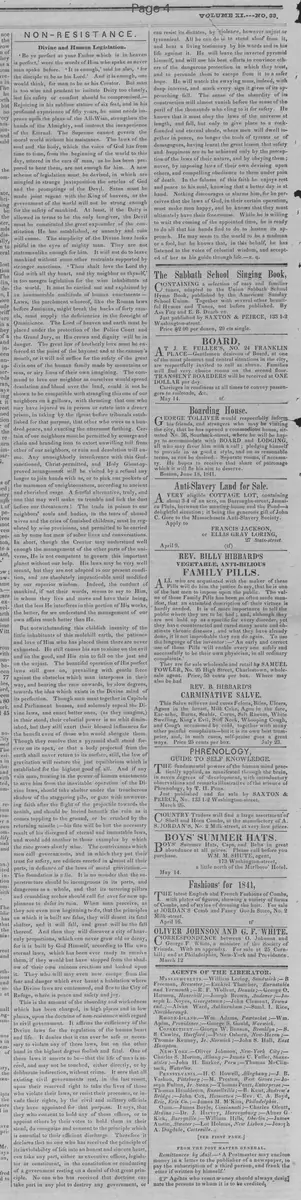
'Be ye perfect as your Father which is in heaven is perfect,' were the words of Him who spake as never man spake before. 'It is enough,' said he also, 'for the disciple to be as his Lord.' And it is enough, one would think, for man to be as his Creator. But man is too wise and prudent to imitate Deity too closely, lest his safety or comfort should be compromised.—Rejoicing in his sublime stature of six feet, and in his profound experience of fifty years, he must needs improve upon the plans of the All-Wise, strengthen the hands of the Almighty, and instruct the inexperience of the Eternal. The Supreme cannot govern the moral world without his assistance. The laws of the soul and the body, which the voice of God has from time to time, from the beginning of the world to this day, uttered in the ears of man, as he has been prepared to hear them, are not enough for him. A new scheme of legislation must be devised, in which are mingled in strange juxtaposition the oracles of God and the promptings of the Devil. Satan must be made joint regent with the King of heaven, or the government of the world will not be strong enough for the safety of mankind. At least, if the Deity is allowed in terms to be the only lawgiver, the Devil must be constituted the great expounder of the constitution He has established, or anarchy and ruin will ensue. The simplicity of the Divine laws looks pitiful in the eyes of mighty man. They are not statesmanlike enough for him. It will not do to leave mankind without some other restraints supported by stronger sanctions. Thou shalt love the Lord thy God with all thy heart, and thy neighbor as thyself, is too meagre legislation for the wise inhabitants of the world. It must be carried out and explained by an innumerable multitude of human enactments—Laws, the parchment whereof, like the Roman laws before Justinian, might break the backs of forty camels, must supply the deficiencies in the foresight of Omniscience. The Lord of heaven and earth must be placed under the protection of the Police Court and the Grand Jury, or His crown and dignity will be in danger. The great law of brotherly love must be enforced at the point of the bayonet and at the cannon's mouth, or it will not suffice for the safety of the great divisions of the human family made by mountains or seas, or airy lines of their own imagining. The command to love our neighbor as ourselves would spread desolation and blood over the land, could it not be shown to be compatible with strangling this one of our neighbors on a gallows, with thrusting that one who may have injured us in person or estate into a dreary prison, in taking by the throat before tribunals established for that purpose, that other who owes us a hundred pence, and exacting the uttermost farthing. Certain of our neighbors must be permitted by scourge and chain and branding iron to extort unwilling toil from other of our neighbors, or ruin and desolation will ensue. Any unneighborly interference with this God-sanctioned, Christ-permitted, and Holy Ghost-approved arrangement will be visited by a refusal any longer to join hands with us, or to pick our pockets of the mammon of unrighteousness, according to ancient and cherished usage. A fearful alternative, truly, and one that may well make us tremble and lick the dust before our threateners! The trade in poison to our neighbors' souls and bodies, in the tears of abused wives and the cries of famished children, must be regulated by wise provisions, and permitted to be carried on by none but men of sober lives and conversations. In short, though the Creator may understand well enough the management of the other parts of the universe, He is not competent to govern this important planet without our help. His laws may be very well meant, but they are not adapted to our present condition, and are absolutely impracticable until modified by our superior wisdom. Indeed, the conduct of mankind, if not their words, seems to say to Him, in whom they live and move and have their being, that the less He interferes in this portion of His works, the better, for we understand the management of our own affairs much better than He.
But notwithstanding this childish insanity of the little inhabitants of this molehill earth, the patience and love of Him who has placed them there are never exhausted. He still causes his sun to shine on the evil and on the good, and His rain to fall on the just and on the unjust. The beautiful operation of His perfect laws still goes on, prevailing with gentle force against the obstacles which man interposes in their way, and bearing the race onwards, by slow degrees, towards the idea which exists in the Divine mind of its perfection. Though men meet together in Capitols and Parliament houses, and solemnly repeal the Divine laws, and enact better ones, (as they imagine,) in their stead, their celestial power is no whit diminished, but they still exert their blessed influences for the benefit even of those who would abrogate them. Though they resolve that a pyramid shall stand forever on its apex, or that a body projected from the earth shall never return to its surface, still, the law of gravitation will restore the just equilibrium which is established for the highest good of all. And if any vain man, trusting in the power of human enactments to save him from the inevitable operation of the Divine laws, should take shelter under the treacherous shadow of the staggering pile, or gaze with unwavering faith after the flight of the projectile towards the zenith, and should be buried beneath the ruin as it comes toppling to the ground, or be crushed by the returning missile;—his fate will be but the necessary result of his disregard of eternal and immutable laws, and would add another to those examples by which the race grows slowly wise. The contrivances which men call governments, and in which they put their trust for safety, are edifices erected in almost all their parts, in defiance of the laws of moral gravitation.—The foundation is a lie. It is no wonder that the superstructure should be incongruous in its parts, and dangerous as a whole, and that its tottering pillars and crumbling arches should call for ever for new appliances to defer its ruin. When men perceive, as they are even now beginning to do, that the principles on which it is built are false, they will desert its fatal shelter, and it will fall, and great will be the fall thereof. And then they will discover a city of heavenly proportions, which can never grow old or decay, for it is built by God Himself, according to His own eternal laws, which has been ever ready to receive them, if they would but have stepped from the shadow of their own ruinous erections and looked upon it. They who will may even now escape from the fear and danger which ever haunt a habitation where the Divine laws are contemned, and flee to the City of Refuge, where is peace and safety and joy.
This is the amount of the absurdity and wickedness which has been charged, in high places and in low places, upon the doctrine of non-resistance with regard to civil government. It affirms the sufficiency of the Divine laws for the regulation of the human heart and life. It denies that it can ever be safe or necessary to violate any of these laws, but on the other hand in the highest degree foolish and fatal. One of these laws it asserts to be—that the life of man is sacred, and may not be touched, either directly, or by deliberate indirection, without crime. It sees that all existing civil governments rest, in the last resort, upon their reserved right to take the lives of those who violate their laws, or resist their processes, or invade their rights, by the civil and military officials they have appointed for that purpose. It says, that they who consent to hold any of these offices, or to appoint others by their votes to hold them in their stead, do recognize and consent to the principle which is essential to their efficient discharge. Therefore it declares that no one who has received the principle of its inviolability of life into an honest and sincere heart, can take any part, either as executive officer, legislator or constituent, in the constitution or conducting of a government resting on a denial of that great principle. No one who has received that doctrine can take part in any plot to destroy any government, or can resist its dictates, by violence, however unjust or tyrannical. All he can do is to stand aloof from it, and bear a living testimony by his words and in his life against it. He will leave the inverted pyramid himself, and will use his best efforts to convince others of the dangerous protection in which they trust, and to persuade them to escape from it to a safer hope. He will watch the swaying mass, indeed, with deep interest, and mark every sign it gives of its approaching fall. The sense of the absurdity of its construction will almost vanish before the sense of the peril of the thousands who cling to it for safety. He knows that it must obey the laws of the universe at length, and fall, but only to give place to a rock-founded and eternal abode, where men will dwell together in peace, no longer the tools of tyrants or of demagogues, having learnt the great lesson that safety and happiness are to be achieved only by the perception of the laws of their nature, and by obeying them; never, by imposing laws of their own devising upon others, and compelling obedience to them under pain of death. In the fulness of this faith he enjoys rest and peace to his soul, knowing that a better day is at hand. Nothing discourages or alarms him, for he perceives that the laws of God, in their certain operation, must make men happy, and he knows that they must ultimately have their free course. While he is willing to wait the coming of the appointed time, he is ready to do all that his hands find to do to hasten its approach. He may seem to the world to be a madman or a fool, but he knows that, in this behalf, he has listened to the voice of celestial wisdom, and accepted of her as his guide through life.—E. Q.
Divine and Human Legislation.
'Be ye perfect as your Father which is in heaven is perfect,' were the words of Him who spake as never man spake before. 'It is enough,' said he also, 'for the disciple to be as his Lord.' And it is enough, one would think, for man to be as his Creator. But man is too wise and prudent to imitate Deity too closely, lest his safety or comfort should be compromised.—Rejoicing in his sublime stature of six feet, and in his profound experience of fifty years, he must needs improve upon the plans of the All-Wise, strengthen the hands of the Almighty, and instruct the inexperience of the Eternal. The Supreme cannot govern the moral world without his assistance. The laws of the soul and the body, which the voice of God has from time to time, from the beginning of the world to this day, uttered in the ears of man, as he has been prepared to hear them, are not enough for him. A new scheme of legislation must be devised, in which are mingled in strange juxtaposition the oracles of God and the promptings of the Devil. Satan must be made joint regent with the King of heaven, or the government of the world will not be strong enough for the safety of mankind. At least, if the Deity is allowed in terms to be the only lawgiver, the Devil must be constituted the great expounder of the constitution He has established, or anarchy and ruin will ensue. The simplicity of the Divine laws looks pitiful in the eyes of mighty man. They are not statesmanlike enough for him. It will not do to leave mankind without some other restraints supported by stronger sanctions. Thou shalt love the Lord thy God with all thy heart, and thy neighbor as thyself, is too meagre legislation for the wise inhabitants of the world. It must be carried out and explained by an innumerable multitude of human enactments—Laws, the parchment whereof, like the Roman laws before Justinian, might break the backs of forty camels, must supply the deficiencies in the foresight of Omniscience. The Lord of heaven and earth must be placed under the protection of the Police Court and the Grand Jury, or His crown and dignity will be in danger. The great law of brotherly love must be enforced at the point of the bayonet and at the cannon's mouth, or it will not suffice for the safety of the great divisions of the human family made by mountains or seas, or airy lines of their own imagining. The command to love our neighbor as ourselves would spread desolation and blood over the land, could it not be shown to be compatible with strangling this one of our neighbors on a gallows, with thrusting that one who may have injured us in person or estate into a dreary prison, in taking by the throat before tribunals established for that purpose, that other who owes us a hundred pence, and exacting the uttermost farthing. Certain of our neighbors must be permitted by scourge and chain and branding iron to extort unwilling toil from other of our neighbors, or ruin and desolation will ensue. Any unneighborly interference with this God-sanctioned, Christ-permitted, and Holy Ghost-approved arrangement will be visited by a refusal any longer to join hands with us, or to pick our pockets of the mammon of unrighteousness, according to ancient and cherished usage. A fearful alternative, truly, and one that may well make us tremble and lick the dust before our threateners! The trade in poison to our neighbors' souls and bodies, in the tears of abused wives and the cries of famished children, must be regulated by wise provisions, and permitted to be carried on by none but men of sober lives and conversations. In short, though the Creator may understand well enough the management of the other parts of the universe, He is not competent to govern this important planet without our help. His laws may be very well meant, but they are not adapted to our present condition, and are absolutely impracticable until modified by our superior wisdom. Indeed, the conduct of mankind, if not their words, seems to say to Him, in whom they live and move and have their being, that the less He interferes in this portion of His works, the better, for we understand the management of our own affairs much better than He.
But notwithstanding this childish insanity of the little inhabitants of this molehill earth, the patience and love of Him who has placed them there are never exhausted. He still causes his sun to shine on the evil and on the good, and His rain to fall on the just and on the unjust. The beautiful operation of His perfect laws still goes on, prevailing with gentle force against the obstacles which man interposes in their way, and bearing the race onwards, by slow degrees, towards the idea which exists in the Divine mind of its perfection. Though men meet together in Capitols and Parliament houses, and solemnly repeal the Divine laws, and enact better ones, (as they imagine,) in their stead, their celestial power is no whit diminished, but they still exert their blessed influences for the benefit even of those who would abrogate them. Though they resolve that a pyramid shall stand forever on its apex, or that a body projected from the earth shall never return to its surface, still, the law of gravitation will restore the just equilibrium which is established for the highest good of all. And if any vain man, trusting in the power of human enactments to save him from the inevitable operation of the Divine laws, should take shelter under the treacherous shadow of the staggering pile, or gaze with unwavering faith after the flight of the projectile towards the zenith, and should be buried beneath the ruin as it comes toppling to the ground, or be crushed by the returning missile;—his fate will be but the necessary result of his disregard of eternal and immutable laws, and would add another to those examples by which the race grows slowly wise. The contrivances which men call governments, and in which they put their trust for safety, are edifices erected in almost all their parts, in defiance of the laws of moral gravitation.—The foundation is a lie. It is no wonder that the superstructure should be incongruous in its parts, and dangerous as a whole, and that its tottering pillars and crumbling arches should call for ever for new appliances to defer its ruin. When men perceive, as they are even now beginning to do, that the principles on which it is built are false, they will desert its fatal shelter, and it will fall, and great will be the fall thereof. And then they will discover a city of heavenly proportions, which can never grow old or decay, for it is built by God Himself, according to His own eternal laws, which has been ever ready to receive them, if they would but have stepped from the shadow of their own ruinous erections and looked upon it. They who will may even now escape from the fear and danger which ever haunt a habitation where the Divine laws are contemned, and flee to the City of Refuge, where is peace and safety and joy.
This is the amount of the absurdity and wickedness which has been charged, in high places and in low places, upon the doctrine of non-resistance with regard to civil government. It affirms the sufficiency of the Divine laws for the regulation of the human heart and life. It denies that it can ever be safe or necessary to violate any of these laws, but on the other hand in the highest degree foolish and fatal. One of these laws it asserts to be—that the life of man is sacred, and may not be touched, either directly, or by deliberate indirection, without crime. It sees that all existing civil governments rest, in the last resort, upon their reserved right to take the lives of those who violate their laws, or resist their processes, or invade their rights, by the civil and military officials they have appointed for that purpose. It says, that they who consent to hold any of these offices, or to appoint others by their votes to hold them in their stead, do recognize and consent to the principle which is essential to their efficient discharge. Therefore it declares that no one who has received the principle of its inviolability of life into an honest and sincere heart, can take any part, either as executive officer, legislator or constituent, in the constitution or conducting of a government resting on a denial of that great principle. No one who has received that doctrine can take part in any plot to destroy any government, or can resist its dictates, by violence, however unjust or tyrannical. All he can do is to stand aloof from it, and bear a living testimony by his words and in his life against it. He will leave the inverted pyramid himself, and will use his best efforts to convince others of the dangerous protection in which they trust, and to persuade them to escape from it to a safer hope. He will watch the swaying mass, indeed, with deep interest, and mark every sign it gives of its approaching fall. The sense of the absurdity of its construction will almost vanish before the sense of the peril of the thousands who cling to it for safety. He knows that it must obey the laws of the universe at length, and fall, but only to give place to a rock-founded and eternal abode, where men will dwell together in peace, no longer the tools of tyrants or of demagogues, having learnt the great lesson that safety and happiness are to be achieved only by the perception of the laws of their nature, and by obeying them; never, by imposing laws of their own devising upon others, and compelling obedience to them under pain of death. In the fulness of this faith he enjoys rest and peace to his soul, knowing that a better day is at hand. Nothing discourages or alarms him, for he perceives that the laws of God, in their certain operation, must make men happy, and he knows that they must ultimately have their free course. While he is willing to wait the coming of the appointed time, he is ready to do all that his hands find to do to hasten its approach. He may seem to the world to be a madman or a fool, but he knows that, in this behalf, he has listened to the voice of celestial wisdom, and accepted of her as his guide through life.—E. Q.
What sub-type of article is it?
Moral Or Religious
What keywords are associated?
Non Resistance
Divine Laws
Human Legislation
Civil Government
Moral Perfection
Life Sanctity
Non Violence
What entities or persons were involved?
God
Civil Governments
E. Q.
Editorial Details
Primary Topic
Doctrine Of Non Resistance To Civil Government
Stance / Tone
Advocacy For Divine Laws Over Human Legislation And Non Violent Withdrawal From Government
Key Figures
God
Civil Governments
E. Q.
Key Arguments
Divine Laws Are Sufficient And Perfect For Human Regulation
Human Governments Mix Divine Oracles With Devilish Promptings And Rely On Violence
Life Is Sacred And Cannot Be Taken Without Crime
Participation In Government Endorses Killing, So True Believers Must Abstain And Testify Against It
Governments Will Inevitably Fall, Giving Way To A Divine Order