Thank you for visiting SNEWPapers!
Sign up free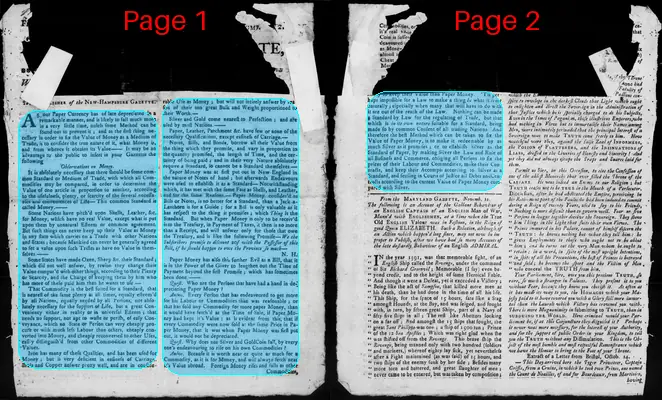
The New Hampshire Gazette
Portsmouth, Rockingham County, New Hampshire
What is this article about?
An editorial critiques the depreciation of colonial paper currency, explaining money's nature and ideal qualities. It argues paper money fails as a standard unlike silver and gold, proposes redeeming paper in silver, and discusses causes of depreciation through Q&A.
Merged-components note: This is a continuation of the editorial discussing the depreciation of paper currency and the nature of money standards, flowing directly from page 1 to page 2 based on sequential reading order and text content.
Clippings
1 of 2
OCR Quality
Full Text
Observations on Money.
It is absolutely necessary that there should be some common Standard or Medium of Trade, with which all Commodities may be compared, in order to determine the Value of one article in proportion to another, according to the usefulness, plenty, or scarcity of the several necessaries and conveniences of Life-- This common Standard is called Money.
Some Nations have pitch'd upon Shells, Leather, &c. for Money, which have no real Value, except what is put upon them by unnatural Esteem or common agreement. But such things can never keep up their Value as Money in any State which carries on a Trade with other Nations and States; because Mankind can never be generally agreed to set a value upon such Trifles as have no Value in themselves.
Some States have made Oxen, Sheep &c. their Standard: which did not well answer, by reason they change their Value compar'd with other things, according to their Plenty or Scarcity, and the Charge of keeping them by him who has more of these paid him than he wants to use.
That Commodity is the best suited for a Standard, that is nearest of the same plenty at all times, equally esteem'd by all Nations, equally needed by all Persons, not absolutely necessary for the support of Life, but a great Convenience either in reality or in universal Esteem: that needs no support, not apt to waste or perish, of easy Conveyance, which no State or Person can very cheaply produce or with much less Labour than others, cheaply converted into Money, and cheaply reconverted to other Uses, easily distinguished from other Commodities of different Values.
Iron has many of these Qualities, and has been used for Money; but is very deficient in easiness of Carriage. Brass and Copper answer pretty well, and are in considerable Use as Money; but will not entirely answer by reason of their too great Bulk and Weight proportioned to their Worth.
Silver and Gold come nearest to Perfection; and are used by most Nations.
Paper, Leather, Parchment &c. have few or none of the necessary Qualifications, except easiness of Carriage.
Notes, Bills, and Bonds, borrow all their Value from the thing which they promise, and vary in proportion to the quantity promised, the length of Time, and the certainty of being paid; and in their very Nature absolutely require a Standard, so cannot be a Standard themselves.
Paper Money was at first put out in New-England in the nature of Notes of hand; but afterwards Endeavours were used to establish it as a Standard-- Notwithstanding which, it has met with the same Fate as Shells, and Leather, and for the same Reasons.
Paper Money consider'd as Bills or Notes, is no better for a Standard, than a Jack-a-Lanthorn is for a Guide; for a Bill is only valuable as it has respect to the thing it promises; which Thing is the Standard. But when Paper Money is only to be receiv'd into the Treasury, in Payment of Taxes, it then is no more than a Receipt, and will answer only for those that owe the Treasury, and is like the following Promise-- We the Subscribers promise to discount 20s with the Possessor of this Bill, if he should happen to owe the Province so much.
N. H.
Paper Money has also this further Evil as a Bill, that it is in the Power of the Giver to lengthen out the Time of Payment beyond the first Promise; which has sometimes been done.
Quet. Who are the Persons that have had a hand in depreciating Paper Money?
Ansv. Every Person that has endeavoured to get more for his Labour or Commodities than was reasonable; or that has sold any Commodity for more paper Money, than it would have fetch'd at the Time of Sale, if Paper Money had kept it's Value: as is evident from this, that if every Commodity were now sold at the same Price in Paper Money, that it was when Paper Money was first put out, it would not be depreciated.
Quet. Why does not Silver and Gold Coin fall, by every one's endeavouring to rise on his own Commodities?
Answ. Because it is worth near or quite as much for a Commodity, as it is for Money, and will always fetch near it's Value abroad. Foreign Money rises and falls as other Commodities,
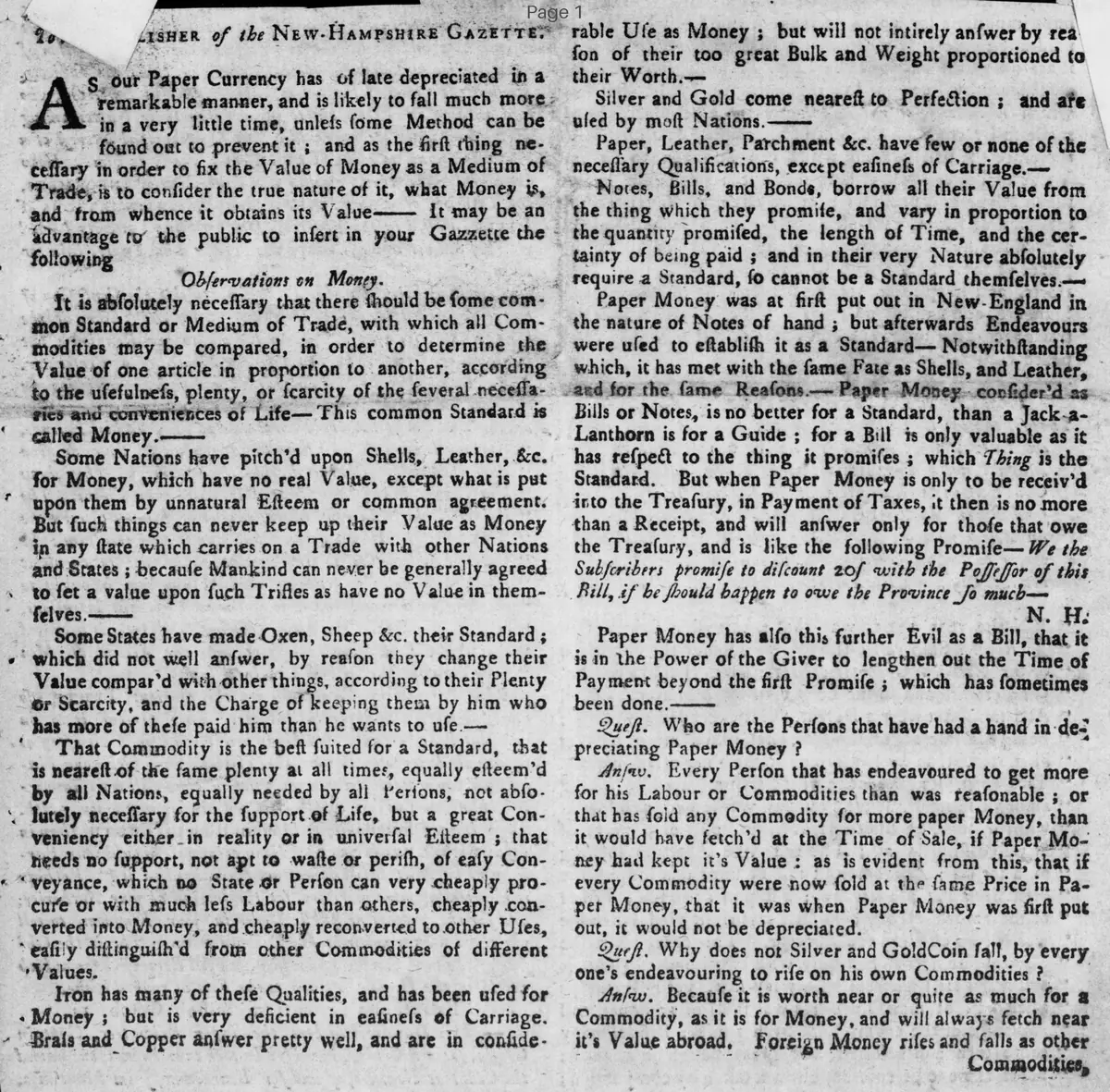
'Tis perhaps impossible for a Law to make a thing be what it is not naturally; especially when many that will have to do with it are out of the reach of the Law. Nothing can be made a Standard by Law for the regulating of Trade, but that which is in its own nature suitable for a Standard, being made so by common Consent of all trading Nations. And therefore the best Method which can be taken to fix the Value of Paper Money, is to make it redeemable by as much Silver as it promises; or to establish Silver as the Standard of Paper, by making Silver the Law and Rule of all Business and Commerce, obliging all Persons to fix the prices of their Labour and Commodities, make their Contracts, and keep their Accompts according to Silver as a Standard, and settling in Courts of Justice all Debts and Contracts according to the current Value of Paper Money compared with Silver.
What sub-type of article is it?
What keywords are associated?
What entities or persons were involved?
Editorial Details
Primary Topic
Depreciation Of Paper Currency And Advocacy For Silver Standard
Stance / Tone
Critical Of Paper Money, Supportive Of Silver And Gold As Standards
Key Figures
Key Arguments