Thank you for visiting SNEWPapers!
Sign up free
Freeman's Chronicle
Columbus, Franklin County, Ohio
What is this article about?
Gen. William H. Harrison reports the successful defense of Fort Meigs against British and Indian forces in May 1813, enemy retreat with low American casualties (under 50 killed), and details of engagements and outcomes at Lower Sandusky.
Merged-components note: Continuation of General Harrison's dispatch on the Siege of Fort Meigs.
Clipping
OCR Quality
Full Text
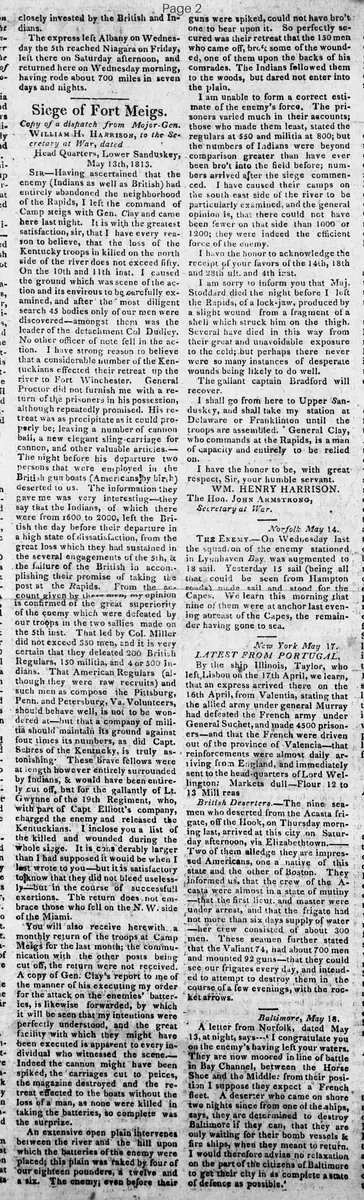
The express left Albany on Wednesday the 5th reached Niagara on Friday, left there on Saturday afternoon, and returned here on Wednesday morning, having rode about 700 miles in seven days and nights.
Siege of Fort Meigs.
Copy of a dispatch from Major-Gen. William H. Harrison, to the Secretary at War, dated Head Quarters, Lower Sandusky, May 13th, 1813.
SIR—Having ascertained that the enemy (Indians as well as British) had entirely abandoned the neighborhood of the Rapids, I left the command of Camp Meigs with Gen. Clay and came here last night. It is with the greatest satisfaction, sir, that I have every reason to believe, that the loss of the Kentucky troops in killed on the north side of the river does not exceed fifty.
On the 10th and 11th inst. I caused the ground which was the scene of the action and its environs to be carefully examined, and after the most diligent search 45 bodies only of our men were discovered—amongst them was the leader of the detachment Col Dudley. No other officer of note fell in the action. I have strong reason to believe that a considerable number of the Kentuckians effected their retreat up the river to Fort Winchester. General Proctor did not furnish me with a return of the prisoners in his possession, although repeatedly promised. His retreat was as precipitate as it could possibly be; leaving a number of cannon balls, a new elegant sling-carriage for cannon, and other valuable articles.
The night before his departure two persons that were employed in the British gun boats (Americans by birth) deserted to us. The information they gave me was very interesting—they say that the Indians, of which there were from 1600 to 2000, left the British the day before their departure in a high state of dissatisfaction, from the great loss which they had sustained in the several engagements of the 5th, & the failure of the British in accomplishing their promise of taking the post at the Rapids. From the account given by these men, my opinion is confirmed of the great superiority of the enemy which were defeated by our troops in the two sallies made on the 5th inst. That led by Col. Miller did not exceed 350 men, and it is very certain that they defeated 200 British Regulars, 150 militia; and 400 or 500 Indians. That American Regulars (although they were raw recruits) and such men as compose the Pittsburgh, Penn. and Petersburg, Va. Volunteers, should behave well, is not to be wondered at—but that a company of militia should maintain its ground against four times its numbers, as did Capt. Sebree of the Kentucky, is truly astonishing: These brave fellows were at length however entirely surrounded by Indians, & would have been entirely cut off, but for the gallantry of Lt. Gwynne of the 19th Regiment, who, with part of Capt Elliott's company, charged the enemy and released the Kentuckians. I inclose you a list of the killed and wounded during the whole siege. It is considerably larger than I had supposed it would be when I first wrote to you—but it is satisfactory to know that they did not bleed uselessly—But in the course of successful exertions. The return does not embrace those who fell on the N. W. side of the Miami.
You will also receive herewith. a monthly return of the troops at Camp Meigs for the last month; the communication with the other posts being cut off, the returns were not received.
A copy of Gen. Clay's report to me of the manner of his executing my order for the attack on the enemies' batteries, is likewise forwarded, by which it will be seen that my intentions were perfectly understood, and the great facility with which they might have been executed is apparent to every individual who witnessed the scene.—Indeed the cannon might have been spiked, the carriages cut to pieces, the magazine destroyed and the retreat effected to the boats without the loss of a man, as none were killed in taking the batteries, so complete was the surprize.
An extensive open plain intervenes between the river and the hill upon which the batteries of the enemy were placed; this plain was raked by four of our eighteen pounders, a twelve and a six. The enemy; even before their guns were spiked, could not have brought one to bear upon it. So perfectly secured was their retreat that the 150 men who came off, brought some of the wounded, one of them upon the backs of his comrades. The Indians followed them to the woods, but dared not enter into the plain.
I am unable to form a correct estimate of the enemy's force. The prisoners varied much in their accounts; those who made them least, stated the regulars at 550 and militia at 800; but the numbers of Indians were beyond comparison greater than have ever been brought into the field before; numbers arrived after the siege commenced. I have caused their camps on the south-east side of the river to be particularly examined, and the general opinion is, that there could not have been fewer on that side than 1000 or 1200; they were indeed the efficient force of the enemy.
I have the honor to acknowledge the receipt of your favors of the 14th, 18th and 28th ult. and 4th inst.
I am sorry to inform you that Maj. Stoddard died the night before I left the Rapids, of a lock-jaw, produced by a slight wound from a fragment of a shell which struck him on the thigh. Several have died in this way from their great and unavoidable exposure to the cold; but perhaps there never were so many instances of desperate wounds being likely to do well.
The gallant captain Bradford will recover.
I shall go from here to Upper Sandusky, and shall take my station at Delaware or Franklinton until the troops are assembled. General Clay, who commands at the Rapids, is a man of capacity and entirely to be relied on.
I have the honor to be, with great respect, Sir, your humble servant.
WM. HENRY HARRISON.
The Hon. JOHN ARMSTRONG, Secretary at War.
What sub-type of article is it?
What keywords are associated?
What entities or persons were involved?
Where did it happen?
Domestic News Details
Primary Location
Fort Meigs, Lower Sandusky
Event Date
May 13th, 1813
Key Persons
Outcome
american losses: 45 bodies found on north side, total killed under 50, wounded per enclosed list; maj. stoddard died of lock-jaw from wound; capt. bradford expected to recover. enemy: heavy indian losses, 1600-2000 indians dissatisfied and left; british retreated precipitously, leaving equipment; defeated in sallies with 200 regulars, 150 militia, 400-500 indians.
Event Details
Dispatch reports enemy (British and Indians) abandonment of Rapids after failed siege of Fort Meigs. Kentucky troops' losses low; examination found 45 bodies including Col. Dudley. Deserters report Indian dissatisfaction and departure. Details of successful sallies on May 5th by Col. Miller and others defeating superior forces. Gen. Clay's attack on batteries successful with no losses in capture. Enemy force estimated 550 regulars, 800 militia, 1000-1200 Indians. Harrison plans to move to Upper Sandusky.