Thank you for visiting SNEWPapers!
Sign up free
The New York Journal, And Weekly Register
New York, New York County, New York
What is this article about?
Record of New York House of Assembly proceedings from February 22-28, covering debates on state agent certificates, relief for merchants owing British debts (Henry Remsen et al.), various petitions, bills passed, messages from governor and senate, and resolutions for constitutional convention delegates.
Clipping
OCR Quality
Full Text
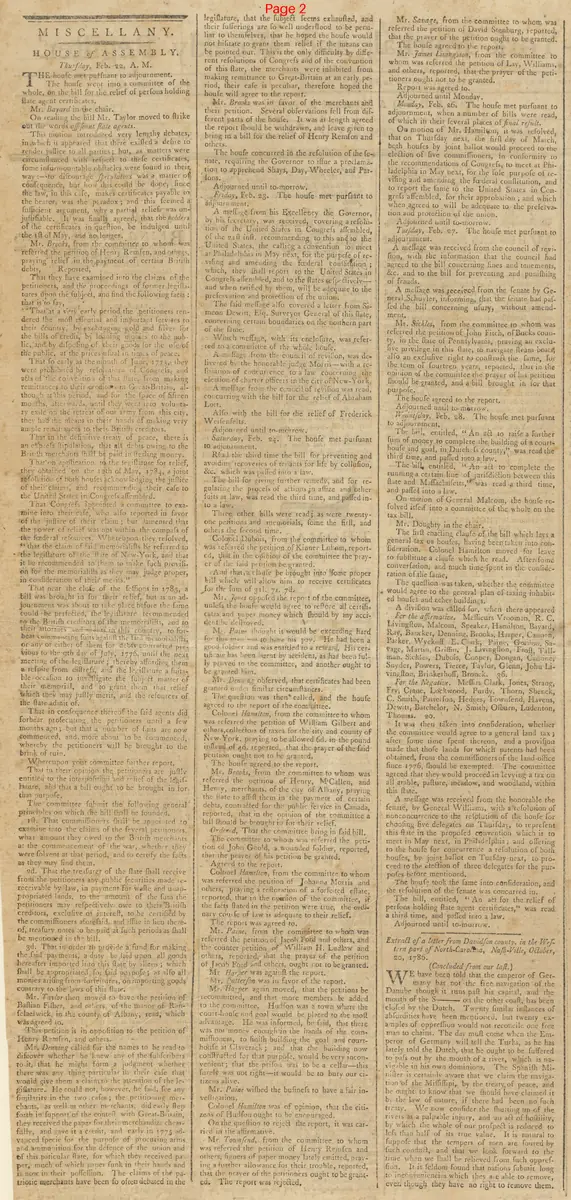
HOUSE OF ASSEMBLY.
Thursday, Feb. 22, A. M.
The house met pursuant to adjournment.
The house went into a committee of the whole, on the bill for the relief of persons holding state agent certificates.
Mr. Bayard in the chair.
On reading the bill Mr. Taylor moved to strike out the words assistant state agents.
This motion introduced very lengthy debates, in which it appeared that there existed a desire to render justice to all parties; but, as matters were circumstanced with respect to these certificates, some insurmountable obstacles were found in their way:--to discourage speculators was a matter of consequence, but how this could be done, since the law, in this case, makes certificates payable to the bearer, was the paradox; and this seemed a sufficient argument, why a partial relief was unjustifiable. It was finally agreed, that the holders of the certificates in question, be indulged until the first of May, and no longer.
Mr. Brooks, from the committee to whom was referred the petition of Henry Remsen, and others, praying relief in the payment of certain British debts, reported,
That they have examined into the claims of the petitioners, and their proceedings of former legislatures upon the subject, and find the following facts: that is to say,
That at a very early period the petitioners rendered the most essential and important services to their country, by exchanging gold and silver for the bills of credit, by loaning monies to the public, and by disposing of their goods for the use of the public, at the prices usual in times of peace.
That so early as the month of June, 1775, they were prohibited by resolutions of Congress, and acts of the convention of this state, from making remittances to their creditors in Great-Britain, although at this period, and for the space of fifteen months, afterwards, until they went into voluntary exile on the retreat of our army from this city, they had the means in their hands of making very ample remittances to their British creditors.
That in the definitive treaty of peace, there is an express stipulation, that all debts owing to the British merchants shall be paid in sterling money.
That on application to the legislature for relief, they obtained, on the 12th of May, 1784, a joint resolution of both houses acknowledging the justice of their claims, and recommending their case to the United States in Congress assembled.
That Congress appointed a committee to examine into their case, who also reported in favor of the justice of their claim; but lamented that the power of relief was not within the compass of the federal resources. Whereupon they resolved, that the claim of said memorialists be referred to the legislature of the state of New-York, and that it be recommended to them to make such provision for the memorialists as they may judge proper, in consideration of their merits."
That near the close of the session in 1785, a bill was brought in for their relief, but as an adjournment was about to take place before the same could be perfected, the legislature recommended to the British creditors of the memorialists, and to their attorneys and agents in this country, to forbear commencing suits against the said memorialists, or any or either of them for debts contracted previous to the 4th day of July, 1776, until the next meeting of the legislature; thereby affording them a respite from distress, and the legislature a suitable occasion to investigate the subject matter of their memorial, and to grant them that relief which they may justly merit, and the resources of the state admit of.
That in consequence thereof the said agents did forbear prosecuting the petitioners until a few months ago; but that a number of suits are now commenced, and more about to be commenced, whereby the petitioners will be brought to the brink of ruin.
Whereupon your committee further report, That in their opinion the petitioners are justly entitled to the interposition and relief of the legislature, and that a bill ought to be brought in for that purpose.
The committee submit the following general principles on which the bill shall be founded.
1st. That commissioners shall be appointed to examine into the claims of the several petitioners, what amount they owed to the British merchants at the commencement of the war, whether they were solvent at that period, and to certify the facts as they may find them.
2d. That the treasurer of the state shall receive from the petitioners any public securities made tender receivable by law, in payment for waste and unappropriated lands, to the amount of the sum the petitioners may respectively owe to their British creditors, exclusive of interest, to be certified by the commissioners aforesaid, and issue in lieu thereof, treasury notes to be paid at such periods as shall be mentioned in the bill.
3d. That in order to provide a fund for making the said payments, a duty be laid upon all goods hereafter imported into this state by aliens; which shall be appropriated for said purpose; as also all monies arising from forfeitures, on importing goods contrary to the laws of this state.
Mr. Taylor then moved to have the petition of Bastian Fisher, and others, of the manor of Rensselaerwyck, in the county of Albany, read, which was agreed to.
This petition is in opposition to the petition of Henry Remsen, and others.
Mr. Denning called for the names to be read to discover whether he knew any of the subscribers to it, that he might form a judgment whether there was any thing particular in their case that would give them a claim to the attention of the legislature. He could not, however, he said, see any similarity in the two cases; the petitioning merchants, as well as other merchants, did early step forth in support of the contest with Great-Britain, they received the paper for their merchandize cheerfully, and gave it a credit, and early in 1775 advanced specie for the purpose of procuring arms and ammunition for the defence of the union and of this particular state, for which they received paper, much of which paper sunk in their hands and is now in their possession. The claims of the patriotic merchants have been so often debated in the legislature, that the subject seems exhausted, and their sufferings are so well understood to be peculiar to themselves, that he hoped the house would not hesitate to grant them relief if the means can be pointed out. This is the only difficulty by different resolutions of Congress and of the convention of this state, the merchants were inhibited from making remittance to Great-Britain at an early period, their case is peculiar, therefore hoped the house will agree to the report.
Mr. Brooks was in favor of the merchants and their petition. Several observations fell from different parts of the house. It was at length agreed the report should be withdrawn, and leave given to bring in a bill for the relief of Henry Remsen and others.
The house concurred in the resolution of the senate, requiring the Governor to issue a proclamation to apprehend Shays, Day, Wheeler, and Parsons.
Adjourned until to-morrow.
Friday, Feb. 23. The house met pursuant to adjournment.
A message from his Excellency the Governor, by his secretary, was received, covering a resolution of the United States in Congress assembled, of the 21st inst. recommending to this and to the other United States, the calling a convention to meet at Philadelphia in May next, for the purpose of revising and amending the federal constitution; which, they shall report to the United States in Congress assembled, and to the states respectively--and when ratified by them, will be adequate to the preservation and protection of the union.
The said message also covered a letter from Simon DeWitt, Esq. Surveyor General of this state, concerning certain boundaries on the northern part of the same.
Which message, with its enclosure, was referred to a committee of the whole house.
A message from the council of revision, was delivered by the honorable judge Morris--with a resolution of concurrence to a law concerning the election of charter officers in the city of New-York.
A message from the council of revision was read, concurring with the bill for the relief of Abraham Lott.
Also with the bill for the relief of Frederick Weissenfels.
Adjourned until to-morrow.
Saturday, Feb. 24. The house met pursuant to adjournment.
It read the third time the bill for preventing and avoiding recoveries of tenants for life by collusion, &c. which was passed into a law.
The bill for giving further remedy, and for regulating the process of actions in assize and other suits at law, was read the third time, and passed into a law.
Three other bills were read; as were twenty-one petitions and memorials, some the first, and others the second time.
Colonel Dubois, from the committee to whom was referred the petition of Kinner Lukom, reported, that in the opinion of the committee the prayer of the said petition be granted.
And that a clause be brought into some proper bill which will allow him to receive certificates for the sum of £31. 7s. 7d.
Mr. Jones opposed the report of the committee, unless the house would agree to restore all certificates and paper money which should by any accident be destroyed.
Mr. Paine thought it would be exceeding hard for this man not to have his pay. He had been a good soldier and was entitled to a reward. His certificate has been burnt by accident, as had been fully proved to the committee, and another ought to be granted him.
Mr. Denning observed, that certificates had been granted under similar circumstances.
The question was then called, and the house agreed to the report of the committee.
Colonel Hamilton, from the committee to whom was referred the petition of William Gilbert and others, collectors of taxes for the city and county of New-York, praying to be allowed 6d. in the pound instead of 3d. reported, that the prayer of the said petition ought not to be granted.
The house agreed to the report.
Mr. Brooks, from the committee to whom was referred the petition of Henry McCallen, and Henry, merchants, of the city of Albany, praying the state to assist them in the payment of certain debts, contracted for the public service in Canada, reported, that in the opinion of the committee a bill should be brought in for their relief.
Ordered, That the committee bring in said bill.
The committee to whom was referred the petition of John Goold, a wounded soldier, reported, that the prayer of his petition be granted.
Agreed to the report.
Colonel Hamilton, from the committee to whom was referred the petition of Johanna Morris and others, praying a restoration of a forfeited estate, reported, that in the opinion of the committee, if the facts stated in the petition were true, the ordinary course of law is adequate to their relief.
The report was agreed to.
Mr. Paine, from the committee to whom was referred the petition of Jacobs Ford and others, and the counter petition of William H. Ludlow and others, reported, that the prayer of the petition of Jacob Ford and others, ought not to be granted.
Mr. Harper was against the report.
Mr. Patterson was in favor of the report.
Mr. Harper again moved, that the petitions be recommitted, and that more members be added to the committee. Hudson was a town where the court-house and goal would be placed to the most advantage. He was informed, he said, that there was not money enough in the hands of the commissioners, to finish building the goal and court-house at Claverack; and that the building now constructed for that purpose, would be very inconvenient; that the prison was to be a cellar--this surely was not right--it would be to bury our citizens alive.
Mr. Paine wished the business to have a fair investigation.
Colonel Hamilton was of opinion, that the citizens of Hudson ought to be encouraged.
On the question to reject the report, it was carried in the affirmative.
Mr. Townend, from the committee to whom was referred the petition of Henry Remsen and others, signers of paper money lately emitted, praying a further allowance for their trouble, reported, that the prayer of the petitioners ought to be granted. The report was rejected.
Mr. Savage, from the committee to whom was referred the petition of David Stenburg, reported, that the prayer of the petition ought to be granted.
The house agreed to the report.
Mr. James Livingston, from the committee to whom was referred the petition of Lay, Williams, and others, reported, that the prayer of the petitioners ought not to be granted.
Report was agreed to.
Adjourned until Monday.
Monday, Feb. 26. The house met pursuant to adjournment, when a number of bills were read, of which in their several places of final result.
On motion of Mr. Hamilton, it was resolved, that on Thursday next, the first day of March, both houses by joint ballot would proceed to the election of five commissioners, in conformity to the recommendations of Congress, to meet at Philadelphia in May next, for the sole purpose of revising and amending the federal constitution, and to report the same to the United States in Congress assembled, for their approbation; and which when agreed to will be adequate to the preservation and protection of the union.
Adjourned until to-morrow.
Tuesday, Feb. 27. The house met pursuant to adjournment.
A message was received from the council of revision, with the information that the council had agreed to the bill concerning fines and tenements, &c. and to the bill for preventing and punishing of frauds.
A message was received from the senate by General Schuyler, informing, that the senate had passed the bill concerning usury, without amendment.
Mr. Sickles, from the committee to whom was referred the petition of John Fitch, of Bucks county, in the state of Pennsylvania, praying an exclusive privilege in this state, to navigate steam boats, also an exclusive right to construct the same, for the term of fourteen years, reported, that in the opinion of the committee the prayer of his petition should be granted, and a bill brought in for that purpose.
The house agreed to the report.
Adjourned until to-morrow.
Wednesday, Feb. 28. The house met pursuant to adjournment.
The bill, entitled, "An act to raise a further sum of money to complete the building of a court-house and goal, in Duchess county," was read the third time, and passed into a law.
The bill entitled, "An act to complete the running a certain line of jurisdiction between this state and Massachusetts," was read a third time, and passed into a law.
On motion of General Malcolm, the house resolved itself into a committee of the whole on the tax bill.
Mr. Doughty in the chair.
The first enacting clause of the bill which lays a general tax on houses, having been taken into consideration, Colonel Hamilton moved for leave to substitute a clause which he read. After some conversation, and much time spent in the consideration of the same,
The question was taken, whether the committee would agree to the general plan of taxing inhabited houses and other buildings.
A division was called for, when there appeared
For the affirmative. Messieurs Vrooman, R. C. Livingston, Malcolm, Speaker, Hamilton, Bayard, Ray, Bancker, Denning, Brooks, Harper, Cannen, Parker, Wyckoff, E. Clark, Paine, Gordon, Savage, Martin, Griffin, J. Livingston, Frost, Tallman, Sickles, Dubois, Cooper, Dongan, Cantine, Snyder, Powers, Tierce, Taylor, Clenn, John Livingston, Brinkerhoff, Bronck. 36.
For the Negative. Messirs Clark, Jones, Strang, Fry, Crane, Lockwood, Purdy, Thorn, Shenck, C. Smith, Patterson, Hedges, Townend, Havens, Dewitt, Batchelor, N. Smith, Osburn, Ludenton, Thomas. 20.
It was then taken into consideration, whether the committee would agree to a general land tax; after some time spent thereon, and a provision made that those lands for which patents had been obtained, from the commissioners of the land-office since 1776, should be exempted. The committee agreed that they would proceed in levying a tax on all arable, pasture, meadow, and woodland, within this state.
A message was received from the honorable the senate, by General Williams, with a resolution of nonconcurrence to the resolution of the house for choosing five delegates on Thursday, to represent this state in the proposed convention which is to meet in May next, in Philadelphia; and offering to the house for concurrence a resolution of both houses, by joint ballot on Tuesday next, to proceed to the election of three delegates for the purposes before mentioned.
The house took the same into consideration, and the resolution of the senate was concurred in.
The bill, entitled, "An act for the relief of persons holding state agent certificates," was read a third time, and passed into a law.
Adjourned until to-morrow.
What sub-type of article is it?
What themes does it cover?
What keywords are associated?
What entities or persons were involved?
Where did it happen?
Story Details
Key Persons
Location
New York
Event Date
February 22 28
Story Details
The House of Assembly debates and acts on bills for relief of certificate holders and merchants with British debts, considers numerous petitions for various reliefs, receives messages on constitutional convention and boundaries, passes several laws including on taxes and court buildings, and agrees to elect delegates to the Philadelphia convention.