Thank you for visiting SNEWPapers!
Sign up free
Poem
September 16, 1834
Richmond Enquirer
Richmond, Richmond County, Virginia
What is this article about?
A lyrical poem 'NIGHT' extols the peace and memories brought by night, contrasting it with the hated day's cares and strife. Followed by a Democratic speech by Mr. Cambreleng criticizing the Bank of the United States' actions against the government and economy in 1834.
Clipping
OCR Quality
95%
Excellent
Full Text
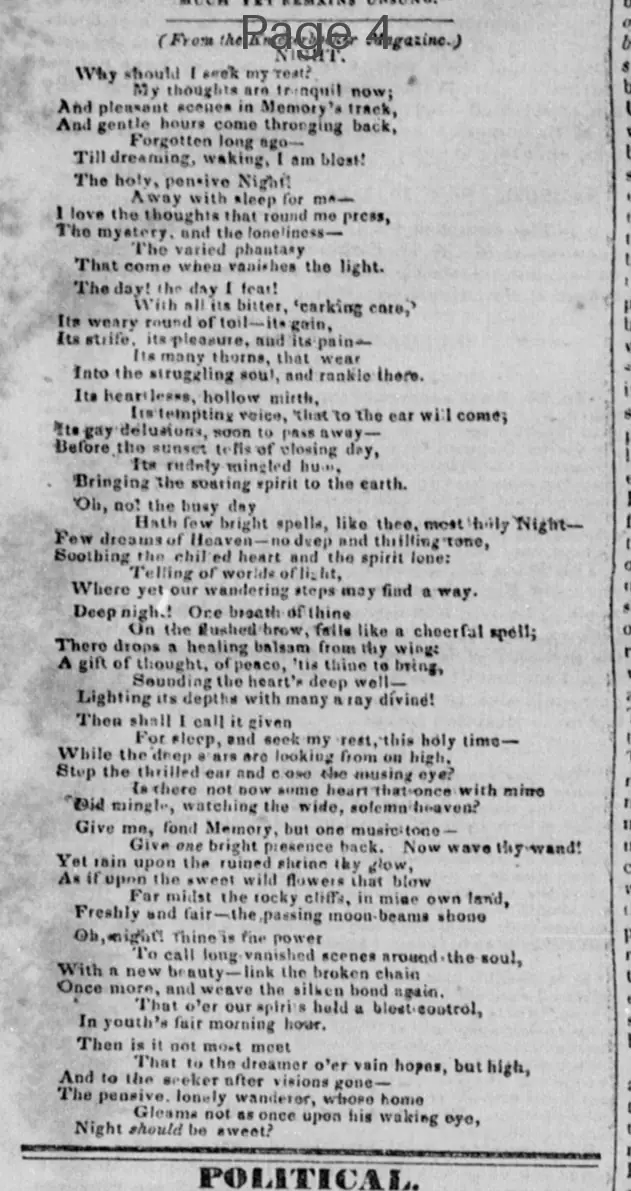
NIGHT
Why should I seek my rest?
My thoughts are tranquil now;
And pleasant scenes in Memory's track,
And gentle hours come thronging back,
Forgotten long ago—
Till dreaming, waking, I am blest!
The holy, pensive Night!
Away with sleep for me—
I love the thoughts that round me press,
The mystery, and the loneliness—
The varied phantasy
That come when vanishes the light.
The day! the day I hate!
With all its bitter, carking care,
Its weary round of toil for gain,
Its strife, its pleasure, and its pain—
Its many thorns, that wear
Into the struggling soul, and rankle there.
Its heartless, hollow mirth,
Its tempting voice, that to the ear will come;
The gay delusions, soon to pass away—
Before the sunset tells of closing day,
Its rudely mingled mirth,
Bringing the soaring spirit to the earth.
Oh, no! the busy day
Hath few bright spells, like thee, most holy Night—
Few dreams of Heaven—no deep and thrilling tone,
Soothing the chilled heart and the spirit lone:
Telling of worlds of light,
Where yet our wandering steps may find a way.
Deep Night! O breath of thine
On the hushed brow, falls like a cheerful spell;
There drops a healing balsam from thy wing:
A gift of thought, of peace, 'tis thine to bring,
Sounding the heart's deep well—
Lighting its depths with many a ray divine!
Then shall I call it given
For sleep, and seek my rest, this holy time—
While the deep ears are looking from on high,
Steep the thrilled ear and close the musing eye?
Do cheer not now some heart that once with mine
Did mingle, watching the wide, solemn heaven?
Give me, fond Memory, but one music tone—
Give one bright presence back. Now wave thy wand!
Yet rain upon the ruined shrine thy glow,
As if upon the sweet wild flowers that blow
Far midst the rocky cliffs, in mine own land,
Freshly and fair—the passing moon-beams shone.
Oh, might! Thine is the power
To call long vanished scenes around the soul,
With a new beauty—link the broken chain
Once more, and weave the silken bond again.
That o'er our spirits held a blest control,
In youth's fair morning hour.
Then is it not most meet
That to the dreamer o'er vain hopes, but high,
And to the seeker after visions gone—
The pensive, lonely wanderer, whose home
Gleams not as once upon his waking eye,
Night should be sweet?
POLITICAL.
MR. CAMBRELENG'S ADDRESS.
New York, September 5.—We have great pleasure in laying before our readers to-day, the following able and truly Democratic speech of Mr. Cambreleng, delivered at the great meeting of the Republican young men of this city, at Tammany Hall, on Wednesday evening last. The history of the audacious warfare which has been maintained by the Bank of the United States against the Government, and the exposition of the daring profligacy of the means it has resorted to, have never been given in a more lucid and satisfactory form. The conduct of the Bank, in refusing to permit the investigation ordered by Congress, is very happily alluded to, and the parallel between the course and motives of the Bank, and those of Warren Hastings, as exposed in the masterly speeches of Burke, is drawn with great force and effect. The production, altogether, is highly creditable to its author, and will well reward, as we doubt not it will receive, the attentive perusal of every Democratic reader.
Address of Mr. Cambreleng, to the Democratic Republican Young Men of New York, at a meeting held at Tammany Hall, on Wednesday evening, the 3d instant.
Fellow-Citizens:—There is no one in this Assembly upon whom you have a greater right to call—none more proud to acknowledge his many obligations; none more grateful for the often repeated evidences of your confidence in his fidelity to those democratic principles of government which are now so violently assailed in every quarter of the Union. We meet, Fellow Citizens, to unite in our efforts to sustain these principles in one of those great struggles, which, under our political system, are indispensable to the preservation of our free institutions. In earlier conflicts our adversaries met us in open war. Differing in their opinions as to the form of government best calculated for our defense and welfare—the one party contended for a consolidated Government—the other for a confederated Republic. The former believed that the republican system would dissolve from inherent weakness—the latter, that consolidation was monarchy in disguise. The parties met on honorable ground as Federalists and Republicans. Our antagonists did not disgrace themselves by borrowing a name, disavowing their principles, or attempting to practice any contemptible political fraud upon the country.
But a defeated adversary naturally resorts to stratagem. Name after name has been adopted and discarded, till they have astonished even themselves by assuming a most ridiculous disguise. It would be a pity, Fellow Citizens, to deprive this forlorn hope of their new costume; for, though once an honorable emblem of revolutionary patriotism, in its modern office, like the mantle of charity, it covereth a multitude of sins. A common name is the only evidence or bond of union among factions entertaining no mutual respect, confidence or sympathy, and concurring in no one principle of government. But yesterday, the Nullifiers and Nationals were denouncing each other as robbers and traitors—the former charged the latter with plundering him of forty per cent. of his income—the latter accused his then adversary, of treason to the Union. The parties were ripe for civil war; the National Republican threatened the Nullifier with an army of "musket-bearing freemen"—he ridiculed the "wild fancies and avaricious propensities of a few men in the nation of South Carolina and of lower Virginia," and bitterly taunted his enemy with a gloomy portrait of Southern desolation—"the fox was to burrow in the wine vault—the rattle-snake to repose among the rubbish of the green house, and bats to take possession of the ball-room." These musket-bearing freemen now ground their arms and shout in the Nullifier's train! The National Republican atones for his brigandage on the income of his ally, and the Nullifier for his assault upon the Union, by a combined and relentless war against the illustrious man who first stayed the rapacity of the one, and admonished the other that "the Union must be preserved."
And what, fellow-citizens, has drawn this storm of invective upon the President? He disarmed the adversary of his country. Challenged in 1832 by the partizans of the Bank, he submitted the question to the people. That high tribunal sustained him, and decreed the dissolution of the Bank. From that hour the institution became the exasperated enemy of a country which it might ruin but could not rule. In its struggles for a charter every interest was destined to feel its vengeance. The war upon the country was approaching, and the President, with his accustomed energy, promptitude and wisdom, decided that the public money should not be employed to aggravate the public distresses. In pursuance of the express provisions of the law, the Secretary of the Treasury—than whom the President had not in his cabinet a purer, more honorable, or abler man—deprived the Bank of the U. States of its boasted power to break every State bank in the Union.
For that measure the President and the Secretary have been denounced by thousands who would have been crushed but for the timely interposition of the Treasury. The Bank had manifestly resolved on war. To secure its charter it was necessary to make the country feel that the institution was indispensable to its prosperity. Before the meeting of Congress—nay, even before the Treasury order was issued—preparations were made for a general assault in and out of Congress, upon the credit and prosperity of the country. The first step taken by the Bank was on the 13th of August of last year—the second on the 1st of October. The resolutions adopted by the Board, ordered that the premium on exchange should be advanced—that no bills should be purchased except on the Atlantic cities, Mobile and New Orleans, and at shorter dates—that loans in the interior should be converted into bills on these cities—that the branches should discontinue receiving the notes of distant State Banks—that the balances against all such Banks should be collected—and the Bank immediately commenced a rapid curtailment. These measures, calculated to ruin our merchants, break our institutions, and disturb our currency and exchanges, were adopted because other Banks were about to be employed to collect the public revenue! Such were the preparations made for an explosion on the meeting of Congress. With the session the campaign commenced vigorously—its friends in both Houses opened in full cry, while the operations of the Exchange Committee were active in every part of the Union. The resolutions of the 13th of August were expressly designed to arm the branches on the Atlantic, and especially the New York branch, with funds in bills at 60 days to create a debt against the local Banks. Under the resolutions of both dates, some thirty or forty millions in bills were thrown into the Atlantic cities, Mobile and New Orleans, for collection. While there millions were drawn from the diminished resources of our distressed merchants, and while the local Banks were alarmed at their accumulating debts to the branches, the public were amused with weekly statements of their discounts as an evidence of their friendship? Armed with these millions in western drafts, with balances steadily accumulating, the branch at New York would have drawn from our city banks their last dollar, and would have broken every bank in the Union, had not the Secretary of the Treasury, between the 10th of September and 1st of April, prevented that branch from collecting $7,600,000 dollars;—had he not armed our city institutions with near nine millions to defend the whole country in this war upon its trade and currency. The war was continued till the friends of the bank became alarmed for their own safety. The Union Committee commenced negotiation for a cessation of hostilities on the 11th of February. But the bank could not act in harmony with our local institutions, without putting an end to the panic and abandoning its assaults upon New York and Pennsylvania. For five weeks, and during the most gloomy period of the winter, the manager of the bank saw, with inexorable unconcern, friends and foes involved in one indiscriminate ruin. At length, fortunately for the country, they began to despair of their experiment. Our city banks had reduced their balances—the pressure was moderating, and the opening spring would soon put in motion the exuberant resources of the country. The President of the Bank relented, on the 17th of March, and proposed an armistice till the 1st of May. The balances from our city banks were not to be demanded, but it was "understood that in case the Bank of the United States should become indebted to the city banks a similar forbearance on their part was to be observed." How grateful should our New York merchants be to the President and Directors of the Bank of the United States for this amicable and timely arrangement, which enabled this branch to become a debtor of our city bank, in nine days, for a balance of one hundred and seventy-nine thousand dollars, and to carry on its war upon the South! Having been defeated in their efforts to break the Union Bank of Maryland, and the Bank of the Metropolis, during the armistice, and having again become the creditor of our city banks for a balance of three hundred thousand dollars, they renewed the campaign after the 1st of May. The old deposite story had become stale, and some new terror must be invented. It was understood that the bank was absolutely compelled to sacrifice the interests of its stockholders, by winding up its concerns four years before the legal period of its dissolution, and keeping its capital in the meantime unemployed! Its pensioned presses announced this sad intelligence in mournful strains, and leading Senators foreboded a disastrous summer and a baleful twilight to the year. But the bank soon found that its friends were quite satisfied with the winter's experiment, and were not disposed to be sacrificed in cold blood, to keep up this imposture upon the country. They had enlisted for the campaign, but not for the war. The managers of the bank found themselves in an awkward predicament. Their friends, in and out of Congress, had assured the country of approaching ruin—the exchange committee had prepared to renew the war vigorously; but their commercial friends were not so amiable as to submit quietly to the torture a second time. To advance was impracticable—to retreat would disgrace their Senatorial allies and expose the whole imposture. Then appeared that celebrated correspondence with a committee of our Merchants, which opened the eyes of the nation and equally astonished friends and foes. The committee frankly told them in substance, that, as the experiment upon Congress had failed, there was no object in continuing the war upon the country—that their resources were "abundant and increasing beyond example," and that their business ought to be extended. The letter was promptly answered. The bank, preparing for its "new relations" with the country, had resolved to stop its curtailments and contemplated a future expansion. Thus ended a twelve months' experiment to break our local institutions, and to convince the country of the indispensable necessity of the Bank of the United States.
There negotiations between our New York committees and the President of the Bank have been conducted with the utmost urbanity on both sides; and in concluding the treaty of peace and amity, the President assures the committee, that their restrictions were "as painful to the Board of Directors as to the community." There is something peculiar—something exquisite in the sensibility of a corporation when once determined to afflict itself. The reduction of the public monies between the first of August, 1833, and the first of August, 1834, was from $7,600,000 to $2,600,000 or five millions of dollars. Now, a hard-hearted banker would probably have thought it sufficient to reduce his discounts and loans to an equal amount—but a corporation, with a noble self-denial, is determined to inflict a deeper wound upon its sensibility, and reduces its loans and discounts in the same term from $64,100,000 to $48,600,000, making fifteen millions and a-half to balance five! It denied itself, too, the satisfaction of saving its friends from wreck amidst the storms of February, through fear of the Treasury; and promptly comes to their aid in the calms of July—though its attitude with the Treasury was not at all changed. It may, too, be a matter of special wonder with captious financiers, how an institution boasting of its twenty-two millions in coin and surplus; with foreign exchange at par and specie flowing into the country—could have been driven to the necessity of ruining its friends, to enable it to pay over a few millions of public money, a demand it had repeatedly met, and at times to twice the amount, in the semi-annual redemption of the public debt. Fellow citizens, during the alarms of the last winter many of us may have been deceived; but none but those who are determined to be duped can now review the conduct and measures of the Bank and its partizans, without comprehending the source and object of the late panic. The storm has passed away—the exchange committee have failed in their bold experiment—the deposite banks are safe—specie payments have not been suspended: the President and the country have triumphed. It is not now in the power of the Bank of the United States to embarrass trade. Our commercial credits are diminished—and our bank note circulation reduced and sustained by a recent addition of twenty millions to our metallic currency and an enlarged circulation of coins. The exchange committee may renew its operations, and the Senate may in December repeat its predictions of ruin; but, in the present condition of the country, the Bank can do no injury, unless aided and abetted by its commercial friends and the local institutions. If there be any among us so determined to be ruined, it would be cruel to interfere with a resolution, emanating from such disinterested, generous and voluntary devotion to the Bank of the United States.
Fellow-citizens! Avarice may find some apology for its struggles; but what atonement can ambition, though assuming the habiliments of patriotism, make for this bold and reckless attempt to rise into power upon the ruins of the country? From the first to the last day of a long session, Opposition leaders, distinguished for their talents, were employed, with a zeal worthy of a nobler cause, in attempting to spread a panic through our land, to break our Banks and ruin our trade. Like the distressed Bank Directors, these afflicted patriots were discharging a painful duty, and weeping over calamities of their own creation. With romantic despair they mourned over a ruined country and a bleeding Constitution. Poverty, desolation and despotism were to curse the land. The President, the great author of our calamities, was denounced as the most abominable of tyrants; reviled and traduced by his constitutional council; condemned without a trial, and denied, by his accusing judges, the common privilege of defence. The revolutionary spirit spread from the Senate chamber to our cities. Public meetings were held, as in 1807 and 1814, when a Jefferson and a Madison were denounced, and thousands answered the appeal of the Senate and were ready to hurl the tyrant from his throne. Committees were appointed and proceeded to Washington, and by whom the President was put on his examination, and in some instances insulted and held up as an object of ridicule and contempt. Orators harangued in our streets to thousands of their infuriated partizans, burning with revolutionary fire, and eager to march to the Capitol to protect an injured Senate from the feeble arm of the Chief Magistrate of the Union. Our arsenals were stormed, and the paths of this Senatorial revolution marked with blood!
It is fortunate, fellow-citizens, that at a crisis so alarming, we had a President at the helm, who stood firm and undaunted amidst the revolutionary violence of the times: A patriot, who never shrunk from any contest with the enemies of our Constitution, our Union, our Country. Let us not suppose, that public virtue and renown like his can escape that persecuting spirit which would pursue its victim to the grave, and inscribe a calumny on the tomb of a Jefferson. "The career of this venerable public servant is drawing rapidly to its close—but he will leave behind him a name gloriously associated with almost every prominent event of his time. He will long be remembered as one who was instrumental in saving his country from the worst of calamities—who executed a great constitutional reform, checked the spirit of disunion, and arrested the march of consolidation—who, though thwarted in his administration by a stormy opposition, illustrated it by a rapid succession of important national services; who caused a reform in the currency calculated to save the industrious and enterprising from the disastrous fluctuations of a rapidly growing paper currency; and who, at the close of a brilliant public career, witnessed the expiring agonies of an institution, which, had he not thrown himself into the breach, would have perpetuated its existence and its power. In recording these illustrious deeds, let not his enemies suppose that their ribaldries will be permitted to sully the same bright page. No—the dignity of history will reject, with scorn, the slanders of the bank pensioner, the denunciations of avarice, and the wild rant of exasperated ambition."
I congratulate you, Fellow-Citizens, that the last acts of the managers of the Bank have confounded even their friends. The President and Directors of the Bank of the United States have deliberately appropriated the public money, by a resolution of their Board—they have established an authority paramount to the laws and the constitution; and, by the same process of bank legislation, may plunder us, not only of our dividends, but of our seven millions of stock. This same paramount authority has insolently bid defiance to the power of the House of Representatives: its managers have resisted all enquiry into their conduct. Their own friends the minority of the committee admit that the President and Directors were charged with "bribery and corruption"—"with a most cruel and perfidious design to bring universal distress upon the country for the sake of paltry and selfish ends; with corrupting the conductors of the press, corrupting the people in the exercise of their elective franchise, and corrupting the members of Congress." Notwithstanding the gravity of these charges, the enquiry has been resisted, upon the extraordinary ground, that "if guilty, the President and Directors ought not to be made to criminate themselves." When Warren Hastings was charged with the management of the East India Company's concerns in India, we are informed by a distinguished statesman that he had "a board for the administration of the revenue in which a most important part of the company's transactions were buried"—"a private bribe exchequer, independent of the company's public exchequer"—private agents whose correspondence "he communicated as he thought proper, but most commonly withheld," leaving nothing for the Directors but "the shell and husk of a dry, formal, official correspondence, which neither meant anything nor was intended to mean anything"—that he treated "the official and regular Directors as a parcel of mean mechanical book-keepers;" and that he had a revenue "to be accounted for or not at his discretion, and to be applied to what service he thought proper."
When Hastings was brought before the council of India, charged with bribery and corruption, he refused to "sit at the board in the character of criminal, and would not acknowledge the members of the board to be his judges"—his answer was, "this may come into a court of justice." We are further told that "contrary to law, contrary to his duty, contrary to what is owed by innocence to itself, Mr. Hastings resisted that enquiry."
The managers of the Bank best know whether they have been fortunate in placing themselves in a similar dilemma—whether they owe a debt of gratitude to the minority of the committee for their delicacy in regard to "private correspondence;" their tender caution in preventing the accused from "criminating themselves;" and for the discovery that it was "the natural dictate of proud and conscious innocence to place themselves upon their rights beneath the aegis of the law." These are unfortunate rules for the protection of the character of public men—at least so thought one of those illustrious men who were appointed by the House of Commons to conduct the prosecution of Hastings. He declares it to be a "necessary duty, on requisition, to communicate your correspondence to those who form the paramount government." He denies the right of Mr. Hastings to plead that his case might come into court—"Is that a proper answer, he exclaims, for a Governor accused of bribery? That accusation, transmitted to his masters and his masters giving credit to it?" And lest the ethics of the very respectable gentlemen composing the minority, should again lead public men to mistake "the natural dictate of proud and conscious innocence," allow me to recommend to their attention the following lofty sentiment of the same illustrious Statesman—"It is the place undoubtedly of a virtuous, firm mind often to despise common calumny; but if ever there is an occasion, in which it does become such a mind to disprove it, it is the case of being charged in high office with pecuniary malversation, pecuniary corruption."
Alarmed at this bold attitude of the Bank, its partizans are driven to another imposture. Seeing this old and tottering platform of their party sinking from under them, they attempt, at this late hour, to escape from the ruin, by proclaiming that the Bank is not the question! What apology can they offer to those honorable men who have conscientiously supported their cause? What atonement can they make to the country for a twelve months' experiment to ruin it? The Bank not the question! Why, Fellow-Citizens, have we not this very day read a resolution authorising the President and Directors to apply for a renewal of its charter? No—for once they have acted nobly—they have declined becoming a party to this contemptible political fraud. If they must go down, they go down with their flag flying, and are determined to drag down with them, those eloquent gentlemen, who have been so long and so loudly declaiming about "the Bank, the whole Bank and nothing but the Bank." They cannot, they dare not, abandon the Bank; it is the basis and life of the Opposition in every district of the Union. Once in power, whether professing to be for a Bank or the Bank, the Bank of the U. States will command a charter from these allies in purpose and in principle. It has been throughout the campaign, the most prominent member of the alliance. Rising in its ambition, it aspires to the rank of a fourth Department, independent of, and controlling every other branch of the government. Let its partizans once triumph in this struggle, and the Bank will not only command its charter but govern the country.
We may imagine what such a government might be, by reviewing the proceedings of the Senate during the last winter. Those who framed the Constitution anticipated that that body would always continue to be an assembly of venerated statesmen, illustrious for public services, private worth and a lofty devotion to constitutional principles. That as a council it would aid the executive by its wisdom, and ever be ready to guarantee to that department its constitutional independence. They designed it for an august tribunal, before which might be arraigned the supreme judicial head of four and twenty States; and at whose bar might be summoned, the Chief Magistrate of a great Republic, to be acquitted or condemned, by Senators, illustrious for their moderation and justice, dignity and wisdom. Little did they imagine, that in less than half a century, that dignified assembly would be found in an attitude of hostility to the President and the House of Representatives, and defending with all its ability and eloquence a monied corporation. Should the Bank ever govern the country—dignity would be discarded from the Senate as an antiquated refinement—political integrity would be denounced as a worn out absurdity, and public virtue rejected as an innovation.
Fellow-Citizens! The Opposition leaders have deceived themselves. They have not elevated the character of the body to which they belong, in public estimation at home or abroad. Mistaking the movements of their frightened partizans for the just public sentiment of an intelligent nation, they thought themselves "in the midst of a revolution," and participated in its phrenzy. These distinguished Senators were making an experiment upon the politics of the country. They have now the mortification to discover, that all their declamations about a violated Constitution, have utterly failed to form a national party upon principle; and that defeat, disgraceful defeat, awaits them. Each disconsolate leader may return to the bosom of his faction, to contrive new stratagems to defeat an election by the people. Imposture may follow imposture. To-day they may pretend to abandon the Bank—to-morrow they may advocate a new one. They may start all their candidates, whether of the bench or of the Senate. They may disgracefully discard principles and attempt to rally a party, as they have done, by calling together the enemies of Andrew Jackson or of Martin Van Buren. The democracy of the Union are not to be duped by these shallow artifices of despairing ambition. They are struggling for great principles, and rise above all personal influences. They are not, at this crisis, to be broken and divided in a contemptible squabble for men—degrading to republicans, destructive to principle, and dangerous to liberty. Nor are they struggling to put down one bank to build up another. They disdain to make war upon one set of stockholders for the benefit of another. They contend against all national corporations, whose managers may elevate or depress at will, the whole property of the country. They protest against a universal monied power, incompatible with the purity, durability and freedom of our institutions. It is not the mere incorporation of a Bank with a capital of thirty-five millions—it is the tendency of the measure to consolidate the whole wealth of our country; to give it an unjust political preponderance and to make it dangerous to liberty. It has been wisely said, and cannot be too often repeated, that "associated wealth is the dynasty of modern states." This maxim should be engraven on the memory of every American—it should be carried into our councils, state and federal; and none should be intrusted with the high office of legislation who does not appreciate its wisdom and its justice. The political encroachments of wealth on our natural and constitutional rights, through vicious legislation, are as unwise as they are unjustifiable. Here there is no apology for them. There is no country where wealth is more profitable and secure—none where it is better protected in all its just and honorable pretensions. The American feels a security which the European capitalist can never know, till the black cloud of revolution which hangs over the destinies of that continent shall be succeeded by the same bright sun which sheds its cheering light upon our happy land—till the constitutions of Europe shall guarantee to men, their natural right of self government." That right, the source of our prosperity and our power and the guardian of our liberty, the democracy of this country will never surrender to the managers of a Corporation.
Fellow-Citizens! The contest is at hand. It will soon be decided, whether it is in the power of the Bank of the United States, not only to ruin trade and break our local institutions, but to control our elections and revolutionize our government. That is the next great experiment; and it is in our District, that the Bank and its partizans have already made, and will make again, the strongest efforts to break down the power of the democracy. Our contest in April was against fearful odds—the Bank and the panic. Even the Senate looked with anxious concern on our struggle, and paused to receive tidings of our elections, and to indulge in mutual congratulations. Another contest is approaching, and we have been forewarned by distinguished Senators, that our doom is sealed—nay, the victory has been already celebrated.—Fellow-Citizens, the democracy of this city and of the Union, like their gallant leader, will not wait for their adversaries to strike the first blow. Like him, though waging a defensive war, they will seek the enemy in his own camp. You go into this battle fearlessly—armed with an assurance of victory your antagonists can never feel—with a firm reliance on the intelligence, public virtue and independence of your fellow men. In this great struggle for self government, whatever others may do, the democracy of the land will never tamely submit to a war upon their country and its institutions, nor condescend to petition an imperial master for relief and protection. No. Fellow-Citizens, the noble spirit which animates this meeting and spreads its fire through the land, rises with the pressure of despotism, spurns all allegiance to the Bank of the United States, and, in a nation's voice, proclaims our Independence.
Why should I seek my rest?
My thoughts are tranquil now;
And pleasant scenes in Memory's track,
And gentle hours come thronging back,
Forgotten long ago—
Till dreaming, waking, I am blest!
The holy, pensive Night!
Away with sleep for me—
I love the thoughts that round me press,
The mystery, and the loneliness—
The varied phantasy
That come when vanishes the light.
The day! the day I hate!
With all its bitter, carking care,
Its weary round of toil for gain,
Its strife, its pleasure, and its pain—
Its many thorns, that wear
Into the struggling soul, and rankle there.
Its heartless, hollow mirth,
Its tempting voice, that to the ear will come;
The gay delusions, soon to pass away—
Before the sunset tells of closing day,
Its rudely mingled mirth,
Bringing the soaring spirit to the earth.
Oh, no! the busy day
Hath few bright spells, like thee, most holy Night—
Few dreams of Heaven—no deep and thrilling tone,
Soothing the chilled heart and the spirit lone:
Telling of worlds of light,
Where yet our wandering steps may find a way.
Deep Night! O breath of thine
On the hushed brow, falls like a cheerful spell;
There drops a healing balsam from thy wing:
A gift of thought, of peace, 'tis thine to bring,
Sounding the heart's deep well—
Lighting its depths with many a ray divine!
Then shall I call it given
For sleep, and seek my rest, this holy time—
While the deep ears are looking from on high,
Steep the thrilled ear and close the musing eye?
Do cheer not now some heart that once with mine
Did mingle, watching the wide, solemn heaven?
Give me, fond Memory, but one music tone—
Give one bright presence back. Now wave thy wand!
Yet rain upon the ruined shrine thy glow,
As if upon the sweet wild flowers that blow
Far midst the rocky cliffs, in mine own land,
Freshly and fair—the passing moon-beams shone.
Oh, might! Thine is the power
To call long vanished scenes around the soul,
With a new beauty—link the broken chain
Once more, and weave the silken bond again.
That o'er our spirits held a blest control,
In youth's fair morning hour.
Then is it not most meet
That to the dreamer o'er vain hopes, but high,
And to the seeker after visions gone—
The pensive, lonely wanderer, whose home
Gleams not as once upon his waking eye,
Night should be sweet?
POLITICAL.
MR. CAMBRELENG'S ADDRESS.
New York, September 5.—We have great pleasure in laying before our readers to-day, the following able and truly Democratic speech of Mr. Cambreleng, delivered at the great meeting of the Republican young men of this city, at Tammany Hall, on Wednesday evening last. The history of the audacious warfare which has been maintained by the Bank of the United States against the Government, and the exposition of the daring profligacy of the means it has resorted to, have never been given in a more lucid and satisfactory form. The conduct of the Bank, in refusing to permit the investigation ordered by Congress, is very happily alluded to, and the parallel between the course and motives of the Bank, and those of Warren Hastings, as exposed in the masterly speeches of Burke, is drawn with great force and effect. The production, altogether, is highly creditable to its author, and will well reward, as we doubt not it will receive, the attentive perusal of every Democratic reader.
Address of Mr. Cambreleng, to the Democratic Republican Young Men of New York, at a meeting held at Tammany Hall, on Wednesday evening, the 3d instant.
Fellow-Citizens:—There is no one in this Assembly upon whom you have a greater right to call—none more proud to acknowledge his many obligations; none more grateful for the often repeated evidences of your confidence in his fidelity to those democratic principles of government which are now so violently assailed in every quarter of the Union. We meet, Fellow Citizens, to unite in our efforts to sustain these principles in one of those great struggles, which, under our political system, are indispensable to the preservation of our free institutions. In earlier conflicts our adversaries met us in open war. Differing in their opinions as to the form of government best calculated for our defense and welfare—the one party contended for a consolidated Government—the other for a confederated Republic. The former believed that the republican system would dissolve from inherent weakness—the latter, that consolidation was monarchy in disguise. The parties met on honorable ground as Federalists and Republicans. Our antagonists did not disgrace themselves by borrowing a name, disavowing their principles, or attempting to practice any contemptible political fraud upon the country.
But a defeated adversary naturally resorts to stratagem. Name after name has been adopted and discarded, till they have astonished even themselves by assuming a most ridiculous disguise. It would be a pity, Fellow Citizens, to deprive this forlorn hope of their new costume; for, though once an honorable emblem of revolutionary patriotism, in its modern office, like the mantle of charity, it covereth a multitude of sins. A common name is the only evidence or bond of union among factions entertaining no mutual respect, confidence or sympathy, and concurring in no one principle of government. But yesterday, the Nullifiers and Nationals were denouncing each other as robbers and traitors—the former charged the latter with plundering him of forty per cent. of his income—the latter accused his then adversary, of treason to the Union. The parties were ripe for civil war; the National Republican threatened the Nullifier with an army of "musket-bearing freemen"—he ridiculed the "wild fancies and avaricious propensities of a few men in the nation of South Carolina and of lower Virginia," and bitterly taunted his enemy with a gloomy portrait of Southern desolation—"the fox was to burrow in the wine vault—the rattle-snake to repose among the rubbish of the green house, and bats to take possession of the ball-room." These musket-bearing freemen now ground their arms and shout in the Nullifier's train! The National Republican atones for his brigandage on the income of his ally, and the Nullifier for his assault upon the Union, by a combined and relentless war against the illustrious man who first stayed the rapacity of the one, and admonished the other that "the Union must be preserved."
And what, fellow-citizens, has drawn this storm of invective upon the President? He disarmed the adversary of his country. Challenged in 1832 by the partizans of the Bank, he submitted the question to the people. That high tribunal sustained him, and decreed the dissolution of the Bank. From that hour the institution became the exasperated enemy of a country which it might ruin but could not rule. In its struggles for a charter every interest was destined to feel its vengeance. The war upon the country was approaching, and the President, with his accustomed energy, promptitude and wisdom, decided that the public money should not be employed to aggravate the public distresses. In pursuance of the express provisions of the law, the Secretary of the Treasury—than whom the President had not in his cabinet a purer, more honorable, or abler man—deprived the Bank of the U. States of its boasted power to break every State bank in the Union.
For that measure the President and the Secretary have been denounced by thousands who would have been crushed but for the timely interposition of the Treasury. The Bank had manifestly resolved on war. To secure its charter it was necessary to make the country feel that the institution was indispensable to its prosperity. Before the meeting of Congress—nay, even before the Treasury order was issued—preparations were made for a general assault in and out of Congress, upon the credit and prosperity of the country. The first step taken by the Bank was on the 13th of August of last year—the second on the 1st of October. The resolutions adopted by the Board, ordered that the premium on exchange should be advanced—that no bills should be purchased except on the Atlantic cities, Mobile and New Orleans, and at shorter dates—that loans in the interior should be converted into bills on these cities—that the branches should discontinue receiving the notes of distant State Banks—that the balances against all such Banks should be collected—and the Bank immediately commenced a rapid curtailment. These measures, calculated to ruin our merchants, break our institutions, and disturb our currency and exchanges, were adopted because other Banks were about to be employed to collect the public revenue! Such were the preparations made for an explosion on the meeting of Congress. With the session the campaign commenced vigorously—its friends in both Houses opened in full cry, while the operations of the Exchange Committee were active in every part of the Union. The resolutions of the 13th of August were expressly designed to arm the branches on the Atlantic, and especially the New York branch, with funds in bills at 60 days to create a debt against the local Banks. Under the resolutions of both dates, some thirty or forty millions in bills were thrown into the Atlantic cities, Mobile and New Orleans, for collection. While there millions were drawn from the diminished resources of our distressed merchants, and while the local Banks were alarmed at their accumulating debts to the branches, the public were amused with weekly statements of their discounts as an evidence of their friendship? Armed with these millions in western drafts, with balances steadily accumulating, the branch at New York would have drawn from our city banks their last dollar, and would have broken every bank in the Union, had not the Secretary of the Treasury, between the 10th of September and 1st of April, prevented that branch from collecting $7,600,000 dollars;—had he not armed our city institutions with near nine millions to defend the whole country in this war upon its trade and currency. The war was continued till the friends of the bank became alarmed for their own safety. The Union Committee commenced negotiation for a cessation of hostilities on the 11th of February. But the bank could not act in harmony with our local institutions, without putting an end to the panic and abandoning its assaults upon New York and Pennsylvania. For five weeks, and during the most gloomy period of the winter, the manager of the bank saw, with inexorable unconcern, friends and foes involved in one indiscriminate ruin. At length, fortunately for the country, they began to despair of their experiment. Our city banks had reduced their balances—the pressure was moderating, and the opening spring would soon put in motion the exuberant resources of the country. The President of the Bank relented, on the 17th of March, and proposed an armistice till the 1st of May. The balances from our city banks were not to be demanded, but it was "understood that in case the Bank of the United States should become indebted to the city banks a similar forbearance on their part was to be observed." How grateful should our New York merchants be to the President and Directors of the Bank of the United States for this amicable and timely arrangement, which enabled this branch to become a debtor of our city bank, in nine days, for a balance of one hundred and seventy-nine thousand dollars, and to carry on its war upon the South! Having been defeated in their efforts to break the Union Bank of Maryland, and the Bank of the Metropolis, during the armistice, and having again become the creditor of our city banks for a balance of three hundred thousand dollars, they renewed the campaign after the 1st of May. The old deposite story had become stale, and some new terror must be invented. It was understood that the bank was absolutely compelled to sacrifice the interests of its stockholders, by winding up its concerns four years before the legal period of its dissolution, and keeping its capital in the meantime unemployed! Its pensioned presses announced this sad intelligence in mournful strains, and leading Senators foreboded a disastrous summer and a baleful twilight to the year. But the bank soon found that its friends were quite satisfied with the winter's experiment, and were not disposed to be sacrificed in cold blood, to keep up this imposture upon the country. They had enlisted for the campaign, but not for the war. The managers of the bank found themselves in an awkward predicament. Their friends, in and out of Congress, had assured the country of approaching ruin—the exchange committee had prepared to renew the war vigorously; but their commercial friends were not so amiable as to submit quietly to the torture a second time. To advance was impracticable—to retreat would disgrace their Senatorial allies and expose the whole imposture. Then appeared that celebrated correspondence with a committee of our Merchants, which opened the eyes of the nation and equally astonished friends and foes. The committee frankly told them in substance, that, as the experiment upon Congress had failed, there was no object in continuing the war upon the country—that their resources were "abundant and increasing beyond example," and that their business ought to be extended. The letter was promptly answered. The bank, preparing for its "new relations" with the country, had resolved to stop its curtailments and contemplated a future expansion. Thus ended a twelve months' experiment to break our local institutions, and to convince the country of the indispensable necessity of the Bank of the United States.
There negotiations between our New York committees and the President of the Bank have been conducted with the utmost urbanity on both sides; and in concluding the treaty of peace and amity, the President assures the committee, that their restrictions were "as painful to the Board of Directors as to the community." There is something peculiar—something exquisite in the sensibility of a corporation when once determined to afflict itself. The reduction of the public monies between the first of August, 1833, and the first of August, 1834, was from $7,600,000 to $2,600,000 or five millions of dollars. Now, a hard-hearted banker would probably have thought it sufficient to reduce his discounts and loans to an equal amount—but a corporation, with a noble self-denial, is determined to inflict a deeper wound upon its sensibility, and reduces its loans and discounts in the same term from $64,100,000 to $48,600,000, making fifteen millions and a-half to balance five! It denied itself, too, the satisfaction of saving its friends from wreck amidst the storms of February, through fear of the Treasury; and promptly comes to their aid in the calms of July—though its attitude with the Treasury was not at all changed. It may, too, be a matter of special wonder with captious financiers, how an institution boasting of its twenty-two millions in coin and surplus; with foreign exchange at par and specie flowing into the country—could have been driven to the necessity of ruining its friends, to enable it to pay over a few millions of public money, a demand it had repeatedly met, and at times to twice the amount, in the semi-annual redemption of the public debt. Fellow citizens, during the alarms of the last winter many of us may have been deceived; but none but those who are determined to be duped can now review the conduct and measures of the Bank and its partizans, without comprehending the source and object of the late panic. The storm has passed away—the exchange committee have failed in their bold experiment—the deposite banks are safe—specie payments have not been suspended: the President and the country have triumphed. It is not now in the power of the Bank of the United States to embarrass trade. Our commercial credits are diminished—and our bank note circulation reduced and sustained by a recent addition of twenty millions to our metallic currency and an enlarged circulation of coins. The exchange committee may renew its operations, and the Senate may in December repeat its predictions of ruin; but, in the present condition of the country, the Bank can do no injury, unless aided and abetted by its commercial friends and the local institutions. If there be any among us so determined to be ruined, it would be cruel to interfere with a resolution, emanating from such disinterested, generous and voluntary devotion to the Bank of the United States.
Fellow-citizens! Avarice may find some apology for its struggles; but what atonement can ambition, though assuming the habiliments of patriotism, make for this bold and reckless attempt to rise into power upon the ruins of the country? From the first to the last day of a long session, Opposition leaders, distinguished for their talents, were employed, with a zeal worthy of a nobler cause, in attempting to spread a panic through our land, to break our Banks and ruin our trade. Like the distressed Bank Directors, these afflicted patriots were discharging a painful duty, and weeping over calamities of their own creation. With romantic despair they mourned over a ruined country and a bleeding Constitution. Poverty, desolation and despotism were to curse the land. The President, the great author of our calamities, was denounced as the most abominable of tyrants; reviled and traduced by his constitutional council; condemned without a trial, and denied, by his accusing judges, the common privilege of defence. The revolutionary spirit spread from the Senate chamber to our cities. Public meetings were held, as in 1807 and 1814, when a Jefferson and a Madison were denounced, and thousands answered the appeal of the Senate and were ready to hurl the tyrant from his throne. Committees were appointed and proceeded to Washington, and by whom the President was put on his examination, and in some instances insulted and held up as an object of ridicule and contempt. Orators harangued in our streets to thousands of their infuriated partizans, burning with revolutionary fire, and eager to march to the Capitol to protect an injured Senate from the feeble arm of the Chief Magistrate of the Union. Our arsenals were stormed, and the paths of this Senatorial revolution marked with blood!
It is fortunate, fellow-citizens, that at a crisis so alarming, we had a President at the helm, who stood firm and undaunted amidst the revolutionary violence of the times: A patriot, who never shrunk from any contest with the enemies of our Constitution, our Union, our Country. Let us not suppose, that public virtue and renown like his can escape that persecuting spirit which would pursue its victim to the grave, and inscribe a calumny on the tomb of a Jefferson. "The career of this venerable public servant is drawing rapidly to its close—but he will leave behind him a name gloriously associated with almost every prominent event of his time. He will long be remembered as one who was instrumental in saving his country from the worst of calamities—who executed a great constitutional reform, checked the spirit of disunion, and arrested the march of consolidation—who, though thwarted in his administration by a stormy opposition, illustrated it by a rapid succession of important national services; who caused a reform in the currency calculated to save the industrious and enterprising from the disastrous fluctuations of a rapidly growing paper currency; and who, at the close of a brilliant public career, witnessed the expiring agonies of an institution, which, had he not thrown himself into the breach, would have perpetuated its existence and its power. In recording these illustrious deeds, let not his enemies suppose that their ribaldries will be permitted to sully the same bright page. No—the dignity of history will reject, with scorn, the slanders of the bank pensioner, the denunciations of avarice, and the wild rant of exasperated ambition."
I congratulate you, Fellow-Citizens, that the last acts of the managers of the Bank have confounded even their friends. The President and Directors of the Bank of the United States have deliberately appropriated the public money, by a resolution of their Board—they have established an authority paramount to the laws and the constitution; and, by the same process of bank legislation, may plunder us, not only of our dividends, but of our seven millions of stock. This same paramount authority has insolently bid defiance to the power of the House of Representatives: its managers have resisted all enquiry into their conduct. Their own friends the minority of the committee admit that the President and Directors were charged with "bribery and corruption"—"with a most cruel and perfidious design to bring universal distress upon the country for the sake of paltry and selfish ends; with corrupting the conductors of the press, corrupting the people in the exercise of their elective franchise, and corrupting the members of Congress." Notwithstanding the gravity of these charges, the enquiry has been resisted, upon the extraordinary ground, that "if guilty, the President and Directors ought not to be made to criminate themselves." When Warren Hastings was charged with the management of the East India Company's concerns in India, we are informed by a distinguished statesman that he had "a board for the administration of the revenue in which a most important part of the company's transactions were buried"—"a private bribe exchequer, independent of the company's public exchequer"—private agents whose correspondence "he communicated as he thought proper, but most commonly withheld," leaving nothing for the Directors but "the shell and husk of a dry, formal, official correspondence, which neither meant anything nor was intended to mean anything"—that he treated "the official and regular Directors as a parcel of mean mechanical book-keepers;" and that he had a revenue "to be accounted for or not at his discretion, and to be applied to what service he thought proper."
When Hastings was brought before the council of India, charged with bribery and corruption, he refused to "sit at the board in the character of criminal, and would not acknowledge the members of the board to be his judges"—his answer was, "this may come into a court of justice." We are further told that "contrary to law, contrary to his duty, contrary to what is owed by innocence to itself, Mr. Hastings resisted that enquiry."
The managers of the Bank best know whether they have been fortunate in placing themselves in a similar dilemma—whether they owe a debt of gratitude to the minority of the committee for their delicacy in regard to "private correspondence;" their tender caution in preventing the accused from "criminating themselves;" and for the discovery that it was "the natural dictate of proud and conscious innocence to place themselves upon their rights beneath the aegis of the law." These are unfortunate rules for the protection of the character of public men—at least so thought one of those illustrious men who were appointed by the House of Commons to conduct the prosecution of Hastings. He declares it to be a "necessary duty, on requisition, to communicate your correspondence to those who form the paramount government." He denies the right of Mr. Hastings to plead that his case might come into court—"Is that a proper answer, he exclaims, for a Governor accused of bribery? That accusation, transmitted to his masters and his masters giving credit to it?" And lest the ethics of the very respectable gentlemen composing the minority, should again lead public men to mistake "the natural dictate of proud and conscious innocence," allow me to recommend to their attention the following lofty sentiment of the same illustrious Statesman—"It is the place undoubtedly of a virtuous, firm mind often to despise common calumny; but if ever there is an occasion, in which it does become such a mind to disprove it, it is the case of being charged in high office with pecuniary malversation, pecuniary corruption."
Alarmed at this bold attitude of the Bank, its partizans are driven to another imposture. Seeing this old and tottering platform of their party sinking from under them, they attempt, at this late hour, to escape from the ruin, by proclaiming that the Bank is not the question! What apology can they offer to those honorable men who have conscientiously supported their cause? What atonement can they make to the country for a twelve months' experiment to ruin it? The Bank not the question! Why, Fellow-Citizens, have we not this very day read a resolution authorising the President and Directors to apply for a renewal of its charter? No—for once they have acted nobly—they have declined becoming a party to this contemptible political fraud. If they must go down, they go down with their flag flying, and are determined to drag down with them, those eloquent gentlemen, who have been so long and so loudly declaiming about "the Bank, the whole Bank and nothing but the Bank." They cannot, they dare not, abandon the Bank; it is the basis and life of the Opposition in every district of the Union. Once in power, whether professing to be for a Bank or the Bank, the Bank of the U. States will command a charter from these allies in purpose and in principle. It has been throughout the campaign, the most prominent member of the alliance. Rising in its ambition, it aspires to the rank of a fourth Department, independent of, and controlling every other branch of the government. Let its partizans once triumph in this struggle, and the Bank will not only command its charter but govern the country.
We may imagine what such a government might be, by reviewing the proceedings of the Senate during the last winter. Those who framed the Constitution anticipated that that body would always continue to be an assembly of venerated statesmen, illustrious for public services, private worth and a lofty devotion to constitutional principles. That as a council it would aid the executive by its wisdom, and ever be ready to guarantee to that department its constitutional independence. They designed it for an august tribunal, before which might be arraigned the supreme judicial head of four and twenty States; and at whose bar might be summoned, the Chief Magistrate of a great Republic, to be acquitted or condemned, by Senators, illustrious for their moderation and justice, dignity and wisdom. Little did they imagine, that in less than half a century, that dignified assembly would be found in an attitude of hostility to the President and the House of Representatives, and defending with all its ability and eloquence a monied corporation. Should the Bank ever govern the country—dignity would be discarded from the Senate as an antiquated refinement—political integrity would be denounced as a worn out absurdity, and public virtue rejected as an innovation.
Fellow-Citizens! The Opposition leaders have deceived themselves. They have not elevated the character of the body to which they belong, in public estimation at home or abroad. Mistaking the movements of their frightened partizans for the just public sentiment of an intelligent nation, they thought themselves "in the midst of a revolution," and participated in its phrenzy. These distinguished Senators were making an experiment upon the politics of the country. They have now the mortification to discover, that all their declamations about a violated Constitution, have utterly failed to form a national party upon principle; and that defeat, disgraceful defeat, awaits them. Each disconsolate leader may return to the bosom of his faction, to contrive new stratagems to defeat an election by the people. Imposture may follow imposture. To-day they may pretend to abandon the Bank—to-morrow they may advocate a new one. They may start all their candidates, whether of the bench or of the Senate. They may disgracefully discard principles and attempt to rally a party, as they have done, by calling together the enemies of Andrew Jackson or of Martin Van Buren. The democracy of the Union are not to be duped by these shallow artifices of despairing ambition. They are struggling for great principles, and rise above all personal influences. They are not, at this crisis, to be broken and divided in a contemptible squabble for men—degrading to republicans, destructive to principle, and dangerous to liberty. Nor are they struggling to put down one bank to build up another. They disdain to make war upon one set of stockholders for the benefit of another. They contend against all national corporations, whose managers may elevate or depress at will, the whole property of the country. They protest against a universal monied power, incompatible with the purity, durability and freedom of our institutions. It is not the mere incorporation of a Bank with a capital of thirty-five millions—it is the tendency of the measure to consolidate the whole wealth of our country; to give it an unjust political preponderance and to make it dangerous to liberty. It has been wisely said, and cannot be too often repeated, that "associated wealth is the dynasty of modern states." This maxim should be engraven on the memory of every American—it should be carried into our councils, state and federal; and none should be intrusted with the high office of legislation who does not appreciate its wisdom and its justice. The political encroachments of wealth on our natural and constitutional rights, through vicious legislation, are as unwise as they are unjustifiable. Here there is no apology for them. There is no country where wealth is more profitable and secure—none where it is better protected in all its just and honorable pretensions. The American feels a security which the European capitalist can never know, till the black cloud of revolution which hangs over the destinies of that continent shall be succeeded by the same bright sun which sheds its cheering light upon our happy land—till the constitutions of Europe shall guarantee to men, their natural right of self government." That right, the source of our prosperity and our power and the guardian of our liberty, the democracy of this country will never surrender to the managers of a Corporation.
Fellow-Citizens! The contest is at hand. It will soon be decided, whether it is in the power of the Bank of the United States, not only to ruin trade and break our local institutions, but to control our elections and revolutionize our government. That is the next great experiment; and it is in our District, that the Bank and its partizans have already made, and will make again, the strongest efforts to break down the power of the democracy. Our contest in April was against fearful odds—the Bank and the panic. Even the Senate looked with anxious concern on our struggle, and paused to receive tidings of our elections, and to indulge in mutual congratulations. Another contest is approaching, and we have been forewarned by distinguished Senators, that our doom is sealed—nay, the victory has been already celebrated.—Fellow-Citizens, the democracy of this city and of the Union, like their gallant leader, will not wait for their adversaries to strike the first blow. Like him, though waging a defensive war, they will seek the enemy in his own camp. You go into this battle fearlessly—armed with an assurance of victory your antagonists can never feel—with a firm reliance on the intelligence, public virtue and independence of your fellow men. In this great struggle for self government, whatever others may do, the democracy of the land will never tamely submit to a war upon their country and its institutions, nor condescend to petition an imperial master for relief and protection. No. Fellow-Citizens, the noble spirit which animates this meeting and spreads its fire through the land, rises with the pressure of despotism, spurns all allegiance to the Bank of the United States, and, in a nation's voice, proclaims our Independence.
What sub-type of article is it?
Ode
What themes does it cover?
Nature Seasons
Moral Virtue
What keywords are associated?
Night Tranquility
Memory Scenes
Day Toil
Pensive Reflection
Holy Night
Poem Details
Title
Night
Key Lines
Why Should I Seek My Rest?
My Thoughts Are Tranquil Now;
The Holy, Pensive Night!
Away With Sleep For Me—
The Day! The Day I Hate!
With All Its Bitter, Carking Care,