Thank you for visiting SNEWPapers!
Sign up free
Virginia Free Press
Charles Town, Jefferson County, West Virginia
What is this article about?
The Whig State Convention in Richmond, Virginia, assembled on the 7th to organize, hear speeches, and nominate electors and delegates for the presidential election and the Whig National Convention in Baltimore. Key figures included Benjamin W. Leigh as president and speakers like William B. Preston and John M. Botts. The opposing Loco Foco ticket was also noted.
Merged-components note: These components are parts of a single continuous story reporting on the Whig State Convention, including proceedings, committees, and electoral ticket; sequential reading order and topic continuity.
Clipping
OCR Quality
Full Text
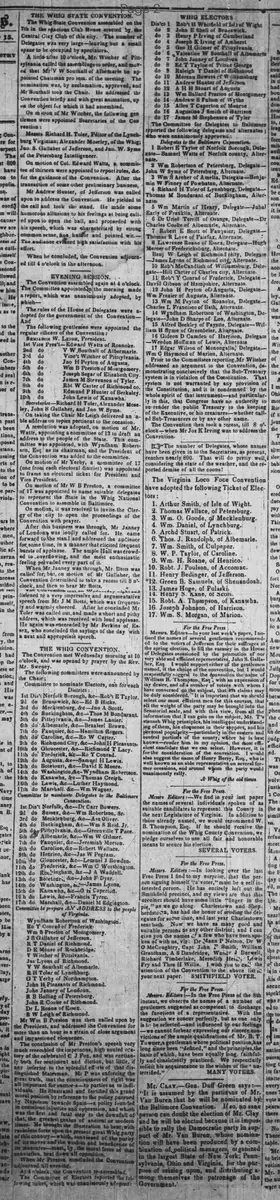
The Whig State Convention assembled on the 7th in the spacious Club House erected by the Central Clay Club of this city. The number of Delegates was very large—leaving but a small space to be occupied by spectators.
A little after 10 o'clock, Mr. Witcher of Pittsylvania called the assemblage to order, and moved that Mr. W. Southall of Albemarle be appointed Chairman pro tem. of the meeting. The nomination was, by acclamation, approved, and Mr. Southall took the Chair. He addressed the Convention briefly and with great animation, upon the object for which it had assembled.
On motion of Mr. Witcher, the following gentlemen were appointed Secretaries of the Convention:
Messrs. Richard H. Toler, Editor of the Lynchburg Virginian; Alexander Moseley, of the Whig; Jno. S. Gallaher of Jefferson, and Jno. W. Syme of the Petersburg Intelligencer.
On motion of Col. Edward Watts, a committee of thirteen were appointed to report rules, &c. for the guidance of the Convention. After the transaction of some other preliminary business, Mr. Andrew Hunter, of Jefferson was called upon to address the Convention. He yielded to the call and took the stand. He made some humorous allusions to his feelings at being called upon to open the ball, and proceeded with his speech, which was characterized by strong common sense, fine humor and pointed wit.—The audience evinced high satisfaction with his effort.
When he concluded, the Convention adjourned till 4 o'clock in the afternoon.
EVENING SESSION.
The Convention assembled again at 4 o'clock. The Committee appointed in the morning made a report, which was unanimously adopted, by which—
The rules of the House of Delegates were adopted for the government of the Convention—
And
The following gentlemen were appointed the regular officers of the Convention:
Benjamin W. Leigh, President.
1st Vice Pres't—Edward Watts of Roanoke.
2d do—W. W. Southall of Albemarle.
3d do—Vincent Witcher of Pittsylvania.
4th do—Jno. H. Peyton of Augusta.
5th do—Wm. B. Preston of Montgomery.
6th do—Joseph Segar of Elizabeth City.
7th do—James M. Stevenson of Tyler.
8th do—Rbt. W. Carter of Richmond co.
9th do—Edmund P. Hunter of Berkeley.
10th do—John Lewis of Kanawha.
Secretaries—Richard H. Toler, Alexander Moseley, John S. Gallaher, and Jno. W. Syme.
On taking the Chair Mr. Leigh delivered an able address on topics pertinent to the occasion.
A resolution was adopted, on motion of Mr. Watts, appointing a committee of 13 to draft an address to the people of the State. This committee was appointed, with Wyndham Robertson, Esq. as its chairman, and the President of the Convention was added to the committee.
On motion of Mr. Yerby, a committee of 17 (one from each electoral district) was appointed to name an electoral ticket for President and Vice President.
On motion of Mr. W. B. Preston, a committee of 17 was appointed to name suitable delegates to represent the State in the Whig National Convention to assemble in Baltimore.
On motion, it was resolved to invite the Clergy of the city to open the proceedings of the Convention with prayer.
After this business was through, Mr. Janney of Loudoun was loudly called for. He came forward to the stand and addressed the audience for some time, in a manner that elicited frequent bursts of applause. The ample Hall was crowded to overflowing, and the most enthusiastic feeling pervaded every part of it.
When Mr. Janney was through, Mr. Botts was called for; but, on motion of Mr. Gallaher, the Convention determined to take a recess till 8 o'clock, and then to hear Mr. Botts.
[Evening session continuation]
The audience listened to a very impressive and argumentative speech from Mr. J. M. Botts, which was frequently and warmly cheered. After he concluded Mr. Toler was called out, and made a short and pithy address, which was received with loud applause. He again was succeeded by Mr. Perkins of Essex, who concluded the sayings of the day with a neat and appropriate speech.
THE WHIG CONVENTION.
The Convention met Wednesday morning at 10 o'clock, and was opened by prayer by the Rev. Mr. Sweeney.
The following committees were announced by the Chair:
Committee to nominate Electors, one for each District:
1st Dist. Norfolk Borough, &c.—Robt. E. Taylor,
2d do. Brunswick, &c.—Ed. B. Hicks.
3rd do. Mecklenburg, &c.—Jno. A. Scott,
4th do. Buckingham, &c.—Thos. M. Bondurant
5th do. Pittsylvania, do.—James Lanier
6th do. Albemarle, dc.—Bezaiel Brown
7th do. Fauquier, &c.—Hamilton Rogers.
8th do. Caroline, dc.—Robt. W. Carter.
9th do. Richmond City, dc. John H. Pleasants
10th do. Gloucester, dc.—Richmond T. Lacy,
11th do. Frederick, &c.—Robt. Y. Conrad.
12th do. Augusta, &c.—Samuel H. Lewis:
13th do. Botetourt, &c.—David E. Moore.
14th do. Washington, &c.—Wyndham Robertson.
15th do. Kanawha, &c.—Thomas Creigh
16th do. Lewis, &c.—Luther Haymond.
17th do. Marshall, &c.—Wm. Wagner,
Committee to nominate Delegates to the Baltimore Convention:
1st Dist. Norfolk, &c.—Dr. Carr Bowers.
2d do. Sussex, &c.—Wm. Robertson, Sr.
3rd do. Mecklenburg, &c.—Asa Oliver.
4th do. Buckingham, &c.—Wm. S. Reid, Jr.
5th do. Pittsylvania, &c.—Greenville T. Pace.
6th do. Albemarle, &c.—Wm. W. Gilmer.
7th do. Fauquier, &c.—Jeremiah Morton.
8th do. Caroline, &c.—Robert Wallace.
9th do. Henrico, &c.—Jas. W. Pegram.
10th do. Gloucester, &c.—Lemuel J. Bowden.
11th do. Frederick, &c.—Wm. C. Worthington.
12th do. Rockingham, &c.—J. A. Waddell.
13th do. Botetourt, &c.—John F. Dyer.
14th do. Washington, &c.—James Lyons,
15th do. Kanawha, &c.—O. H. Caperton.
16th do. Lewis, &c.—Francis Tyree.
17th do. Marshall, &c.—Daniel M. Edgington.
Committee to prepare an ADDRESS to the people of Virginia.
Wyndham Robertson of Washington.
Robt. Y. Conrad of Frederick.
Wm. B. Preston of Montgomery.
J. S. Gallaher of Jefferson.
R. T. Daniel of Richmond.
D. E. Moore of Rockbridge.
V. Witcher of Pittsylvania.
Jas. Lyons of Richmond.
W. W. Southall of Albemarle.
R. H. Toler of Lynchburg.
G. T. Yerby of Northampton.
John H. Pleasants of Richmond.
John Janney of Loudoun.
R. B. Bolling of Petersburg.
John R. Cooke of Richmond.
Dr. L. Roane of Essex.
B. W. Leigh of Richmond.
Mr. Wm. B. Preston was then called upon by the President, and addressed the Convention for more than an hour in a strain of close argument and impassioned eloquence.
The conclusion of Mr. Preston's speech very much resembled the impetuous, high souled oratory of the celebrated C. J. Fox, and was certainly both for sentiment and diction, but little, if any inferior to the splendid efforts of that distinguished Statesman. Mr. P. was enforcing the great truth, that the consciousness of right was all important for success—to parties as to individuals. He illustrated and fortified this grand moral position by reference to the policy pursued by Napoleon towards Spain—a policy founded in conscious injustice and oppression, and which was the first and fatal step to the downfall of that, the greatest genius of ancient or modern times. He brought the illustration to bear with resistless force upon the present great Whig party of this country—which, convinced of the purity of its motives and the wisdom and beneficence of its measures—must, by the moral force of that conviction, beat down all opposition.
When Mr. Preston concluded the Convention adjourned till evening.
At 4 o'clock, the Convention re-assembled. The Committee of Electors reported the following ticket, which was unanimously adopted:
[Electoral ticket and delegates]
The Committee for Delegates to Baltimore reported the following delegates and alternates; who were unanimously approved:
Delegates to the Baltimore Convention.
1. Robert E. Taylor of Norfolk Borough, Delegate—Samuel Watts of Norfolk county; Alternate.
2. Wm. Robertson of Petersburg, Delegate—John W. Syme of Petersburg, Alternate.
3. Wm. S. Archer of Amelia, Delegate—Benjamin W. Finney of Powhatan, Alternate.
4. Richard H. Toler of Lynchburg, Delegate—Thomas M. Bondurant of Buckingham, Alternate.
5. Wm. Martin of Henry, Delegate—Jubal Early of Franklin, Alternate.
6. Dr. Uriel Terrill of Orange, Delegate—Dr. Charles Cooke of Albemarle, Alternate.
7. Robert E. Scott of Fauquier; Delegate—Thomas R. Love of Fairfax, Alternate.
8. Lawrence Roane of Essex, Delegate—Hugh Mercer of Fredericksburg, Alternate.
Benj. W. Leigh of Richmond city, Delegate—James Lyons of Richmond city Alternate.
10. Robt. McCandlish of Williamsburg. Delegate—Hill Carter of Charles city, Alternate.
11. Robt. Y. Conrad of Frederick, Delegate—David Gibson of Hampshire, Alternate.
12. John H. Peyton of Augusta, Delegate—Wm. Frazier of Augusta, Alternate.
13. Wm. M. Peyton of Roanoke, Delegate—Charles L. Francisco of Bath, Alternate.
14. Wyndham Robertson of Washington, Delegate—John D. Sharpe of Lee, Alternate.
15. Alfred Beckley of Fayette, Delegate—William H. Syme of Greenbrier, Alternate.
16. Gideon D. Camden of Harrison, Delegate—Weedon Hoffman of Lewis, Alternate.
17. Edgar Wilson of Monongalia, Delegate—Wm. C. Haymond of Marion, Alternate.
Prior to the Committees reporting, Mr. Witcher addressed an argument to the Convention, demonstrating conclusively that the Sub-Treasury system is in violation of the Constitution. That system is not warranted by any provision of the Constitution, and it is condemned by the whole spirit of that instrument—and particularly in this, that Congress have no authority to surrender the public Treasury to the keeping of the Executive, or his creatures—whether called Sub-Treasurers or by any other name.
The Convention then took a recess, till 8 o'clock—when Mr. Jos. K. Irving was to address the Convention.
The number of Delegates, whose names have been given in to the Secretaries, as present, reaches nearly 500. That will do pretty well, considering the state of the weather, and the reported demise of all the coons!
The Virginia Loco Foco Convention have adopted the following Ticket of Electors:
1. Arthur Smith, of Isle of Wight.
2. Thomas Wallace, of Petersburg.
3. Wm. O. Goode, of Mecklenburg.
4. Wm. Daniel, of Lynchburg.
5. Archd. Stuart, of Patrick.
6. Thos. J. Randolph, of Albemarle.
7. Wm. Smith, of Culpeper.
8. W. P. Taylor, of Caroline.
9. Wm. H. Roane, of Henrico.
10. Robt. J. Poulson, of Accomac.
11. Henry Bedinger, of Jefferson.
12. Green B. Samuels, of Shenandoah.
13. James Hoge, of Pulaski.
14. Henry S. Kane, of Scott.
15. Robt. A. Thompson, of Kanawha.
16. Joseph Johnson, of Harrison.
17. Wm. S. Morgan, of Marion.
What sub-type of article is it?
What themes does it cover?
What keywords are associated?
What entities or persons were involved?
Where did it happen?
Story Details
Key Persons
Location
Richmond, Virginia
Event Date
Assembled On The 7th
Story Details
The Whig State Convention organized with officers appointed, committees formed to draft addresses and nominate electors and delegates to the Baltimore National Convention, and featured speeches emphasizing constitutional principles and party moral strength; the electoral ticket and delegates were unanimously adopted.