Thank you for visiting SNEWPapers!
Sign up free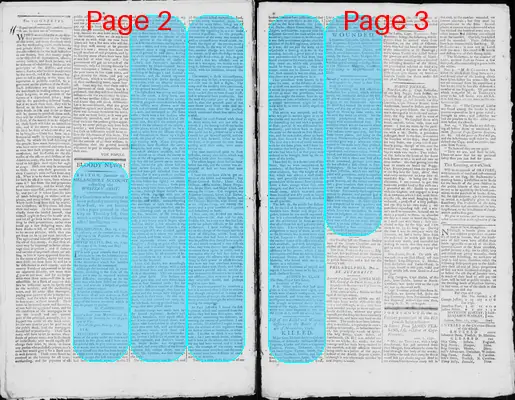
The New Hampshire Gazette And General Advertiser
Portsmouth, Rockingham County, New Hampshire
What is this article about?
Official report of Major-General Arthur St. Clair's army's defeat by Native American forces on November 4, 1791, near the Miami villages in the Northwest Territory. The surprise attack led to heavy casualties, abandonment of artillery, and retreat to Fort Washington, with about half the force lost.
Merged-components note: This is a continuation of the narrative story about the defeat of General St. Clair's army, spanning across pages with sequential reading order.
Clippings
1 of 2
OCR Quality
Full Text
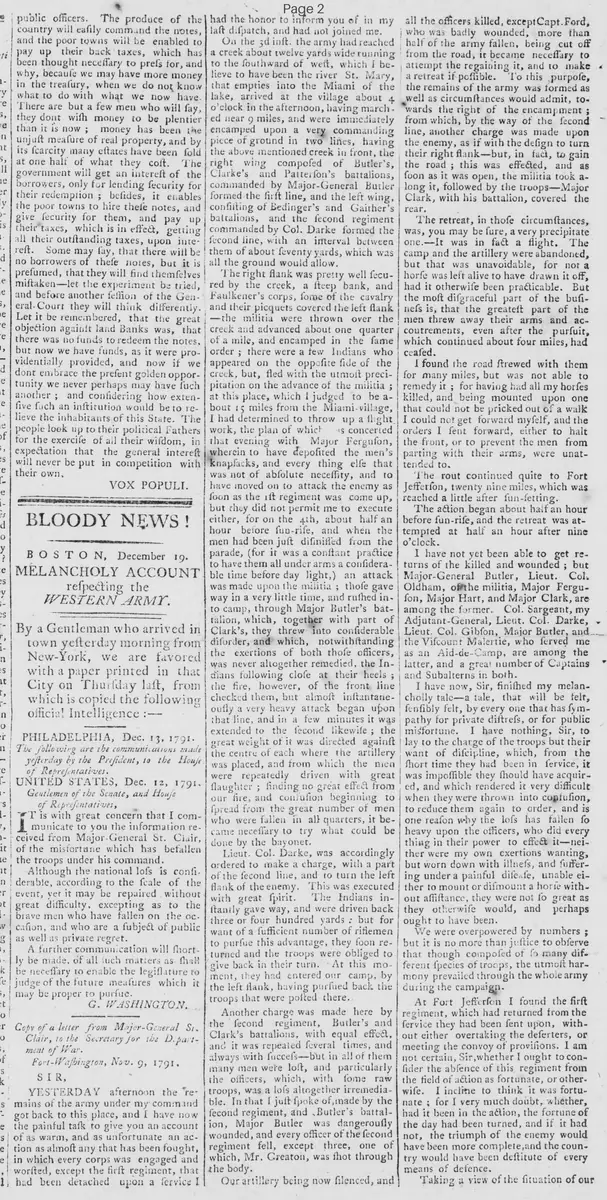
BOSTON, December 19.
MELANCHOLY ACCOUNT respecting the WESTERN ARMY.
By a Gentleman who arrived in town yesterday morning from New-York, we are favored with a paper printed in that City on Thursday last, from which is copied the following official Intelligence:--
PHILADELPHIA, Dec. 13, 1791.
The following are the communications made yesterday by the President, to the House of Representatives.
UNITED STATES, Dec. 12, 1791.
Gentlemen of the Senate, and House of Representatives,
It is with great concern that I communicate to you the information received from Major-General St. Clair, of the misfortune which has befallen the troops under his command.
Although the national loss is considerable, according to the scale of the event, yet it may be repaired without great difficulty, excepting as to the brave men who have fallen on the occasion, and who are a subject of public as well as private regret.
A further communication will shortly be made, of all such matters as shall be necessary to enable the legislature to judge of the future measures which it may be proper to pursue.
G. WASHINGTON.
Copy of a letter from Major-General St. Clair, to the Secretary for the Department of War.
Fort-Washington, Nov. 9, 1791.
SIR,
YESTERDAY afternoon the remains of the army under my command got back to this place, and I have now the painful task to give you an account of as warm, and as unfortunate an action as almost any that has been fought, in which every corps was engaged and worsted, except the first regiment, that had been detached upon a service I had the honor to inform you of in my last dispatch, and had not joined me.
On the 2d inst. the army had reached a creek about twelve yards wide running to the southward of west, which I believe to have been the river St. Mary, that empties into the Miami of the lake, arrived at the village about 4 o'clock in the afternoon, having marched near 9 miles, and were immediately encamped upon a very commanding piece of ground in two lines, having the above mentioned creek in front, the right wing composed of Butler's, Clarke's and Patterson's battalions, commanded by Major-General Butler formed the first line, and the left wing, consisting of Bedinger's and Gaither's battalions, and the second regiment commanded by Col. Darke formed the second line, with an interval between them of about seventy yards, which was all the ground would allow.
The right flank was pretty well secured by the creek, a steep bank, and Faulkener's corps, some of the cavalry and their picquets covered the left flank--the militia were thrown over the creek and advanced about one quarter of a mile, and encamped in the same order; there were a few Indians who appeared on the opposite side of the creek, but, fled with the utmost precipitation on the advance of the militia; at this place, which I judged to be about 15 miles from the Miami-village, I had determined to throw up a slight work, the plan of which was concerted that evening with Major Ferguson, wherein to have deposited the men's knapsacks, and every thing else that was not of absolute necessity, and to have moved on to attack the enemy as soon as the 1st regiment was come up, but they did not permit me to execute either, for on the 4th, about half an hour before sun-rise, and when the men had been just dismissed from the parade, (for it was a constant practice to have them all under arms a considerable time before day light.) an attack was made upon the militia; those gave way in a very little time, and rushed into camp, through Major Butler's battalion, which, together with part of Clark's, they threw into considerable disorder, and which, notwithstanding the exertions of both those officers, was never altogether remedied, the Indians following close at their heels: the fire, however, of the front line checked them, but almost instantaneously a very heavy attack began upon that line, and in a few minutes it was extended to the second likewise; the great weight of it was directed against the centre of each where the artillery was placed, and from which the men were repeatedly driven with great slaughter; finding no great effect from our fire, and confusion beginning to spread from the great number of men who were fallen in all quarters, it became necessary to try what could be done by the bayonet.
Lieut. Col. Darke, was accordingly ordered to make a charge, with a part of the second line, and to turn the left flank of the enemy. This was executed with great spirit. The Indians instantly gave way, and were driven back three or four hundred yards: but for want of a sufficient number of riflemen to pursue this advantage, they soon returned and the troops were obliged to give back in their turn. At this moment, they had entered our camp, by the left flank, having pursued back the troops that were posted there.
Another charge was made here by the second regiment, Butler's and Clark's battalions, with equal effect, and it was repeated several times, and always with success--but in all of them many men were lost, and particularly the officers, which, with some raw troops, was a loss altogether irremediable. In that I just spoke of, made by the second regiment, and Butler's battalion, Major Butler was dangerously wounded, and every officer of the second regiment fell, except three, one of which, Mr. Creaton, was shot through the body.
Our artillery being now silenced, and all the officers killed, except Capt. Ford, who was badly wounded, more than half of the army fallen, being cut off from the road, it became necessary to attempt the regaining it, and to make a retreat if possible. To this purpose, the remains of the army was formed as well as circumstances would admit, towards the right of the encampment; from which, by the way of the second line, another charge was made upon the enemy, as if with the design to turn their right flank--but, in fact, to gain the road; this was effected, and as soon as it was open, the militia took along it, followed by the troops--Major Clark, with his battalion, covered the rear.
The retreat, in those circumstances, was, you may be sure, a very precipitate one.--It was in fact a flight. The camp and the artillery were abandoned, but that was unavoidable, for not a horse was left alive to have drawn it off. had it otherwise been practicable. But the most disgraceful part of the business is, that the greatest part of the men threw away their arms and accoutrements, even after the pursuit, which continued about four miles, had ceased.
I found the road trewed with them for many miles, but was not able to remedy it; for having had all my horses killed, and being mounted upon one that could not be pricked out of a walk I could not get forward myself, and the orders I sent forward, either to halt the front, or to prevent the men from parting with their arms, were unattended to.
The rout continued quite to Fort Jefferson, twenty nine miles, which was reached a little after sun-setting. The action began about half an hour before sun-rise, and the retreat was attempted at half an hour after nine o'clock.
I have not yet been able to get returns of the killed and wounded: but Major-General Butler, Lieut. Col. Oldham, of the militia, Major Ferguson, Major Hart, and Major Clark, are among the former. Col. Sargeant, my Adjutant-General, Lieut. Col. Darke, Lieut. Col. Gibson, Major Butler. and the Viscount Malartie, who served me as an Aid-de-Camp, are among the latter, and a great number of Captains and Subalterns in both.
I have now, Sir, finished my melancholy tale--a tale, that will be felt, sensibly felt, by every one that has sympathy for private distress, or for public misfortune. I have nothing, Sir, to lay to the charge of the troops but their want of discipline, which, from the short time they had been in service, it was impossible they should have acquired, and which rendered it very difficult when they were thrown into confusion, to reduce them again to order, and is one reason why the loss has fallen so heavy upon the officers, who did every thing in their power to effect it--neither were my own exertions wanting, but worn down with illness, and suffering under a painful disease, unable either to mount or dismount a horse without assistance, they were not so great as they otherwise would, and perhaps ought to have been.
We were overpowered by numbers; but it is no more than justice to observe that though composed of so many different species of troops, the utmost harmony prevailed through the whole army during the campaign.
At Fort Jefferson I found the first regiment, which had returned from the service they had been sent upon, without either overtaking the deserters, or meeting the convoy of provisions. I am not certain, Sir, whether I ought to consider the absence of this regiment from the field of action as fortunate, or otherwise. I incline to think it was fortunate; for I very much doubt, whether, had it been in the action, the fortune of the day had been turned, and if it had not, the triumph of the enemy would have been more complete, and the country would have been destitute of every means of defence.
Taking a view of the situation of our
broken troops at Fort Jefferson, and that there were no provisions in the Fort, I called on the field officers, viz. Lieut. Col. Darke, Major Hamtramck, Major Zeigler, and Gaither, together with the Adjutant-General, for their advice what would be proper further to be done; and it was their unanimous opinion, that the addition of the first regiment, unbroken as it was, did not put the army on so respectable a footing as it was in the morning, because a great part of it was now unarmed—that it had been then found unequal to the enemy, and, should they come on, which was probable, would be found so again; that the troops could not be thrown into the fort, both because it was too small, and that there was no provisions in it. That provisions were known to be upon the road, at the distance of one, or at most two marches—that therefore it would be proper to move without loss of time to meet the provisions, when the men might the sooner have an opportunity of some refreshment, and that a proper detachment might be sent back with it, to have it safely deposited in the fort.
This advice was accepted, and the army was put in motion again at 10 o'clock, and marched all night, and the succeeding day met with a quantity of flour, part of it was distributed immediately, part taken back to supply the army on the march to Fort Hamilton, and the remainder, about 50 horse loads, sent forward to Fort Jefferson. The next day a drove of cattle was met with for the same place, and I have information that both got in. The wounded who had been left at that place were ordered to be brought here by the return of the horses.
I have said, sir, in a former part of this letter, that we were overpowered by numbers; of that however, I have no other evidence, but the weight of the fire, which was always a most deadly one, and generally delivered from the ground, few of the enemy showing themselves afoot, except when they were charged, and that in a few minutes our whole camp, which extended above three hundred and fifty yards in length was entirely surrounded and attacked on all quarters.
The loss, sir, the public has sustained, by the fall of so many officers, particularly Gen. Butler and Major Ferguson, cannot be too much regretted; but it is a circumstance that will alleviate the misfortune in some measure, that all of them fell most gallantly doing their duty. I have had very particular obligations to many of them, as well as to the survivors, but to none more than to Col. Sargeant: He has discharged the various duties of his office with zeal, with exactness, and with intelligence; and, on all occasions afforded me every assistance in his power, which I have also experienced from my Aid-de-Camps Lieutenant Denny, and the Viscount Malartie, who served with me in the station as a volunteer.
With every sentiment of respect and regard, I have the honor to be Sir, your most obedient servant,
ARTHUR ST. CLAIR.
The Hon. Major Gen Knox,
Secretary of War.
P. S. Some orders that had been given to Col. Oldham over night, and which were of much consequence, were not executed, and some very material intelligence was communicated by Captain Slough to General Butler in the course of the night, before the action, which was never imparted to me, nor did I hear of it, until my arrival here.
List of the Killed and Wounded Officers in the Battle of the 4th of November, 1791.
KILLED.
Major Gen. Richard Butler—Colonel Oldham, of Kentucky militia.—Majors Ferguson, Clarke and Hart.—Captains Bradford, Phelon, Kirkwood, Price, Van Swearingen, Tipton, Smith, Purdy, Pratt, Guthrie, Cribbs, and Newman.—Lieutenants, Spear, Warren, Boyd, M'Math, Burgess, Kelso, Read, Little, Hooper and Lickins.—Ensigns Cobb, Baich, Chace, Turner, Wilson, Brooks, Beatty and Purdy.—Quartermasters, Reynolds and Ward.—Adjutant Anderson.—Doctor Grafton.
WOUNDED.
Lieutenant-Colonels, Gibson, Darke and Sargeant, Adjutant-General.—Major Butler.—Captains, Doyle, Trueman, Ford, Buchanan, Darke, and Slough.—Lieutenants, Greaton, Davidson, De Butts, Price, Morgan, Macrea, Lysle, and Thompson.—Adjutants Whitler and Crawford.—Ensign Bines.—The Viscount Malartie, volunteer, aid-de-Camp to Major-General St. Clair.
Extract of a letter written by a Gentleman in Congress to his friend in New-Pork, dated the 11th inst.
"This evening the first official information has arrived, which without giving the particular detail of the killed and wounded, leaves the gross loss as great as was represented. General St. Clair had formed his army in two lines, and the day of the battle was designed to throw up some works, and the next day make an attack. But the enemy precipitated this event and fought with unaccustomed fury. The principal attack was on the centre of our army where the artillery was planted. The Indians never appeared, but fired from covert places, and lying on the ground. Whenever charged with the bayonet they gave way; when our troops retired to the main body they pursued. The artillery was not taken, as at first represented, and then re-taken. It was silenced, and abandoned in the retreat. St. Clair's loss is about one half of his whole command, perhaps 1000 men. He has effected a safe retreat to Fort Washington. He has left the wounded at Fort Jefferson, which was well supplied with provisions, and it is expected is very safe. The troops behaved with great bravery, till the retreat commenced; great numbers then threw away their arms and abandoned themselves to despair. Fortunately the savages were allured by plunder, and pursued but a short distance, or the destruction would have been complete. St. Clair says he was overpowered in every quarter, and yet from the manner in which the whole scene was conducted, he could form no judgment of the numbers of his enemy. It does not appear that they ever rushed on our army, but preserved a certain distance, from which they effected a sure execution. The above are such particulars as have been communicated by Gen. Knox."
What sub-type of article is it?
What themes does it cover?
What keywords are associated?
What entities or persons were involved?
Where did it happen?
Story Details
Key Persons
Location
Near The Miami Villages, On A Creek Believed To Be The St. Mary, About 15 Miles From The Miami Village, Northwest Territory
Event Date
November 4, 1791
Story Details
St. Clair's army encamped near the Miami villages was surprised at dawn by a large Native American force. The militia routed, causing disorder; repeated bayonet charges drove back attackers but at heavy cost. Overwhelmed, the army abandoned artillery and fled to Fort Jefferson, losing about half its men including many officers.