Thank you for visiting SNEWPapers!
Sign up free
Literary
November 14, 1932
The Daily Alaska Empire
Juneau, Juneau County, Alaska
What is this article about?
Biographical essay on Sir Henry Fielding Dickens, son of Charles Dickens, retiring at 83 as Common Sergeant at Old Bailey. Highlights his hereditary leniency, father's advocacy for common rights, and social progress in England, with a humorous nod to Pickwick Papers.
Clipping
OCR Quality
98%
Excellent
Full Text
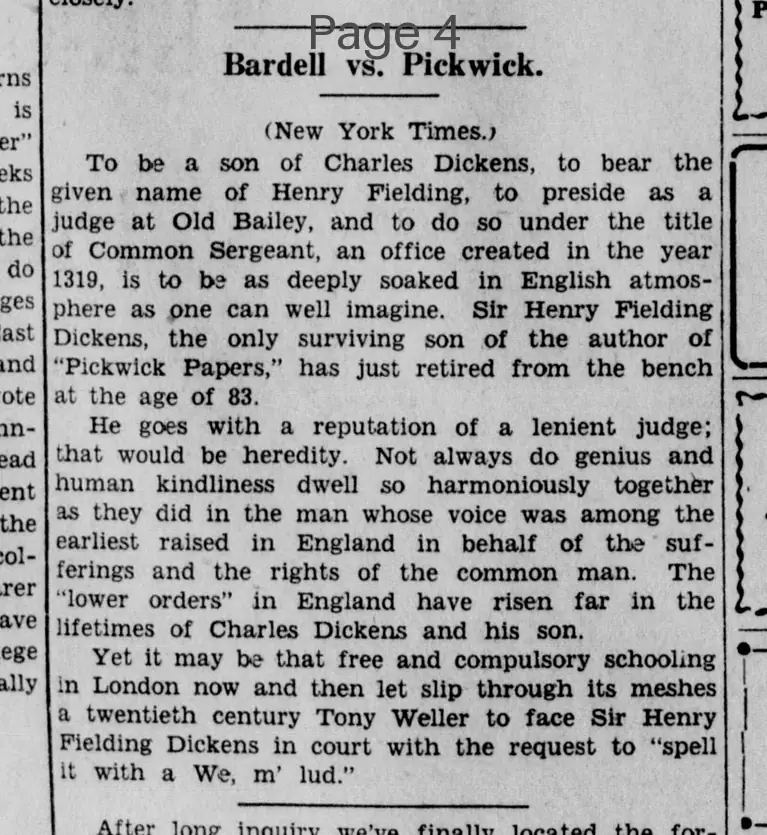
Bardell vs. Pickwick.
(New York Times.)
To be a son of Charles Dickens, to bear the given name of Henry Fielding, to preside as a judge at Old Bailey, and to do so under the title of Common Sergeant, an office created in the year 1299, is to be as deeply soaked in English atmosphere as one can well imagine. Sir Henry Fielding Dickens, the only surviving son of the author of "Pickwick Papers," has just retired from the bench at the age of 83.
He goes with a reputation of a lenient judge; that would be hereditary. Not always do genius and human kindliness dwell so harmoniously together as they did in the man whose voice was among the earliest raised in England in behalf of the sufferings and the rights of the common man. The "lower orders" in England have risen far in the lifetimes of Charles Dickens and his son.
Yet it may be that free and compulsory schooling in London now and then let slip through its meshes a twentieth century Tony Weller to face Sir Henry Fielding Dickens in court with the request to "spell it with a W, m' lud."
(New York Times.)
To be a son of Charles Dickens, to bear the given name of Henry Fielding, to preside as a judge at Old Bailey, and to do so under the title of Common Sergeant, an office created in the year 1299, is to be as deeply soaked in English atmosphere as one can well imagine. Sir Henry Fielding Dickens, the only surviving son of the author of "Pickwick Papers," has just retired from the bench at the age of 83.
He goes with a reputation of a lenient judge; that would be hereditary. Not always do genius and human kindliness dwell so harmoniously together as they did in the man whose voice was among the earliest raised in England in behalf of the sufferings and the rights of the common man. The "lower orders" in England have risen far in the lifetimes of Charles Dickens and his son.
Yet it may be that free and compulsory schooling in London now and then let slip through its meshes a twentieth century Tony Weller to face Sir Henry Fielding Dickens in court with the request to "spell it with a W, m' lud."
What sub-type of article is it?
Essay
What themes does it cover?
Social Manners
Moral Virtue
What keywords are associated?
Dickens
Pickwick
Judge
Retirement
Old Bailey
Common Sergeant
Lenient Judge
Lower Orders
What entities or persons were involved?
(New York Times.)
Literary Details
Title
Bardell Vs. Pickwick.
Author
(New York Times.)
Subject
Retirement Of Sir Henry Fielding Dickens
Key Lines
To Be A Son Of Charles Dickens, To Bear The Given Name Of Henry Fielding, To Preside As A Judge At Old Bailey, And To Do So Under The Title Of Common Sergeant, An Office Created In The Year 1299, Is To Be As Deeply Soaked In English Atmosphere As One Can Well Imagine.
He Goes With A Reputation Of A Lenient Judge; That Would Be Hereditary.
The "Lower Orders" In England Have Risen Far In The Lifetimes Of Charles Dickens And His Son.