Thank you for visiting SNEWPapers!
Sign up free
Editorial
July 25, 1806
Norfolk Gazette And Publick Ledger
Norfolk, Virginia
What is this article about?
An editorial critiques Democratic editors and the Madison administration for claiming a $2 million payment to France is for purchasing Florida from Spain, arguing it is instead a bribe to France to facilitate the deal, referencing secret congressional appropriations and past territorial purchases like Louisiana.
Clipping
OCR Quality
95%
Excellent
Full Text
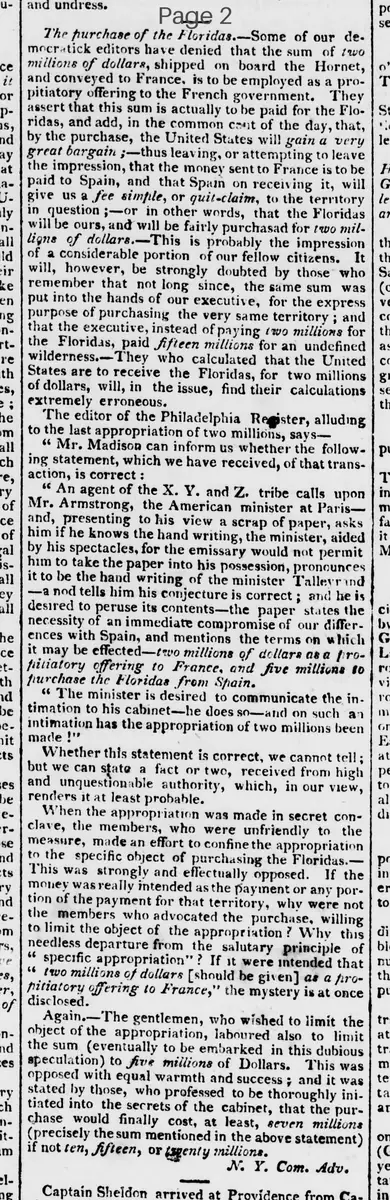
The purchase of the Floridas.—Some of our democratick editors have denied that the sum of two millions of dollars, shipped on board the Hornet, and conveyed to France, is to be employed as a propitiatory offering to the French government. They assert that this sum is actually to be paid for the Floridas, and add, in the common cant of the day, that, by the purchase, the United States will gain a very great bargain;—thus leaving, or attempting to leave the impression, that the money sent to France is to be paid to Spain, and that Spain on receiving it, will give us a fee simple, or quit-claim, to the territory in question;—or in other words, that the Floridas will be ours, and will be fairly purchased for two millions of dollars.—This is probably the impression of a considerable portion of our fellow citizens. It will, however, be strongly doubted by those who remember that not long since, the same sum was put into the hands of our executive, for the express purpose of purchasing the very same territory; and that the executive, instead of paying two millions for the Floridas, paid fifteen millions for an undefined wilderness.—They who calculated that the United States are to receive the Floridas, for two millions of dollars, will, in the issue, find their calculations extremely erroneous.
The editor of the Philadelphia Register, alluding to the last appropriation of two millions, says—
"Mr. Madison can inform us whether the following statement, which we have received, of that transaction, is correct:
"An agent of the X. Y. and Z. tribe calls upon Mr. Armstrong, the American minister at Paris—and, presenting to his view a scrap of paper, asks him if he knows the hand writing, the minister, aided by his spectacles, for the emissary would not permit him to take the paper into his possession, pronounces it to be the hand writing of the minister Talleyrand—and a nod tells him his conjecture is correct; and he is desired to peruse its contents—the paper states the necessity of an immediate compromise of our differences with Spain, and mentions the terms on which it may be effected—two millions of dollars as a propitiatory offering to France, and five millions to purchase the Floridas from Spain.
"The minister is desired to communicate the intimation to his cabinet—he does so—and on such an intimation has the appropriation of two millions been made!"
Whether this statement is correct, we cannot tell; but we can state a fact or two, received from high and unquestionable authority, which, in our view, renders it at least probable.
When the appropriation was made in secret conclave, the members, who were unfriendly to the measure, made an effort to confine the appropriation to the specific object of purchasing the Floridas.—This was strongly and effectually opposed. If the money was really intended as the payment or any portion of the payment for that territory, why were not the members who advocated the purchase, willing to limit the object of the appropriation? Why this needless departure from the salutary principle of "specific appropriation"? If it were intended that "two millions of dollars [should be given] as a propitiatory offering to France," the mystery is at once disclosed.
Again.—The gentlemen, who wished to limit the object of the appropriation, laboured also to limit the sum (eventually to be embarked in this dubious speculation) to five millions of Dollars. This was opposed with equal warmth and success; and it was stated by those, who professed to be thoroughly initiated into the secrets of the cabinet, that the purchase would finally cost, at least, seven millions (precisely the sum mentioned in the above statement) if not ten, fifteen, or twenty millions.
N. Y. Com. Adv.
The editor of the Philadelphia Register, alluding to the last appropriation of two millions, says—
"Mr. Madison can inform us whether the following statement, which we have received, of that transaction, is correct:
"An agent of the X. Y. and Z. tribe calls upon Mr. Armstrong, the American minister at Paris—and, presenting to his view a scrap of paper, asks him if he knows the hand writing, the minister, aided by his spectacles, for the emissary would not permit him to take the paper into his possession, pronounces it to be the hand writing of the minister Talleyrand—and a nod tells him his conjecture is correct; and he is desired to peruse its contents—the paper states the necessity of an immediate compromise of our differences with Spain, and mentions the terms on which it may be effected—two millions of dollars as a propitiatory offering to France, and five millions to purchase the Floridas from Spain.
"The minister is desired to communicate the intimation to his cabinet—he does so—and on such an intimation has the appropriation of two millions been made!"
Whether this statement is correct, we cannot tell; but we can state a fact or two, received from high and unquestionable authority, which, in our view, renders it at least probable.
When the appropriation was made in secret conclave, the members, who were unfriendly to the measure, made an effort to confine the appropriation to the specific object of purchasing the Floridas.—This was strongly and effectually opposed. If the money was really intended as the payment or any portion of the payment for that territory, why were not the members who advocated the purchase, willing to limit the object of the appropriation? Why this needless departure from the salutary principle of "specific appropriation"? If it were intended that "two millions of dollars [should be given] as a propitiatory offering to France," the mystery is at once disclosed.
Again.—The gentlemen, who wished to limit the object of the appropriation, laboured also to limit the sum (eventually to be embarked in this dubious speculation) to five millions of Dollars. This was opposed with equal warmth and success; and it was stated by those, who professed to be thoroughly initiated into the secrets of the cabinet, that the purchase would finally cost, at least, seven millions (precisely the sum mentioned in the above statement) if not ten, fifteen, or twenty millions.
N. Y. Com. Adv.
What sub-type of article is it?
Foreign Affairs
Partisan Politics
What keywords are associated?
Florida Purchase
France Bribe
Secret Appropriation
Madison Administration
Talleyrand
Congressional Debate
What entities or persons were involved?
Mr. Madison
French Government
Spain
Mr. Armstrong
Talleyrand
Democratick Editors
Executive
Editorial Details
Primary Topic
Critique Of Secret Appropriation For Florida Purchase Involving France
Stance / Tone
Critical And Suspicious Of Administration Motives
Key Figures
Mr. Madison
French Government
Spain
Mr. Armstrong
Talleyrand
Democratick Editors
Executive
Key Arguments
The $2m Sent To France Is A Propitiatory Offering, Not Payment To Spain For Florida.
Past Executive Used Similar Funds To Buy Louisiana For $15m Instead Of Florida.
Congressional Opposition To Limiting Appropriation To Florida Purchase Suggests Hidden Purposes.
Estimates Suggest Total Cost Could Reach $7m Or More, Including Bribe To France.
Democratic Editors Mislead Public By Claiming It's A Bargain Purchase From Spain.