Thank you for visiting SNEWPapers!
Sign up free
Editorial
March 8, 1842
The Caledonian
Saint Johnsbury, Caledonia County, Vermont
What is this article about?
Editorial from Springfield Gazette criticizes free trade and low tariffs for causing wage reductions in New England cotton mills, such as at Three Rivers, arguing it forces American workers to compete with cheap European labor, benefiting locofoco advocates at laborers' expense.
Clipping
OCR Quality
95%
Excellent
Full Text
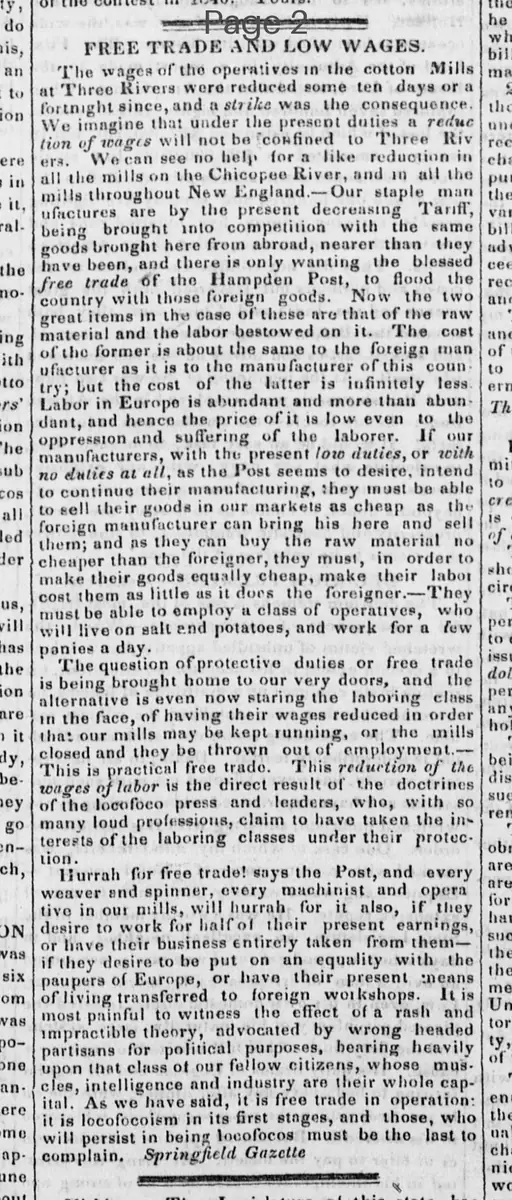
FREE TRADE AND LOW WAGES.
The wages of the operatives in the cotton Mills at Three Rivers were reduced some ten days or a fortnight since, and a strike was the consequence. We imagine that under the present duties a reduction of wages will not be confined to Three Rivers. We can see no help for a like reduction in all the mills on the Chicopee River, and in all the mills throughout New England.—Our staple manufactures are by the present decreasing Tariff, being brought into competition with the same goods brought here from abroad, nearer than they have been, and there is only wanting the blessed free trade of the Hampden Post, to flood the country with those foreign goods. Now the two great items in the case of these are that of the raw material and the labor bestowed on it. The cost of the former is about the same to the foreign manufacturer as it is to the manufacturer of this country; but the cost of the latter is infinitely less. Labor in Europe is abundant and more than abundant, and hence the price of it is low even to the oppression and suffering of the laborer. If our manufacturers, with the present low duties, or with no duties at all, as the Post seems to desire, intend to continue their manufacturing, they must be able to sell their goods in our markets as cheap as the foreign manufacturer can bring his here and sell them; and as they can buy the raw material no cheaper than the foreigner, they must, in order to make their goods equally cheap, make their labor cost them as little as it does the foreigner.—They must be able to employ a class of operatives, who will live on salt and potatoes, and work for a few pennies a day.
The question of protective duties or free trade is being brought home to our very doors, and the alternative is even now staring the laboring class in the face, of having their wages reduced in order that our mills may be kept running, or the mills closed and they be thrown out of employment.—
This is practical free trade. This reduction of the wages of labor is the direct result of the doctrines of the locofoco press and leaders, who, with so many loud professions, claim to have taken the interests of the laboring classes under their protection.
Hurrah for free trade! says the Post, and every weaver and spinner, every machinist and operative in our mills, will hurrah for it also, if they desire to work for half of their present earnings, or have their business entirely taken from them—if they desire to be put on an equality with the paupers of Europe, or have their present means of living transferred to foreign workshops. It is most painful to witness the effect of a rash and impracticable theory, advocated by wrong headed partisans for political purposes, bearing heavily upon that class of our fellow citizens, whose muscles, intelligence and industry are their whole capital. As we have said, it is free trade in operation: it is locofocoism in its first stages, and those, who will persist in being locofocos must be the last to complain. Springfield Gazette
The wages of the operatives in the cotton Mills at Three Rivers were reduced some ten days or a fortnight since, and a strike was the consequence. We imagine that under the present duties a reduction of wages will not be confined to Three Rivers. We can see no help for a like reduction in all the mills on the Chicopee River, and in all the mills throughout New England.—Our staple manufactures are by the present decreasing Tariff, being brought into competition with the same goods brought here from abroad, nearer than they have been, and there is only wanting the blessed free trade of the Hampden Post, to flood the country with those foreign goods. Now the two great items in the case of these are that of the raw material and the labor bestowed on it. The cost of the former is about the same to the foreign manufacturer as it is to the manufacturer of this country; but the cost of the latter is infinitely less. Labor in Europe is abundant and more than abundant, and hence the price of it is low even to the oppression and suffering of the laborer. If our manufacturers, with the present low duties, or with no duties at all, as the Post seems to desire, intend to continue their manufacturing, they must be able to sell their goods in our markets as cheap as the foreign manufacturer can bring his here and sell them; and as they can buy the raw material no cheaper than the foreigner, they must, in order to make their goods equally cheap, make their labor cost them as little as it does the foreigner.—They must be able to employ a class of operatives, who will live on salt and potatoes, and work for a few pennies a day.
The question of protective duties or free trade is being brought home to our very doors, and the alternative is even now staring the laboring class in the face, of having their wages reduced in order that our mills may be kept running, or the mills closed and they be thrown out of employment.—
This is practical free trade. This reduction of the wages of labor is the direct result of the doctrines of the locofoco press and leaders, who, with so many loud professions, claim to have taken the interests of the laboring classes under their protection.
Hurrah for free trade! says the Post, and every weaver and spinner, every machinist and operative in our mills, will hurrah for it also, if they desire to work for half of their present earnings, or have their business entirely taken from them—if they desire to be put on an equality with the paupers of Europe, or have their present means of living transferred to foreign workshops. It is most painful to witness the effect of a rash and impracticable theory, advocated by wrong headed partisans for political purposes, bearing heavily upon that class of our fellow citizens, whose muscles, intelligence and industry are their whole capital. As we have said, it is free trade in operation: it is locofocoism in its first stages, and those, who will persist in being locofocos must be the last to complain. Springfield Gazette
What sub-type of article is it?
Economic Policy
Labor
Trade Or Commerce
What keywords are associated?
Free Trade
Low Wages
Tariffs
Cotton Mills
Labor Reduction
Protectionism
Locofocoism
New England Manufactures
What entities or persons were involved?
Hampden Post
Locofoco Press And Leaders
Springfield Gazette
Three Rivers
Chicopee River
Editorial Details
Primary Topic
Impact Of Free Trade And Low Tariffs On Wages In New England Cotton Mills
Stance / Tone
Strongly Pro Protectionist And Anti Free Trade
Key Figures
Hampden Post
Locofoco Press And Leaders
Springfield Gazette
Three Rivers
Chicopee River
Key Arguments
Reductions In Tariffs Bring American Manufactures Into Closer Competition With Cheaper Foreign Goods
Foreign Labor Costs Less Due To Abundance In Europe, Leading To Oppression Of Laborers There
To Compete Without Duties, American Manufacturers Must Reduce Wages To Match Foreign Levels
Free Trade Will Force Operatives To Live On Minimal Sustenance Like Salt And Potatoes For Pennies A Day
Laborers Face Choice Of Wage Cuts To Keep Mills Running Or Unemployment If Mills Close
Wage Reductions Result From Locofoco Doctrines Claiming To Protect Laboring Classes
Free Trade Equates American Workers With European Paupers, Harming Their Livelihoods