Thank you for visiting SNEWPapers!
Sign up free
The Daily Union
Washington, District Of Columbia
What is this article about?
U.S. Senate proceedings on December 12, 1851, included presentation of petitions for pensions and claims, referral of papers, committee reports, introduction of several bills on patents, salaries, revolutionary claims, and lands, debate on the seizure of the American steamship Prometheus by a British vessel, and passage of a resolution welcoming Louis Kossuth, governor of Hungary.
Clipping
OCR Quality
Full Text
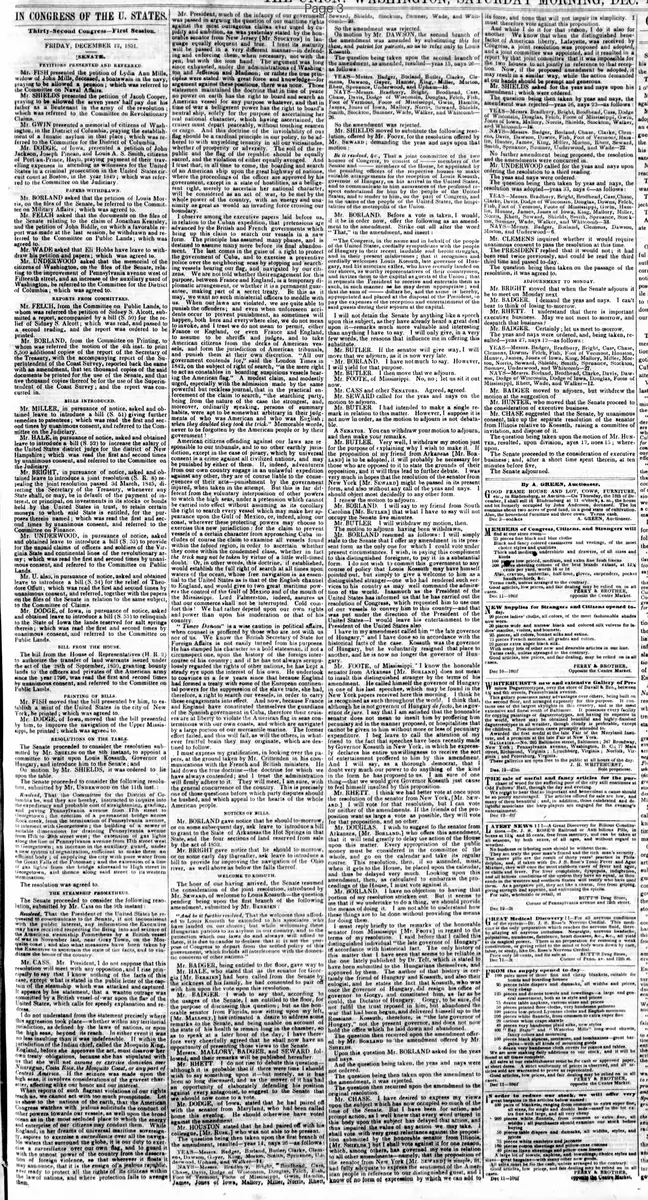
Thirty-Second Congress—First Session,
FRIDAY, DECEMBER 12, 1851.
PETITIONS PRESENTED AND REFERRED.
Mr. FISH presented the petition of Lydia Ann Mills, widow of John Mills, deceased, a boatswain in the navy, praying to be allowed a pension; which was referred to the Committee on Naval Affairs.
Mr. SHIELDS presented the petition of Jacob Cooper, praying to be allowed the seven years' half pay due his father as a lieutenant in the army of the revolution; which was referred to the Committee on Revolutionary Claims.
Mr. GWIN presented a memorial of citizens of Washington, in the District of Columbia, praying the establishment of a lunatic asylum in that place; which was referred to the Committee for the District of Columbia.
Mr. DODGE, of Iowa, presented a petition of John Jackson, Joseph Pincan, and Louis A. S. Smith, citizens of Port-au-Prince, Hayti, praying payment of their travelling expenses in attending as witnesses for the United States in a criminal prosecution in the United States circuit court at Boston, in the year 1849; which was referred to the Committee on the Judiciary.
PAPERS WITHDRAWN.
Mr. BORLAND asked that the petition of Louis Morris, on the files of the Senate, be referred to the Committee on Military Affairs; which was agreed to.
Mr. FELCH asked that the documents on the files of the Senate relating to the claim of Jonathan Kearsley, and the petition of John Biddle, on which a favorable report was made at the last session, be withdrawn and referred to the Committee on Public Lands; which was agreed to.
Mr. WADE asked that Eli Hobbs have leave to withdraw his petition and papers; which was agreed to.
Mr. UNDERWOOD asked that the memorial of the citizens of Washington, on the files of the Senate, relating to the improvement of Pennsylvania avenue west of Fifteenth street, and an increase of the auxiliary guard of Washington, be referred to the Committee for the District of Columbia; which was agreed to.
REPORTS FROM COMMITTEES.
Mr. FELCH, from the Committee on Public Lands, to whom was referred the petition of Sidney S. Alcott, submitted a report, accompanied by a bill (S. 50) for the relief of Sidney S. Alcott; which was read, and passed to a second reading, and the report was ordered to be printed.
Mr. BORLAND, from the Committee on Printing, to whom was referred the motion of the 4th inst. to print 5,500 additional copies of the report of the Secretary of the Treasury, with the accompanying report of the Superintendent of the Coast Survey, reported back the same with an amendment, that ten thousand copies of the said documents be printed for the use of the Senate, and that five thousand copies thereof be for the use of the Superintendent of the Coast Survey; and the report was concurred in.
BILLS INTRODUCED.
Mr. MILLER, in pursuance of notice, asked and obtained leave to introduce a bill (S. 51) giving further remedies to patentees; which was read the first and second times by unanimous consent, and referred to the Committee on the Judiciary.
Mr. HALE, in pursuance of notice, asked and obtained leave to introduce a bill (S. 52) to increase the salary of the United States district judge for the district of New Hampshire; which was read the first and second times by unanimous consent, and referred to the Committee on the Judiciary.
Mr. BRIGHT, in pursuance of notice, asked and obtained leave to introduce a joint resolution (S. R. 8) repealing the joint resolution passed 3d March, 1845, directing the Secretary of the Treasury, whenever any State shall, or may, be in default of the payment of interest, or principal, on investments in its stocks or bonds held by the United States in trust, to retain certain moneys to which said State is entitled, for the purposes therein named; which was read the first and second times by unanimous consent, and referred to the Committee on Finance.
Mr. UNDERWOOD, in pursuance of notice, asked and obtained leave to introduce a bill (S. 53) to provide for the unpaid claims of officers and soldiers of the Virginia State and continental lines of the revolutionary army; which was read the first and second times by unanimous consent, and referred to the Committee on Public Lands.
Mr. U. also, in pursuance of notice, asked and obtained leave to introduce a bill (S. 54) for the relief of Theodore Offutt; which was read the first and second times by unanimous consent, and referred, together with the papers on the files of the Senate in relation to the same subject, to the Committee of Claims.
Mr. DODGE, of Iowa, in pursuance of notice, asked and obtained leave to introduce a bill (S. 55) to relinquish to the State of Iowa the lands reserved for salt springs therein; which was read the first and second times by unanimous consent, and referred to the Committee on Public Lands.
BILL FROM THE HOUSE.
The bill from the House of Representatives (H. R. 2) to authorize the transfer of land warrants issued under the act of the 28th of September, 1850, granting bounty lands to the officers and privates of the American army since the year 1790, was read the first and second times by unanimous consent, and referred to the Committee on Public Lands.
PRINTING OF BILLS.
Mr. FISH moved that the bill presented by him, to establish a mint of the United States in the city of New York, be printed; which was agreed to.
Mr. DODGE, of Iowa, moved that the bill presented by him, to improve the navigation of the Upper Mississippi, be printed; which was agreed to.
RESOLUTIONS ON THE TABLE.
The Senate proceeded to consider the resolution submitted by Mr. SHIELDS on the 5th instant, to appoint a committee to wait upon Louis Kossuth, Governor of Hungary, and introduce him to the Senate; and on motion by Mr. SHIELDS, it was ordered to lie upon the table.
The Senate proceeded to consider the following resolution, submitted by Mr. UNDERWOOD on the 11th inst.:
Resolved, That the Committee for the District of Columbia be, and they are hereby, instructed to inquire into the expediency and probable cost of straightening, grading, and paving Pennsylvania avenue from 17th street to Georgetown; the erection of a permanent bridge across Rock creek, from the termination of Pennsylvania avenue, to intersect with Georgetown; the building of a sewer of suitable dimensions for draining Pennsylvania avenue from 17th to 20th street west; the extension of gas lights along the line of Pennsylvania avenue from 17th street west to Georgetown; an increase in the auxiliary guard, under a new system of organization, sufficient to make them an efficient body; of supplying the city with pure water from the Great Falls of the Potomac; and the extension of a line of gas lights from the bridge aforesaid to High street in Georgetown, and thence along said street to its western termination.
The resolution was agreed to.
THE STEAMSHIP PROMETHEUS.
The Senate proceeded to consider the following resolution, submitted by Mr. CASS on the 9th instant:
Resolved, That the President of the United States be requested to communicate to the Senate, if not inconsistent with the public interest, any information the Executive may have received respecting the firing into and seizure of the American steamship Prometheus by a British vessel of war in November last, near Gray Town, on the Mosquito coast; and also what measures have been taken by the Executive to ascertain the state of the facts, and to vindicate the honor of the country.
Mr. CASS. Mr. President, I do not suppose that this resolution will meet with any opposition, and I rise principally to say that I know nothing of the facts of this case, except what is stated in the public letter of the captain of the steamship which was attacked and captured. It appears by his statement, that a wanton outrage was committed by a British vessel-of-war upon the flag of the United States, which calls for speedy explanation and redress. I do not understand from the statement precisely where this aggression took place—whether within any territorial jurisdiction, as defined by the laws of nations, or upon the high seas, beyond its reach. In either event it was no less insulting than it was indefensible. If within the jurisdiction of the Indian chief, called the Mosquito King, England, before she approves the act, must disavow her own treaty obligations, because she has stipulated with us that she will not assume or exercise dominion over Nicaragua, Costa Rica, the Mosquito Coast, or any part of Central America. If the seizure was made upon the high seas, it involves considerations of the gravest character, affecting alike our honor and our interest. When reports of such flagrant violations of our rights reach us, we cannot act with too much promptitude. Let us show to the nations of the earth, that the American Congress watches with jealous solicitude the conduct of other powers towards our vessels, as well upon the broad ocean as in the most secluded place to which the energy and enterprise of our citizens may conduct them. While England, in her dreams of universal maritime sovereignty, aspires to exercise a surveillance over all the navigable waters that surround the globe, it is our duty to exercise a surveillance over our own flag, and to guard it with the utmost power of the country from the desecration of foreign violence, so that wherever it floats it may announce, that it is the ensign of a jealous republic, ever ready to protect all the rights of its citizens within the laws of nations, and where protection fails to avenge them.
Mr. President, much of the infancy of our government was passed in arguing the question of our maritime rights against the most outrageous claims ever urged by cupidity and ambition, as was yesterday stated by the honorable senator from New Jersey [Mr. STOCKTON] in language equally eloquent and true. I trust its maturity will be passed in a very different manner—in defending and enforcing them, when necessary, not with the pen, but with the iron hand. The argument was long since exhausted, under the administrations of Washington and Jefferson and Madison; or rather the true principles were stated with great force and knowledge—for argument against these positions, there was none. Those statesmen maintained the doctrine that in time of peace no power on earth has the right to board and search an American vessel for any purpose whatever, and that in time of war a belligerent power has the right to board a neutral ship, solely for the purpose of ascertaining her real national character, which having ascertained, the cruiser must depart peaceably, without touching seamen or cargo. And this doctrine of the inviolability of our flag should be a cardinal principle in our policy, to be adhered to with unyielding tenacity in all our vicissitudes, whether of prosperity or adversity. The soil of the republic and the flag of the republic should be equally sacred, and the violation of either equally avenged. And I trust that, in all time to come, the boarding and search of an American ship upon the great highway of nations, where the proceedings of the officer are approved by his government, except in a state of hostilities, as a belligerent right, merely to ascertain her national character, will be considered as an act of war, to be met by the whole power of the country, with an energy and unanimity as great as would an invading force crossing our boundary.
I observe among the executive papers laid before us, in relation to the Cuban expedition, that pretensions are advanced by the British and French governments which bring up this claim to search our vessels in a new form. The principle has assumed many phases, and is destined to assume many more before its final abandonment. The last comes in the guise of a right to protect the government of Cuba, and to exercise a preventive police over the neighboring seas by stopping and searching vessels bearing our flag, and navigated by our citizens. We are not told whether their engagement for this purpose, between France and England, is a temporary diplomatic arrangement, or whether it is a permanent guarantee, making part of a secret treaty. Be this as it may, we want no such ministerial officers to meddle with us. When our laws are violated, we are quite able to punish the offenders; and even when unforeseen accidents occur to prevent punishment, as sometimes will happen, both here and everywhere else, we do not mean to invoke, and I trust we do not mean to permit, either France or England, or even France and England, to assume to be sheriffs and judges, and to take American citizens from the decks of American vessels, from the jurisdiction of American tribunals, and punish them at their own discretion. "All our government contends for," said the London Times in 1842, on the subject of right of search, "is the mere right to act as constables in boarding suspicious vessels bearing the American flag." A modest claim, and modestly urged, especially with the admission made by the same powerful but reckless journal, that in the practical enforcement of the claim to search, "the searching party, being from the nature of the case the strongest, and, moreover, ordinarily speaking, persons of summary habits, were apt to be somewhat arbitrary in their judgments of who was American and who was English; when they doubted they took the trick." Memorable words, never to be forgotten by the American people or by their government!
American citizens offending against our laws are responsible to our tribunals, and to no other earthly jurisdiction, except in the case of piracy, which by universal consent is a crime against all civilized nations, and may be punished by either of them. If, indeed, adventurers from our own country engage in an unlawful expedition against any other, they are of course liable to the consequences of their acts—punishment by the government injured, when taken in the attempt. But this is far different from the voluntary interposition of other powers to watch the high seas, under a pretension which cannot be carried into effect without assuming as its corollary the right to search every vessel which may make her appearance upon the Gulf of Mexico, or, indeed, along our coast, wherever these protecting powers may choose to exercise this new jurisdiction: for the claim to prevent vessels of a certain character from approaching Cuba includes of course the claim to examine all vessels found within the tabooed region, in order to ascertain whether they come within the condemned class, whether in fact the trick may not be taken by virtue of a little well-timed doubt. Or, in other words, this doctrine, if established, would establish the full right of search at all times upon waters of the ocean, whose free navigation is as essential to the United States as is that of the English channel to England, and would give to two great maritime powers the control of the Gulf of Mexico and of the mouth of the Mississippi. Lord Palmerston, indeed, assures us that our commerce shall not be interrupted. Cold comfort this! We had rather depend upon our own rights and power than upon his moderation or that of his country.
"Timeo Danaos" is a wise caution in political affairs when counsel is proffered by those who are not with us nor of us. We know the British Secretary of State for Foreign Affairs is not easily turned from his purposes. He has stamped his character as a bold statesman, if not a circumspect one, upon the history of the foreign intercourse of his country; and if he has not always scrupulously regarded the rights of other nations, he has kept a steady eye upon the interest of his own. He undertook to convince us a few years since that because England had formed a treaty with some of the European continental powers for the suppression of the slave trade, she had, therefore, a right to search our vessels, in order to carry these engagements into effect. And now, because France and England have constituted themselves the guardians of the Spanish government in Cuba, therefore their cruisers are at liberty to violate the American flag in seas contiguous with our own coasts, and which are navigated by a large portion of our mercantile marine. The former effort failed, and this will fail, as will the others, in whatever fruitful brain they may originate, which are destined to follow.
I must express my gratification, in looking over the papers, at the ground taken by Mr. Crittenden in his communications with the French and British ministers. He laid down the true doctrine—the doctrine for which we have always contended; and I trust the administration will firmly adhere to it. They will meet, I am sure, with the general concurrence of the country. This is precisely one of those questions before which party disputes should be hushed, and which appeal to the hearts of the whole American people.
NOTICES OF BILLS.
Mr. BORLAND gave notice that he should to-morrow, or on some subsequent day, ask leave to introduce a bill to grant to the State of Arkansas the Hot Springs in that State, and the four sections of land reserved from sale by the act of 1832.
Mr. BRIGHT gave notice that he should to-morrow, or on some early day thereafter, ask leave to introduce a bill to provide for improving the navigation of the Ohio river, as well above as below the falls thereof.
WELCOME TO KOSSUTH.
The hour of one having arrived, the Senate resumed the consideration of the joint resolution, introduced by Mr. SEWARD, of welcome to Louis Kossuth—the question pending being upon the first branch of the following amendment, submitted by Mr. BERRIEN:
"And be it further resolved, That the welcome thus afforded to Louis Kossuth be extended to his associates who have landed on our shores; but while welcoming these Hungarian patriots to an asylum in our country, and to the protection which our laws do and always will afford to them, it is due to candor to declare that it is not the purpose of Congress to depart from the settled policy of this government, which forbids all interference with the domestic concerns of other nations."
Mr. BADGER, being entitled to the floor, gave way to Mr. HALE, who stated that as the senator for Georgia [Mr. BERRIEN] had been called from the Senate by the sickness of his family, he had consented to pair off with him upon the vote upon this resolution.
Mr. BADGER. I wish to say that, according to the usages of the Senate, I am entitled to the floor, for the purpose of discussing this question; but as the honorable senator from Florida, now sitting upon my left, [Mr. MALLORY,] has intimated a desire to address some remarks to the Senate, and being unable on account of the state of his health to remain long in the chamber, so as to speak at a later hour of the day, I have therefore very cheerfully agreed that he shall now have an opportunity of presenting those views to the Senate.
Messrs. MALLORY, BADGER, and SEWARD followed, and their remarks will be published hereafter.
Mr. RHETT. I do not rise to debate this question—although it is probable that if there were time I should wish to say something upon it—but merely, as it has been so long discussed, and as the mover of it has had an opportunity of elaborately defending his position against every antagonist, to suggest to the Senate that we should now come to a vote.
Mr. DODGE, of Iowa, stated that he had paired off with the senator from Maryland, [Mr. PEARCE,] who was not able to be present. He should otherwise have voted against the amendment.
Mr. HOUSTON stated that he had paired off with his colleague, [Mr. Rusk,] who was not able to be present.
The question being then taken upon the first branch of the amendment, resulted—yeas 14, nays 26—as follows:
YEAS—Messrs. Badger, Borland, Butler, Clarke, Clemens, Dawson, Geyer, King, Morton, Smith, Spruance, Underwood, Upham, and Walker—14.
NAYS—Messrs. Bradbury, Bright, Brodhead, Cass, Chase, Davis, Dodge of Wisconsin, Douglas, Felch, Fish, Foot of Vermont, Foote of Mississippi, Gwin, Hamlin, James, Jones of Iowa, Mallory, Miller, Norris, Rhett, Seward, Shields, Stockton, Sumner, Wade, and Whitcomb—26.
So the amendment was rejected.
On motion by Mr. DAWSON, the second branch of the amendment was amended by substituting this for these, and patriot for patriots, so as to refer only to Louis Kossuth.
The question being taken upon the second branch of the amendment, as amended, resulted—yeas 15, nays 26—as follows:
YEAS—Messrs. Badger, Borland, Butler, Clarke, Clemens, Dawson, Geyer, Hunter, King, Miller, Morton, Rhett, Spruance, Underwood, and Upham—15.
NAYS—Messrs. Bradbury, Bright, Brodhead, Cass, Chase, Davis, Dodge of Wisconsin, Douglas, Felch, Fish, Foot of Vermont, Foote of Mississippi, Gwin, Hamlin, James, Jones of Iowa, Mallory, Norris, Seward, Shields, Smith, Stockton, Sumner, Wade, Walker, and Whitcomb—26.
So the amendment was rejected.
Mr. SHIELDS moved to substitute the following resolution, offered by Mr. FOOTE, for the resolution offered by Mr. SEWARD; demanding the yeas and nays upon that motion:
Be it resolved, &c., That a joint committee of the two houses of Congress, to consist of five members of the Senate and seven members of the House, be appointed by the presiding officers of the respective houses to make suitable arrangements for the reception of Louis Kossuth, governor of Hungary, on his arrival in the United States, and to communicate to him assurances of the profound respect entertained for him by the people of the United States, and to tender to him, on the part of Congress, and in the name of the people of the United States, the hospitalities of the metropolis of the Union.
Mr. BORLAND. Before a vote is taken, I would, if it be in order now, offer the following as an amendment to the amendment. Strike out all after the word "That," in the amendment, and insert:
"The Congress, in the name and in behalf of the people of the United States, cordially sympathizes with the people of Hungary in their recent laudable and heroic struggles, and in their present misfortunes; that it recognises and cordially welcomes Louis Kossuth, late governor of Hungary, and his associate exiles, who have recently landed on our shores, as worthy representatives of their countrymen, and invites them to the capital as guests of the Union: that it requests the President to receive and entertain them as such, in such manner as he may deem appropriate; and that the sum of -- dollars be, and the same is hereby, appropriated and placed at the disposal of the President, to pay the expenses of the reception and entertainment of the said guests during their sojourn at the capital."
I will not detain the Senate by anything like a speech upon this subject, as they have already heard a great deal upon it—remarks much more valuable and interesting than anything I have to say. I will only give, in a very few words, the reasons that influence me in offering this substitute.
Mr. BUTLER. If the senator will give way, I will move that we adjourn, as it is now very late.
Mr. BORLAND. I have not much to say. However, I will yield for that purpose.
Mr. BUTLER. I then move that we adjourn.
Mr. FOOTE, of Mississippi. No, no; let us sit it out now.
Mr. CASS and other Senators. Agreed, agreed.
Mr. SEWARD called for the yeas and nays on the motion to adjourn.
Mr. BUTLER. I had intended to make a single remark in relation to this matter. However, I suppose it is not now in order, as the motion to adjourn is not debatable.
A Senator. You can withdraw your motion to adjourn, and then make your remarks.
Mr. BUTLER. Very well, I withdraw my motion just for the purpose of explaining why I wish to make it. If the proposition of my friend from Arkansas [Mr. BORLAND] is to be adopted, it will probably be necessary for those who are opposed to it to state the grounds of their opposition, and it will thus lead to further debate. I was very much in hopes that the resolution of the senator from New York [Mr. SEWARD] might be passed in its present form, and also without any call of the yeas and nays. I should object most decidedly to any other form.
I renew the motion to adjourn.
Mr. BORLAND. I will say to my friend from South Carolina [Mr. BUTLER] that what I have to say will not occupy the Senate five minutes.
Mr. BUTLER. I will withdraw my motion, then.
The motion to adjourn having been withdrawn, Mr. BORLAND resumed as follows: I will simply state to the Senate that I offer my amendment in its present form as the only one for which I could vote under present circumstances. I wish, in paying this compliment to this distinguished foreigner, to pay it in a substantial form. I do not wish to commit this government to any course of policy that Louis Kossuth may have himself pointed out, but simply to give a welcome to him as a distinguished stranger—one who had rendered such services to his country as may well command the admiration of the world. Inasmuch as the President of the United States has informed us that he has carried out the resolution of Congress, which requested him to use one of our vessels to convey him to this country—and that was put under the direction of the President of the United States—I would leave his entertainment to the President of the United States also.
I have in my amendment called him "the late governor of Hungary," and I have done so in accordance with the historical facts of the case. Kossuth was the governor of Hungary, but he voluntarily resigned that place to Gorgy, and constituted him, as far as he could, the Dictator of Hungary. Gorgy, to be sure, did not fulfil the trust reposed in him, but abandoned the war that had been begun, and delivered himself up to the Russians. Kossuth, therefore, is "the late governor of Hungary," not the present governor, and does not now hold the office which he laid down and abandoned.
Mr. FOOTE, of Mississippi. I know the honorable senator from Arkansas [Mr. BORLAND] does not mean to insult this distinguished stranger by the terms of his amendment. He called himself the governor of Hungary in one of his last speeches, which may be found in the New York papers received here this morning. I think he is recognised as such throughout the world. I think that, although he is not governor of Hungary de facto, he is governor de jure. I say that I am satisfied that the honorable senator does not mean to insult him by proffering him pecuniary aid in the manner proposed, or hospitalities that cannot be given to him without more or less of pecuniary expenditure. I beg leave to call the attention of my friend to the fact that speeches have been recently made by Governor Kossuth in New York, in which he expressly declares his entire unwillingness to receive the sort of entertainment proffered to him by this amendment. And I will say, as a thorough democrat, that I doubt very much our power to do anything of the kind in the form he has proposed to us. I am sure of one thing—that we would give Governor Kossuth just cause to feel himself insulted by this proposition.
Mr. RHETT. I think we had better vote at once upon the resolution of the senator from New York, [Mr. SEWARD.] I will vote for that resolution, but I can vote for neither of the amendments. If the friends of the proposition want as large a vote as possible, they will vote for that proposition, and no other.
Mr. DOUGLAS. I wish to suggest to the senator from Arkansas, [Mr. BORLAND,] who offers this amendment, that it will tend greatly to delay the action of the House upon this matter. Every appropriation of the public money must be considered in the committee of the whole, and go on the calendar and take its regular course. This resolution, then, if so amended, must, when it gets to the House, be placed upon the calendar, and thus be delayed very much. Looking upon this amendment, then, as calculated to embarrass the proceedings of the House, I must vote against it.
Mr. BORLAND. I have no objection to having that portion of my resolution stricken out. But it seems to me that if we undertake to do a thing, we should provide the means of doing it. I am not able to understand how these things are to be done without providing the means for doing them.
I must reply briefly to the remarks of the honorable senator from Mississippi [Mr. FOOTE] in regard to the terms of my resolution. I said before that I called this distinguished individual "the late governor of Hungary" in accordance with historical fact. The only history of this matter that I have seen that seems to be reliable is the one lately published by Dr. Teft, which is stated to have been submitted to the Hungarians themselves, and approved by them. The author of that history is certainly the friend of Hungary and Kossuth, and their eulogist, and he states the fact that Kossuth, who was once the governor of Hungary, did resign his office of governor to Gorgy, and constituted him, as far as he could, the Dictator of Hungary. Gorgy, to be sure, did not fulfil the trust reposed in him, but abandoned the war that had been begun, and delivered himself up to the Russians. Kossuth, therefore, is "the late governor of Hungary," not the present governor, and does not now hold the office which he laid down and abandoned.
The question then recurred upon the amendment offered by Mr. BORLAND to the amendment offered by Mr. SHIELDS.
Upon this question Mr. BORLAND asked for the yeas and nays.
And the question being taken, the yeas and nays were not ordered.
The question being then taken upon the amendment to the amendment, it was rejected.
The question then recurred upon the amendment to the original resolution.
Mr. CHASE. I have desired to express my views upon the subject which has now occupied so much of the time of the Senate. But I have been for action, and prompt action, as I well knew that every word uttered in this body upon this subject has delayed that action, and thus impaired the value of any action we may take. I shall vote with very great reluctance against the proposition submitted by the honorable senator from Illinois, (Mr. SHIELDS,) but I shall vote against it for one reason, which, among others, has governed my vote in relation to all other amendments—namely, that the proposition of the senator from New York [Mr. SEWARD] is simple, and fully adequate to express the sentiment of the American people in reference to our distinguished guest, and I know of no form of expression by which we can add to its force, and none that will not impair its simplicity. I must therefore vote against this proposition. And while I do it for that reason, I do it also for another. We know that when the distinguished benefactor of American liberty, Lafayette, was received, a joint resolution was proposed and adopted, and a joint committee was appointed, and it resulted in a report by that joint committee that it was impossible for the two houses to act jointly in reference to that reception. Now, if the proposed amendment be adopted, it may result in a similar way, while the action demanded at our hands should be prompt and generous.
Mr. SHIELDS asked for the yeas and nays upon his amendment; which were ordered.
The question being then taken by yeas and nays, the amendment was rejected—yeas 16, nays 23—as follows:
YEAS—Messrs. Bradbury, Bright, Brodhead, Cass, Dodge of Wisconsin, Douglas, Felch, Foote of Mississippi, Gwin, Jones of Iowa, Mallory, Norris, Shields, Stockton, Walker, and Whitcomb—16.
NAYS—Messrs. Badger, Borland, Chase, Clarke, Clemens, Davis, Dawson, Downs, Fish, Foot of Vermont, Hamlin, Hunter, James, King, Miller, Morton, Smith, Spruance, Sumner, Underwood, and Wade—23.
No further amendment being proposed, the resolution and the amendments were concurred in.
Mr. UNDERWOOD called for the yeas and nays upon ordering the resolution to a third reading.
The yeas and nays were ordered.
The question being then taken by yeas and nays, the resolution was adopted—yeas 33, nays 6—as follows:
YEAS—Messrs. Bradbury, Bright, Brodhead, Cass, Chase, Clarke, Davis, Dodge of Wisconsin, Douglas, Downs, Felch, Fish, Foot of Vermont, Foote of Mississippi, Gwin, Hamlin, Hunter, James, Jones of Iowa, King, Mallory, Miller, Norris, Rhett, Seward, Shields, Smith, Spruance, Stockton, Sumner, Wade, Walker, and Whitcomb—33.
NAYS—Messrs. Badger, Borland, Clemens, Dawson, Morton, and Underwood—6.
Mr. CLEMENS inquired whether it would require unanimous consent to pass the resolution at this time.
The PRESIDENT replied that it would not; it had been read twice previously, and could be read the third time and passed to-day.
The question being then taken on the passage of the resolution, it was agreed to.
ADJOURNMENT TO MONDAY.
Mr. BRIGHT moved that when the Senate adjourn it be to meet on Monday next.
Mr. BADGER. I demand the yeas and nays. I can't bear to think of losing to-morrow.
Mr. RHETT. I understand that there is important executive business. May we not meet to-morrow, and despatch that business?
Mr. BADGER. Certainly; let us meet to-morrow.
The yeas and nays were ordered, and, being taken, resulted—yeas 27, nays 12—as follows:
YEAS—Messrs. Badger, Bradbury, Bright, Cass, Chase, Clemens, Downs, Felch, Fish, Foot of Vermont, Houston, Hunter, James, Jones of Iowa, King, Mallory, Miller, Morton, Norris, Seward, Shields, Smith, Spruance, Stockton, Sumner, Underwood, and Whitcomb—27.
NAYS—Messrs. Borland, Brodhead, Clarke, Davis, Dawson, Dodge of Wisconsin, Dodge of Iowa, Douglas, Foote of Mississippi, Rhett, Wade, and Walker—12.
Mr. BADGER moved to adjourn, but withdrew the motion at the suggestion of Mr. HUNTER, who moved that the Senate proceed to the consideration of executive business.
Mr. CHASE suggested that the Senate, by unanimous consent, take up the separate resolution of the senator from Illinois relative to Kossuth, raising a committee of invitation, and dispose of it.
The question being taken upon the motion of Mr. HUNTER, resulted, upon division, ayes 17, noes 15; whereupon,
The Senate proceeded to the consideration of executive business; and, after a short time spent therein, at ten minutes before five,
The Senate adjourned.
What sub-type of article is it?
What keywords are associated?
What entities or persons were involved?
Where did it happen?
Domestic News Details
Primary Location
Washington, District Of Columbia
Event Date
1851 12 12
Key Persons
Outcome
various petitions referred to committees; papers withdrawn and referred; reports submitted and bills passed to second reading; multiple bills introduced and referred; house bill referred; bills ordered printed; resolutions on table considered and agreed or laid aside; resolution on steamship prometheus considered with speech by mr. cass; resolution welcoming louis kossuth debated, amended, and passed by yeas 33, nays 6; senate adjourned to executive business and then adjourned at 4:50 pm.
Event Details
The U.S. Senate, Thirty-Second Congress First Session, on Friday, December 12, 1851, handled petitions for pensions, claims, and memorials, referring them to appropriate committees; withdrew and referred papers on various claims; received reports from committees on public lands and printing, introducing and referring bills; introduced several bills on patents, judicial salaries, state defaults, revolutionary claims, individual relief, and land relinquishments, referring them to committees; received and referred a House bill on land warrants; ordered printing of bills on mint establishment and river navigation; considered resolutions including one on District of Columbia improvements, agreed to; debated a resolution requesting information on the seizure of the American steamship Prometheus by a British vessel near Gray Town on the Mosquito coast in November 1851, with a speech by Mr. Cass emphasizing U.S. maritime rights; extensively debated and passed a joint resolution welcoming Louis Kossuth, governor of Hungary, after rejecting amendments, with votes recorded; gave notices of future bills; and adjourned to Monday after executive session.