Thank you for visiting SNEWPapers!
Sign up free
Literary
January 15, 1857
The Weekly Ottumwa Courier
Ottumwa, Wapello County, Iowa
What is this article about?
An introduction presents Daniel Webster's letter from Richmond, October 15, 1850, as a model of epistolary style, simplicity, and religious sentiment. The letter describes an early morning scene by the James River, reflects on the metaphorical and literal beauty of morning, its rarity in city life, poetic descriptions, and divine renewal, comparing it favorably to Adam's experience.
Clipping
OCR Quality
98%
Excellent
Full Text
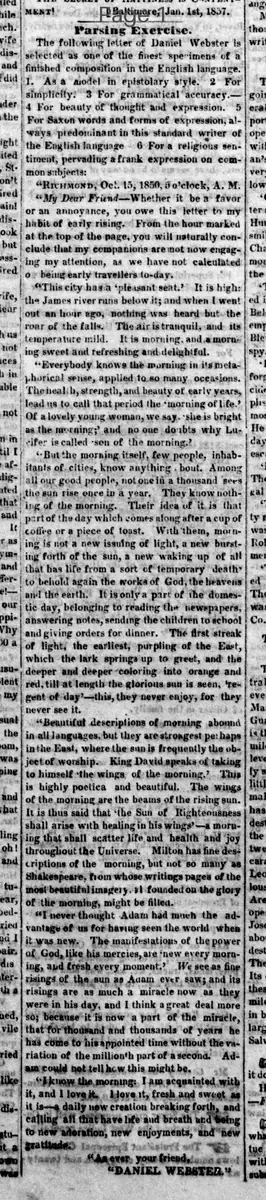
Parsing Exercise.
The following letter of Daniel Webster is selected as one of the finest specimens of a finished composition in the English language. 1. As a model in epistolary style. 2 For simplicity: 3 For grammatical accuracy. 4 For beauty of thought and expression. 5 For Saxon words and forms of expression, always predominant in this standard writer of the English language -6 For a religious sentiment, pervading a frank expression on common subjects:
RICHMOND, Oct. 15, 1850, 5 o'clock, A. M.
My Dear Friend--Whether it be a favor or an annoyance, you owe this letter to my habit of early rising. From the hour marked at the top of the page, you will naturally conclude that my companions are not now engaging my attention, as we have not calculated on being early travellers to-day.
This city has a pleasant seat. It is high: the James river runs below it; and when I went out an hour ago, nothing was heard but the roar of the falls. The air is tranquil, and its temperature mild. It is morning, and a morning sweet and refreshing and delightful.
Everybody knows the morning in its metaphorical sense, applied to so many occasions. The health, strength, and beauty of early years, lead us to call that period the morning of life. Of a lovely young woman, we say, she is bright as the morning; and no one doubts why Lucifer is called son of the morning.
But the morning itself, few people, inhabitants of cities, know anything about. Among all our good people, not one in a thousand sees the sun rise once in a year. They know nothing of the morning. Their idea of it is that part of the day which comes along after a cup of coffee or a piece of toast. With them, morning is not a new issuing of light, a new bursting forth of the sun, a new waking up of all that has life from a sort of temporary death to behold again the works of God, the heavens and the earth. It is only a part of the domestic day, belonging to reading the newspapers, answering notes, sending the children to school and giving orders for dinner. The first streak of light, the earliest, purpling of the East, which the lark springs up to greet, and the deeper and deeper coloring into orange and red, till at length the glorious sun is seen, regent of day--this, they never enjoy, for they never see it.
Beautiful descriptions of morning abound in all languages, but they are strongest perhaps in the East, where the sun is frequently the object of worship. King David speaks of taking to himself the wings of the morning. This is highly poetical and beautiful. The wings of the morning are the beams of the rising sun. It is thus said that the Sun of Righteousness shall arise with healing in his wings--a morning that shall scatter life and health and joy throughout the Universe. Milton has fine descriptions of the morning, but not so many as Shakespeare, from whose writings pages of the most beautiful imagery, all founded on the glory of the morning, might be filled.
I never thought Adam had much the advantage of us for having seen the world when it was new. The manifestations of the power of God, like his mercies, are new every morning, and fresh every moment. We see as fine risings of the sun as Adam ever saw; and its risings are as much a miracle now as they were in his day, and I think a great deal more so; because it is now a part of the miracle, that for thousand and thousands of years he has come to his appointed time without the variation of the millionth part of a second. Adam could not tell how this might be. I know the morning: I am acquainted with it, and I love it a I love it, fresh and sweet as it is--a daily new creation breaking forth, and calling all that have life and breath and being to new adoration, new enjoyments, and new gratitude.
DANIEL WEBSTER.
The following letter of Daniel Webster is selected as one of the finest specimens of a finished composition in the English language. 1. As a model in epistolary style. 2 For simplicity: 3 For grammatical accuracy. 4 For beauty of thought and expression. 5 For Saxon words and forms of expression, always predominant in this standard writer of the English language -6 For a religious sentiment, pervading a frank expression on common subjects:
RICHMOND, Oct. 15, 1850, 5 o'clock, A. M.
My Dear Friend--Whether it be a favor or an annoyance, you owe this letter to my habit of early rising. From the hour marked at the top of the page, you will naturally conclude that my companions are not now engaging my attention, as we have not calculated on being early travellers to-day.
This city has a pleasant seat. It is high: the James river runs below it; and when I went out an hour ago, nothing was heard but the roar of the falls. The air is tranquil, and its temperature mild. It is morning, and a morning sweet and refreshing and delightful.
Everybody knows the morning in its metaphorical sense, applied to so many occasions. The health, strength, and beauty of early years, lead us to call that period the morning of life. Of a lovely young woman, we say, she is bright as the morning; and no one doubts why Lucifer is called son of the morning.
But the morning itself, few people, inhabitants of cities, know anything about. Among all our good people, not one in a thousand sees the sun rise once in a year. They know nothing of the morning. Their idea of it is that part of the day which comes along after a cup of coffee or a piece of toast. With them, morning is not a new issuing of light, a new bursting forth of the sun, a new waking up of all that has life from a sort of temporary death to behold again the works of God, the heavens and the earth. It is only a part of the domestic day, belonging to reading the newspapers, answering notes, sending the children to school and giving orders for dinner. The first streak of light, the earliest, purpling of the East, which the lark springs up to greet, and the deeper and deeper coloring into orange and red, till at length the glorious sun is seen, regent of day--this, they never enjoy, for they never see it.
Beautiful descriptions of morning abound in all languages, but they are strongest perhaps in the East, where the sun is frequently the object of worship. King David speaks of taking to himself the wings of the morning. This is highly poetical and beautiful. The wings of the morning are the beams of the rising sun. It is thus said that the Sun of Righteousness shall arise with healing in his wings--a morning that shall scatter life and health and joy throughout the Universe. Milton has fine descriptions of the morning, but not so many as Shakespeare, from whose writings pages of the most beautiful imagery, all founded on the glory of the morning, might be filled.
I never thought Adam had much the advantage of us for having seen the world when it was new. The manifestations of the power of God, like his mercies, are new every morning, and fresh every moment. We see as fine risings of the sun as Adam ever saw; and its risings are as much a miracle now as they were in his day, and I think a great deal more so; because it is now a part of the miracle, that for thousand and thousands of years he has come to his appointed time without the variation of the millionth part of a second. Adam could not tell how this might be. I know the morning: I am acquainted with it, and I love it a I love it, fresh and sweet as it is--a daily new creation breaking forth, and calling all that have life and breath and being to new adoration, new enjoyments, and new gratitude.
DANIEL WEBSTER.
What sub-type of article is it?
Epistolary
Essay
What themes does it cover?
Nature
Religious
What keywords are associated?
Daniel Webster
Morning
Nature
Sunrise
Religious Sentiment
Epistolary
Richmond
James River
What entities or persons were involved?
Daniel Webster
Literary Details
Author
Daniel Webster
Subject
On The Beauty And Religious Significance Of Morning
Key Lines
My Dear Friend Whether It Be A Favor Or An Annoyance, You Owe This Letter To My Habit Of Early Rising.
It Is Morning, And A Morning Sweet And Refreshing And Delightful.
With Them, Morning Is Not A New Issuing Of Light, A New Bursting Forth Of The Sun, A New Waking Up Of All That Has Life From A Sort Of Temporary Death To Behold Again The Works Of God, The Heavens And The Earth.
The Manifestations Of The Power Of God, Like His Mercies, Are New Every Morning, And Fresh Every Moment.
I Know The Morning: I Am Acquainted With It, And I Love It A I Love It, Fresh And Sweet As It Is A Daily New Creation Breaking Forth, And Calling All That Have Life And Breath And Being To New Adoration, New Enjoyments, And New Gratitude.