Thank you for visiting SNEWPapers!
Sign up free
The Liberator
Boston, Suffolk County, Massachusetts
What is this article about?
Henry C. Wright writes to Garrison describing Rev. Edward Beecher's lecture in Boston on March 2, 1854, arguing that the Union with slavery has morally paralyzed the nation across politics, religion, and society. Beecher calls for Northern unity against slavery and vindicates the Bible from supporting it; Wright adds an anecdote about Stephen A. Douglas and urges uncompromising resistance.
Clipping
OCR Quality
Full Text
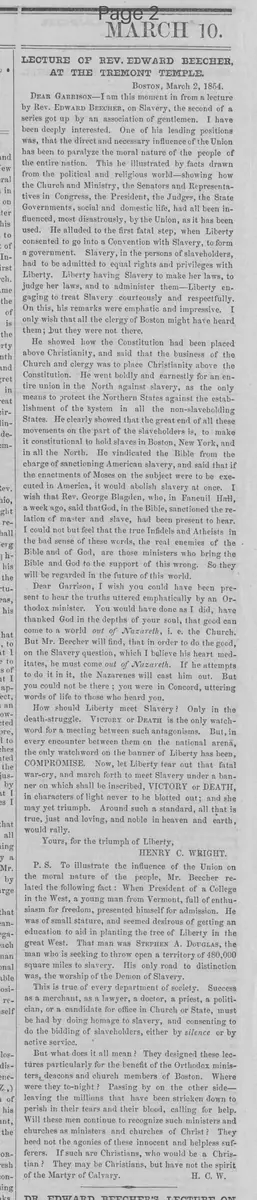
Boston, March 2, 1854.
Dear Garrison—I am this moment in from a lecture by Rev. EDWARD Beecher, on Slavery, the second of a series got up by an association of gentlemen. I have been deeply interested. One of his leading positions was, that the direct and necessary influence of the Union has been to paralyze the moral nature of the people of the entire nation. This he illustrated by facts drawn from the political and religious world—showing how the Church and Ministry, the Senators and Representatives in Congress, the President, the Judges, the State Governments, social and domestic life, had all been influenced, most disastrously, by the Union, as it has been used. He alluded to the first fatal step, when Liberty consented to go into a Convention with Slavery, to form a government. Slavery, in the persons of slaveholders, had to be admitted to equal rights and privileges with Liberty. Liberty having Slavery to make her laws, to judge her laws, and to administer them—Liberty engaging to treat Slavery courteously and respectfully.
On this, his remarks were emphatic and impressive. I only wish that all the clergy of Boston might have heard them; but they were not there.
He showed how the Constitution had been placed above Christianity, and said that the business of the Church and clergy was to place Christianity above the Constitution. He went boldly and earnestly for an entire union in the North against slavery, as the only means to protect the Northern States against the establishment of the system in all the non-slaveholding States. He clearly showed that the great end of all these movements on the part of the slaveholders is, to make it constitutional to hold slaves in Boston, New York, and in all the North. He vindicated the Bible from the charge of sanctioning American slavery, and said that if the enactments of Moses on the subject were to be executed in America, it would abolish slavery at once. I wish that Rev. George Blagden, who, in Faneuil Hall, a week ago, said that God, in the Bible, sanctioned the relation of master and slave, had been present to hear.
I could not but feel that the true Infidels and Atheists in the bad sense of these words, the real enemies of the Bible and of God, are those ministers who bring the Bible and God to the support of this wrong. So they will be regarded in the future of this world.
Dear Garrison, I wish you could have been present to hear the truths uttered emphatically by an Orthodox minister. You would have done as I did, have thanked God in the depths of your soul, that good can come to a world out of Nazareth, i. e. the Church.
But Mr. Beecher will find, that in order to do the good, on the Slavery question, which I believe his heart meditates, he must come out of Nazareth. If he attempts to do it in it, the Nazarenes will cast him out. But you could not be there; you were in Concord, uttering words of life to those who heard you.
How should Liberty meet Slavery? Only in the death-struggle. Victory or Death is the only watch-word for a meeting between such antagonisms. But, in every encounter between them on the national arena, the only watchword on the banner of Liberty has been, COMPROMISE. Now, let Liberty tear out that fatal war-cry, and march forth to meet Slavery under a banner on which shall be inscribed, VICTORY or DEATH, in characters of light never to be blotted out; and she may yet triumph. Around such a standard, all that is true, just and loving, and noble in heaven and earth, would rally.
Yours, for the triumph of Liberty,
HENRY C. WRIGHT.
P. S. To illustrate the influence of the Union on the moral nature of the people, Mr. Beecher related the following fact: When President of a College in the West, a young man from Vermont, full of enthusiasm for freedom, presented himself for admission. He was of small stature, and seemed desirous of getting an education to aid in planting the tree of Liberty in the great West. That man was STEPHEN A. DOUGLAS, the man who is seeking to throw open a territory of 480,000 square miles to slavery. His only road to distinction was, the worship of the Demon of Slavery.
This is true of every department of society. Success as a merchant, as a lawyer, a doctor, a priest, a politician, or a candidate for office in Church or State, must be had by doing homage to slavery, and consenting to do the bidding of slaveholders, either by silence or by active service.
But what does it all mean? They designed these lectures particularly for the benefit of the Orthodox ministers, deacons and church members of Boston. Where were they to-night? Passing by on the other side—leaving the millions that have been stricken down to perish in their tears and their blood, calling for help.
Will these men continue to recognize such ministers and churches as ministers and churches of Christ? They heed not the agonies of these innocent and helpless sufferers. If such are Christians, who would be a Christian? They may be Christians, but have not the spirit of the Martyr of Calvary.
H. C. W.
What sub-type of article is it?
What themes does it cover?
What keywords are associated?
What entities or persons were involved?
Letter to Editor Details
Author
Henry C. Wright
Recipient
Dear Garrison
Main Argument
rev. edward beecher's lecture argues that the union with slavery has paralyzed the moral nature of the nation, placing the constitution above christianity and enabling slaveholders' influence; wright endorses calls for northern unity against slavery without compromise to prevent its spread.
Notable Details