Thank you for visiting SNEWPapers!
Sign up free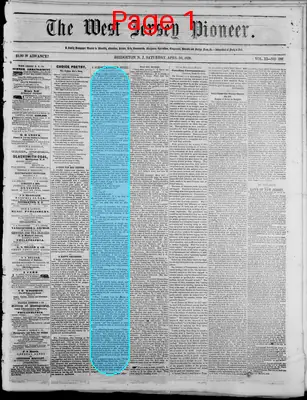
Story
April 30, 1859
West Jersey Pioneer
Bridgeton, Cumberland County, New Jersey
What is this article about?
A schoolmaster recounts using the Golden Rule as his sole teaching principle, fostering responsibility in students. He resolves a dilemma when student George Jones refuses to reveal a prankster, William Brown, by demonstrating the rule's application to the school's collective interest.
Clipping

OCR Quality
98%
Excellent
Full Text
A SCHOOLMASTER'S STORY
A Lesson for Teachers and Pupils.
"When I taught a district school," said he, "I adopted as a principle to give as few rules to my scholars as possible. I had, however, one standing rule, which was, 'Strive under all circumstances to do right,' and the test of right, under all circumstances, was the golden rule, 'All things whatsoever ye would that men should do unto you, do ye even so unto them.'
If an offence was committed, it was my invariable practice to ask, 'Was it right?' 'Was it as you would be done by?'
All my experience and observation have convinced me that no act of a pupil ought to be regarded as an offence, unless it be when measured by the standard of the golden rule. During the last year of my teaching, the only tests I ever applied to an act of which it was necessary to judge, were those of the above questions. By this course I gained many important advantages.
In the first place, the plea, 'You have not made any rule against it,' which for a long time was a terrible burden to me, lost all its power.
In the second place, by keeping constantly before the scholar, as a standard of action, the single text of right and wrong as one which they were to apply for themselves, I was enabled to cultivate in them a deep feeling of personal responsibility.
In the third place, I got a stronger hold on their feelings, and acquired a new power of cultivating and directing them.
In the fourth place, I had the satisfaction of seeing them become more truthful, honest, trust-worthy and manly in their intercourse with me, with their friends, and with each other.
Once, however, I was sadly puzzled by an application of the principle, by one of my scholars, George Jones, a large boy, who partly through a false feeling of honor, and partly through a feeling of stubbornness, refused to give me some information. The circumstances were these:
A scholar had played some trick which interrupted the exercises. As was my custom I called on the one who had done the mischief to come forward. As no one started, I repeated the request, but with no success. Finding that the culprit would not confess his guilt, I asked George if he knew who had committed the offence.
'I did not do it,' was the reply.
'But do you know who did?'
'Yes sir.'
'Who was it?'
'I do not wish to tell.'
'But you must tell. It is my duty to ask; and yours to answer me.'
'I cannot do it,' said George, firmly.
'Then you must stop with me after school.'
He stopped as requested, but nothing which I could urge would induce him to reveal anything. At last, out of patience with what I believed to be the obstinacy of the boy, I said,
'Well, George, I have borne with you as long as I can, and you must either tell me or be punished.'
With a triumphant look, as though conscious that he had cornered me by an application of my favorite rule, he replied, 'I can't tell you, because it would not be right. The boy would not like to have me tell of him, and I'll do as I'd be done by.'
A few years earlier I should have deemed a reply thus given an insult, and should have resented it accordingly; but experience and reflection had taught me the folly of this, and that one of the most important applications of my oft quoted rule, was—to judge of the nature of others as I would have them judge of mine. Yet, for the moment, I was staggered. His plea was plausible; he might be honest in making it. I did not see in what respect it was fallacious. I felt that it would not do to retreat from my position, and suffer the offender to escape; and yet, that I should do a great injustice by compelling a boy to do a thing, if he really believed it to be wrong.
After a little pause, I said, 'Well George, I do not wish you to do anything which is wrong; or which conflicts with your golden rule. We will leave this for to-night, and perhaps you will alter your mind before to-morrow.'
I saw him privately before school, and found him more firm in his refusal than ever. After the devotional exercises of the morning, I began to question the scholars—as was my wont—on various points of duty, and gradually led the conversation to the golden rule.
'Who,' I asked, 'are the persons to whom as the members of this school, you ought to do as you would be done by? Your parents, who support and send you here?—Your school-mates, who are engaged in the same work with yourselves? the citizens of the town, who, by taxing themselves, raise money to pay the expenses of this school? the school committee, who take so great an interest in your welfare? your teacher? or the scholar who carelessly or wilfully commits some offence against good order?'
A hearty 'yes' was responded to every question except the last, at which they were silent.
Then, addressing George, I said: 'Yesterday, I asked you who had committed a certain offence. You refused to tell me, because you thought it would not be doing as you would be done by. I now wish you to re-consider the subject. On one side are your parents, your school-mates, the citizens of this town, the school committee and your teacher, all deeply interested in everything affecting the prosperity of this school. On the other side is the boy who, by this act, has shown himself ready to injure all these. To which party will you do as you would be done by?'
After a moment's pause, he said; 'To the first; it was William Brown who did it.'
My triumph, or rather the triumph of principle, was complete; and the lesson was as deeply felt by the other members of the school as by him for whom it was especially designed.
Professor Robert Allyn.
A Lesson for Teachers and Pupils.
"When I taught a district school," said he, "I adopted as a principle to give as few rules to my scholars as possible. I had, however, one standing rule, which was, 'Strive under all circumstances to do right,' and the test of right, under all circumstances, was the golden rule, 'All things whatsoever ye would that men should do unto you, do ye even so unto them.'
If an offence was committed, it was my invariable practice to ask, 'Was it right?' 'Was it as you would be done by?'
All my experience and observation have convinced me that no act of a pupil ought to be regarded as an offence, unless it be when measured by the standard of the golden rule. During the last year of my teaching, the only tests I ever applied to an act of which it was necessary to judge, were those of the above questions. By this course I gained many important advantages.
In the first place, the plea, 'You have not made any rule against it,' which for a long time was a terrible burden to me, lost all its power.
In the second place, by keeping constantly before the scholar, as a standard of action, the single text of right and wrong as one which they were to apply for themselves, I was enabled to cultivate in them a deep feeling of personal responsibility.
In the third place, I got a stronger hold on their feelings, and acquired a new power of cultivating and directing them.
In the fourth place, I had the satisfaction of seeing them become more truthful, honest, trust-worthy and manly in their intercourse with me, with their friends, and with each other.
Once, however, I was sadly puzzled by an application of the principle, by one of my scholars, George Jones, a large boy, who partly through a false feeling of honor, and partly through a feeling of stubbornness, refused to give me some information. The circumstances were these:
A scholar had played some trick which interrupted the exercises. As was my custom I called on the one who had done the mischief to come forward. As no one started, I repeated the request, but with no success. Finding that the culprit would not confess his guilt, I asked George if he knew who had committed the offence.
'I did not do it,' was the reply.
'But do you know who did?'
'Yes sir.'
'Who was it?'
'I do not wish to tell.'
'But you must tell. It is my duty to ask; and yours to answer me.'
'I cannot do it,' said George, firmly.
'Then you must stop with me after school.'
He stopped as requested, but nothing which I could urge would induce him to reveal anything. At last, out of patience with what I believed to be the obstinacy of the boy, I said,
'Well, George, I have borne with you as long as I can, and you must either tell me or be punished.'
With a triumphant look, as though conscious that he had cornered me by an application of my favorite rule, he replied, 'I can't tell you, because it would not be right. The boy would not like to have me tell of him, and I'll do as I'd be done by.'
A few years earlier I should have deemed a reply thus given an insult, and should have resented it accordingly; but experience and reflection had taught me the folly of this, and that one of the most important applications of my oft quoted rule, was—to judge of the nature of others as I would have them judge of mine. Yet, for the moment, I was staggered. His plea was plausible; he might be honest in making it. I did not see in what respect it was fallacious. I felt that it would not do to retreat from my position, and suffer the offender to escape; and yet, that I should do a great injustice by compelling a boy to do a thing, if he really believed it to be wrong.
After a little pause, I said, 'Well George, I do not wish you to do anything which is wrong; or which conflicts with your golden rule. We will leave this for to-night, and perhaps you will alter your mind before to-morrow.'
I saw him privately before school, and found him more firm in his refusal than ever. After the devotional exercises of the morning, I began to question the scholars—as was my wont—on various points of duty, and gradually led the conversation to the golden rule.
'Who,' I asked, 'are the persons to whom as the members of this school, you ought to do as you would be done by? Your parents, who support and send you here?—Your school-mates, who are engaged in the same work with yourselves? the citizens of the town, who, by taxing themselves, raise money to pay the expenses of this school? the school committee, who take so great an interest in your welfare? your teacher? or the scholar who carelessly or wilfully commits some offence against good order?'
A hearty 'yes' was responded to every question except the last, at which they were silent.
Then, addressing George, I said: 'Yesterday, I asked you who had committed a certain offence. You refused to tell me, because you thought it would not be doing as you would be done by. I now wish you to re-consider the subject. On one side are your parents, your school-mates, the citizens of this town, the school committee and your teacher, all deeply interested in everything affecting the prosperity of this school. On the other side is the boy who, by this act, has shown himself ready to injure all these. To which party will you do as you would be done by?'
After a moment's pause, he said; 'To the first; it was William Brown who did it.'
My triumph, or rather the triumph of principle, was complete; and the lesson was as deeply felt by the other members of the school as by him for whom it was especially designed.
Professor Robert Allyn.
What sub-type of article is it?
Biography
Personal Triumph
What themes does it cover?
Moral Virtue
Justice
What keywords are associated?
Golden Rule
Teaching Principle
Moral Lesson
School Discipline
Personal Responsibility
Student Refusal
What entities or persons were involved?
Professor Robert Allyn
George Jones
William Brown
Where did it happen?
District School
Story Details
Key Persons
Professor Robert Allyn
George Jones
William Brown
Location
District School
Story Details
Schoolmaster uses Golden Rule as sole principle, cultivates responsibility; resolves student's refusal to inform on prankster by showing rule's application to school's greater good, leading to revelation and lesson learned.