Thank you for visiting SNEWPapers!
Sign up free
The National Intelligencer And Washington Advertiser
Washington, District Of Columbia
What is this article about?
A letter to the editor defends secret government proceedings, including Congress's closed sessions and a $2 million presidential appropriation in 1803, arguing that while republican principles demand transparency, secrecy is essential in foreign affairs to safeguard U.S. interests, such as negotiations over New Orleans and Mississippi land.
Clipping
OCR Quality
Full Text
MR. SMITH,
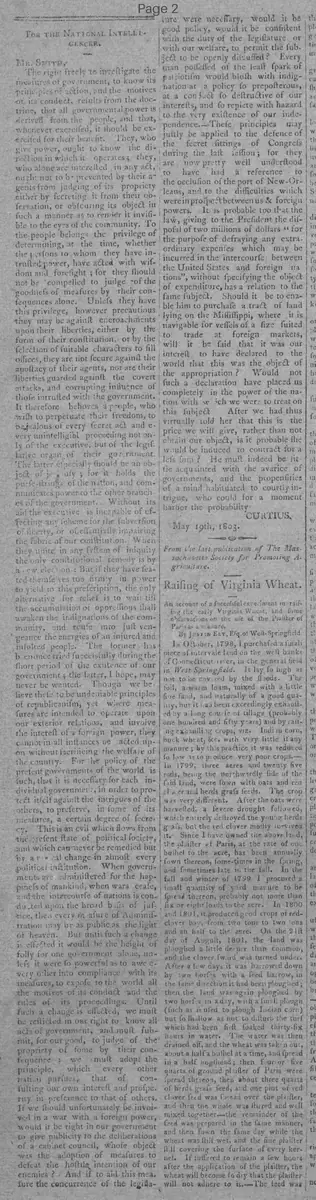
The right freely to investigate the measures of government, to know its principles of action, and the motives of its conduct, results from the doctrine, that all governmental power is derived from the people, and that, whenever exercised, it should be exercised for their benefit. They, who give power, ought to know the direction in which it operates; they, who alone are interested in any act, ought not to be prevented by their agents from judging of its propriety either by secreting it from their observation, or obscuring its object in such a manner as to render it invisible to the eyes of the community. To the people belongs the privilege of determining, at the time, whether the persons to whom they have intrusted power, have acted with wisdom and foresight; for they should not be compelled to judge of the goodness of measures by their consequences alone. Unless they have this privilege, however precautious they may be against encroachments upon their liberties, either by the form of their constitution, or by the selection of suitable characters to fill offices, they are not secure against the apostasy of their agents, nor are their liberties guarded against the covert attacks, and corrupting influence of those intrusted with the government. It therefore behooves a people, who wish to perpetuate their freedom, to be jealous of every secret act and every unintelligible proceeding not only of the executive, but of the legislative organ of their government. The latter especially should be an object of jealousy; for it holds the purse-strings of the nation, and communicates power to the other branches of the government. Without its aid the executive is incapable of effecting any scheme for the subversion of liberty, or essentially impairing the fabric of our constitution. When they unite in any system of iniquity the only constitutional remedy is by a new election: But if they have seated themselves too firmly in power to yield to this prescription, the only alternative for relief is to wait till the accumulation of oppressions shall awaken the indignations of the community, and rouse into just vengeance the energies of an injured and insulted people. The former has been once tried successfully during the short period of the existence of our government; the latter, I hope, may never be wanted. Though we believe these to be undeniable principles of republicanism, yet where measures are intended to operate upon our exterior relations, and involve the interest of a foreign power, they cannot in all instances be acted upon without sacrificing the welfare of the country. For the policy of the present governments of the world is such, that it is necessary for each individual government, in order to protect itself against the intrigues of the others, to preserve, in some of its measures, a certain degree of secrecy. This is an evil which flows from the present state of political society, and which can never be remedied but by a radical change in almost every political institution. When governments are administered for the happiness of mankind, when wars cease, and the intercourse of nations is conducted upon the broad basis of justice, then every measure of administration may be as public as the light of heaven. But until such a change is effected it would be the height of folly for one government alone, unless it were so powerful as to awe every other into compliance with its measures, to expose to the world all the motives of its conduct and the rules of its proceedings. Until such a change is effected, we must be restricted in our right to know all acts of government, and must submit, for our good, to judge of the propriety of some by their consequence; we must adopt the principle, which every other nation pursues, that of consulting our own interest and prosperity in preference to that of others. If we should unfortunately be involved in a war with a foreign power, would it be right in our government to give publicity to the deliberations of a cabinet council, whose object was the adoption of measures to defeat the hostile intention of our enemies? And if to aid this measure the concurrence of the legislature were necessary, would it be good policy, would it be consistent with the duty of the legislature, or with our welfare, to permit the subject to be openly discussed? Every man possessed of the least spark of patriotism would blush with indignation at a policy so preposterous, at a conduct so destructive of our interests, and so replete with hazard to the very existence of our independence. These principles may justly be applied to the defence of the secret sittings of Congress during the last session; for they are now pretty well understood to have had a reference to the occlusion of the port of New-Orleans, and to the difficulties which were then projected between us & foreign powers. It is probable too that the law, giving to the President the disposal of two millions of dollars "for the purpose of defraying any extraordinary expenses which may be incurred in the intercourse between the United States and foreign nations", without specifying the object of expenditure, has a relation to the same subject. Should it be to enable him to purchase a tract of land lying on the Mississippi, where it is navigable for vessels of a size suited to trade at foreign markets, will it be said that it was our interest to have declared to the world that this was the object of the appropriation? Would not such a declaration have placed us completely in the power of the nation with which we were to treat on this subject After we had thus virtually told her that this is the price we will give, rather than not obtain our object, is it probable she would be induced to contract for a less sum? He must indeed be little acquainted with the avarice of governments, and the propensities of a mind habituated to courtly intrigue, who could for a moment harbor the probability
CURTIUS.
May 19th, 1803.
What sub-type of article is it?
What themes does it cover?
What keywords are associated?
What entities or persons were involved?
Letter to Editor Details
Author
Curtius
Recipient
Mr. Smith
Main Argument
while affirming the people's right to scrutinize government actions under republican principles, the letter argues that secrecy is necessary in foreign relations to protect national interests, as exemplified by congress's secret sessions and a discretionary presidential appropriation related to new orleans and mississippi navigation.
Notable Details