Thank you for visiting SNEWPapers!
Sign up free
Story
February 28, 1882
The Sun
New York, New York County, New York
What is this article about?
Opinion piece supporting President Arthur's nomination of Roscoe Conkling to the Supreme Court, highlighting their ties, Conkling's past refusals of honors, and political attacks by rivals like Hoar and Ingalls, predicting confirmation despite enmities.
Clipping
OCR Quality
98%
Excellent
Full Text
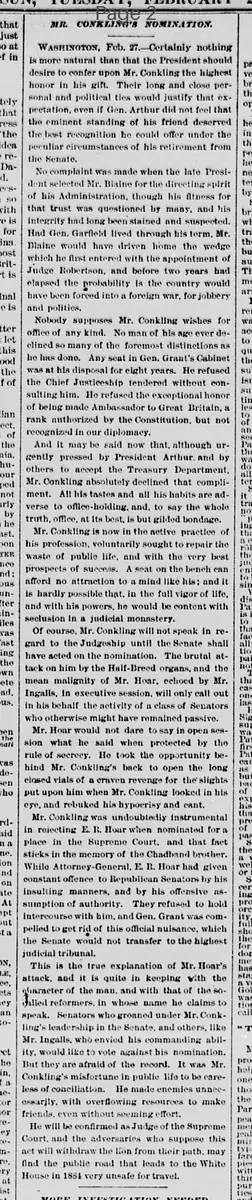
MR. CONKLING'S NOMINATION
Washington, Feb. 27.—Certainly nothing is more natural than that the President should desire to confer upon Mr. Conkling the highest honor in his gift. Their long and close personal and political ties would justify that expectation, even if Gen. Arthur did not feel that the eminent standing of his friend deserved the best recognition he could offer under the peculiar circumstances of his retirement from the Senate.
No complaint was made when the late President selected Mr. Blaine for the directing spirit of his Administration, though his fitness for that trust was questioned by many, and his integrity had long been stained and suspected.
Had Gen. Garfield lived through his term, Mr. Blaine would have driven home the wedge which he first entered with the appointment of Judge Robertson, and before two years had elapsed the probability is the country would have been forced into a foreign war, for jobbery and politics,
Nobody supposes Mr. Conkling wishes for office of any kind. No man of his age ever declined so many of the foremost distinctions as he has done. Any seat in Gen. Grant's Cabinet was at his disposal for eight years. He refused the Chief Justiceship tendered without consulting him. He refused the exceptional honor of being made Ambassador to Great Britain, a rank authorized by the Constitution, but not recognized in our diplomacy.
And it may be said now that, although urgently pressed by President Arthur and by others to accept the Treasury Department Mr. Conkling absolutely declined that compliment. All his tastes and all his habits are adverse to office-holding, and, to say the whole truth, office, at its best, is but gilded bondage.
Mr. Conkling is now in the active practice of his profession, voluntarily sought to repair the waste of public life, and with the very best prospects of success. A seat on the bench can afford no attraction to a mind like his: and it is hardly possible that, in the full vigor of life, and with his powers, he would be content with seclusion in a judicial monastery
Of course, Mr. Conkling will not speak in regard to the Judgeship until the Senate shall have acted on the nomination. The brutal attack on him by the Half-Breed organs, and the mean malignity of Mr. Hoar, echoed by Mr. Ingalls, in executive session, will only call out in his behalf the activity of a class of Senators who otherwise might have remained passive.
Mr. Hoar would not dare to say in open session what he said when protected by the rule of secrecy. He took the opportunity behind Mr. Conkling's back to open the long closed vials of a craven revenge for the slights put upon him when Mr. Conkling looked in his eye, and rebuked his hypocrisy and cant.
Mr. Conkling was undoubtedly instrumental in rejecting E. R. Hoar when nominated for a place in the Supreme Court, and that fact sticks in the memory of the Chadband brother.
While Attorney-General, E. R. Hoar had given constant offence to Republican Senators by his insulting manners, and by his offensive assumption of authority. They refused to hold intercourse with him, and Gen. Grant was compelled to get rid of this official nuisance, which the Senate would not transfer to the highest judicial tribunal.
This is the true explanation of Mr. Hoar's attack, and it is quite in keeping with the character of the man, and with that of the so-called reformers, in whose name he claims to speak. Senators who groaned under Mr. Conkling's leadership in the Senate, and others, like Mr. Ingalls, who envied his commanding ability, would like to vote against his nomination.
But they are afraid of the record. It was Mr. Conkling's misfortune in public life to be careless of conciliation.
He made enemies unnecessarily, with overflowing resources to make friends, even without seeming effort.
He will be confirmed as Judge of the Supreme Court, and the adversaries who suppose this act will withdraw the lion from their path, may find the public road that leads to the White House in 1884 very unsafe for travel.
Washington, Feb. 27.—Certainly nothing is more natural than that the President should desire to confer upon Mr. Conkling the highest honor in his gift. Their long and close personal and political ties would justify that expectation, even if Gen. Arthur did not feel that the eminent standing of his friend deserved the best recognition he could offer under the peculiar circumstances of his retirement from the Senate.
No complaint was made when the late President selected Mr. Blaine for the directing spirit of his Administration, though his fitness for that trust was questioned by many, and his integrity had long been stained and suspected.
Had Gen. Garfield lived through his term, Mr. Blaine would have driven home the wedge which he first entered with the appointment of Judge Robertson, and before two years had elapsed the probability is the country would have been forced into a foreign war, for jobbery and politics,
Nobody supposes Mr. Conkling wishes for office of any kind. No man of his age ever declined so many of the foremost distinctions as he has done. Any seat in Gen. Grant's Cabinet was at his disposal for eight years. He refused the Chief Justiceship tendered without consulting him. He refused the exceptional honor of being made Ambassador to Great Britain, a rank authorized by the Constitution, but not recognized in our diplomacy.
And it may be said now that, although urgently pressed by President Arthur and by others to accept the Treasury Department Mr. Conkling absolutely declined that compliment. All his tastes and all his habits are adverse to office-holding, and, to say the whole truth, office, at its best, is but gilded bondage.
Mr. Conkling is now in the active practice of his profession, voluntarily sought to repair the waste of public life, and with the very best prospects of success. A seat on the bench can afford no attraction to a mind like his: and it is hardly possible that, in the full vigor of life, and with his powers, he would be content with seclusion in a judicial monastery
Of course, Mr. Conkling will not speak in regard to the Judgeship until the Senate shall have acted on the nomination. The brutal attack on him by the Half-Breed organs, and the mean malignity of Mr. Hoar, echoed by Mr. Ingalls, in executive session, will only call out in his behalf the activity of a class of Senators who otherwise might have remained passive.
Mr. Hoar would not dare to say in open session what he said when protected by the rule of secrecy. He took the opportunity behind Mr. Conkling's back to open the long closed vials of a craven revenge for the slights put upon him when Mr. Conkling looked in his eye, and rebuked his hypocrisy and cant.
Mr. Conkling was undoubtedly instrumental in rejecting E. R. Hoar when nominated for a place in the Supreme Court, and that fact sticks in the memory of the Chadband brother.
While Attorney-General, E. R. Hoar had given constant offence to Republican Senators by his insulting manners, and by his offensive assumption of authority. They refused to hold intercourse with him, and Gen. Grant was compelled to get rid of this official nuisance, which the Senate would not transfer to the highest judicial tribunal.
This is the true explanation of Mr. Hoar's attack, and it is quite in keeping with the character of the man, and with that of the so-called reformers, in whose name he claims to speak. Senators who groaned under Mr. Conkling's leadership in the Senate, and others, like Mr. Ingalls, who envied his commanding ability, would like to vote against his nomination.
But they are afraid of the record. It was Mr. Conkling's misfortune in public life to be careless of conciliation.
He made enemies unnecessarily, with overflowing resources to make friends, even without seeming effort.
He will be confirmed as Judge of the Supreme Court, and the adversaries who suppose this act will withdraw the lion from their path, may find the public road that leads to the White House in 1884 very unsafe for travel.
What sub-type of article is it?
Biography
Historical Event
What themes does it cover?
Fortune Reversal
Justice
Betrayal
What keywords are associated?
Conkling Nomination
Supreme Court
Political Rivalry
Senate Confirmation
Arthur Presidency
Hoar Grudge
What entities or persons were involved?
Mr. Conkling
Gen. Arthur
Mr. Blaine
Gen. Garfield
Mr. Hoar
Mr. Ingalls
Gen. Grant
E. R. Hoar
Where did it happen?
Washington
Story Details
Key Persons
Mr. Conkling
Gen. Arthur
Mr. Blaine
Gen. Garfield
Mr. Hoar
Mr. Ingalls
Gen. Grant
E. R. Hoar
Location
Washington
Event Date
Feb. 27
Story Details
President Arthur nominates his friend Roscoe Conkling for Supreme Court justice despite Conkling's reluctance for office and past refusals of honors; political rivals like Hoar attack due to old grudges, but confirmation is predicted amid 1884 presidential speculation.