Thank you for visiting SNEWPapers!
Sign up free
Literary
May 12, 1830
Virginia Free Press & Farmers' Repository
Charles Town, Jefferson County, West Virginia
What is this article about?
An allegorical tale by Frederick Richter, translated from French: The Angel of Death enters a dying warrior's body on a battlefield to experience human mortality. He endures pain, love for the warrior's betrothed, societal injustices, and loss, ultimately understanding life's burdens before returning to heaven.
Clipping
OCR Quality
95%
Excellent
Full Text
MISCELLANEOUS.
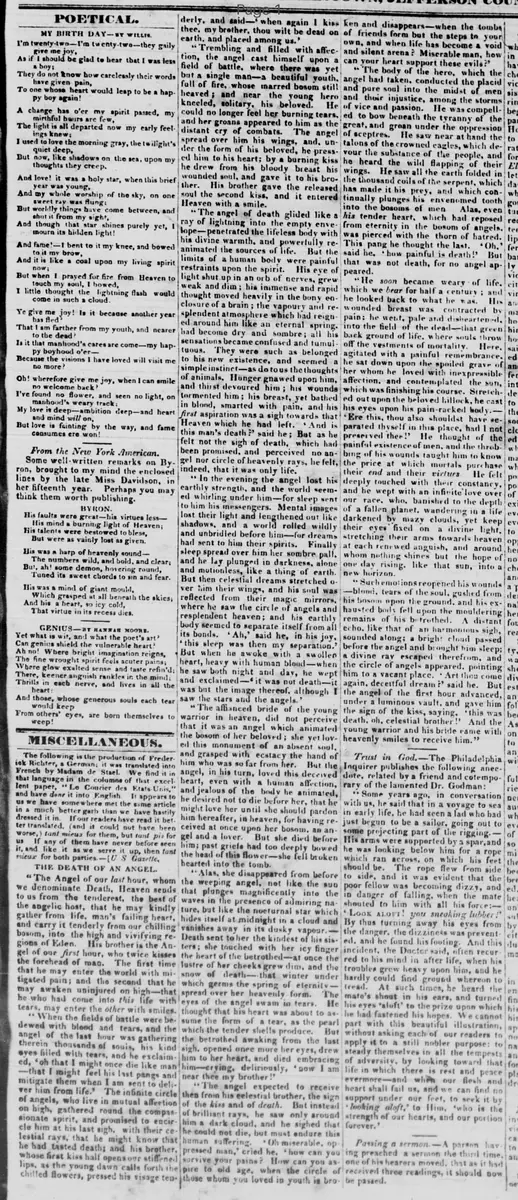
The following is the production of Frederick Richter, a German: it was translated into French by Madam de Stael. We find it in that language in the columns of that excellent paper, "Le Courier des Etats Unis," and have done it into English. It appears to us we have somewhere met the same article in a much better garb than we have hastily dressed it in. If our readers have read it better translated (and it could not have been worse), tant mieux for them, but tant pis for us. If any of them have never before seen it, and like it as we serve it up, then tant mieux for both parties.--[U S Gazette.
THE DEATH OF AN ANGEL.
"The Angel of our last hour, whom we denominate Death, Heaven sends to us from the tenderest, the best of the angelic host, that he may kindly gather from life, man's failing heart, and carry it tenderly from our chilling bosom, into the high and vivifying regions of Eden. His brother is the Angel of our first hour, who twice kisses the forehead of man. The first time that he may enter the world with mitigated pain; and the second that he may awaken uninjured on high--that he who had come into this life with tears, may enter the other with smiles.
"When the fields of battle were bedewed with blood and tears, and the angel of the last hour was gathering therein thousands of souls, his kind eyes filled with tears, and he exclaimed, 'oh that I might once die like man--that I might feel his last pangs and mitigate them when I am sent to deliver him from life.' The infinite circle of angels, who live in mutual affection on high, gathered round the compassionate spirit, and promised to encircle him at his last sigh with their celestial rays, that he might know that he had tasted death; and his brother, whose first kiss half opens our stiffened lips, as the young dawn calls forth the chilled flowers, pressed his visage tenderly, and said--'when again I kiss thee, my brother, thou wilt be dead on earth, and placed among us.'
"Trembling and filled with affection, the angel cast himself upon a field of battle, where there was yet but a single man--a beautiful youth, full of fire, whose marred bosom still heaved; and near the young hero knelt, solitary, his beloved. He could no longer feel her burning tears, and her groans appeared to him as the distant cry of combats. The angel spread over him his wings, and, under the form of his beloved, he pressed him to his heart; by a burning kiss he drew from his bloody breast his wounded soul, and gave it to his brother. His brother gave the released soul the second kiss, and it entered Heaven with a smile.
"The angel of death glided like a ray of lightning into the empty envelope--penetrated the lifeless body with his divine warmth, and powerfully re-animated the sources of life. But the limits of a human body were painful restraints upon the spirit. His eye of light shut up in an orb of nerves, grew weak and dim: his immense and rapid thought moved heavily in the bony enclosure of a brain; the vapoury and resplendent atmosphere which had reigned around him like an eternal spring, had become dry and sombre; all his sensations became confused and tumultuous. They were such as belonged to his new existence, and seemed a simple instinct--as do to us the thoughts of animals. Hunger gnawed upon him, and thirst devoured him; his wounds tormented him: his breast, yet bathed in blood, smarted with pain, and his first aspiration was a sigh towards that Heaven which he had left. And is this man's death?' said he; But as he felt not the sigh of death, which had been promised, and perceived no angel nor circle of heavenly rays, he felt, indeed, that it was only life.
"In the evening the angel lost his earthly strength, and the world seemed whirling under him--for sleep sent to him his messengers. Mental images lost their light and lengthened out like shadows, and a world rolled wildly and unbridled before him--for dreams had sent to him their spirits. Finally sleep spread over him her sombre pall, and he lay plunged in darkness, alone and motionless, like a thing of earth. But then celestial dreams stretched over him their wings, and his soul was reflected from their magic mirrors, where he saw the circle of angels and resplendent heaven: and his earthly body seemed to separate itself from all its bonds. 'Ah,' said he, in his joy, 'this sleep was then my separation.' But when he awoke with a swollen heart, heavy with human blood--when he saw both night and day, he wept and exclaimed--'it was not death--it was but the image thereof, although I saw the stars and the angels.'
"The affianced bride of the young warrior in heaven, did not perceive that it was an angel which animated the bosom of her beloved; she yet loved this monument of an absent soul, and grasped with ecstasy the hand of him who was so far from her. But the angel, in his turn, loved this deceived heart, even with a human affection, and jealous of the body he animated, he desired not to die before her, that he might love her until she should pardon him hereafter, in heaven, for having received at once upon her bosom, an angel and a lover. But she died before him; past griefs had too deeply bowed the head of this flower--she fell broken hearted into the tomb.
"Alas, she disappeared from before the weeping angel, not like the sun that plunges magnificently into the waves in the presence of admiring nature, but like the nocturnal star which hides itself at midnight in a cloud and vanishes away in its dusky vapour.--Death sent to her the kindest of his sisters: she touched with her icy finger the heart of the betrothed--at once the lustre of her cheeks grew dim, and the snow of death--that winter under which germs the spring of eternity--spread over her heavenly form. The eyes of the angel swam in tears. He thought that his heart was about to assume the form of a tear, as the pearl which the tender shells produce. But the betrothed awaking from the last sigh, opened once more her eyes, drew him to her heart, and died embracing him--crying deliriously, 'now I am near thee my brother!'
"The angel expected to receive then from his celestial brother, the sign of the kiss and of death. But instead of brilliant rays, he saw only around him a dark cloud, and he sighed that he could not die, but must endure this human suffering. Oh miserable, oppressed man,' cried he, 'how can you survive your pains? How can you aspire to old age, when the circle of those whom you loved in youth is broken and disappears--when the tombs of friends form but the steps to your own, and when life has become a void and silent arena? Miserable man, how can your heart support these evils?'
"The body of the hero, which the angel had taken, conducted the placid and pure soul into the midst of men and their injustice, among the storms of vice and passion. He was compelled to bow beneath the tyranny of the great, and groan under the oppression of sceptres. He saw near at hand the talons of the crowned eagles, which devour the substance of the people, and he heard the wild flapping of their wings. He saw all the earth folded in the thousand coils of the serpent, which has made it his prey, and which continually plunges his envenomed tooth into the bosoms of men. Alas, even his tender heart, which had reposed from eternity in the bosom of angels, was pierced with the thorn of hatred. This pang he thought the last. Oh,' said he, 'how painful is death!' But that was not death, for no angel appeared.
"He soon became weary of life, which we bear for half a century; and he looked back to what he was. His wounded breast was contracted by pain; he went, pale and disheartened, into the field of the dead--that green back ground of life, where souls throw off the vestments of mortality. Here, agitated with a painful remembrance, he sat down upon the spoiled grave of her whom he loved with inexpressible affection, and contemplated the sun, which was finishing his course. Stretched out upon the beloved hillock, he cast his eyes upon his pain-racked body.--'Ere this, thou also shouldst have separated thyself in this place, had I not preserved thee!' He thought of the painful existence of men, and the throbbing of his wounds taught him to know the price at which mortals purchase their end and their virtues. He felt deeply touched with their constancy, and he wept with an infinite love over our race, who, banished to the depth of a fallen planet, wandering in a life darkened by mazy clouds, yet keep their eyes fixed on a divine light, stretching their arms towards heaven at each renewed anguish, and around whom nothing shines but the hope of one day rising, like that sun, into a new horizon.
"Such emotions reopened his wounds--blood, tears of the soul, gushed from his bosom upon the ground, and his exhausted body fell upon the mouldering remains of his betrothed. A distant echo, like that of an harmonious sigh, sounded along: a bright cloud passed before the angel and brought him sleep; a divine ray escaped therefrom, and the circle of angels appeared, pointing him to a vacant place. 'Art thou come again, deceitful dream?' said he. But the angel of the first hour advanced, under a luminous vault, and gave him the sign of the kiss, saying, 'this was death, oh, celestial brother!' And the young warrior and his bride came with heavenly smiles to receive him."
The following is the production of Frederick Richter, a German: it was translated into French by Madam de Stael. We find it in that language in the columns of that excellent paper, "Le Courier des Etats Unis," and have done it into English. It appears to us we have somewhere met the same article in a much better garb than we have hastily dressed it in. If our readers have read it better translated (and it could not have been worse), tant mieux for them, but tant pis for us. If any of them have never before seen it, and like it as we serve it up, then tant mieux for both parties.--[U S Gazette.
THE DEATH OF AN ANGEL.
"The Angel of our last hour, whom we denominate Death, Heaven sends to us from the tenderest, the best of the angelic host, that he may kindly gather from life, man's failing heart, and carry it tenderly from our chilling bosom, into the high and vivifying regions of Eden. His brother is the Angel of our first hour, who twice kisses the forehead of man. The first time that he may enter the world with mitigated pain; and the second that he may awaken uninjured on high--that he who had come into this life with tears, may enter the other with smiles.
"When the fields of battle were bedewed with blood and tears, and the angel of the last hour was gathering therein thousands of souls, his kind eyes filled with tears, and he exclaimed, 'oh that I might once die like man--that I might feel his last pangs and mitigate them when I am sent to deliver him from life.' The infinite circle of angels, who live in mutual affection on high, gathered round the compassionate spirit, and promised to encircle him at his last sigh with their celestial rays, that he might know that he had tasted death; and his brother, whose first kiss half opens our stiffened lips, as the young dawn calls forth the chilled flowers, pressed his visage tenderly, and said--'when again I kiss thee, my brother, thou wilt be dead on earth, and placed among us.'
"Trembling and filled with affection, the angel cast himself upon a field of battle, where there was yet but a single man--a beautiful youth, full of fire, whose marred bosom still heaved; and near the young hero knelt, solitary, his beloved. He could no longer feel her burning tears, and her groans appeared to him as the distant cry of combats. The angel spread over him his wings, and, under the form of his beloved, he pressed him to his heart; by a burning kiss he drew from his bloody breast his wounded soul, and gave it to his brother. His brother gave the released soul the second kiss, and it entered Heaven with a smile.
"The angel of death glided like a ray of lightning into the empty envelope--penetrated the lifeless body with his divine warmth, and powerfully re-animated the sources of life. But the limits of a human body were painful restraints upon the spirit. His eye of light shut up in an orb of nerves, grew weak and dim: his immense and rapid thought moved heavily in the bony enclosure of a brain; the vapoury and resplendent atmosphere which had reigned around him like an eternal spring, had become dry and sombre; all his sensations became confused and tumultuous. They were such as belonged to his new existence, and seemed a simple instinct--as do to us the thoughts of animals. Hunger gnawed upon him, and thirst devoured him; his wounds tormented him: his breast, yet bathed in blood, smarted with pain, and his first aspiration was a sigh towards that Heaven which he had left. And is this man's death?' said he; But as he felt not the sigh of death, which had been promised, and perceived no angel nor circle of heavenly rays, he felt, indeed, that it was only life.
"In the evening the angel lost his earthly strength, and the world seemed whirling under him--for sleep sent to him his messengers. Mental images lost their light and lengthened out like shadows, and a world rolled wildly and unbridled before him--for dreams had sent to him their spirits. Finally sleep spread over him her sombre pall, and he lay plunged in darkness, alone and motionless, like a thing of earth. But then celestial dreams stretched over him their wings, and his soul was reflected from their magic mirrors, where he saw the circle of angels and resplendent heaven: and his earthly body seemed to separate itself from all its bonds. 'Ah,' said he, in his joy, 'this sleep was then my separation.' But when he awoke with a swollen heart, heavy with human blood--when he saw both night and day, he wept and exclaimed--'it was not death--it was but the image thereof, although I saw the stars and the angels.'
"The affianced bride of the young warrior in heaven, did not perceive that it was an angel which animated the bosom of her beloved; she yet loved this monument of an absent soul, and grasped with ecstasy the hand of him who was so far from her. But the angel, in his turn, loved this deceived heart, even with a human affection, and jealous of the body he animated, he desired not to die before her, that he might love her until she should pardon him hereafter, in heaven, for having received at once upon her bosom, an angel and a lover. But she died before him; past griefs had too deeply bowed the head of this flower--she fell broken hearted into the tomb.
"Alas, she disappeared from before the weeping angel, not like the sun that plunges magnificently into the waves in the presence of admiring nature, but like the nocturnal star which hides itself at midnight in a cloud and vanishes away in its dusky vapour.--Death sent to her the kindest of his sisters: she touched with her icy finger the heart of the betrothed--at once the lustre of her cheeks grew dim, and the snow of death--that winter under which germs the spring of eternity--spread over her heavenly form. The eyes of the angel swam in tears. He thought that his heart was about to assume the form of a tear, as the pearl which the tender shells produce. But the betrothed awaking from the last sigh, opened once more her eyes, drew him to her heart, and died embracing him--crying deliriously, 'now I am near thee my brother!'
"The angel expected to receive then from his celestial brother, the sign of the kiss and of death. But instead of brilliant rays, he saw only around him a dark cloud, and he sighed that he could not die, but must endure this human suffering. Oh miserable, oppressed man,' cried he, 'how can you survive your pains? How can you aspire to old age, when the circle of those whom you loved in youth is broken and disappears--when the tombs of friends form but the steps to your own, and when life has become a void and silent arena? Miserable man, how can your heart support these evils?'
"The body of the hero, which the angel had taken, conducted the placid and pure soul into the midst of men and their injustice, among the storms of vice and passion. He was compelled to bow beneath the tyranny of the great, and groan under the oppression of sceptres. He saw near at hand the talons of the crowned eagles, which devour the substance of the people, and he heard the wild flapping of their wings. He saw all the earth folded in the thousand coils of the serpent, which has made it his prey, and which continually plunges his envenomed tooth into the bosoms of men. Alas, even his tender heart, which had reposed from eternity in the bosom of angels, was pierced with the thorn of hatred. This pang he thought the last. Oh,' said he, 'how painful is death!' But that was not death, for no angel appeared.
"He soon became weary of life, which we bear for half a century; and he looked back to what he was. His wounded breast was contracted by pain; he went, pale and disheartened, into the field of the dead--that green back ground of life, where souls throw off the vestments of mortality. Here, agitated with a painful remembrance, he sat down upon the spoiled grave of her whom he loved with inexpressible affection, and contemplated the sun, which was finishing his course. Stretched out upon the beloved hillock, he cast his eyes upon his pain-racked body.--'Ere this, thou also shouldst have separated thyself in this place, had I not preserved thee!' He thought of the painful existence of men, and the throbbing of his wounds taught him to know the price at which mortals purchase their end and their virtues. He felt deeply touched with their constancy, and he wept with an infinite love over our race, who, banished to the depth of a fallen planet, wandering in a life darkened by mazy clouds, yet keep their eyes fixed on a divine light, stretching their arms towards heaven at each renewed anguish, and around whom nothing shines but the hope of one day rising, like that sun, into a new horizon.
"Such emotions reopened his wounds--blood, tears of the soul, gushed from his bosom upon the ground, and his exhausted body fell upon the mouldering remains of his betrothed. A distant echo, like that of an harmonious sigh, sounded along: a bright cloud passed before the angel and brought him sleep; a divine ray escaped therefrom, and the circle of angels appeared, pointing him to a vacant place. 'Art thou come again, deceitful dream?' said he. But the angel of the first hour advanced, under a luminous vault, and gave him the sign of the kiss, saying, 'this was death, oh, celestial brother!' And the young warrior and his bride came with heavenly smiles to receive him."
What sub-type of article is it?
Allegory
Prose Fiction
Vision Or Dream
What themes does it cover?
Death Mortality
Religious
Moral Virtue
What keywords are associated?
Angel Of Death
Human Mortality
Celestial Experience
Battlefield Love
Eternal Heaven
What entities or persons were involved?
Frederick Richter (Translated From French By Madam De Stael)
Literary Details
Title
The Death Of An Angel.
Author
Frederick Richter (Translated From French By Madam De Stael)
Subject
The Angel Of Death Experiences Human Life And Mortality
Key Lines
"The Angel Of Our Last Hour, Whom We Denominate Death, Heaven Sends To Us From The Tenderest, The Best Of The Angelic Host..."
"Oh That I Might Once Die Like Man That I Might Feel His Last Pangs And Mitigate Them..."
"And Is This Man's Death?' Said He; But As He Felt Not The Sigh Of Death... He Felt, Indeed, That It Was Only Life."
"Oh Miserable, Oppressed Man,' Cried He, 'How Can You Survive Your Pains?..."
"This Was Death, Oh, Celestial Brother!' And The Young Warrior And His Bride Came With Heavenly Smiles To Receive Him."