Thank you for visiting SNEWPapers!
Sign up free
Editorial
January 17, 1954
Atlanta Daily World
Atlanta, Fulton County, Georgia
What is this article about?
Editorial reflects on the Taft-Hartley labor law amid the President's State of the Union message, noting its origins, political mishandling by figures like Durkin and Lewis, historical labor-capital tensions, and calls for fairer treatment or potential repeal.
Merged-components note: Continuation of editorial 'The Struggle Of Taft-Hartley' within page; merged.
Clipping
OCR Quality
95%
Excellent
Full Text
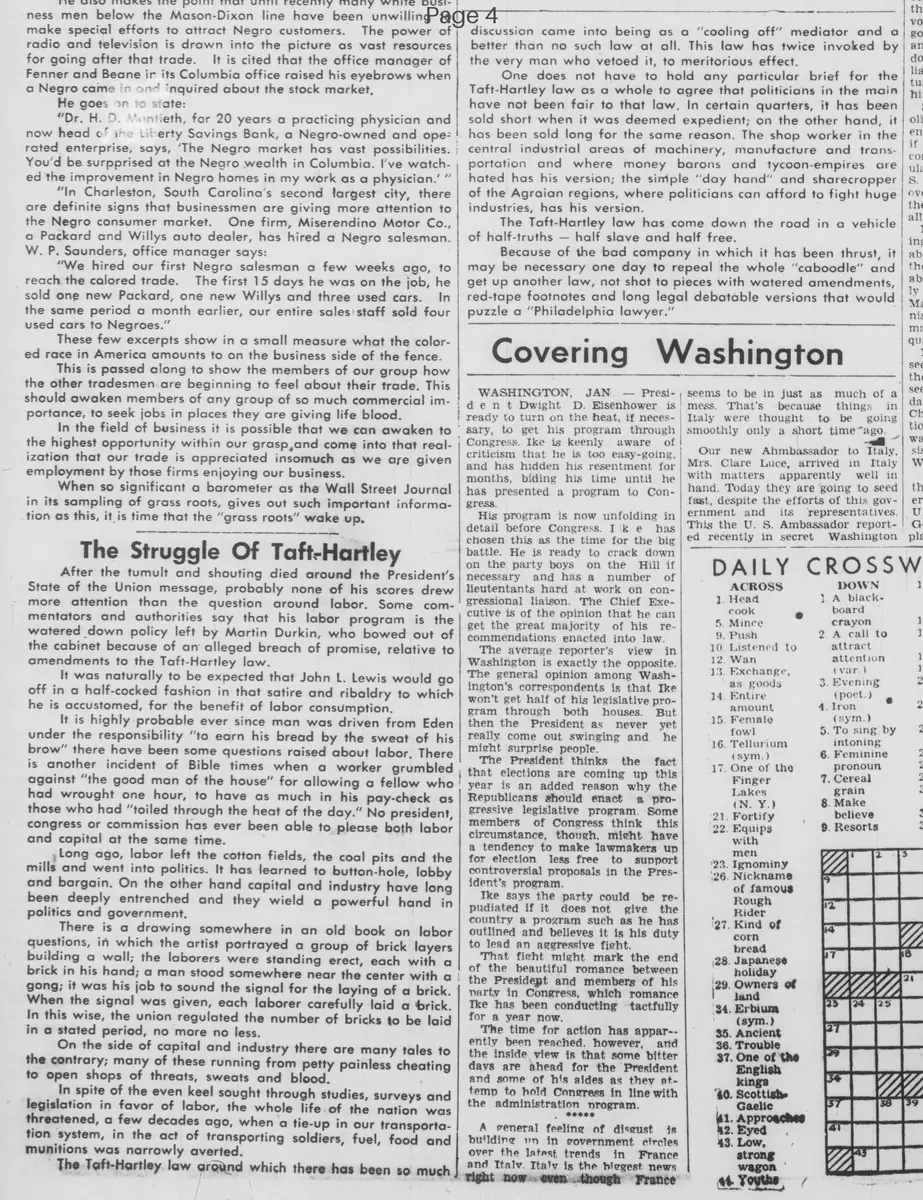
The Struggle Of Taft-Hartley
After the tumult and shouting died around the President's
State of the Union message, probably none of his scores drew
more attention than the question around labor. Some com-
mentators and authorities say that his labor program is the
watered down policy left by Martin Durkin, who bowed out of
the cabinet because of an alleged breach of promise, relative to
amendments to the Taft-Hartley law.
It was naturally to be expected that John L. Lewis would go
off in a half-cocked fashion in that satire and ribaldry to which
he is accustomed, for the benefit of labor consumption.
It is highly probable ever since man was driven from Eden
under the responsibility "to earn his bread by the sweat of his
brow" there have been some questions raised about labor. There
is another incident of Bible times when a worker grumbled
against "the good man of the house" for allowing a fellow who
had wrought one hour, to have as much in his pay-check as
those who had "toiled through the heat of the day." No president,
congress or commission has ever been able to please both labor
and capital at the same time.
Long ago, labor left the cotton fields, the coal pits and the
mills and went into politics. It has learned to button-hole, lobby
and bargain. On the other hand capital and industry have long
been deeply entrenched and they wield a powerful hand in
politics and government.
There is a drawing somewhere in an old book on labor
questions, in which the artist portrayed a group of brick layers
building a wall; the laborers were standing erect, each with a
brick in his hand; a man stood somewhere near the center with a
gong; it was his job to sound the signal for the laying of a brick.
When the signal was given, each laborer carefully laid a brick.
In this wise, the union regulated the number of bricks to be laid
in a stated period, no more no less.
On the side of capital and industry there are many tales to
the contrary; many of these running from petty painless cheating
to open shops of threats, sweats and blood.
In spite of the even keel sought through studies, surveys and
legislation in favor of labor, the whole life of the nation was
threatened, a few decades ago, when a tie-up in our transporta-
tion system, in the act of transporting soldiers, fuel, food and
munitions was narrowly averted.
The Taft-Hartley law around which there has been so much
discussion came into being as a "cooling off" mediator and a
better than no such law at all. This law has twice invoked by
the very man who vetoed it, to meritorious effect.
One does not have to hold any particular brief for the
Taft-Hartley law as a whole to agree that politicians in the main
have not been fair to that law. In certain quarters, it has been
sold short when it was deemed expedient; on the other hand, it
has been sold long for the same reason. The shop worker in the
central industrial areas of machinery, manufacture and trans-
portation and where money barons and tycoon-empires are
hated has his version; the simple "day hand" and sharecropper
of the Agraian regions, where politicians can afford to fight huge
industries, has his version.
The Taft-Hartley law has come down the road in a vehicle
of half-truths - half slave and half free.
Because of the bad company in which it has been thrust, it
may be necessary one day to repeal the whole "caboodle" and
get up another law, not shot to pieces with watered amendments,
red-tape footnotes and long legal debatable versions that would
puzzle a "Philadelphia lawyer."
After the tumult and shouting died around the President's
State of the Union message, probably none of his scores drew
more attention than the question around labor. Some com-
mentators and authorities say that his labor program is the
watered down policy left by Martin Durkin, who bowed out of
the cabinet because of an alleged breach of promise, relative to
amendments to the Taft-Hartley law.
It was naturally to be expected that John L. Lewis would go
off in a half-cocked fashion in that satire and ribaldry to which
he is accustomed, for the benefit of labor consumption.
It is highly probable ever since man was driven from Eden
under the responsibility "to earn his bread by the sweat of his
brow" there have been some questions raised about labor. There
is another incident of Bible times when a worker grumbled
against "the good man of the house" for allowing a fellow who
had wrought one hour, to have as much in his pay-check as
those who had "toiled through the heat of the day." No president,
congress or commission has ever been able to please both labor
and capital at the same time.
Long ago, labor left the cotton fields, the coal pits and the
mills and went into politics. It has learned to button-hole, lobby
and bargain. On the other hand capital and industry have long
been deeply entrenched and they wield a powerful hand in
politics and government.
There is a drawing somewhere in an old book on labor
questions, in which the artist portrayed a group of brick layers
building a wall; the laborers were standing erect, each with a
brick in his hand; a man stood somewhere near the center with a
gong; it was his job to sound the signal for the laying of a brick.
When the signal was given, each laborer carefully laid a brick.
In this wise, the union regulated the number of bricks to be laid
in a stated period, no more no less.
On the side of capital and industry there are many tales to
the contrary; many of these running from petty painless cheating
to open shops of threats, sweats and blood.
In spite of the even keel sought through studies, surveys and
legislation in favor of labor, the whole life of the nation was
threatened, a few decades ago, when a tie-up in our transporta-
tion system, in the act of transporting soldiers, fuel, food and
munitions was narrowly averted.
The Taft-Hartley law around which there has been so much
discussion came into being as a "cooling off" mediator and a
better than no such law at all. This law has twice invoked by
the very man who vetoed it, to meritorious effect.
One does not have to hold any particular brief for the
Taft-Hartley law as a whole to agree that politicians in the main
have not been fair to that law. In certain quarters, it has been
sold short when it was deemed expedient; on the other hand, it
has been sold long for the same reason. The shop worker in the
central industrial areas of machinery, manufacture and trans-
portation and where money barons and tycoon-empires are
hated has his version; the simple "day hand" and sharecropper
of the Agraian regions, where politicians can afford to fight huge
industries, has his version.
The Taft-Hartley law has come down the road in a vehicle
of half-truths - half slave and half free.
Because of the bad company in which it has been thrust, it
may be necessary one day to repeal the whole "caboodle" and
get up another law, not shot to pieces with watered amendments,
red-tape footnotes and long legal debatable versions that would
puzzle a "Philadelphia lawyer."
What sub-type of article is it?
Labor
Economic Policy
Partisan Politics
What keywords are associated?
Taft Hartley Law
Labor Policy
Union Politics
Industrial Relations
Political Influence
Labor Legislation
What entities or persons were involved?
President
Martin Durkin
John L. Lewis
Taft Hartley Law
Labor
Capital
Industry
Editorial Details
Primary Topic
Debate Over Taft Hartley Labor Law
Stance / Tone
Defensive Of Taft Hartley Against Political Misuse
Key Figures
President
Martin Durkin
John L. Lewis
Taft Hartley Law
Labor
Capital
Industry
Key Arguments
President's Labor Program Seen As Watered Down Remnant Of Durkin's Policy
John L. Lewis's Reactions Expected But Satirical
Historical Labor Disputes From Biblical Times Persist
Labor And Capital Both Influential In Politics
Taft Hartley Acts As Cooling Off Mediator, Invoked Beneficially
Politicians Unfair To The Law, Using It Expediently
Law Burdened By Half Truths, May Need Repeal For Better Version