Thank you for visiting SNEWPapers!
Sign up free
Gazette Of The United States
New York, New York County, New York
What is this article about?
Continuation of philosophical reflections critiquing the French Revolution's abolition of titles and pensions, lamenting the decline of aristocratic politeness and social graces in favor of republican equality. Contrasts this with the British peerage's loyalty to the crown and satirizes changes in French judicial and social customs, including quoted French verses.
Merged-components note: Continuation of the 'Philosophical Reflections on the Late Revolution in France' across pages, indicated by matching text flow and sequential reading order.
Clippings
1 of 2
OCR Quality
Full Text
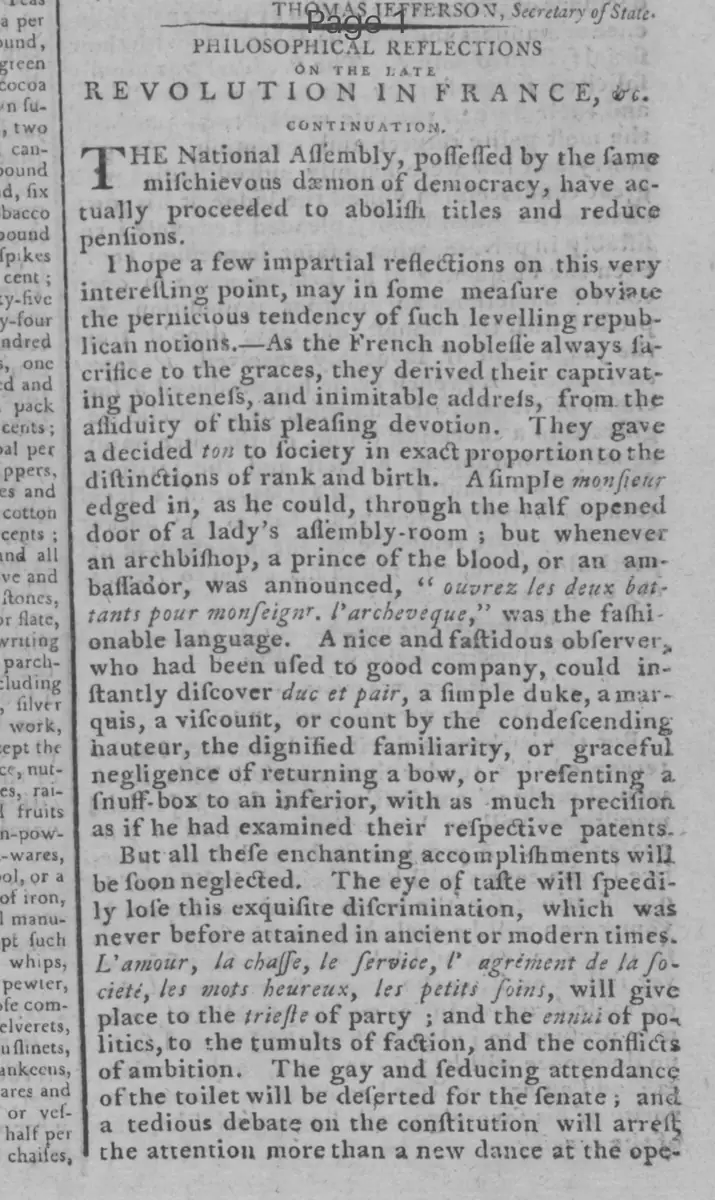
ON THE LATE
REVOLUTION IN FRANCE, &c.
CONTINUATION.
THE National Assembly, by have actually proceeded to abolish titles and reduce pensions.
I hope a few impartial reflections on this very interesting point, may in some measure obviate the pernicious tendency of such levelling republican notions.—As the French nobility always sacrifice to the graces, they derived their captivating politeness, and inimitable address, from the assiduity of this pleasing devotion. They gave a decided tone to society in exact proportion to the distinctions of rank and birth. A simple monsieur edged in, as he could, through the half opened door of a lady's assembly-room; but whenever an archbishop, a prince of the blood, or an ambassador, was announced, "ouvrez les deux battants pour monseigneur l'archevêque," was the fashionable language. A nice and fastidious observer, who had been used to good company, could instantly discover duc et pair, a simple duke, a marquis, a viscount, or count by the condescending hauteur, the dignified familiarity, or graceful negligence of returning a bow, or presenting a snuff-box to an inferior, with as much precision as if he had examined their respective patents.
But all these enchanting accomplishments will be soon neglected. The eye of taste will speedily lose this exquisite discrimination, which was such never before attained in ancient or modern times. L'amour, la chasse, le service, l'agrement de la societe, les mots heureux, les petits soins, will give place to the trifles of party; and the ennui of politics, to the tumults of faction, and the conflicts of ambition. The gay and seducing attendance of the toilet will be deserted for the senate; and a tedious debate on the constitution will arrest the attention more than a new dance at the opera. Opera, or a ballet at Versailles. A poetical aristocrat who feels for the decadence of his country, laments this fatal change of manners in the following pathetic and affecting lines:
"Autrefois, dans la France,
La présence d'un duc faisoit taire un marquis
Devant l'homme à la cour admis
Un gentilhomme de province
N'auroit osé rester assis
Un bourgeois répétoit le noble le plus mince
Les plus grands imposoient toujours aux plus petits
Et c'étoit un ordre admirable:
Mais l'aujourd'hui dans ce Paris
C'est un despotisme effroyable;
Tout le monde y dit son avis"
How different is our situation at this moment! How triumphant the contrast! By the auspicious exercise of the prerogative, the British and Irish peerage have been liberally increased during the present reign. As birth, fortune, and desert are not fastidiously deemed indispensable qualifications, the gratitude of the new peer to the crown is insured, as he can only ascribe his promotion to the gracious favor of his sovereign, and the benign influence of the minister. Thus the pride and arrogance of assuming merit are effectually checked; and a courtly compliant race of nobles gradually formed; all actuated by the true spirit of aristocracy, and implicitly devoted to the crown; always ready to support its prerogatives, and maintain the splendid privileges of their own order, against vulgar prejudice, and popular encroachments.
For though the lords derive their honor from the crown, the fountain of all honor; still as they are only trustees, they should be ever ready to resign it with alacrity on any great political crisis. By a spirited exertion, founded on this generous sentiment, a few noble peers, [if report is to be credited] gallantly despising reproach and obloquy, and disdaining to be bound by too rigid and scrupulous an adherence to their word, saved the king, the church, and the nation, by voting against the East India bill in 1783.
On the same maxim, a desertion of friends, party, and principle, may sometimes be considered as a political test, and as a just, fair, and constitutional claim to a pension and peerage; being a sort of feudal homage, and the most unequivocal proof of profound duty, loyalty, and attachment. Surely even the malignity of faction must admit, that the elevation of soul which indignant virtue inspires, could alone induce any person to act what is commonly, but very erroneously, deemed a dishonorable part in politics.
Would the most unprincipled administration abandon such an intrepid convert, to be vilified, traduced, and exposed to the bitter taunts, and contemptuous sneers of a calumniating opposition? No: let a man of such heroic merit never be consigned to disgrace; let him be ennobled by a title, and enriched by a pension, in order to excite a generous emulation in others, and as the only adequate reward and consolation he himself can relish.
I have also, Sir, often reflected with singular satisfaction on the pleasing mode in which civil suits were carried on in France; where even the decisions of justice were biassed by the gentle influence of manners and customs, & blended with their social system of policy. The President was usually solicited in person, by his noble or fair clients, and their state of the case was listened to with the most polite respect and attention. As gallantry and law were happily united, ladies with great condescension visited the judge at his own chamber. When beauty pleaded her cause irresistibly in private, what a faint impression could even the eloquence of an Erskine make in open court? Sometimes an amorous proposition, expressed with the utmost delicacy, drop'd from the judge, and if favorably received, le proces etoit gagné. A French critic has produced a specimen of elegant wit, addressed by a judicial magistrate to a charming suitor, on this nice point, equally honorable to himself and the jurisprudence of his country: The equivoque of a legal term is happily preserved; for as the author was a lawyer, he remembered the profession in his poetical rapture, and rested his claim to reciprocity on a double entendre:
"Vous avez chez moi libre accès,
J'en demande chez vous un autre.
Si je ne gagne mon procès,
Vous ne gagnerez pas le vôtre:" &c.
But the barbarous spirit of democracy has interrupted this tender intercourse! This sentimental mode of conducting law-suits! Judicial magistrates will no longer be permitted to pursue amours. A previous study and long practice in the courts will be esteemed indispensable qualifications for the bench; and consequently young men will be excluded, on whose generous feelings the tears and solicitations of the fair sex never fail in exciting the warmest emotions. Inexorable bourgeois juries will be established, who may presume to judge both of the law and fact; no deference will be paid to birth, rank, or riches; and an accomplished courtier, perhaps a favorite of his sovereign, will be treated like one of the canaille.
But the evil will not stop here: not only the soft intercourse which has been just described, will no longer be tolerated. but all the delicacies of polite society will be abolished, and ancient rusticity revived. The ideas which the Greeks formed of politeness, must have been very different from ours," says Mr. Hume, in quoting this passage from Menander: "It is not in the power of the Gods to make a polite soldier."
The reason is obvious. The turbulent spirit of licentious equality diffused among the Grecian republics, inspired a contempt for those finer social arts, the original invention of which even Mr. Dutens admits to be modern. They disdained to acquire that respectful address, that delicate adulation, and honourable subserviency to the pleasure and inclination of others, in which the very essence of true politeness consists. Such a sensitive plant shrinks from the rude hand of democracy, and can be only cultivated to its utmost perfection under the genial influence and cheering beams of court sunshine. The author of Esprit des Loix, who saw this fully exemplified in his own country, remarks, with patriotic exultation, "that politeness and arbitrary power made an equal progress among the Romans."
The converse of this proposition is likewise true. The French will soon lose that boasted superiority which has so long excited the envy and emulation of Europe. Even the Dutch, under the protection and auspices of the Prussian monarch, will speedily be drilled into more refinement, and excel them in every graceful and elegant accomplishment. As amiableness of character is attained by the agreeable art of concealing the boisterous allies of passion, and restraining the disgusting bluntness of sincerity, politeness and dissimulation are indissolubly connected, and always flourish under the protection of royalty. This exterior varnish pleases the eye, though it disguises the heart;—as painting glass, beautifies it, but renders it less transparent.
(To be continued.)
What sub-type of article is it?
What themes does it cover?
What keywords are associated?
Literary Details
Title
Philosophical Reflections On The Late Revolution In France, &C. Continuation.
Subject
Reflections On The French Revolution's Impact On Nobility, Politeness, And Society, Contrasted With British Aristocracy.
Form / Style
Prose Essay With Satirical Critique And Embedded French Poetry.
Key Lines