Thank you for visiting SNEWPapers!
Sign up free
Public Ledger
Memphis, Shelby County, Tennessee
What is this article about?
Description of the Bank of England's operations, including its secure location, staffing, note printing and tracking, issuance limits backed by government loans and bullion, and handling of gold coins by weight.
Clipping
OCR Quality
Full Text
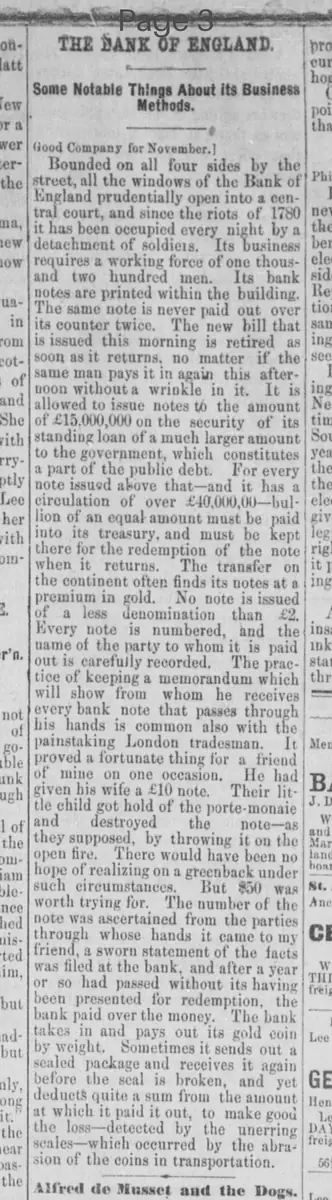
Some Notable Things About its Business Methods.
[Good Company for November.]
Bounded on all four sides by the street, all the windows of the Bank of England prudentially open into a central court, and since the riots of 1780 it has been occupied every night by a detachment of soldiers. Its business requires a working force of one thousand two hundred men. Its bank notes are printed within the building. The same note is never paid out over its counter twice. The new bill that is issued this morning is retired as soon as it returns, no matter if the same man pays it in again this afternoon without a wrinkle in it. It is allowed to issue notes to the amount of £15,000,000 on the security of its standing loan of a much larger amount to the government, which constitutes a part of the public debt. For every note issued above that—and it has a circulation of over £40,000,000—bullion of an equal amount must be paid into its treasury, and must be kept there for the redemption of the note when it returns. The transfer on the continent often finds its notes at a premium in gold. No note is issued of a less denomination than £5 Every note is numbered, and the name of the party to whom it is paid out is carefully recorded. The practice of keeping a memorandum which will show from whom he receives every bank note that passes through his hands is common also with the painstaking London tradesman. It proved a fortunate thing for a friend of mine on one occasion. He had given his wife a £10 note. Their little child got hold of the porte-monnaie and destroyed the note—as they supposed, by throwing it on the open fire. There would have been no hope of realizing on a greenback under such circumstances. But £10 was worth trying for. The number of the note was ascertained from the parties through whose hands it came to my friend, a sworn statement of the facts was filed at the bank, and after a year or so had passed without its having been presented for redemption, the bank paid over the money. 'The bank takes in and pays out its gold coin by weight. Sometimes it sends out a sealed package and receives it again before the seal is broken. and yet deducts quite a sum from the amount at which it paid it out, to make good the loss—detected by the unerring scales—which occurred by the abrasion of the coins in transportation.
What sub-type of article is it?
What keywords are associated?
Where did it happen?
Foreign News Details
Primary Location
London
Event Details
The Bank of England is bounded by streets with windows opening to a central court, guarded by soldiers since 1780 riots, employs 1200 men, prints notes internally, retires and replaces used notes, issues up to £15,000,000 on government loan security and more backed by bullion up to over £40,000,000 circulation, notes premium on continent, minimum £5 denomination, numbered with recipient recorded, London tradesmen track notes, anecdote of lost £10 note redeemed after a year via records, handles gold by weight detecting abrasion losses.