Thank you for visiting SNEWPapers!
Sign up free
The Gazette
Portland, Cumberland County, Maine
What is this article about?
Detailed description of Malta's geography, history, economy, inhabitants, and the Knights of St. John who govern it, including fortifications, resources, and military capabilities as observed by a modern writer.
Clipping
OCR Quality
Full Text
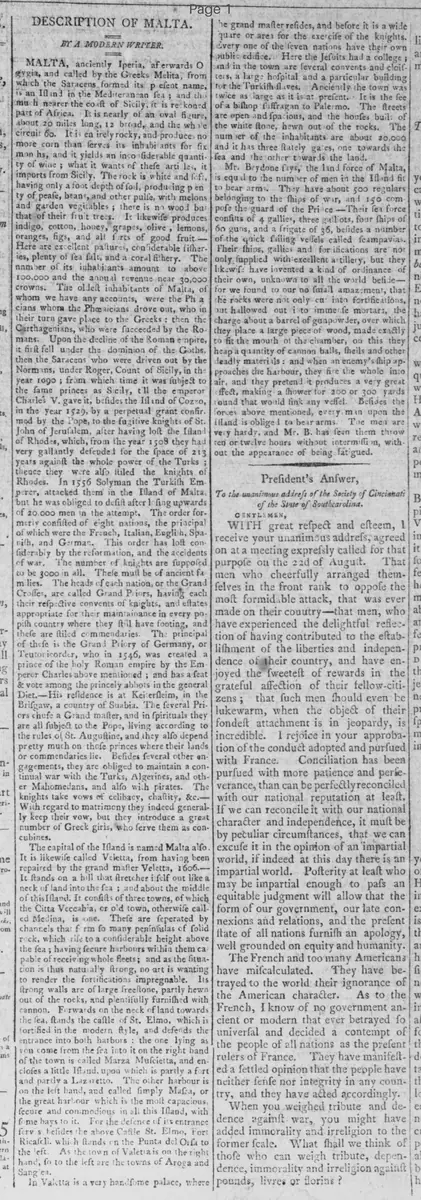
BY A MODERN WRITER.
MALTA, anciently Melita, afterwards Ogygia, and called by the Greeks Melita, from which the Saracens formed its present name, is an Island in the Mediterranean Sea; and tho much nearer the coast of Sicily, it is reckoned part of Africa. It is nearly of an oval figure, about 20 miles long, 12 broad, and the whole circuit 60. It is entirely rocky, and produces no more corn than serves its inhabitants for six months, and it yields an inconsiderable quantity of wine; what it wants of these articles, it imports from Sicily. The rock is white and soft, having only a foot depth of soil, producing plenty of pease, beans, and other pulse, with melons and garden vegetables; there is no wood but that of their fruit trees. It likewise produces indigo, cotton, honey, grapes, olives, lemons, oranges, figs, and all sorts of good fruit. Here are excellent pastures, considerable fisheries, plenty of sea salt, and a coral fishery. The number of its inhabitants amount to above 100,000 and the annual revenue near 30,000 crowns.
The oldest inhabitants of Malta, of whom we have any accounts, were the Phoenicians whom the Phoenicians drove out, who in their turn gave place to the Greeks: then the Carthagenians, who were succeeded by the Romans. Upon the decline of the Roman empire, it first fell under the dominion of the Goths, then the Saracens who were driven out by the Normans, under Roger, Count of Sicily, in the year 1090; from which time it was subject to the same princes as Sicily, till the emperor Charles V. gave it, besides the Island of Gozzo, in the year 1522, by a perpetual grant confirmed by the Pope, to the fugitive knights of St. John of Jerusalem, after having lost the Island of Rhodes, which, from the year 1508 they had very gallantly defended for the space of 213 years against the whole power of the Turks; thence they were all titled the knights of Rhodes. In 1565 Solyman the Turkish Emperor, attacked them in the Island of Malta, but he was obliged to desist after losing upwards of 20,000 men in the attempt.
The order formerly consisted of eight nations, the principal of which were the French, Italian, English, Spanish, and German. This order has lost considerably by the reformation, and the accidents of war. The number of knights are supposed to be 3000 in all. These must be of ancient families. The heads of each nation, or the Grand Crosses, are called Grand Priors, having each their respective convents of knights, and estates appropriate for their maintenance in every popish country where they still have footing, and these are styled commanderies. The principal of these is the Grand Priory of Germany, or Teutonic order, who in 1540, was created a prince of the holy Roman empire by the Emperor Charles above mentioned; and has a seat & vote among the princely abbots in the general Diet.—His residence is at Heitersheim, in the Bipgau, a country of Suabia. The several Priors chuse a Grand master, and in spirituals they are all subject to the Pope, living according to the rules of St. Augustine, and they also depend pretty much on those princes where their lands or commanderies lie. Besides several other engagements, they are obliged to maintain a continual war with the Turks, Algerines, and other Mahomedans, and also with pirates. The knights take vows of celibacy, chastity, &c.—With regard to matrimony they indeed generally keep their vow, but they introduce a great number of Greek girls, who serve them as concubines.
The capital of the Island is named Malta also. It is likewise called Valetta, from having been repaired by the grand master Valetta. 1566.—It stands on a hill that stretches itself out like a neck of land into the sea: and about the middle of this Island. It consists of three towns. of which the Citta Vecchia, or old town, otherwise called Medina, is one. These are separated by channels that form so many peninsulas of solid rock, which rise to a considerable height above the sea; having secure harbours within them capable of receiving whole fleets; and as the Situation is thus naturally strong, no art is wanting to render the fortifications impregnable. Its strong walls are of large freestone, partly hewn out of the rocks, and plentifully furnished with cannon. Forwards on the neck of land towards the sea. stands the castle of St. Elmo, which is fortified in the modern style, and defends the entrance into both harbors: the one lying as you come from the sea into it on the right hand of the town is called Marza Muscietta, and encloses a little Island, upon which is partly a fort and partly a Lazaretto. The other harbour is on the left hand, and called simply Marsa, or the great harbour which is the most capacious, secure and commodious in all this Island, with some bays to it. For the defence of its entrance serves besides the above Castle St. Elmo, Fort Ricasoli. which stands on the Punta del Oria to the left. As the town of Valetta is on the right hand, so to the left are the towns of Birgu and Senglea.
In Valetta is a very handsome palace, where the grand master resides, and before it is a wide square or area for the exercise of the knights. Every one of the eight nations have their own public edifice. Here the Jesuits had a college; and in the town are several convents and cloisters, a large hospital and a particular building for the Turkish slaves. Anciently the town was twice as large as it is at present. It is the see of a bishop suffragan to Palermo. The streets are open and spacious, and the houses built of the white stone, hewn out of the rocks. The number of the inhabitants are about 20,000 and it has three stately gates, one towards the sea and the other towards the land.
Mr. Brydone says, the land force of Malta, is equal to the number of men in the Island fit to bear arms. They have about 500 regulars belonging to the ships of war, and 150 compose the guard of the Prince —Their sea force consists of 4 galleys, three galliots, four ships of 60 guns, and a frigate of 36, besides a number of the quick sailing vessels called xebecks. Their ships, galleys and fortifications are not only supplied with excellent artillery, but they likewise have invented a kind of ordinance of their own, unknown to all the world beside—for we found to our no small amazement, that the rocks were not only cut into fortifications, but hollowed out into immense mortars, the charge about a barrel of gunpowder, over which they place a large piece of wood, made exactly to fit the mouth of the chamber, on this they heap a quantity of cannon balls, shells and other deadly materials: and when an enemy's ship approaches the harbour, they fire the whole into the air, and they pretend it produces a very great effect, making a shower for 200 or 300 yards round that would sink any vessel. Besides the forces above mentioned, every man upon the Island is obliged to bear arms. The men are very hardy, and Mr. B. has seen them throw ten or twelve hours without intermission, without the appearance of being fatigued.
What sub-type of article is it?
What keywords are associated?
What entities or persons were involved?
Where did it happen?
Foreign News Details
Primary Location
Malta
Key Persons
Outcome
in 1565, solyman the turkish emperor attacked malta but desisted after losing upwards of 20,000 men.
Event Details
Malta is an oval-shaped rocky island in the Mediterranean, 20 miles long, 12 broad, with 100,000 inhabitants and revenue of 30,000 crowns. It produces limited corn and wine, imports from Sicily, and yields various fruits, vegetables, indigo, cotton, honey, and supports fisheries and salt production. Historically ruled by Phoenicians, Greeks, Carthaginians, Romans, Goths, Saracens, and Normans; granted in 1522 to Knights of St. John after loss of Rhodes. Knights, numbering 3000 from eight nations, defend against Turks and pirates, maintain commanderies, and follow vows though with concubines. Capital Valetta, fortified with harbors, castles like St. Elmo, and unique rock mortars. Military includes land forces equal to able men, 500 regulars, sea force of galleys, ships, and xebecks.