Thank you for visiting SNEWPapers!
Sign up free
Editorial
May 10, 1813
Virginia Argus
Richmond, Virginia
What is this article about?
Virginia Argus editorial critiques absurd British war reports from Europe, predicts setbacks for Napoleon's foes, praises U.S. naval triumphs over Britain due to American liberty, notes British naval inquiries, reports Sicily's revolt against British, mocks Ned Livingston, details Ohio militia mobilization against Indians, and includes postscript with U.S. fleet news, English updates on prisoners, expeditions, Hamburg occupation, and Java capture.
Clipping
OCR Quality
98%
Excellent
Full Text
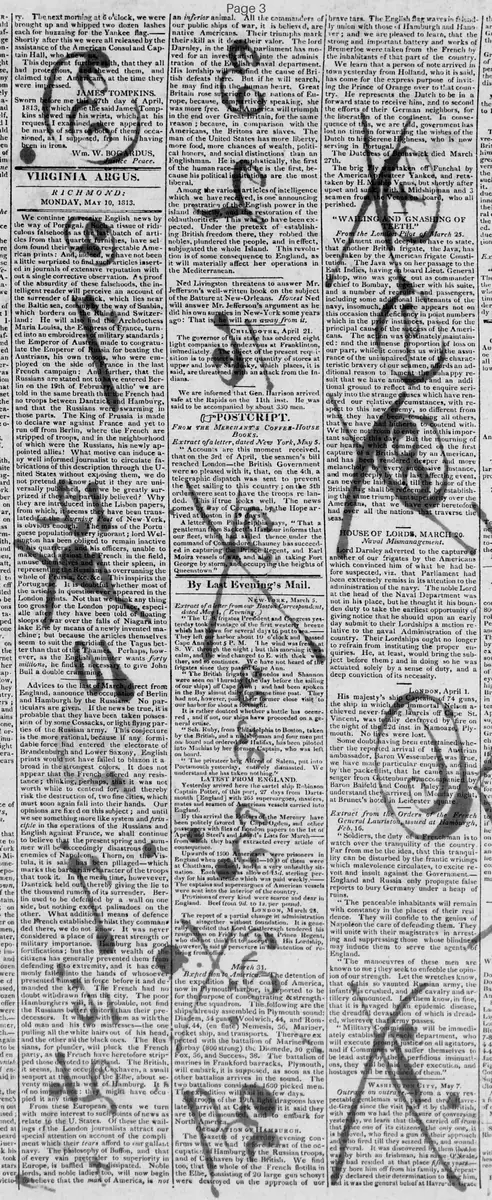
VIRGINIA ARGUS.
RICHMOND:
MONDAY, MAY 10, 1813.
We continue to receive English news by the way of Portugal. Such a tissue of ridiculous falsehoods as the last batch of articles from that quarter furnishes, have seldom found their way into respectable American prints: And, indeed, we have not been a little surprized to find such articles inserted in journals of extensive reputation without a single corrective observation. As proof of the absurdity of these falsehoods, the intelligent reader will perceive an account of the surrender of Dantzick, which lies near the Baltic sea, coming by the way of Suabia, which borders on the Rhine and Switzerland: He will also find the Archduchess Maria Louisa, the Empress of France, turned into an embroidress of military standards; the Emperor of Austria made to congratulate the Emperor of Russia for beating the Austrians, his own troops, who were employed on the side of France in the last French campaign: And further, that the Russians are stated not to have entered Berlin on the 19th of February altho' we are told in the same breath that the French had no troops between Dantzick and Hamburg, and that the Russians were swarming in those parts. The King of Prussia is made to declare war against France and yet to run off from Berlin, where the French are stripped of troops, and in the neighborhood of which were the Russians, his newly appointed allies! What motive can induce any well informed journalist to circulate fabrications of this description through the United States without exposing them, we do not pretend to know; but if they are universally published, can we be greatly surprized if they are partially believed? Why they are introduced into the Lisbon papers, from which, it seems they have been translated for the Evening Post of New-York, is obvious enough. The mass of the Portuguese population is very ignorant; lord Wellington has been obliged to remain inactive in his quarters; and his officers, unable to make head against the French in the field, amuse themselves and vent their spleen, in representing the Russians as overrunning the whole of Prussia, &c. &c. This inspirits the Portuguese. It is doubtful whether most of the articles in question ever appeared in the London prints. Not that we think any thing too gross for the London populace, especially after they have been told of floating sloops of war over the falls of Niagara into lake Erie by means of a newly invented machine; but because the articles themselves seem to suit the meridian of the Tagus better than that of the Thames. Perhaps, however, as the English minister wants forty millions, he finds it necessary to give John Bull a double cramming. Advices to the last of March direct from England, announce the occupation of Berlin and Hamburgh by the Russians. No particulars are given. If the news be true, it is probable that they have been taken possession of by some Cossacks, or light flying parties of the Russian army. This conjecture is the more rational, because if any formidable force had entered the electorate of Brandenburgh and Lower Saxony, English prints would not have failed to blazon it abroad in the strongest colors. It does not appear that the French offered any resistance; thinking, perhaps, that it was not worth while to contend for, and thereby risk the destruction of, two fine cities, which must soon again fall into their hands. Our opinions are fixed on this subject; and until we see something more like system and discipline in the operations of the Russians and English against France, we shall continue to believe that the present spring and summer will be exceedingly disastrous to the enemies of Napoleon. Thorn, on the Vistula, it is said has been pillaged-which marks the barbarian character of the troops that took it. In the mean time, however, Dantzick held out thereby giving the lie to the thousand rumors of its surrender. Berlin used to be defended by a wall on one side, but nothing except palisadoes on the other. What additional means of defence the French established whilst they commanded there, we do not know. It was never considered a place of any great strength or military importance. Hamburg has good fortifications; but the great wealth of the citizens has generally prevented them from defending it to extremity, and it has commonly fallen into the hands of whosoever presented himself in force before it and demanded the keys. The French had no doubt withdrawn from the city. The poor Hamburghers will, it is probable, not find the Russians better visitors than their predecessors. It will be with them as with the old man and his two mistresses—the one pulling all the white hairs out of his head, and the other all the black ones. The Russians, for plunder, will pluck the French party, as the French have heretofore stripped those devoted to England. The British, it seems, have occupied Cuxhaven, a small seaport at the mouth of the Elbe, about seventy miles north west of Hamburg. It is of no importance: they might have occupied it any time. From these European events we turn with more interest to such points of news as relate to the U. States. Of these the wailings of the London journalists attract our special attention on account of the compliment which their tears afford to our gallant navy. The philosophy of Buffon, and that of every vain pretender to superiority in Europe, is baffled and dissipated. Noble lords, and noble ladies too, will now begin to believe that the man of America, is not an inferior animal. All the commanders of our public ships of war, it is believed, are native Americans. Their triumphs mark their skill as it does their valor. The lord Darnley, in the British parliament has moved for an investigation into the administration of the English naval department. His lordship will not find the cause of British defeats there. But if he will search, he may find it in the human heart. Great Britain rose superior to the nations of Europe, because, comparatively speaking, she was more free. And America will triumph in the end over Great Britain, for the same reason; because, in comparison with the Americans, the Britons are slaves. The man of the United States has more liberty, more food, more chances of wealth, political honors, and social distinctions than an Englishman. He is, emphatically, the first of the human race-and he is the first, because his political institutions are the most liberal.
Among the various articles of intelligence which we have received, is one announcing the prostration of the English power in the island of Sicily and the restoration of the old authorities. This was to have been expected. Under the pretext of establishing British freedom there, they robbed the nobles, plundered the people, and in effect, subjugated the whole Island. This revolution is of some consequence to England, as it will materially affect her operations in the Mediterranean.
Ned Livingston threatens to answer Mr. Jefferson's well-written book on the subject of the Batture at New-Orleans. Honest Ned will answer Mr. Jefferson's argument as he did his own sureties in New-York some years ago: That is, he will run away from it.
Chillicothe, April 21.
The governor of this state has ordered eight light companies to rendezvous at Franklinton, immediately. The object of the present requisition is to protect a large quantity of stores at upper and lower Sandusky, which places, it is said, are threatened with an attack from the Indians.
We are informed that Gen. Harrison arrived safe at the Rapids on the 11th inst. He was said to be accompanied by about 350 men.
POSTSCRIPT.
From The Merchant's Coffee-House Books.
Extract of a letter, dated New York, May 5.
"Accounts are this moment received, that on the 3rd of April, the seamen's bill reached London-the British Government were so pleased with it, that, on the 4th, a telegraphic dispatch was sent to prevent the fleet sailing to this country; on the 5th orders were sent to have the troops re-landed. This if true looks well, The news comes by way of Corunna, by the Hope arrived at Boston in 19 days."
A letter from Philadelphia says,
"That a gentleman from Sackett's Harbour informs that our fleet, which had sailed thence under the command of Commodore Chauncey has succeeded in capturing the Prince Regent, and Earl Moira vessels of war, and also in taking Fort George by storm, and occupying the heights of Queenstown."
By Last Evening's Mail.
NEW YORK, May 5.
Extract of a letter from our Boston Correspondent, dated May 1, (Evening.)
"The U. S. frigates President and Congress yesterday took advantage of the first westerly breeze which has blown for several days to put to sea. They left our harbor about 10 o'clock and passed Cape Ann about 5 P. M. The wind was fresh at S. W. through the night; but this morning it was calm, and the wind changed to E. with thick weather, and so continues. We have not heard of the frigates since they passed Cape Ann."
"The British frigates Tenedos and Shannon were seen on Thursday (the day before the sailing of our ships) off Cape Ann; and had been spoken in the Bay almost daily for some time past. They had not, however, paid their former close visit to our harbor for about a fortnight. It is rather doubted whether a battle has occurred, and if not, our ships have proceeded on a general cruise."
"Sch. Ruby, from Philadelphia to Boston, taken by the British, and a midshipman and four men put onboard and ordered for Halifax, has been piloted into Machias by her former Captain, who was left on board."
"The privateer brig Alfred of Salem, put into Portsmouth yesterday, entirely dismasted. We understand she has taken nothing."
LATEST FROM ENGLAND.
Yesterday arrived here the cartel ship Robinson Captain Potter, of this port, 27 days from Dartmouth [England] with 265 supercargoes, masters, mates and seamen of American vessels carried into England.
By this arrival the Editors of the Mercury have been politely favored by Capt. Ogden, and other passengers with files of London papers to the 1st of April and Steel's and Hasard's Lists for March-- from which they have extracted every article of consequence.
Upwards of 1500 Americans were prisoners in England when capt. P. sailed-1000 of them were at Chatham, confined, and in a very unhealthy situation. Each man was allowed 15d. sterling per day for his subsistence which was paid weekly.
The captains and supercargoes of American vessels were sent into the interior of the country.
Provisions of every kind were scarce and dear in England. Beef from 9d. to 1s. per pound.
London, March 28.
The report of a partial change in administration is not altogether without foundation. It is generally credited that Lord Castlereagh tendered his resignation on Friday last to the Prince Regent, who did not think fit to accept it. His Lordship, however, is said to persevere in his intention of retiring from office.
March 31.
Bound from to America.-The detention of the expedition for the coast of America, now in Plymouth harbor, is reported to be for the purpose of concentrating & strengthening the squadron. The following are the ships already assembled in Plymouth sound:
Diadem, 54 guns, Woolwich, 44, and Romulus, 44, (en flute) Nemesis, 36, Mariner rocket ship, and transports.
There are expected with the battalion of Marines from Torbay (800 strong) the Diomede, 50 guns, Fox, 36, and Success, 38. The battalion of marines in Frankford barracks, Plymouth, will embark, it is supposed, as soon as the other battalion arrives in the sound. The two battalions consist of 1600 picked men.
The expedition will sail in a few days.
Six troops of the 19th light dragoons have lately arrived at Cork where it is said they are to be dismounted, and to embark for North America.
OCCUPATION OF HAMBURGH.
The Gazette of yesterday evening confirms what we had before learnt of the occupation of Hamburg by the Russian troops, and of Cuxhaven by the British. We find too, that the whole of the French flotilla in the Elbe, consisting of 20 large gun schooyts were destroyed on the approach of our brave tars. The English flag waves in proud union with those of Hamburgh and Hanover; and we are pleased to learn, that the strong and important battery and works of Bremerloe were taken from the French by the inhabitants of that part of the country. We learn that a person of note arrived in town yesterday from Holland, who it is said, has come for the express purpose of inviting the Prince of Orange over to that country. He represents the Dutch to be in a forward state to receive him, and to second the efforts of their German neighbors, for the liberation of the continent. In consequence of this, we are told, government has lost no time in forwarding the wishes of the Dutch to his Serene Highness, who is now serving in Portugal.
The Dutchess of Brunswick died March 27th.
The brig ... taken off Funchal by the American privateer Yankee, and re-taken by H.M.S. Venus, but shortly after upset and sunk, with a Midshipman and 3 seamen from Venus on board, who all perished.
"WAILING AND GNASHING OF TEETH."
From the London Pilot of March 25.
We lament most deeply to have to state, that another British frigate, the Java, has been taken by the American frigate Constitution. The Java was on her passage to the East Indies, having on board Lieut. General Hislop, who was going out as commander in chief to Bombay, together with his suite, and a number of recruits and passengers, including some additional lieutenants of the navy, insomuch, that there appears not on this occasion that deficiency in point numbers which in the prior instances, passed for the principal cause of the success of the Americans. The action was obstinately maintained: and the immense proportion of loss on our part, while it consoles us with the assurance of the unimpaired state of the characteristic bravery of our seamen, affords an additional reason to lament the unhappy result that we have announced, and an additional ground to reflect and to enquire seriously into the strange causes which have rendered our relative circumstances, with respect to this new enemy, so different from what they have been, touching all others, that we have had hitherto to contend with. We have not room to enter into this important subject this day. But the mourning of our hearts, which commenced on the first capture of a British ship by an American, and has been rendered deeper and more melancholy by every successive instance, and most deeply by this last affecting event, can never be laid aside, till the honor of the British flag shall be redeemed, by establishing the same triumphant superiority over the Americans, that we have ever heretofore had over all the nations that traverse the seas.
HOUSE OF LORDS, MARCH 20.
Naval Mismanagement.
Lord Darnley adverted to the capture of another of our frigates by the Americans which convinced him of what he had before suspected, viz. that Parliament had been extremely remiss in its attention to the administration of the navy. The noble Lord at the head of the Naval Department was not in his place, but he thought it his bounden duty to take the earliest opportunity of giving notice that he should upon an early day submit to their Lordships a motion relative to the naval Administration of the country. Their Lordships ought no longer to refrain from instituting the proper enquiries. He, at least, would bring the subject before them; and in doing so he was actuated solely by a sense of duty, and a deep conviction of its necessity.
London, April 1.
His majesty's ship Captain, of 74 guns, the ship in which the immortal Nelson achieved never-fading laurels off Cape St. Vincent, was totally destroyed by fire on the night of the 22d inst. in Hamoaze, Plymouth. No lives were lost.
Some doubt having been entertained whether the reported arrival of the Austrian ambassador, Baron Wessenberg, was true, we have made particular enquiry, and find by the packet list, that he came as a passenger from Altenburg accompanied by Baron Baifeld and Count Paley: and understand they arrived on Monday night, at Brunet's hotel in Leicester square.
Extract from the Orders of the French General Lauriston issued at Hamburgh, Feb. 16.
"Soldiers, the duty of a Frenchman is to watch over the tranquility of the country. Far from me be the idea, that this tranquility can be disturbed by the frantic writings which malevolence circulates, to excite revolt and insult against the Government.- England and Russia only propagate false reports to bury Germany under a heap of ruins.
"The peaceable inhabitants will remain with constancy in the places of their residence. They will confide to the genius of Napoleon the care of defending them. They will unite with their magistrates in arresting and suppressing those whose blindness may induce them to serve the agents of England.
"The manoeuvres of these men are known to me; they seek to enfeeble the opinion of our strength. Let the wretches know, that of this so vaunted Russian army, the infantry is crushed, and the cavalry and artillery dismounted. Let them know, in fine, that it is ravaged by an epidemic disease, the dreadful devastation of which is dreaded, wherever that army passes.
"Military Commissions will be immediately established in each department, who will execute prompt justice on all agitators, and if Communities will suffer themselves to be led astray by their perfidious insinuations, they will be laid under execution, and hostages will be required of them."
RICHMOND:
MONDAY, MAY 10, 1813.
We continue to receive English news by the way of Portugal. Such a tissue of ridiculous falsehoods as the last batch of articles from that quarter furnishes, have seldom found their way into respectable American prints: And, indeed, we have not been a little surprized to find such articles inserted in journals of extensive reputation without a single corrective observation. As proof of the absurdity of these falsehoods, the intelligent reader will perceive an account of the surrender of Dantzick, which lies near the Baltic sea, coming by the way of Suabia, which borders on the Rhine and Switzerland: He will also find the Archduchess Maria Louisa, the Empress of France, turned into an embroidress of military standards; the Emperor of Austria made to congratulate the Emperor of Russia for beating the Austrians, his own troops, who were employed on the side of France in the last French campaign: And further, that the Russians are stated not to have entered Berlin on the 19th of February altho' we are told in the same breath that the French had no troops between Dantzick and Hamburg, and that the Russians were swarming in those parts. The King of Prussia is made to declare war against France and yet to run off from Berlin, where the French are stripped of troops, and in the neighborhood of which were the Russians, his newly appointed allies! What motive can induce any well informed journalist to circulate fabrications of this description through the United States without exposing them, we do not pretend to know; but if they are universally published, can we be greatly surprized if they are partially believed? Why they are introduced into the Lisbon papers, from which, it seems they have been translated for the Evening Post of New-York, is obvious enough. The mass of the Portuguese population is very ignorant; lord Wellington has been obliged to remain inactive in his quarters; and his officers, unable to make head against the French in the field, amuse themselves and vent their spleen, in representing the Russians as overrunning the whole of Prussia, &c. &c. This inspirits the Portuguese. It is doubtful whether most of the articles in question ever appeared in the London prints. Not that we think any thing too gross for the London populace, especially after they have been told of floating sloops of war over the falls of Niagara into lake Erie by means of a newly invented machine; but because the articles themselves seem to suit the meridian of the Tagus better than that of the Thames. Perhaps, however, as the English minister wants forty millions, he finds it necessary to give John Bull a double cramming. Advices to the last of March direct from England, announce the occupation of Berlin and Hamburgh by the Russians. No particulars are given. If the news be true, it is probable that they have been taken possession of by some Cossacks, or light flying parties of the Russian army. This conjecture is the more rational, because if any formidable force had entered the electorate of Brandenburgh and Lower Saxony, English prints would not have failed to blazon it abroad in the strongest colors. It does not appear that the French offered any resistance; thinking, perhaps, that it was not worth while to contend for, and thereby risk the destruction of, two fine cities, which must soon again fall into their hands. Our opinions are fixed on this subject; and until we see something more like system and discipline in the operations of the Russians and English against France, we shall continue to believe that the present spring and summer will be exceedingly disastrous to the enemies of Napoleon. Thorn, on the Vistula, it is said has been pillaged-which marks the barbarian character of the troops that took it. In the mean time, however, Dantzick held out thereby giving the lie to the thousand rumors of its surrender. Berlin used to be defended by a wall on one side, but nothing except palisadoes on the other. What additional means of defence the French established whilst they commanded there, we do not know. It was never considered a place of any great strength or military importance. Hamburg has good fortifications; but the great wealth of the citizens has generally prevented them from defending it to extremity, and it has commonly fallen into the hands of whosoever presented himself in force before it and demanded the keys. The French had no doubt withdrawn from the city. The poor Hamburghers will, it is probable, not find the Russians better visitors than their predecessors. It will be with them as with the old man and his two mistresses—the one pulling all the white hairs out of his head, and the other all the black ones. The Russians, for plunder, will pluck the French party, as the French have heretofore stripped those devoted to England. The British, it seems, have occupied Cuxhaven, a small seaport at the mouth of the Elbe, about seventy miles north west of Hamburg. It is of no importance: they might have occupied it any time. From these European events we turn with more interest to such points of news as relate to the U. States. Of these the wailings of the London journalists attract our special attention on account of the compliment which their tears afford to our gallant navy. The philosophy of Buffon, and that of every vain pretender to superiority in Europe, is baffled and dissipated. Noble lords, and noble ladies too, will now begin to believe that the man of America, is not an inferior animal. All the commanders of our public ships of war, it is believed, are native Americans. Their triumphs mark their skill as it does their valor. The lord Darnley, in the British parliament has moved for an investigation into the administration of the English naval department. His lordship will not find the cause of British defeats there. But if he will search, he may find it in the human heart. Great Britain rose superior to the nations of Europe, because, comparatively speaking, she was more free. And America will triumph in the end over Great Britain, for the same reason; because, in comparison with the Americans, the Britons are slaves. The man of the United States has more liberty, more food, more chances of wealth, political honors, and social distinctions than an Englishman. He is, emphatically, the first of the human race-and he is the first, because his political institutions are the most liberal.
Among the various articles of intelligence which we have received, is one announcing the prostration of the English power in the island of Sicily and the restoration of the old authorities. This was to have been expected. Under the pretext of establishing British freedom there, they robbed the nobles, plundered the people, and in effect, subjugated the whole Island. This revolution is of some consequence to England, as it will materially affect her operations in the Mediterranean.
Ned Livingston threatens to answer Mr. Jefferson's well-written book on the subject of the Batture at New-Orleans. Honest Ned will answer Mr. Jefferson's argument as he did his own sureties in New-York some years ago: That is, he will run away from it.
Chillicothe, April 21.
The governor of this state has ordered eight light companies to rendezvous at Franklinton, immediately. The object of the present requisition is to protect a large quantity of stores at upper and lower Sandusky, which places, it is said, are threatened with an attack from the Indians.
We are informed that Gen. Harrison arrived safe at the Rapids on the 11th inst. He was said to be accompanied by about 350 men.
POSTSCRIPT.
From The Merchant's Coffee-House Books.
Extract of a letter, dated New York, May 5.
"Accounts are this moment received, that on the 3rd of April, the seamen's bill reached London-the British Government were so pleased with it, that, on the 4th, a telegraphic dispatch was sent to prevent the fleet sailing to this country; on the 5th orders were sent to have the troops re-landed. This if true looks well, The news comes by way of Corunna, by the Hope arrived at Boston in 19 days."
A letter from Philadelphia says,
"That a gentleman from Sackett's Harbour informs that our fleet, which had sailed thence under the command of Commodore Chauncey has succeeded in capturing the Prince Regent, and Earl Moira vessels of war, and also in taking Fort George by storm, and occupying the heights of Queenstown."
By Last Evening's Mail.
NEW YORK, May 5.
Extract of a letter from our Boston Correspondent, dated May 1, (Evening.)
"The U. S. frigates President and Congress yesterday took advantage of the first westerly breeze which has blown for several days to put to sea. They left our harbor about 10 o'clock and passed Cape Ann about 5 P. M. The wind was fresh at S. W. through the night; but this morning it was calm, and the wind changed to E. with thick weather, and so continues. We have not heard of the frigates since they passed Cape Ann."
"The British frigates Tenedos and Shannon were seen on Thursday (the day before the sailing of our ships) off Cape Ann; and had been spoken in the Bay almost daily for some time past. They had not, however, paid their former close visit to our harbor for about a fortnight. It is rather doubted whether a battle has occurred, and if not, our ships have proceeded on a general cruise."
"Sch. Ruby, from Philadelphia to Boston, taken by the British, and a midshipman and four men put onboard and ordered for Halifax, has been piloted into Machias by her former Captain, who was left on board."
"The privateer brig Alfred of Salem, put into Portsmouth yesterday, entirely dismasted. We understand she has taken nothing."
LATEST FROM ENGLAND.
Yesterday arrived here the cartel ship Robinson Captain Potter, of this port, 27 days from Dartmouth [England] with 265 supercargoes, masters, mates and seamen of American vessels carried into England.
By this arrival the Editors of the Mercury have been politely favored by Capt. Ogden, and other passengers with files of London papers to the 1st of April and Steel's and Hasard's Lists for March-- from which they have extracted every article of consequence.
Upwards of 1500 Americans were prisoners in England when capt. P. sailed-1000 of them were at Chatham, confined, and in a very unhealthy situation. Each man was allowed 15d. sterling per day for his subsistence which was paid weekly.
The captains and supercargoes of American vessels were sent into the interior of the country.
Provisions of every kind were scarce and dear in England. Beef from 9d. to 1s. per pound.
London, March 28.
The report of a partial change in administration is not altogether without foundation. It is generally credited that Lord Castlereagh tendered his resignation on Friday last to the Prince Regent, who did not think fit to accept it. His Lordship, however, is said to persevere in his intention of retiring from office.
March 31.
Bound from to America.-The detention of the expedition for the coast of America, now in Plymouth harbor, is reported to be for the purpose of concentrating & strengthening the squadron. The following are the ships already assembled in Plymouth sound:
Diadem, 54 guns, Woolwich, 44, and Romulus, 44, (en flute) Nemesis, 36, Mariner rocket ship, and transports.
There are expected with the battalion of Marines from Torbay (800 strong) the Diomede, 50 guns, Fox, 36, and Success, 38. The battalion of marines in Frankford barracks, Plymouth, will embark, it is supposed, as soon as the other battalion arrives in the sound. The two battalions consist of 1600 picked men.
The expedition will sail in a few days.
Six troops of the 19th light dragoons have lately arrived at Cork where it is said they are to be dismounted, and to embark for North America.
OCCUPATION OF HAMBURGH.
The Gazette of yesterday evening confirms what we had before learnt of the occupation of Hamburg by the Russian troops, and of Cuxhaven by the British. We find too, that the whole of the French flotilla in the Elbe, consisting of 20 large gun schooyts were destroyed on the approach of our brave tars. The English flag waves in proud union with those of Hamburgh and Hanover; and we are pleased to learn, that the strong and important battery and works of Bremerloe were taken from the French by the inhabitants of that part of the country. We learn that a person of note arrived in town yesterday from Holland, who it is said, has come for the express purpose of inviting the Prince of Orange over to that country. He represents the Dutch to be in a forward state to receive him, and to second the efforts of their German neighbors, for the liberation of the continent. In consequence of this, we are told, government has lost no time in forwarding the wishes of the Dutch to his Serene Highness, who is now serving in Portugal.
The Dutchess of Brunswick died March 27th.
The brig ... taken off Funchal by the American privateer Yankee, and re-taken by H.M.S. Venus, but shortly after upset and sunk, with a Midshipman and 3 seamen from Venus on board, who all perished.
"WAILING AND GNASHING OF TEETH."
From the London Pilot of March 25.
We lament most deeply to have to state, that another British frigate, the Java, has been taken by the American frigate Constitution. The Java was on her passage to the East Indies, having on board Lieut. General Hislop, who was going out as commander in chief to Bombay, together with his suite, and a number of recruits and passengers, including some additional lieutenants of the navy, insomuch, that there appears not on this occasion that deficiency in point numbers which in the prior instances, passed for the principal cause of the success of the Americans. The action was obstinately maintained: and the immense proportion of loss on our part, while it consoles us with the assurance of the unimpaired state of the characteristic bravery of our seamen, affords an additional reason to lament the unhappy result that we have announced, and an additional ground to reflect and to enquire seriously into the strange causes which have rendered our relative circumstances, with respect to this new enemy, so different from what they have been, touching all others, that we have had hitherto to contend with. We have not room to enter into this important subject this day. But the mourning of our hearts, which commenced on the first capture of a British ship by an American, and has been rendered deeper and more melancholy by every successive instance, and most deeply by this last affecting event, can never be laid aside, till the honor of the British flag shall be redeemed, by establishing the same triumphant superiority over the Americans, that we have ever heretofore had over all the nations that traverse the seas.
HOUSE OF LORDS, MARCH 20.
Naval Mismanagement.
Lord Darnley adverted to the capture of another of our frigates by the Americans which convinced him of what he had before suspected, viz. that Parliament had been extremely remiss in its attention to the administration of the navy. The noble Lord at the head of the Naval Department was not in his place, but he thought it his bounden duty to take the earliest opportunity of giving notice that he should upon an early day submit to their Lordships a motion relative to the naval Administration of the country. Their Lordships ought no longer to refrain from instituting the proper enquiries. He, at least, would bring the subject before them; and in doing so he was actuated solely by a sense of duty, and a deep conviction of its necessity.
London, April 1.
His majesty's ship Captain, of 74 guns, the ship in which the immortal Nelson achieved never-fading laurels off Cape St. Vincent, was totally destroyed by fire on the night of the 22d inst. in Hamoaze, Plymouth. No lives were lost.
Some doubt having been entertained whether the reported arrival of the Austrian ambassador, Baron Wessenberg, was true, we have made particular enquiry, and find by the packet list, that he came as a passenger from Altenburg accompanied by Baron Baifeld and Count Paley: and understand they arrived on Monday night, at Brunet's hotel in Leicester square.
Extract from the Orders of the French General Lauriston issued at Hamburgh, Feb. 16.
"Soldiers, the duty of a Frenchman is to watch over the tranquility of the country. Far from me be the idea, that this tranquility can be disturbed by the frantic writings which malevolence circulates, to excite revolt and insult against the Government.- England and Russia only propagate false reports to bury Germany under a heap of ruins.
"The peaceable inhabitants will remain with constancy in the places of their residence. They will confide to the genius of Napoleon the care of defending them. They will unite with their magistrates in arresting and suppressing those whose blindness may induce them to serve the agents of England.
"The manoeuvres of these men are known to me; they seek to enfeeble the opinion of our strength. Let the wretches know, that of this so vaunted Russian army, the infantry is crushed, and the cavalry and artillery dismounted. Let them know, in fine, that it is ravaged by an epidemic disease, the dreadful devastation of which is dreaded, wherever that army passes.
"Military Commissions will be immediately established in each department, who will execute prompt justice on all agitators, and if Communities will suffer themselves to be led astray by their perfidious insinuations, they will be laid under execution, and hostages will be required of them."
What sub-type of article is it?
Foreign Affairs
War Or Peace
Military Affairs
What keywords are associated?
Napoleonic Wars
British Propaganda
American Navy
War Of 1812
European Occupation
Naval Victories
Ohio Militia
Indian Threats
What entities or persons were involved?
Napoleon
Lord Wellington
Russians
British Navy
Lord Darnley
Gen. Harrison
Commodore Chauncey
Ned Livingston
Mr. Jefferson
Editorial Details
Primary Topic
Critique Of British War Propaganda And Praise For American Naval Superiority
Stance / Tone
Skeptical Of British Reports, Pro American Liberty, Pro Napoleon
Key Figures
Napoleon
Lord Wellington
Russians
British Navy
Lord Darnley
Gen. Harrison
Commodore Chauncey
Ned Livingston
Mr. Jefferson
Key Arguments
British News From Portugal Contains Ridiculous Falsehoods To Inspire Allies
Russian Advances In Europe Are Minor And Barbaric, French Will Regain Control
American Naval Victories Prove Superiority Due To Greater Liberty
British Defeats Stem From Loss Of Freedom Compared To Americans
Sicily Revolt Against British Occupation Expected
Ohio Militia Mobilized Against Indian Threats