Thank you for visiting SNEWPapers!
Sign up free
Story
April 25, 1860
The River Falls Journal
River Falls, Pierce County, Saint Croix County, Wisconsin
What is this article about?
Narrator witnesses the tragic downfall of schoolmate John Anderson, a once-wealthy, happy family man who succumbs to alcoholism, loses his fortune, family dies, commits theft, and ends in suicide in jail.
Clipping
OCR Quality
95%
Excellent
Full Text
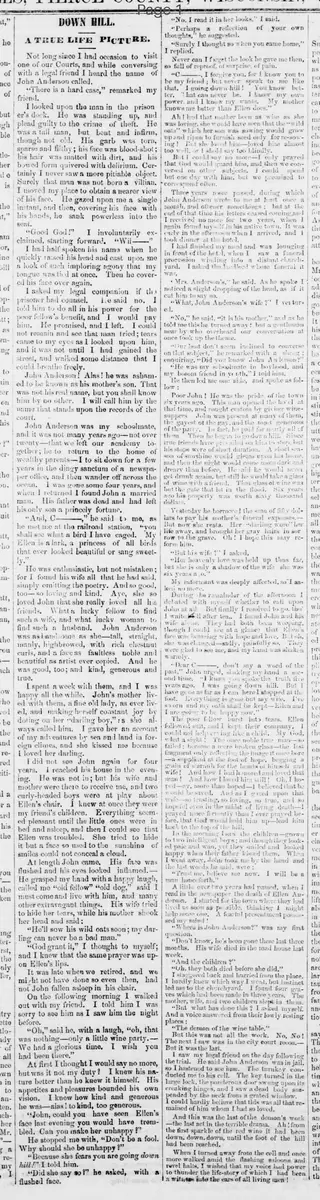
DOWN HILL
A TRUE LIFE PICTURE.
Not long since I had occasion to visit one of our Courts, and while conversing with a legal friend I heard the name of John Anderson called.
"There is a hard case," remarked my friend.
I looked upon the man in the prisoner's dock. He was standing up, and plead guilty to the crime of theft. He was a tall man, but bent and infirm, though not old. His garb was torn, sparse and filthy; his face was blood-shot; his hair was matted with dirt, and his bowed form quivered with delirium. Certainly I never saw a more pitiable object. Surely that man was not born a villain.
I moved my place to obtain a nearer view of his face. He gazed upon me a single instant, and then, covering his face with his hands, he sank powerless into the seat.
"Good God!" I involuntarily exclaimed, starting forward. "Will—"
I had half spoken his name when he quickly raised his head and cast upon me a look of such imploring agony that my tongue was tied at once. Then he covered his face over again.
I asked my legal companion if the prisoner had counsel. He said no. I told him to do all in his power for the poor fellow's benefit, and I would pay him. He promised, and I left. I could not remain and see that man tried; tears came to my eyes as I looked upon him, and it was not until I had gained the street, and walked some distance that I could breathe freely.
John Anderson! Alas! he was ashamed to be known as his mother's son. That was not his real name, but you shall know him by no other. I will call him by the name that stands upon the records of the court.
John Anderson was my schoolmate, and it was not many years ago—not over twenty—that we left our academy together; he to return to the home of wealthy parents—I to sit down for a few years in the dingy sanctum of a newspaper office, and then wander off across the ocean. I was gone some four years, and when I returned I found John a married man. His father was dead and had left his only son a princely fortune.
"And, C—," he said to me, as he met me at the railroad station, "you shall see what a bird I have caged. My Ellen is a lark, a princess of all birds that ever looked beautiful or sang sweetly."
He was enthusiastic, but not mistaken; for I found his wife all that he had said, simply omitting the poetry. And so good, too—so loving and kind. Aye, she so loved John that she really loved all his friends. What a lucky fellow to find such a wife, and what lucky woman to find such a husband. John Anderson was as handsome as she—tall, straight, manly, highbrowed, with rich chestnut curls, and a face as faultless, noble and beautiful as artist ever copied. And he was good, too; and kind, generous and true.
I spent a week with them, and I was happy all the while. John's mother lived with them, a fine old lady, as ever lived, and making herself constant joy by doting on her "darling boy," as she always called him. I gave her an account of my adventures by sea and land in foreign climes, and she kissed me because I loved her darling.
I did not see John again for four years. I reached his house in the evening. He was not in; but his wife and mother were there to receive me, and two curly-headed boys were at play about Ellen's chair. I knew at once they were my friend's children. Everything seemed pleasant until the little ones were in bed and asleep, and then I could see that Ellen was troubled. She tried to hide it but a face so used to the sunshine of smiles could not conceal a cloud.
At length John came. His face was flushed and his eyes looked inflamed. He grasped my hand with a happy laugh, called me "old fellow" "old dog," said I must come and live with him, and many other extravagant things. His wife tried to hide her tears, while his mother shook her head and said:
"He'll sow his wild oats soon; my darling can never be a bad man."
"God grant it," I thought to myself: and I knew that the same prayer was upon Ellen's lips.
It was late when we retired, and we might not have done so even then, had not John fallen asleep in his chair.
On the following morning I walked out with my friend. I told him I was sorry to see him as I saw him the night before.
"Oh," said he, with a laugh, "oh, that was nothing—only a little wine party. We had a glorious time. I wish you had been there."
At first I thought I would say no more, but was it not my duty? I knew his nature better than he knew it himself. His appetites and pleasures bounded his own vision. I knew how kind and generous he was—alas! too kind, too generous.
"John, could you have seen Ellen's face last evening you would have trembled. Can you make her unhappy?"
He stopped me with, "Don't be a fool. Why should she be unhappy?"
"Because she fears you are going down hill!" I told him.
"Did she say so?" he asked, with a flushed face.
"No. I read it in her looks." I said.
"Perhaps a reflection of your own thoughts," he suggested.
"Surely I thought so when you came home," I replied.
Never can I forget the look he gave me then, so full of reproof, of surprise, of pain.
"C—. I forgive you, for I know you to be my friend; but never speak to me like that," I going down hill! "You know better. That can never be. I know my own power, and I know my wants. My mother knows me better than Ellen does."
Ah! had that mother been as wise as she was loving, she would have seen that the "wild oats" which her son was sowing would grow up and ripen to furnish seed only for re-sowing! But she loved him—loved him almost too well, or I should say too blindly.
But I could say no more—I only prayed that God would guard him, and then we conversed on other subjects. I could spend but one day with him, but we promised to correspond often.
Three years more passed, during which John Anderson wrote to me at least once a month, and oftener sometimes; but at the end of that time his letters ceased coming, and I received no more for two years, when I again found myself in his native town. It was early in the afternoon when I arrived, and I took dinner at the hotel.
I had finished my meal and was lounging in front of the hotel, when I saw a funeral procession winding into a distant church-yard. I asked the landlord whose funeral it was.
"Mrs. Anderson's," he said. As he spoke I noticed a slight dropping of the head, as if it cut him to say so.
"What, John Anderson's wife?" I ventured.
"No," he said. "it is his mother." and as he told me this he turned away: but a gentleman near by who overheard our conversation at once took up the theme.
"Our host don't seem inclined to converse on that subject," he remarked with a shrug; enquiring, "Did you know John Anderson?"
"He was my schoolmate in boyhood, and my bosom friend in youth," I told him.
He then led me one side, and spoke as follows:
Poor John! He was the pride of the town six years ago. This man opened the hotel at that time, and sought custom by giving wine-suppers John was present at many of them, the gayest of the gay, and the most generous of the party. In fact, he paid for nearly all of them. Then he began to go down hill. Since true friends have prevailed on him to stop, but his stops were of short duration. A short season of sunshine would gleam upon his home, and then the night would come blacker and drearier than before. He said he would never get drunk again, but still he would take a glass of wine with a friend. That glass of wine was but the gate that let in the flood. Six years ago his property was worth sixty thousand dollars.
Yesterday he borrowed the sum of fifty dollars to pay his mother's funeral expenses. But now she rests. Her "darling boy" wore her life away, and brought her gray hairs in sorrow to the grave. Oh! I hope this may reform him.
"But his wife?" I asked.
Her heavenly love was held up thus far, but she is only a shadow of the wife she was six years ago.
My informant was deeply affected, so I asked no more.
During the remainder of the afternoon I debated with myself whether to call upon John at all. But finally I resolved to go, though I waited till after tea. I found John and his wife alone. They had both been weeping, though I could see at a glance that Ellen's face was beaming with hope and love. But, oh, she was changed—sadly, painfully so. They were glad to see me, and my hand was shaken warmly.
"Dear C., don't say a word of the past," John urged, shaking my hand a second time. "I know you spoke the truth five years ago. I was going down hill. But I have gone as far as I can here I stopped at the foot. Everything is gone but my wife. I've sworn and my oath shall be kept—Ellen and I are going to be happy now."
The poor fellow burst into tears, Ellen followed suit, and I kept their company. I could not help crying like a child. My God, what a sight! The once noble true man—so failed; become a mere broken glass—the last fragment only reflecting the image it once bore—a suppliant at the foot of hope, begging a grain of warmth for the hearts of himself and wife! And how I had honored and loved that man! And how I loved him still: Oh, I hoped—aye, more than hoped—I believed that he would be saved. And as I gazed upon that wife—so trusting, so loving, so true, and so hopeful even in the midst of living death—I prayed more fervently than I ever prayed before, that God would hold him up—lead him back to the top of the hill.
In the morning I saw the children—grown to two intelligent boys; and though they looked pale and wan, yet they smiled and looked happy when their father kissed them. When I went away, John took me by the hand and the last words he said, were:
"Trust me, believe me now. I will be a man hence forth."
A little over two years had passed, when I read in the newspaper the death of Ellen Anderson. I started for the town where they had lived as soon as possible, thinking I might help some one. A fearful presentiment possessed my mind.
"Where is John Anderson?" was my first question.
"Don't know, he's been gone these last three months. His wife died in the mad house last week.
"And the children?"
"Oh, they both died before she did."
I staggered back and hurried from the place. I hardly knew which way I went, but instinct led me to the churchyard. I found four graves which had been made in three years. The mother, wife, and two children slept in them.
"But what has done this?" I asked myself.
And a voice answered from their lowly resting places:
"The demon of the wine table."
But this was not all the work. No. No! The next I saw was in the city court room. But it was the last.
I saw my legal friend on the day following the trial. He said John Anderson was in jail, so I hastened to see him. The turnkey conducted me to his cell. The key turned in the large lock, the ponderous door swung upon its creaking hinges, and I saw a dead body suspended by the neck from a grated window.
I could hardly believe that this was all that remained of him whom I had so loved.
And this was the last of the demon's work—the last act in the terrible drama. Ah! from the first sparkle of the red wine it had been down, down, down, until the foot of the hill had been reached.
When I turned away from the cell and once more walked amid the flashing saloons and revel halls, I wished that my voice had power to thunder the life-story of which I had been a witness into the ears of all living men!
A TRUE LIFE PICTURE.
Not long since I had occasion to visit one of our Courts, and while conversing with a legal friend I heard the name of John Anderson called.
"There is a hard case," remarked my friend.
I looked upon the man in the prisoner's dock. He was standing up, and plead guilty to the crime of theft. He was a tall man, but bent and infirm, though not old. His garb was torn, sparse and filthy; his face was blood-shot; his hair was matted with dirt, and his bowed form quivered with delirium. Certainly I never saw a more pitiable object. Surely that man was not born a villain.
I moved my place to obtain a nearer view of his face. He gazed upon me a single instant, and then, covering his face with his hands, he sank powerless into the seat.
"Good God!" I involuntarily exclaimed, starting forward. "Will—"
I had half spoken his name when he quickly raised his head and cast upon me a look of such imploring agony that my tongue was tied at once. Then he covered his face over again.
I asked my legal companion if the prisoner had counsel. He said no. I told him to do all in his power for the poor fellow's benefit, and I would pay him. He promised, and I left. I could not remain and see that man tried; tears came to my eyes as I looked upon him, and it was not until I had gained the street, and walked some distance that I could breathe freely.
John Anderson! Alas! he was ashamed to be known as his mother's son. That was not his real name, but you shall know him by no other. I will call him by the name that stands upon the records of the court.
John Anderson was my schoolmate, and it was not many years ago—not over twenty—that we left our academy together; he to return to the home of wealthy parents—I to sit down for a few years in the dingy sanctum of a newspaper office, and then wander off across the ocean. I was gone some four years, and when I returned I found John a married man. His father was dead and had left his only son a princely fortune.
"And, C—," he said to me, as he met me at the railroad station, "you shall see what a bird I have caged. My Ellen is a lark, a princess of all birds that ever looked beautiful or sang sweetly."
He was enthusiastic, but not mistaken; for I found his wife all that he had said, simply omitting the poetry. And so good, too—so loving and kind. Aye, she so loved John that she really loved all his friends. What a lucky fellow to find such a wife, and what lucky woman to find such a husband. John Anderson was as handsome as she—tall, straight, manly, highbrowed, with rich chestnut curls, and a face as faultless, noble and beautiful as artist ever copied. And he was good, too; and kind, generous and true.
I spent a week with them, and I was happy all the while. John's mother lived with them, a fine old lady, as ever lived, and making herself constant joy by doting on her "darling boy," as she always called him. I gave her an account of my adventures by sea and land in foreign climes, and she kissed me because I loved her darling.
I did not see John again for four years. I reached his house in the evening. He was not in; but his wife and mother were there to receive me, and two curly-headed boys were at play about Ellen's chair. I knew at once they were my friend's children. Everything seemed pleasant until the little ones were in bed and asleep, and then I could see that Ellen was troubled. She tried to hide it but a face so used to the sunshine of smiles could not conceal a cloud.
At length John came. His face was flushed and his eyes looked inflamed. He grasped my hand with a happy laugh, called me "old fellow" "old dog," said I must come and live with him, and many other extravagant things. His wife tried to hide her tears, while his mother shook her head and said:
"He'll sow his wild oats soon; my darling can never be a bad man."
"God grant it," I thought to myself: and I knew that the same prayer was upon Ellen's lips.
It was late when we retired, and we might not have done so even then, had not John fallen asleep in his chair.
On the following morning I walked out with my friend. I told him I was sorry to see him as I saw him the night before.
"Oh," said he, with a laugh, "oh, that was nothing—only a little wine party. We had a glorious time. I wish you had been there."
At first I thought I would say no more, but was it not my duty? I knew his nature better than he knew it himself. His appetites and pleasures bounded his own vision. I knew how kind and generous he was—alas! too kind, too generous.
"John, could you have seen Ellen's face last evening you would have trembled. Can you make her unhappy?"
He stopped me with, "Don't be a fool. Why should she be unhappy?"
"Because she fears you are going down hill!" I told him.
"Did she say so?" he asked, with a flushed face.
"No. I read it in her looks." I said.
"Perhaps a reflection of your own thoughts," he suggested.
"Surely I thought so when you came home," I replied.
Never can I forget the look he gave me then, so full of reproof, of surprise, of pain.
"C—. I forgive you, for I know you to be my friend; but never speak to me like that," I going down hill! "You know better. That can never be. I know my own power, and I know my wants. My mother knows me better than Ellen does."
Ah! had that mother been as wise as she was loving, she would have seen that the "wild oats" which her son was sowing would grow up and ripen to furnish seed only for re-sowing! But she loved him—loved him almost too well, or I should say too blindly.
But I could say no more—I only prayed that God would guard him, and then we conversed on other subjects. I could spend but one day with him, but we promised to correspond often.
Three years more passed, during which John Anderson wrote to me at least once a month, and oftener sometimes; but at the end of that time his letters ceased coming, and I received no more for two years, when I again found myself in his native town. It was early in the afternoon when I arrived, and I took dinner at the hotel.
I had finished my meal and was lounging in front of the hotel, when I saw a funeral procession winding into a distant church-yard. I asked the landlord whose funeral it was.
"Mrs. Anderson's," he said. As he spoke I noticed a slight dropping of the head, as if it cut him to say so.
"What, John Anderson's wife?" I ventured.
"No," he said. "it is his mother." and as he told me this he turned away: but a gentleman near by who overheard our conversation at once took up the theme.
"Our host don't seem inclined to converse on that subject," he remarked with a shrug; enquiring, "Did you know John Anderson?"
"He was my schoolmate in boyhood, and my bosom friend in youth," I told him.
He then led me one side, and spoke as follows:
Poor John! He was the pride of the town six years ago. This man opened the hotel at that time, and sought custom by giving wine-suppers John was present at many of them, the gayest of the gay, and the most generous of the party. In fact, he paid for nearly all of them. Then he began to go down hill. Since true friends have prevailed on him to stop, but his stops were of short duration. A short season of sunshine would gleam upon his home, and then the night would come blacker and drearier than before. He said he would never get drunk again, but still he would take a glass of wine with a friend. That glass of wine was but the gate that let in the flood. Six years ago his property was worth sixty thousand dollars.
Yesterday he borrowed the sum of fifty dollars to pay his mother's funeral expenses. But now she rests. Her "darling boy" wore her life away, and brought her gray hairs in sorrow to the grave. Oh! I hope this may reform him.
"But his wife?" I asked.
Her heavenly love was held up thus far, but she is only a shadow of the wife she was six years ago.
My informant was deeply affected, so I asked no more.
During the remainder of the afternoon I debated with myself whether to call upon John at all. But finally I resolved to go, though I waited till after tea. I found John and his wife alone. They had both been weeping, though I could see at a glance that Ellen's face was beaming with hope and love. But, oh, she was changed—sadly, painfully so. They were glad to see me, and my hand was shaken warmly.
"Dear C., don't say a word of the past," John urged, shaking my hand a second time. "I know you spoke the truth five years ago. I was going down hill. But I have gone as far as I can here I stopped at the foot. Everything is gone but my wife. I've sworn and my oath shall be kept—Ellen and I are going to be happy now."
The poor fellow burst into tears, Ellen followed suit, and I kept their company. I could not help crying like a child. My God, what a sight! The once noble true man—so failed; become a mere broken glass—the last fragment only reflecting the image it once bore—a suppliant at the foot of hope, begging a grain of warmth for the hearts of himself and wife! And how I had honored and loved that man! And how I loved him still: Oh, I hoped—aye, more than hoped—I believed that he would be saved. And as I gazed upon that wife—so trusting, so loving, so true, and so hopeful even in the midst of living death—I prayed more fervently than I ever prayed before, that God would hold him up—lead him back to the top of the hill.
In the morning I saw the children—grown to two intelligent boys; and though they looked pale and wan, yet they smiled and looked happy when their father kissed them. When I went away, John took me by the hand and the last words he said, were:
"Trust me, believe me now. I will be a man hence forth."
A little over two years had passed, when I read in the newspaper the death of Ellen Anderson. I started for the town where they had lived as soon as possible, thinking I might help some one. A fearful presentiment possessed my mind.
"Where is John Anderson?" was my first question.
"Don't know, he's been gone these last three months. His wife died in the mad house last week.
"And the children?"
"Oh, they both died before she did."
I staggered back and hurried from the place. I hardly knew which way I went, but instinct led me to the churchyard. I found four graves which had been made in three years. The mother, wife, and two children slept in them.
"But what has done this?" I asked myself.
And a voice answered from their lowly resting places:
"The demon of the wine table."
But this was not all the work. No. No! The next I saw was in the city court room. But it was the last.
I saw my legal friend on the day following the trial. He said John Anderson was in jail, so I hastened to see him. The turnkey conducted me to his cell. The key turned in the large lock, the ponderous door swung upon its creaking hinges, and I saw a dead body suspended by the neck from a grated window.
I could hardly believe that this was all that remained of him whom I had so loved.
And this was the last of the demon's work—the last act in the terrible drama. Ah! from the first sparkle of the red wine it had been down, down, down, until the foot of the hill had been reached.
When I turned away from the cell and once more walked amid the flashing saloons and revel halls, I wished that my voice had power to thunder the life-story of which I had been a witness into the ears of all living men!
What sub-type of article is it?
Biography
Tragedy
What themes does it cover?
Misfortune
Tragedy
Moral Virtue
What keywords are associated?
Alcoholism
Downfall
Family Tragedy
Theft
Suicide
Moral Tale
What entities or persons were involved?
John Anderson
Ellen Anderson
John's Mother
Narrator (C )
John's Two Sons
Where did it happen?
Native Town And City Court
Story Details
Key Persons
John Anderson
Ellen Anderson
John's Mother
Narrator (C )
John's Two Sons
Location
Native Town And City Court
Event Date
Not Over Twenty Years Ago
Story Details
Narrator recounts John Anderson's descent from prosperous, loving husband and father to destitute thief and suicide, driven by alcoholism that destroys his family and fortune.