Thank you for visiting SNEWPapers!
Sign up free
Editorial
December 29, 1901
The Honolulu Republican
Honolulu, Honolulu County, Hawaii
What is this article about?
Editorial discusses Russian beet sugar export bounty criticism in St. Petersburg, contrasts with US rejection of cereal bounties, defends dual pricing for home/export markets to handle overproduction and compete globally, questions high consumer prices in Hawaii despite export basis sales.
Clipping
OCR Quality
98%
Excellent
Full Text
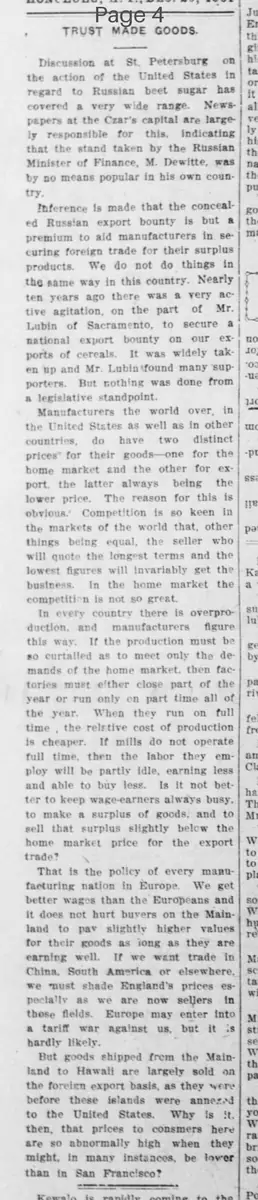
TRUST MADE GOODS.
Discussion at St. Petersburg on the action of the United States in regard to Russian beet sugar has covered a very wide range. Newspapers at the Czar's capital are largely responsible for this, indicating that the stand taken by the Russian Minister of Finance, M. Dewitte, was by no means popular in his own country. Inference is made that the concealed Russian export bounty is but a premium to aid manufacturers in securing foreign trade for their surplus products.
We do not do things in the same way in this country. Nearly ten years ago there was a very active agitation, on the part of Mr. Lubin of Sacramento, to secure a national export bounty on our exports of cereals. It was widely taken up and Mr. Lubin found many supporters. But nothing was done from a legislative standpoint.
Manufacturers the world over, in the United States as well as in other countries, do have two distinct prices for their goods—one for the home market and the other for export the latter always being the lower price. The reason for this is obvious. Competition is so keen in the markets of the world that, other things being equal, the seller who will quote the longest terms and the lowest figures will invariably get the business. In the home market the competition is not so great.
In every country there is overproduction, and manufacturers figure this way. If the production must be so curtailed as to meet only the demands of the home market, then factories must either close part of the year or run only on part time all of the year. When they run on full time the relative cost of production is cheaper. If mills do not operate full time, then the labor they employ will be partly idle, earning less and able to buy less.
Is it not better to keep wage-earners always busy, to make a surplus of goods, and to sell that surplus slightly below the home market price for the export trade? That is the policy of every manufacturing nation in Europe. We get better wages than the Europeans and it does not hurt buyers on the mainland to pay slightly higher values for their goods as long as they are earning well.
If we want trade in China, South America or elsewhere, we must shade England's prices especially as we are now sellers in those fields. Europe may enter into a tariff war against us, but it is hardly likely. But goods shipped from the mainland to Hawaii are largely sold on the foreign export basis, as they were before these islands were annexed to the United States. Why is it, then, that prices to consumers here are so abnormally high when they might, in many instances, be lower than in San Francisco!
Discussion at St. Petersburg on the action of the United States in regard to Russian beet sugar has covered a very wide range. Newspapers at the Czar's capital are largely responsible for this, indicating that the stand taken by the Russian Minister of Finance, M. Dewitte, was by no means popular in his own country. Inference is made that the concealed Russian export bounty is but a premium to aid manufacturers in securing foreign trade for their surplus products.
We do not do things in the same way in this country. Nearly ten years ago there was a very active agitation, on the part of Mr. Lubin of Sacramento, to secure a national export bounty on our exports of cereals. It was widely taken up and Mr. Lubin found many supporters. But nothing was done from a legislative standpoint.
Manufacturers the world over, in the United States as well as in other countries, do have two distinct prices for their goods—one for the home market and the other for export the latter always being the lower price. The reason for this is obvious. Competition is so keen in the markets of the world that, other things being equal, the seller who will quote the longest terms and the lowest figures will invariably get the business. In the home market the competition is not so great.
In every country there is overproduction, and manufacturers figure this way. If the production must be so curtailed as to meet only the demands of the home market, then factories must either close part of the year or run only on part time all of the year. When they run on full time the relative cost of production is cheaper. If mills do not operate full time, then the labor they employ will be partly idle, earning less and able to buy less.
Is it not better to keep wage-earners always busy, to make a surplus of goods, and to sell that surplus slightly below the home market price for the export trade? That is the policy of every manufacturing nation in Europe. We get better wages than the Europeans and it does not hurt buyers on the mainland to pay slightly higher values for their goods as long as they are earning well.
If we want trade in China, South America or elsewhere, we must shade England's prices especially as we are now sellers in those fields. Europe may enter into a tariff war against us, but it is hardly likely. But goods shipped from the mainland to Hawaii are largely sold on the foreign export basis, as they were before these islands were annexed to the United States. Why is it, then, that prices to consumers here are so abnormally high when they might, in many instances, be lower than in San Francisco!
What sub-type of article is it?
Economic Policy
Trade Or Commerce
What keywords are associated?
Russian Sugar Bounty
Export Pricing
Overproduction
Hawaii Prices
Global Trade Competition
Factory Full Time
What entities or persons were involved?
M. Dewitte
Mr. Lubin Of Sacramento
Russian Minister Of Finance
Editorial Details
Primary Topic
Us Export Practices Versus Russian Bounties And High Prices In Hawaii
Stance / Tone
Supportive Of Export Pricing Strategies To Maintain Full Production And Global Competitiveness
Key Figures
M. Dewitte
Mr. Lubin Of Sacramento
Russian Minister Of Finance
Key Arguments
Russian Export Bounty On Beet Sugar Is Unpopular And Aids Surplus Exports
Us Rejected National Export Bounty On Cereals Despite Agitation
Manufacturers Use Lower Export Prices Due To Keen Global Competition
Overproduction Requires Full Time Factory Operation To Reduce Costs And Keep Workers Employed
Exporting Surplus Below Home Prices Benefits Economy And Wage Earners
Europe Follows This Policy; Us Has Better Wages And Can Compete By Shading Prices
Goods To Hawaii Sold On Export Basis But Consumer Prices Abnormally High