Thank you for visiting SNEWPapers!
Sign up free
Bryan Daily Eagle And Pilot
Bryan, Brazos County, Texas
What is this article about?
Seventeen-year locusts, absent since 1894, emerge near New York and are due in Kansas this summer, threatening farmers by devouring all green vegetation in vast swarms after a 17-year underground cycle.
Merged-components note: Image illustrates the 'Locusts on the Way' story; sequential reading order and spatial overlap.
Clipping
OCR Quality
Full Text
To Plague the Farmers of the Country This Summer.
Seventeen-Year Pest, Which Caused Great Loss on Last Visitation, is Ready for Business-Grubs Found in New York and Kansas
New York.-The seventeen-year locusts, which are due to return to plague the American farmer this summer, after being absent since 1894, have made their appearance in the vicinity of New York city. Curator Ditmars of the New York Zoological society has discovered the first grubs, several thousand in number, in an excavation near Nyack, N. Y. By the time the frost is out of the ground these thousands will be millions, he says.
During the last previous visitations the locusts literally covered suburban New York, stripping trees, bushes, hedges, lawns and truck farms of everything green and then, moving in vast clouds, which obscured the sun, to fresh fields. Chinatown will welcome the visitation. The Chinese cook makes them into pies, roasts them, eats them as a salad and dresses them in many mysterious ways, and even New Yorkers have found some of these dishes palatable.
The seventeen-year locust will also visit Kansas within the next two or three months, according to a prediction of Prof. P. A. Glenn of the department of entomology at the University of Kansas. Seventeen years ago this spring Kansas experienced the last visitation of the pest known to scientists as cicada. All indications here point to their seventeen-year proverbial visit.
The agricultural department in Washington will issue instructions how to cope with these destructive insects. Benzine, gasoline or turpentine mixed with animal fertilizer, corrosive sublimate and nitrates have been found effective heretofore in checking the ravages of the pest.
Seventeen years ago the locusts settled in New Jersey, stripping the trees, bushes, hedges and lawns of everything green, and then moving in vast clouds which obscured the sun to fresh fields. The individual locusts lived only a few days, but each female in that time found time to lay about 500 eggs on the branches of the denuded trees. When the larvae hatched they fell to the ground and burrowed straight down for more than a foot. They have rested for seventeen years before the process of hatching was complete, and as soon as the frost leaves the ground they will dig their way to the surface and appear as small, oblong shells. These shells soon burst open, and the winged, musical and ravenous locust appears to devour everything in sight, and lay more eggs to be hatched out about the same time seventeen years hence.
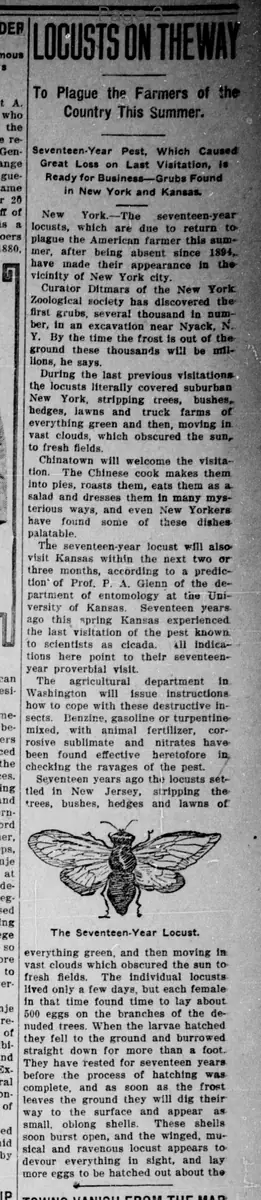
The Seventeen-Year Locust.
What sub-type of article is it?
What themes does it cover?
What keywords are associated?
What entities or persons were involved?
Where did it happen?
Story Details
Key Persons
Location
Vicinity Of New York City, Kansas, New Jersey
Event Date
This Summer, Absent Since 1894
Story Details
Seventeen-year locusts emerge near New York, with grubs found, set to plague farmers by stripping vegetation; expected in Kansas soon; past visitations caused great loss, with instructions for control issued.