Thank you for visiting SNEWPapers!
Sign up free
Editorial
January 1, 1863
Richmond Whig
Richmond, Virginia
What is this article about?
Confederate editorial mocks President Lincoln's focus on military success as key to victory, arguing that despite Union advantages, subjugating the South is impossible, drawing parallels to the American Revolution where British wins failed to prevent independence.
Clipping
OCR Quality
95%
Excellent
Full Text
WHAT LINCOLN WANTS.
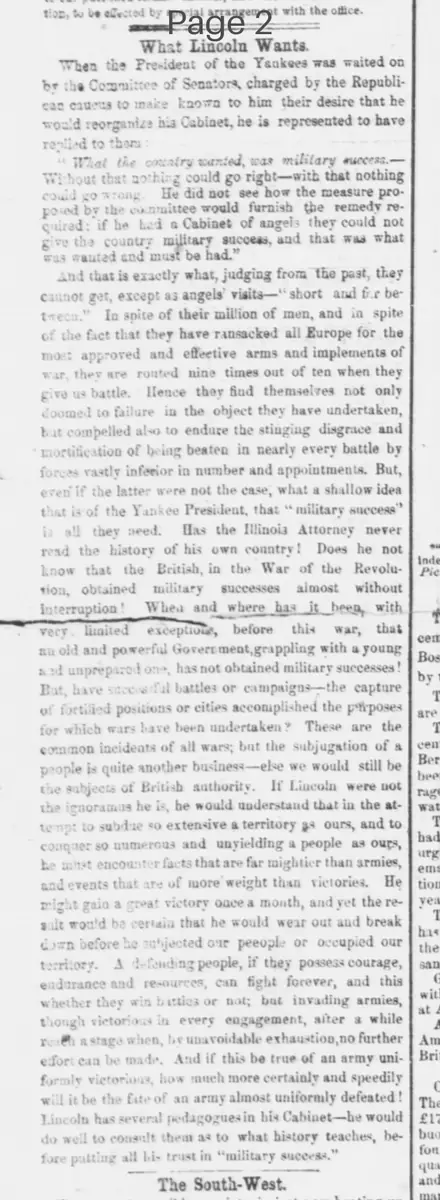
When the President of the Yankees was waited on by the Committee of Senators charged by the Republican caucus to make known to him their desire that he would reorganize his Cabinet, he is represented to have replied to them:
What the country wanted, was military success.—Without that nothing could go right—with that nothing could go wrong.
He did not see how the measure proposed by the committee would furnish the remedy required: if he had a Cabinet of angels they could not procure the country military success, and that was what was wanted and must be had.
And that is exactly what, judging from the past, they cannot get, except as angels' visits—short and far between. In spite of their million of men, and in spite of the fact that they have ransacked all Europe for the most approved and effective arms and implements of war, they are routed nine times out of ten when they give us battle. Hence they find themselves not only compelled to failure in the object they have undertaken, but compelled also to endure the stinging disgrace and mortification of being beaten in nearly every battle by forces vastly inferior in number and appointments. But, even if the latter were not the case, what a shallow idea that is of the Yankee President, that "military success" is all they need, as the Illinois Attorney never read the history of his own country! Does he not know that the British, in the War of the Revolution, obtained military successes almost without interruption? When and where has it been, with very limited exception, before this war, that an old and powerful Government, grappling with a young and unprepared one, has not obtained military successes? But have all battles or campaigns—the capture of fortified positions or cities—accomplished the purposes for which wars have been undertaken? These are the common incidents of all wars; but the subjugation of a people is quite another business—else we would still be the subjects of British authority. If Lincoln were not the ignoramus he is he would understand that in the attempt to subdue so extensive a territory as ours, and to conquer so numerous and unyielding a people as ours, he must encounter facts that are far mightier than armies, and events that are of more weight than victories. He might gain a great victory once a month, and yet the result would be certain that he would wear out and break down before he subjugated our people or occupied our territory. A defending people, if they possess courage, endurance and resources, can fight forever, and this whether they win battles or not; but invading armies, though victorious in every engagement, after a while are a stag when, by unavoidable exhaustion, no further effort can be made. And if this be true of an army uniformly victorious, how much more certainly and speedily will it be the fate of an army almost uniformly defeated!
Lincoln has several pedagogues in his Cabinet—he would do well to consult them as to what history teaches, before putting all his trust in "military success."
When the President of the Yankees was waited on by the Committee of Senators charged by the Republican caucus to make known to him their desire that he would reorganize his Cabinet, he is represented to have replied to them:
What the country wanted, was military success.—Without that nothing could go right—with that nothing could go wrong.
He did not see how the measure proposed by the committee would furnish the remedy required: if he had a Cabinet of angels they could not procure the country military success, and that was what was wanted and must be had.
And that is exactly what, judging from the past, they cannot get, except as angels' visits—short and far between. In spite of their million of men, and in spite of the fact that they have ransacked all Europe for the most approved and effective arms and implements of war, they are routed nine times out of ten when they give us battle. Hence they find themselves not only compelled to failure in the object they have undertaken, but compelled also to endure the stinging disgrace and mortification of being beaten in nearly every battle by forces vastly inferior in number and appointments. But, even if the latter were not the case, what a shallow idea that is of the Yankee President, that "military success" is all they need, as the Illinois Attorney never read the history of his own country! Does he not know that the British, in the War of the Revolution, obtained military successes almost without interruption? When and where has it been, with very limited exception, before this war, that an old and powerful Government, grappling with a young and unprepared one, has not obtained military successes? But have all battles or campaigns—the capture of fortified positions or cities—accomplished the purposes for which wars have been undertaken? These are the common incidents of all wars; but the subjugation of a people is quite another business—else we would still be the subjects of British authority. If Lincoln were not the ignoramus he is he would understand that in the attempt to subdue so extensive a territory as ours, and to conquer so numerous and unyielding a people as ours, he must encounter facts that are far mightier than armies, and events that are of more weight than victories. He might gain a great victory once a month, and yet the result would be certain that he would wear out and break down before he subjugated our people or occupied our territory. A defending people, if they possess courage, endurance and resources, can fight forever, and this whether they win battles or not; but invading armies, though victorious in every engagement, after a while are a stag when, by unavoidable exhaustion, no further effort can be made. And if this be true of an army uniformly victorious, how much more certainly and speedily will it be the fate of an army almost uniformly defeated!
Lincoln has several pedagogues in his Cabinet—he would do well to consult them as to what history teaches, before putting all his trust in "military success."
What sub-type of article is it?
War Or Peace
Military Affairs
What keywords are associated?
Lincoln
Military Success
Civil War
Subjugation
Confederate Endurance
Yankee Defeats
American Revolution
What entities or persons were involved?
Lincoln
Yankees
Republican Caucus
British
Editorial Details
Primary Topic
Lincoln's Overreliance On Military Success For Subjugating The Confederacy
Stance / Tone
Pro Confederate Critique Mocking Union Ignorance And Inevitable Failure
Key Figures
Lincoln
Yankees
Republican Caucus
British
Key Arguments
Military Success Alone Cannot Subjugate A Determined Defending People With Courage And Resources
Union Forces Suffer Frequent Defeats Despite Superior Numbers And Arms From Europe
Historical Parallel: British Military Successes In The Revolution Failed To Prevent American Independence
Invading Armies Exhaust And Break Down Even If Victorious, While Defenders Can Endure Indefinitely
Subjugation Of Extensive Territory And Unyielding People Requires More Than Battles Or Campaigns
Lincoln's Cabinet Reorganization Won't Achieve Needed Military Success