Thank you for visiting SNEWPapers!
Sign up free
Letter to Editor
February 17, 1836
The Herald
New York, New York County, New York
What is this article about?
Publishers Howe & Bates defend Maria Monk's 'Awful Disclosures' against affidavits published in the New York Herald, arguing they fail to disprove the book's claims about the Hotel Dieu Nunnery in Montreal and demanding an inspection of the institution.
Clipping
OCR Quality
95%
Excellent
Full Text
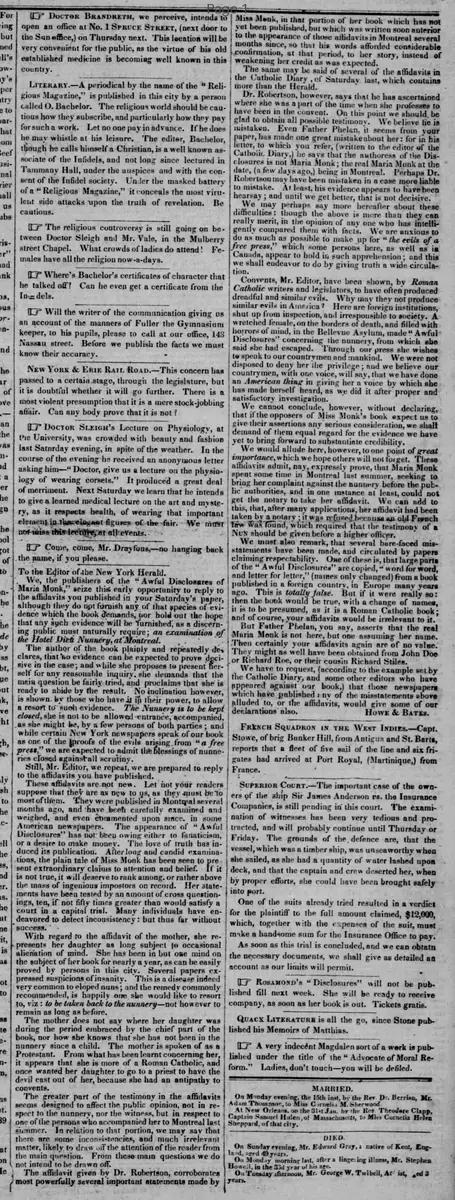
To the Editor of the New York Herald.
We, the publishers of the "Awful Disclosures of Maria Monk," seize this early opportunity to reply to the affidavits you published in your Saturday's paper, although they do not furnish any of that species of evidence which the book demands, nor hold out the hope that any such evidence will be furnished, as a discerning public must naturally require; an examination of the Hotel Dieu Nunnery, at Montreal.
The author of the book plainly and repeatedly declares, that 'no evidence can be expected to prove decisive in the case; and while she proposes to present herself for any reasonable inquiry, she demands that the main question be fairly tried, and proclaims that she is ready to abide by the result. No inclination however, is shown by those who have it in their power, to allow a resort to such evidence. The Nunnery is to be kept closed, she is not to be allowed entrance, accompanied, as she might be, by a few persons of both parties; and while certain New York newspapers speak of our book as one of the proofs of the evils arising from "a free press," we are expected to admit the blessings of nunneries closed against all scrutiny.
Still, Mr. Editor, we repeat, we are prepared to reply to the affidavits you have published.
These affidavits are not new. Let not your readers suppose that they are as new to us, as they must be to most of them. They were published in Montreal several months ago, and have been carefully examined and weighed, and even commented upon since, in some American newspapers. The appearance of "Awful Disclosures" has not been owing either to fanaticism, or a desire to make money. The love of truth has induced its publication. After long and candid examinations, the plain tale of Miss Monk has been seen to present extraordinary claims to attention and belief. If it is not true, it will deserve to rank among, or rather above the mass of ingenious impostors on record. Her statements have been tested by an amount of cross questionings, ten, if not fifty times greater than would satisfy a court in a capital trial. Many individuals have endeavored to detect inconsistency: but thus far without success.'
With regard to the affidavit of the mother, she represents her daughter as long subject to occasional alienation of mind. She has been in but one mind on the subject of her book for nearly a year, as can be easily proved by persons in this city. Several papers expressed suspicions of insanity. This is a disease indeed very common to eloped nuns; and the remedy commonly recommended, is happily one she would like to resort to, viz: to be taken back to the nunnery—not however to remain as long as before.
The mother does not say where her daughter was during the period embraced by the chief part of the book, nor how she knows that she has not been in the nunnery since a child. The mother is spoken of as a Protestant. From what has been learnt concerning her, it appears that she is more of a Roman Catholic, and once wanted her daughter to go to a priest to have the devil cast out of her, because she had an antipathy to convents.
The greater part of the testimony in the affidavits seems designed to affect the public opinion, not in respect to the nunnery, nor the witness, but in respect to one of the persons who accompanied her to Montreal last summer. In relation to that portion, we may say that there are some inconsistencies, and much irrelevant matter, likely to draw off the attention of the reader from the main question. From these man questions we do not intend to be drawn off.
The affidavit given by Dr. Robertson, corroborates most powerfully several important statements made by Miss Monk, in that portion of her book which has not yet been published, but which was written soon anterior to the appearance of those affidavits in Montreal several months since, so that his words afforded considerable confirmation, at that period, to her story, instead of weakening her credit as was expected.
The same may be said of several of the affidavits in the Catholic Diary, of Saturday last, which contains more than the Herald.
Dr. Robertson, however, says that he has ascertained where she was a part of the time when she professes to have been in the convent. On this point we should be glad to obtain all possible testimony. We believe he is mistaken. Even Father Phelan, it seems from your paper, has made one great mistake about her: for in his letter, to which you refer, (written to the editor of the Catholic Diary,) he says that the authoress of the Disclosures is not Maria Monk: the real Maria Monk at the date, (a few days ago,) being in Montreal. Perhaps Dr. Robertson may have been mistaken in a case more liable to mistake. At least, his evidence appears to have been hearsay; and until we get better, that is not decisive.
We may perhaps say more hereafter about these difficulties: though the above is more than they can really merit, in the opinion of any one who has intelligently compared them with facts. We are anxious to do as much as possible to make up for "the evils of a free press," which some persons here, as well as in Canada, appear to hold in such apprehension; and this we shall endeavor to do by giving truth a wide circulation.
Convents, Mr. Editor, have been shown, by Roman Catholic writers and legislators, to have often produced dreadful and similar evils. Why may they not produce similar evils in America? Here are foreign institutions, shut up from inspection, and irresponsible to society. A wretched female, on the borders of death, and filled with horrors of mind, in the Bellevue Asylum, made "Awful Disclosures" concerning the nunnery, from which she said she had escaped. Through our press she wishes to speak to our countrymen and mankind. We were not disposed to deny her the privilege; and we believe our countrymen, with one voice, will say, that we have done an American thing in giving her a voice by which she has made herself heard, as we did it after proper and satisfactory investigation.
We cannot conclude, however, without declaring, that if the opposers of Miss Monk's book expect us to give their assertions any serious consideration, we shall demand of them equal regard for the evidence we have yet to bring forward to substantiate credibility.
We would allude here, however, to one point of great importance, which we hope others will not forget. These affidavits admit, nay, expressly prove, that Maria Monk spent some time in Montreal last summer, seeking to bring her complaint against the nunnery before the public authorities, and in one instance at least, could not get the notary to take her affidavit. We can add to this, that, after many applications, her affidavit had been taken by a notary: it was refused because an old French law was found, which required that the testimony of a Nun should be given before a higher officer.
We must also remark, that several bare-faced misstatements have been made, and circulated by papers claiming respectability. One of these is, that large parts of the "Awful Disclosures" are copied, word for word and letter for letter." (names only changed) from a book published in a foreign country, in Europe many years ago. This is totally false. But if it were really so: then the book would be true, with a change of names, it is to be presumed, as it is a Roman Catholic book; and of course, your affidavits would be irrelevant to it.
But Father Phelan, you say, asserts that the real Maria Monk is not here, but one assuming her name. Then certainly your affidavits again are of no value. They might as well have been obtained from John Doe or Richard Roe, or their cousin Richard Stiles.
We have to request, (according to the example set by the Catholic Diary, and some other editors who have appeared against our book,) that those newspapers which have published any of the misstatements above alluded to, or the affidavits, would give some of our declarations also.
Howe & Bates.
We, the publishers of the "Awful Disclosures of Maria Monk," seize this early opportunity to reply to the affidavits you published in your Saturday's paper, although they do not furnish any of that species of evidence which the book demands, nor hold out the hope that any such evidence will be furnished, as a discerning public must naturally require; an examination of the Hotel Dieu Nunnery, at Montreal.
The author of the book plainly and repeatedly declares, that 'no evidence can be expected to prove decisive in the case; and while she proposes to present herself for any reasonable inquiry, she demands that the main question be fairly tried, and proclaims that she is ready to abide by the result. No inclination however, is shown by those who have it in their power, to allow a resort to such evidence. The Nunnery is to be kept closed, she is not to be allowed entrance, accompanied, as she might be, by a few persons of both parties; and while certain New York newspapers speak of our book as one of the proofs of the evils arising from "a free press," we are expected to admit the blessings of nunneries closed against all scrutiny.
Still, Mr. Editor, we repeat, we are prepared to reply to the affidavits you have published.
These affidavits are not new. Let not your readers suppose that they are as new to us, as they must be to most of them. They were published in Montreal several months ago, and have been carefully examined and weighed, and even commented upon since, in some American newspapers. The appearance of "Awful Disclosures" has not been owing either to fanaticism, or a desire to make money. The love of truth has induced its publication. After long and candid examinations, the plain tale of Miss Monk has been seen to present extraordinary claims to attention and belief. If it is not true, it will deserve to rank among, or rather above the mass of ingenious impostors on record. Her statements have been tested by an amount of cross questionings, ten, if not fifty times greater than would satisfy a court in a capital trial. Many individuals have endeavored to detect inconsistency: but thus far without success.'
With regard to the affidavit of the mother, she represents her daughter as long subject to occasional alienation of mind. She has been in but one mind on the subject of her book for nearly a year, as can be easily proved by persons in this city. Several papers expressed suspicions of insanity. This is a disease indeed very common to eloped nuns; and the remedy commonly recommended, is happily one she would like to resort to, viz: to be taken back to the nunnery—not however to remain as long as before.
The mother does not say where her daughter was during the period embraced by the chief part of the book, nor how she knows that she has not been in the nunnery since a child. The mother is spoken of as a Protestant. From what has been learnt concerning her, it appears that she is more of a Roman Catholic, and once wanted her daughter to go to a priest to have the devil cast out of her, because she had an antipathy to convents.
The greater part of the testimony in the affidavits seems designed to affect the public opinion, not in respect to the nunnery, nor the witness, but in respect to one of the persons who accompanied her to Montreal last summer. In relation to that portion, we may say that there are some inconsistencies, and much irrelevant matter, likely to draw off the attention of the reader from the main question. From these man questions we do not intend to be drawn off.
The affidavit given by Dr. Robertson, corroborates most powerfully several important statements made by Miss Monk, in that portion of her book which has not yet been published, but which was written soon anterior to the appearance of those affidavits in Montreal several months since, so that his words afforded considerable confirmation, at that period, to her story, instead of weakening her credit as was expected.
The same may be said of several of the affidavits in the Catholic Diary, of Saturday last, which contains more than the Herald.
Dr. Robertson, however, says that he has ascertained where she was a part of the time when she professes to have been in the convent. On this point we should be glad to obtain all possible testimony. We believe he is mistaken. Even Father Phelan, it seems from your paper, has made one great mistake about her: for in his letter, to which you refer, (written to the editor of the Catholic Diary,) he says that the authoress of the Disclosures is not Maria Monk: the real Maria Monk at the date, (a few days ago,) being in Montreal. Perhaps Dr. Robertson may have been mistaken in a case more liable to mistake. At least, his evidence appears to have been hearsay; and until we get better, that is not decisive.
We may perhaps say more hereafter about these difficulties: though the above is more than they can really merit, in the opinion of any one who has intelligently compared them with facts. We are anxious to do as much as possible to make up for "the evils of a free press," which some persons here, as well as in Canada, appear to hold in such apprehension; and this we shall endeavor to do by giving truth a wide circulation.
Convents, Mr. Editor, have been shown, by Roman Catholic writers and legislators, to have often produced dreadful and similar evils. Why may they not produce similar evils in America? Here are foreign institutions, shut up from inspection, and irresponsible to society. A wretched female, on the borders of death, and filled with horrors of mind, in the Bellevue Asylum, made "Awful Disclosures" concerning the nunnery, from which she said she had escaped. Through our press she wishes to speak to our countrymen and mankind. We were not disposed to deny her the privilege; and we believe our countrymen, with one voice, will say, that we have done an American thing in giving her a voice by which she has made herself heard, as we did it after proper and satisfactory investigation.
We cannot conclude, however, without declaring, that if the opposers of Miss Monk's book expect us to give their assertions any serious consideration, we shall demand of them equal regard for the evidence we have yet to bring forward to substantiate credibility.
We would allude here, however, to one point of great importance, which we hope others will not forget. These affidavits admit, nay, expressly prove, that Maria Monk spent some time in Montreal last summer, seeking to bring her complaint against the nunnery before the public authorities, and in one instance at least, could not get the notary to take her affidavit. We can add to this, that, after many applications, her affidavit had been taken by a notary: it was refused because an old French law was found, which required that the testimony of a Nun should be given before a higher officer.
We must also remark, that several bare-faced misstatements have been made, and circulated by papers claiming respectability. One of these is, that large parts of the "Awful Disclosures" are copied, word for word and letter for letter." (names only changed) from a book published in a foreign country, in Europe many years ago. This is totally false. But if it were really so: then the book would be true, with a change of names, it is to be presumed, as it is a Roman Catholic book; and of course, your affidavits would be irrelevant to it.
But Father Phelan, you say, asserts that the real Maria Monk is not here, but one assuming her name. Then certainly your affidavits again are of no value. They might as well have been obtained from John Doe or Richard Roe, or their cousin Richard Stiles.
We have to request, (according to the example set by the Catholic Diary, and some other editors who have appeared against our book,) that those newspapers which have published any of the misstatements above alluded to, or the affidavits, would give some of our declarations also.
Howe & Bates.
What sub-type of article is it?
Persuasive
Investigative
Provocative
What themes does it cover?
Religion
Press Freedom
Morality
What keywords are associated?
Maria Monk
Awful Disclosures
Hotel Dieu Nunnery
Montreal
Affidavits
Free Press
Convents
Catholic Diary
What entities or persons were involved?
Howe & Bates
To The Editor Of The New York Herald
Letter to Editor Details
Author
Howe & Bates
Recipient
To The Editor Of The New York Herald
Main Argument
the publishers defend the credibility of maria monk's 'awful disclosures' against published affidavits, asserting that they fail to provide decisive evidence and instead demand an examination of the hotel dieu nunnery in montreal to verify the claims.
Notable Details
Affidavits From Montreal Published Months Ago
Mother's Affidavit Claims Insanity
Dr. Robertson's Affidavit Corroborates Unpublished Parts
Father Phelan's Mistake About Maria Monk's Identity
Misstatements About Book Being Copied From European Source