Thank you for visiting SNEWPapers!
Sign up free
Jackson Advocate
Jackson, Hinds County, Mississippi
What is this article about?
Truman's Commission on Higher Education proposes democratic national scholarships and fellowships up to $1,500/year for able students, focusing on financial need and opposing discrimination, to equalize educational opportunities, with Dr. Patterson advocating for fair practices.
Clipping
OCR Quality
Full Text
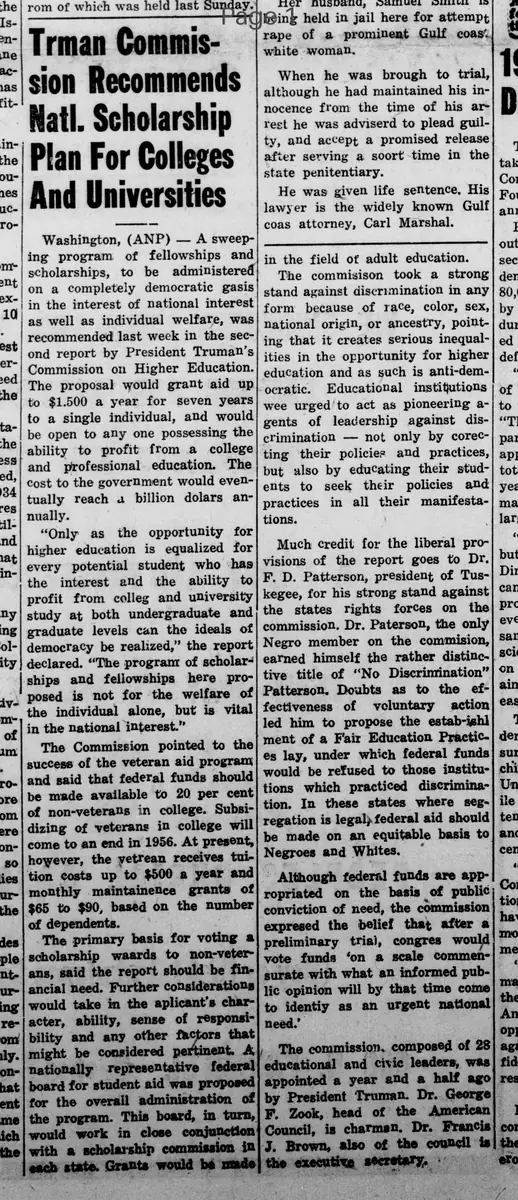
Washington, (ANP) - A sweeping program of fellowships and scholarships, to be administered on a completely democratic basis in the interest of national interest as well as individual welfare, was recommended last week in the second report by President Truman's Commission on Higher Education.
The proposal would grant aid up to $1,500 a year for seven years to a single individual, and would be open to any one possessing the ability to profit from a college and professional education. The cost to the government would eventually reach a billion dollars annually.
"Only as the opportunity for higher education is equalized for every potential student who has the interest and the ability to profit from college and university study at both undergraduate and graduate levels can the ideals of democracy be realized," the report declared. "The program of scholarships and fellowships here proposed is not for the welfare of the individual alone, but is vital in the national interest."
The Commission pointed to the success of the veteran aid program and said that federal funds should be made available to 20 per cent of non-veterans in college. Subsidizing of veterans in college will come to an end in 1956. At present, however, the veteran receives tuition costs up to $500 a year and monthly maintenance grants of $65 to $90, based on the number of dependents.
The primary basis for voting scholarship awards to non-veterans, said the report should be financial need. Further considerations would take in the applicant's character, ability, sense of responsibility and any other factors that might be considered pertinent. A nationally representative federal board for student aid was proposed for the overall administration of the program. This board, in turn, would work in close conjunction with a scholarship commission in each state. Grants would be made
in the field of adult education.
The commission took a strong stand against discrimination in any form because of race, color, sex, national origin, or ancestry, pointing that it creates serious inequalities in the opportunity for higher education and as such is anti-democratic. Educational institutions were urged to act as pioneering agents of leadership against discrimination -- not only by correcting their policies and practices, but also by educating their students to seek their policies and practices in all their manifestations.
Much credit for the liberal provisions of the report goes to Dr. F. D. Patterson, president of Tuskegee, for his strong stand against the states rights forces on the commission. Dr. Patterson, the only Negro member on the commission, earned himself the rather distinctive title of "No Discrimination" Patterson. Doubts as to the effectiveness of voluntary action led him to propose the establishment of a Fair Education Practices law, under which federal funds would be refused to those institutions which practiced discrimination. In these states where segregation is legal, federal aid should be made on an equitable basis to Negroes and Whites.
Although federal funds are appropriated on the basis of public conviction of need, the commission expressed the belief that after a preliminary trial, congress would vote funds on a scale commensurate with what an informed public opinion will by that time come to identify as an urgent national need.
The commission, composed of 28 educational and civic leaders, was appointed a year and a half ago by President Truman. Dr. George F. Zook, head of the American Council, is chairman. Dr. Francis J. Brown, also of the council is the executive secretary.
What sub-type of article is it?
What themes does it cover?
What keywords are associated?
What entities or persons were involved?
Where did it happen?
Story Details
Key Persons
Location
Washington
Event Date
Last Week
Story Details
President Truman's Commission on Higher Education recommends a national program of fellowships and scholarships up to $1,500 annually for seven years, open to all able individuals based on need, character, and ability, administered by a federal board and state commissions, costing a billion dollars yearly, emphasizing equal opportunity and opposing discrimination, with credit to Dr. Patterson for anti-discrimination stance.