Thank you for visiting SNEWPapers!
Sign up free
Letter to Editor
January 18, 1825
The National Republican And Ohio Political Register
Cincinnati, Hamilton County, Ohio
What is this article about?
An unsigned article reports rumors of John Quincy Adams and Henry Clay allying to secure Adams' presidency over Andrew Jackson in the House, despite Clay's past efforts to divide Western support. It reprints their 1822 letters disputing roles in Ghent negotiations on Mississippi navigation and fisheries to highlight potential discord.
Clipping
OCR Quality
98%
Excellent
Full Text
J.Q. ADAMS AND MR. CLAY
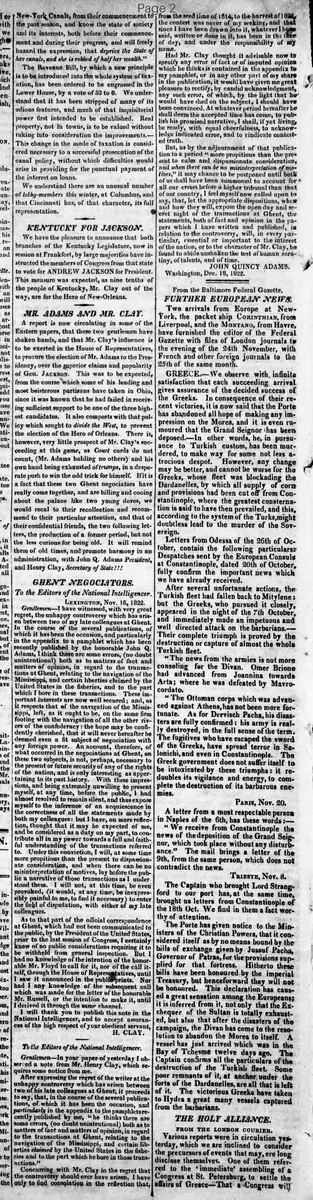
A report is now circulating in some of the Eastern papers, that these two gentlemen have shaken hands, and that Mr. Clay's influence is to be exerted in the House of Representatives, to procure the election of Mr. Adams to the Presidency, over the superior claims and popularity of Gen. Jackson. This was to be expected, from the course which some of his leading and most boisterous partizans have taken in Ohio, since it was known that he had failed in receiving sufficient support to be one of the three highest candidates. It also comports with that policy which sought to divide the West, to prevent the election of the Hero of Orleans. There is, however, very little prospect of Mr. Clay's succeeding at this game, as Court cards do not count, (Mr. Adams holding no others) and his own hand being exhausted of trumps, in a desperate push to win the odd trick for himself. If it is a fact that these two Ghent negociators have really come together, and are billing and cooing about the palace like two young doves, we would recall to their recollection and recommend to their particular attention, and that of their confidential friends, the two following letters, the production of a former period, but not the less curious for being old. It will remind them of old times, and promote harmony in an administration, with John Q. Adams President, and Henry Clay, Secretary of State!!!
GHENT NEGOCIATORS.
To the Editors of the National Intelligencer.
LEXINGTON, NOV. 16, 1822
Gentlemen--I have witnessed, with very great regret, the unhappy controversy which has arisen between two of my late colleagues at Ghent. In the course of the several publications, of which it has been the occasion, and particularly in the appendix to a pamphlet which has been recently published by the honorable John Q. Adams, I think there are some errors, (no doubt unintentional) both as to matters of fact and matters of opinion, in regard to the transactions at Ghent, relating to the navigation of the Mississippi, and certain liberties claimed by the United States in the fisheries, and to the part which I bore in these transactions. These important interests are now well secured; and, as it respects that of the navigation of the Mississippi, left, as it ought to be, on the same firm footing with the navigation of all the other rivers of the confederacy : the hope may be confidently cherished, that it will never hereafter be deemed even a fit subject of negociation with any foreign power. An account, therefore, of what occurred in the negociations at Ghent, on these two subjects, is not, perhaps, necessary to the present or future security of any of the rights of the nation, and is only interesting as appertaining to its past history. With these impressions, and being extremely unwilling to present myself, at any time, before the public, I had almost resolved to remain silent, and thus expose myself to the inference of an acquiescence in the correctness of all the statements made by both my colleagues: but I have, on more reflection, thought that it may be expected of me, and be considered as a duty on my part, to contribute all in my power towards a full and faithful understanding of the transactions referred to. Under this conviction, I will, at some time more propitious than the present to dispassionate consideration, and when there can be no misinterpretation of motives, lay before the public a narrative of those transactions as I understood them. I will not, at this time, be even provoked, (it would, at any time, be inexpressibly painful to me, to find it necessary) to enter the field of disputation, with either of my late colleagues.
As to that part of the official correspondence at Ghent, which had not been communicated to the public, by the President of the United States, prior to the last session of Congress, I certainly knew of no public considerations requiring it to be withheld from general inspection. But I had no knowledge of the intention of the honorable Mr. Floyd to call for it, nor of the call itself, through the House of Representatives, until I saw it announced in the public prints. Nor had I any knowledge of the subsequent call which was made for the letter of the honorable Mr. Russell, or the intention to make it, until I derived it through the same channel.
I will thank you to publish this note in the National Intelligencer, and to accept assurances of the high respect of your obedient servant,
H. CLAY.
To the Editors of the National Intelligencer.
Gentlemen--In your paper of yesterday I observed a note from Mr. Henry Clay, which requires some notice from me. After expressing the regret of the writer at the unhappy controversy which has arisen between two of his late colleagues at Ghent; it proceeds to say, that, in the course of the several publications, of which it has been the occasion, and particularly in the appendix to the pamphlet recently published by me, "he thinks there are some errors, (no doubt unintentional) both as to matters of fact and matters of opinion, in regard to the transactions at Ghent, relating to the navigation of the Mississippi, and certain liberties claimed by the United States in the fisheries and to the part which he bore in those transactions."
Concurring with Mr. Clay in the regret that the controversy should ever have arisen, I have only to find consolation in the reflection that, from the seed time of 1814, to the harvest of 1822, the contest was never of my seeking, and that since I have been drawn into it, whatever I have said, written or done in it, has been in the face of day, and under the responsibility of my name.
Had Mr. Clay thought it advisable now to specify any error of fact or of imputed opinion which he thinks is contained in the appendix to my pamphlet, or in any other part of my share in the publication, it would have given me great pleasure to rectify, by candid acknowledgment, any such error, of which, by the light that he would have shed on the subject, I should have been convinced. At whatever period hereafter he shall deem the accepted time has come, to publish his promised narrative, I shall, if yet living be ready, with equal cheerfulness, to acknowledge indicated error, and to vindicate contested truth.
But, as by the adjournment of that publication to a period " more propitious than the present to calm and dispassionate consideration. and when there can be no misinterpretation of motives," it may chance to be postponed until both of us shall have been summoned to account for all our errors before a higher tribunal than that of our country, I feel myself now called upon to say, that, let the appropriate dispositions, when and how they will, expose the open day and secret night of the transactions at Ghent, the statements, both of fact and opinion in the papers which I have written and published, in relation to the controversy will, in every particular, essential or important to the interest of the nation, or to the character of Mr. Clay, be found to abide unshaken the test of human scrutiny, of talents, and of time.
JOHN QUINCY ADAMS
Washington, Dec. 18, 1822.
A report is now circulating in some of the Eastern papers, that these two gentlemen have shaken hands, and that Mr. Clay's influence is to be exerted in the House of Representatives, to procure the election of Mr. Adams to the Presidency, over the superior claims and popularity of Gen. Jackson. This was to be expected, from the course which some of his leading and most boisterous partizans have taken in Ohio, since it was known that he had failed in receiving sufficient support to be one of the three highest candidates. It also comports with that policy which sought to divide the West, to prevent the election of the Hero of Orleans. There is, however, very little prospect of Mr. Clay's succeeding at this game, as Court cards do not count, (Mr. Adams holding no others) and his own hand being exhausted of trumps, in a desperate push to win the odd trick for himself. If it is a fact that these two Ghent negociators have really come together, and are billing and cooing about the palace like two young doves, we would recall to their recollection and recommend to their particular attention, and that of their confidential friends, the two following letters, the production of a former period, but not the less curious for being old. It will remind them of old times, and promote harmony in an administration, with John Q. Adams President, and Henry Clay, Secretary of State!!!
GHENT NEGOCIATORS.
To the Editors of the National Intelligencer.
LEXINGTON, NOV. 16, 1822
Gentlemen--I have witnessed, with very great regret, the unhappy controversy which has arisen between two of my late colleagues at Ghent. In the course of the several publications, of which it has been the occasion, and particularly in the appendix to a pamphlet which has been recently published by the honorable John Q. Adams, I think there are some errors, (no doubt unintentional) both as to matters of fact and matters of opinion, in regard to the transactions at Ghent, relating to the navigation of the Mississippi, and certain liberties claimed by the United States in the fisheries, and to the part which I bore in these transactions. These important interests are now well secured; and, as it respects that of the navigation of the Mississippi, left, as it ought to be, on the same firm footing with the navigation of all the other rivers of the confederacy : the hope may be confidently cherished, that it will never hereafter be deemed even a fit subject of negociation with any foreign power. An account, therefore, of what occurred in the negociations at Ghent, on these two subjects, is not, perhaps, necessary to the present or future security of any of the rights of the nation, and is only interesting as appertaining to its past history. With these impressions, and being extremely unwilling to present myself, at any time, before the public, I had almost resolved to remain silent, and thus expose myself to the inference of an acquiescence in the correctness of all the statements made by both my colleagues: but I have, on more reflection, thought that it may be expected of me, and be considered as a duty on my part, to contribute all in my power towards a full and faithful understanding of the transactions referred to. Under this conviction, I will, at some time more propitious than the present to dispassionate consideration, and when there can be no misinterpretation of motives, lay before the public a narrative of those transactions as I understood them. I will not, at this time, be even provoked, (it would, at any time, be inexpressibly painful to me, to find it necessary) to enter the field of disputation, with either of my late colleagues.
As to that part of the official correspondence at Ghent, which had not been communicated to the public, by the President of the United States, prior to the last session of Congress, I certainly knew of no public considerations requiring it to be withheld from general inspection. But I had no knowledge of the intention of the honorable Mr. Floyd to call for it, nor of the call itself, through the House of Representatives, until I saw it announced in the public prints. Nor had I any knowledge of the subsequent call which was made for the letter of the honorable Mr. Russell, or the intention to make it, until I derived it through the same channel.
I will thank you to publish this note in the National Intelligencer, and to accept assurances of the high respect of your obedient servant,
H. CLAY.
To the Editors of the National Intelligencer.
Gentlemen--In your paper of yesterday I observed a note from Mr. Henry Clay, which requires some notice from me. After expressing the regret of the writer at the unhappy controversy which has arisen between two of his late colleagues at Ghent; it proceeds to say, that, in the course of the several publications, of which it has been the occasion, and particularly in the appendix to the pamphlet recently published by me, "he thinks there are some errors, (no doubt unintentional) both as to matters of fact and matters of opinion, in regard to the transactions at Ghent, relating to the navigation of the Mississippi, and certain liberties claimed by the United States in the fisheries and to the part which he bore in those transactions."
Concurring with Mr. Clay in the regret that the controversy should ever have arisen, I have only to find consolation in the reflection that, from the seed time of 1814, to the harvest of 1822, the contest was never of my seeking, and that since I have been drawn into it, whatever I have said, written or done in it, has been in the face of day, and under the responsibility of my name.
Had Mr. Clay thought it advisable now to specify any error of fact or of imputed opinion which he thinks is contained in the appendix to my pamphlet, or in any other part of my share in the publication, it would have given me great pleasure to rectify, by candid acknowledgment, any such error, of which, by the light that he would have shed on the subject, I should have been convinced. At whatever period hereafter he shall deem the accepted time has come, to publish his promised narrative, I shall, if yet living be ready, with equal cheerfulness, to acknowledge indicated error, and to vindicate contested truth.
But, as by the adjournment of that publication to a period " more propitious than the present to calm and dispassionate consideration. and when there can be no misinterpretation of motives," it may chance to be postponed until both of us shall have been summoned to account for all our errors before a higher tribunal than that of our country, I feel myself now called upon to say, that, let the appropriate dispositions, when and how they will, expose the open day and secret night of the transactions at Ghent, the statements, both of fact and opinion in the papers which I have written and published, in relation to the controversy will, in every particular, essential or important to the interest of the nation, or to the character of Mr. Clay, be found to abide unshaken the test of human scrutiny, of talents, and of time.
JOHN QUINCY ADAMS
Washington, Dec. 18, 1822.
What sub-type of article is it?
Political
Persuasive
Historical
What themes does it cover?
Politics
Military War
Commerce Trade
What keywords are associated?
Adams Clay Alliance
Presidential Election 1824
Ghent Negotiations
Mississippi Navigation
Fisheries
Jackson Opposition
Henry Clay
John Quincy Adams
What entities or persons were involved?
To The Editors
Letter to Editor Details
Recipient
To The Editors
Main Argument
rumors of adams and clay allying for the presidency against jackson are dubious given their past acrimony over ghent negotiations; reprinting their 1822 letters serves as a reminder of potential future discord in such an administration.
Notable Details
References Ghent Negotiations On Mississippi Navigation And Fisheries
Card Playing Metaphor For Political Maneuvering
Reprints Clay's Letter From Lexington, Nov. 16, 1822
Reprints Adams' Response From Washington, Dec. 18, 1822