Thank you for visiting SNEWPapers!
Sign up free
Story
May 5, 1849
New England Religious Herald
Hartford, Hartford County, Connecticut
What is this article about?
Satirical logical paraphrase debates if critic Fidelis is an infidel by comparing to Moor, Mohammedan, or Pagan, concluding he is a Pagan infidel. Followed by serious defense of Dr. Bushnell's book against labeling as Unitarian, urging focus on truth's alignment with facts and Christian progress.
Clipping
OCR Quality
98%
Excellent
Full Text
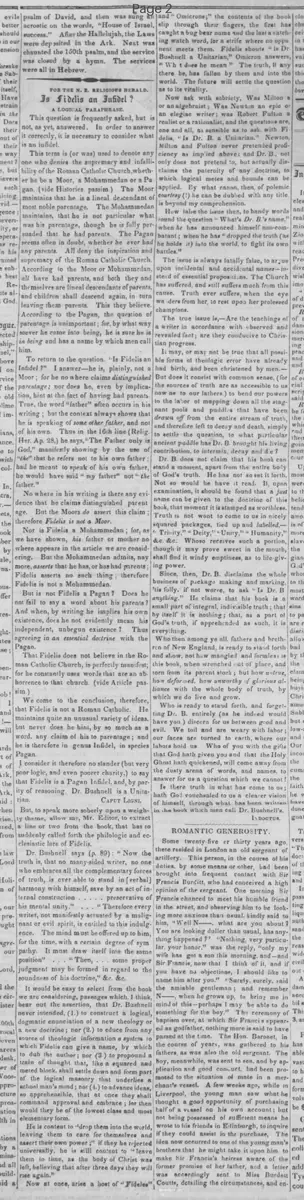
FOR THE N. E. RELIGIOUS HERALD.
Is Fidelis an Infidel?
A LOGICAL PARAPHRASE.
This question is frequently asked, but is not, as yet, answered. In order to answer it correctly, it is necessary to consider what is an infidel.
This term is (or was) used to denote any one who denies the supremacy and infallibility of the Roman Catholic Church, whether he be a Moor, a Mohammedan or a Pagan. (vide Histories passim.) The Moor maintains that he is a lineal descendant of most noble parentage. The Mohammedan maintains, that he is not particular what was his parentage, though he is fully persuaded that he had parents. The Pagan seems often in doubt, whether he ever had any parents. All deny the inspiration and supremacy of the Roman Catholic Church.
According to the Moor or Mohammedan, all have bad parents, and both they and themselves are lineal descendants of parents, and children shall descend again, in turn leaving them parents. This they believe.
According to the Pagan, the question of parentage is unimportant; for, by what way soever he came into being, he is sure he is in being and has a name by which men call him.
To return to the question. "Is Fidelis an Infidel?" I answer—he is, plainly, not a Moor; for he nowhere claims distinguished parentage; nor does he, even by implication, hint at the fact of having had parents. True, the word "father" often occurs in his writing; but the context always shows that he is speaking of some other father, and not he would have said "my father" not "the father."
No where in his writing is there any evidence that he claims distinguished parentage. But the Moors do assert this claim; therefore Fidelis is not a Moor.
Nor is Fidelis a Mohammedan; for, as we have shown, his father or mother nowhere appears in the article we are considering. But the Mohammedan admits, nay more, asserts that he has, or has had parents; Fidelis asserts no such thing: therefore Fidelis is not a Mohammedan.
But is not Fidelis a Pagan? Does he not fail to say a word about his parents? And when, by writing he implies his own existence, does he not evidently mean his independent, unbegun existence? Thus agreeing in an essential doctrine with the Pagan.
That Fidelis does not believe in the Roman Catholic Church, is perfectly manifest; for he constantly uses words that are an abhorrence to that church. (vide Article passim)
We come to the conclusion, therefore, that Fidelis is not a Roman Catholic. He maintains quite an unusual variety of ideas, but never does he hint, by so much as a word, any claim of his to parentage; and he is therefore in genus Infidel, in species Pagan.
I consider it therefore no slander (but very poor logic, and even poorer charity,) to say that Fidelis is a Pagan Infidel, and, by parity of reasoning Dr. Bushnell is a Unitarian.
CAPUT LIGNI.
But, to speak more soberly upon a weighty theme, allow me, Mr. Editor, to extract a line or two from the book, that has so suddenly called forth the philologic and ecclesiastic lore of Fidelis.
Dr. Bushnell says (p. 89): "Now the truth is, that no many-sided writer, no one who embraces all the complementary forces of truth, is ever able to stand in [verbal] harmony with himself, save by an act of internal construction . . . . . preservative of his mental unity." .. . "Therefore every writer, not manifestly actuated by a malignant or evil spirit, is entitled to this indulgence. The mind must be offered up to him, for the time, with a certain degree of sympathy. It must draw itself into the same position" .. . "Then, . . . some proper judgment may be formed in regard to the soundness of his doctrine," &c. &c.
It would be easy to select from the book we are considering, passages which, I think, bear out the assertion, that Dr. Bushnell never intended, (1.) to construct a logical, dogmatic enunciation of a new theology or a new doctrine; nor (2.) to educe from any source of theologic information a system to which Fidelis can give a name, by which to dub the author; nor (3) to propound a train of thought that, like a squared and meted block, shall settle down and form part of the logical masonry that underlies a school man's mind; nor (4.) to advance ideas, so apprehensible, that at once they shall command approval and embrace; for then would they be of the lowest class and most elementary form.
He is content to "drop them into the world, leaving them to care for themselves and assert their own power;" if they be rejected universally, he is still content to "leave them to time, as the body of Christ was left, believing that after three days they will rise again."
Now at once, arise a host of "Fidelis" and "Omicrons;" the contents of the book slip through their fingers, the first has caught a bug bear name and the last a catch-ing watch word, for a strife where no opponent meets them. Fidelis shouts "Is Dr. Bushnell a Unitarian," Omicron answers, "What does he mean? The truth, any there be, has fallen by them and into the world. The future will settle the question as to its vitality."
Now ask with sobriety, Was Milton a Unitarian or an algebraist: Was Newton an epic or an elegiac writer: was Robert Fulton a realist or a rationalist, and the questions are, one and all, as sensible as to ask, with Fidelis, "Is Dr. B. a Unitarian." Newton, Milton and Fulton never pretended proficiency as implied above: and Dr. B. not only does not pretend to, but actually disclaims the paternity of any doctrine, to which logical metes and bounds can be applied. By what canon, then, of polemic courtesy (!) he can be dubbed with any title is beyond my comprehension.
How false the issue then, to bandy words round the question "What's Dr. B.'s name," when he has announced himself non-combatant: when he has "dropped the truth (as he holds it) into the world, to fight its own battles."
The issue is always fatally false, to argue upon incidental and accidental names-in-stead of essential propositions. The Church has suffered, and still suffers much from this cause. Truth ever suffers, when the eye wanders from her, to rest upon her professed champions.
The true issue is,—Are the teachings of a writer in accordance with observed and revealed fact: are they conducive to Christian progress.
It may, or may not be true that all possible forms of theologic error have already had birth, and been christened by men. But does it consist with common sense, (for the sources of truth are as accessible to us now as to our fathers.) to bend our powers to the labor of mopping down all the stagnant pools and puddles that have been drawn off from the entire stream of truth and therefore left to decay and death, simply to settle the question, to what particular ancient puddle has Dr. B brought his living contribution, to intermix, decay and die?
Dr. B. does not claim that his book can stand a moment, apart from the entire body of God's truth. He has not so set it forth, Not so would he have it read. If, upon examination, it should be found that a just name can be given to the doctrine of this book, that moment it is stamped as worthless.
Truth is not wont to come to us in nicely squared packages, tied up and labelled,— "Trinity," "Deity," "Unity," "Humanity," &c. &c. Whoso receives such a portion, though it may prove sweet in the mouth, shall find it windy emptiness, as to life-giving power.
Since, then, Dr. B. disclaims the whole business of package making and marking, 'tis folly, if not worse, to ask "Is Dr. B anything." He claims that his book is a small part of integral, indivisible truth; that by itself it is nothing; that, as a part of God's truth, if apprehended as such, it is everything.
Who then among ye all, fathers and brethren of New England, is ready to stand forth and show, not how mangled and formless is this book, when wrenched out of place, and torn from its parent stock; but how untrue, how deformed, how unworthy of glorious alliance with the whole body of truth, by which we do live and grow.
Who is ready to stand forth, and forgetting Dr. B. entirely (as he indeed would have you) discern for us between good and evil. We toil and are weary with labor; our faces are turned to earth, where our labors hold us. Who of you with the gifts that God hath given you and that the Holy Ghost hath quickened, will come away from the dusty arena of words, and names, to answer for us a question which we cannot!
Is there truth in what has come to us; hath God vouchsafed to us a clearer vision of himself, through what has been written in the book which men call Dr. Bushnell's.
DOCTUS.
Is Fidelis an Infidel?
A LOGICAL PARAPHRASE.
This question is frequently asked, but is not, as yet, answered. In order to answer it correctly, it is necessary to consider what is an infidel.
This term is (or was) used to denote any one who denies the supremacy and infallibility of the Roman Catholic Church, whether he be a Moor, a Mohammedan or a Pagan. (vide Histories passim.) The Moor maintains that he is a lineal descendant of most noble parentage. The Mohammedan maintains, that he is not particular what was his parentage, though he is fully persuaded that he had parents. The Pagan seems often in doubt, whether he ever had any parents. All deny the inspiration and supremacy of the Roman Catholic Church.
According to the Moor or Mohammedan, all have bad parents, and both they and themselves are lineal descendants of parents, and children shall descend again, in turn leaving them parents. This they believe.
According to the Pagan, the question of parentage is unimportant; for, by what way soever he came into being, he is sure he is in being and has a name by which men call him.
To return to the question. "Is Fidelis an Infidel?" I answer—he is, plainly, not a Moor; for he nowhere claims distinguished parentage; nor does he, even by implication, hint at the fact of having had parents. True, the word "father" often occurs in his writing; but the context always shows that he is speaking of some other father, and not he would have said "my father" not "the father."
No where in his writing is there any evidence that he claims distinguished parentage. But the Moors do assert this claim; therefore Fidelis is not a Moor.
Nor is Fidelis a Mohammedan; for, as we have shown, his father or mother nowhere appears in the article we are considering. But the Mohammedan admits, nay more, asserts that he has, or has had parents; Fidelis asserts no such thing: therefore Fidelis is not a Mohammedan.
But is not Fidelis a Pagan? Does he not fail to say a word about his parents? And when, by writing he implies his own existence, does he not evidently mean his independent, unbegun existence? Thus agreeing in an essential doctrine with the Pagan.
That Fidelis does not believe in the Roman Catholic Church, is perfectly manifest; for he constantly uses words that are an abhorrence to that church. (vide Article passim)
We come to the conclusion, therefore, that Fidelis is not a Roman Catholic. He maintains quite an unusual variety of ideas, but never does he hint, by so much as a word, any claim of his to parentage; and he is therefore in genus Infidel, in species Pagan.
I consider it therefore no slander (but very poor logic, and even poorer charity,) to say that Fidelis is a Pagan Infidel, and, by parity of reasoning Dr. Bushnell is a Unitarian.
CAPUT LIGNI.
But, to speak more soberly upon a weighty theme, allow me, Mr. Editor, to extract a line or two from the book, that has so suddenly called forth the philologic and ecclesiastic lore of Fidelis.
Dr. Bushnell says (p. 89): "Now the truth is, that no many-sided writer, no one who embraces all the complementary forces of truth, is ever able to stand in [verbal] harmony with himself, save by an act of internal construction . . . . . preservative of his mental unity." .. . "Therefore every writer, not manifestly actuated by a malignant or evil spirit, is entitled to this indulgence. The mind must be offered up to him, for the time, with a certain degree of sympathy. It must draw itself into the same position" .. . "Then, . . . some proper judgment may be formed in regard to the soundness of his doctrine," &c. &c.
It would be easy to select from the book we are considering, passages which, I think, bear out the assertion, that Dr. Bushnell never intended, (1.) to construct a logical, dogmatic enunciation of a new theology or a new doctrine; nor (2.) to educe from any source of theologic information a system to which Fidelis can give a name, by which to dub the author; nor (3) to propound a train of thought that, like a squared and meted block, shall settle down and form part of the logical masonry that underlies a school man's mind; nor (4.) to advance ideas, so apprehensible, that at once they shall command approval and embrace; for then would they be of the lowest class and most elementary form.
He is content to "drop them into the world, leaving them to care for themselves and assert their own power;" if they be rejected universally, he is still content to "leave them to time, as the body of Christ was left, believing that after three days they will rise again."
Now at once, arise a host of "Fidelis" and "Omicrons;" the contents of the book slip through their fingers, the first has caught a bug bear name and the last a catch-ing watch word, for a strife where no opponent meets them. Fidelis shouts "Is Dr. Bushnell a Unitarian," Omicron answers, "What does he mean? The truth, any there be, has fallen by them and into the world. The future will settle the question as to its vitality."
Now ask with sobriety, Was Milton a Unitarian or an algebraist: Was Newton an epic or an elegiac writer: was Robert Fulton a realist or a rationalist, and the questions are, one and all, as sensible as to ask, with Fidelis, "Is Dr. B. a Unitarian." Newton, Milton and Fulton never pretended proficiency as implied above: and Dr. B. not only does not pretend to, but actually disclaims the paternity of any doctrine, to which logical metes and bounds can be applied. By what canon, then, of polemic courtesy (!) he can be dubbed with any title is beyond my comprehension.
How false the issue then, to bandy words round the question "What's Dr. B.'s name," when he has announced himself non-combatant: when he has "dropped the truth (as he holds it) into the world, to fight its own battles."
The issue is always fatally false, to argue upon incidental and accidental names-in-stead of essential propositions. The Church has suffered, and still suffers much from this cause. Truth ever suffers, when the eye wanders from her, to rest upon her professed champions.
The true issue is,—Are the teachings of a writer in accordance with observed and revealed fact: are they conducive to Christian progress.
It may, or may not be true that all possible forms of theologic error have already had birth, and been christened by men. But does it consist with common sense, (for the sources of truth are as accessible to us now as to our fathers.) to bend our powers to the labor of mopping down all the stagnant pools and puddles that have been drawn off from the entire stream of truth and therefore left to decay and death, simply to settle the question, to what particular ancient puddle has Dr. B brought his living contribution, to intermix, decay and die?
Dr. B. does not claim that his book can stand a moment, apart from the entire body of God's truth. He has not so set it forth, Not so would he have it read. If, upon examination, it should be found that a just name can be given to the doctrine of this book, that moment it is stamped as worthless.
Truth is not wont to come to us in nicely squared packages, tied up and labelled,— "Trinity," "Deity," "Unity," "Humanity," &c. &c. Whoso receives such a portion, though it may prove sweet in the mouth, shall find it windy emptiness, as to life-giving power.
Since, then, Dr. B. disclaims the whole business of package making and marking, 'tis folly, if not worse, to ask "Is Dr. B anything." He claims that his book is a small part of integral, indivisible truth; that by itself it is nothing; that, as a part of God's truth, if apprehended as such, it is everything.
Who then among ye all, fathers and brethren of New England, is ready to stand forth and show, not how mangled and formless is this book, when wrenched out of place, and torn from its parent stock; but how untrue, how deformed, how unworthy of glorious alliance with the whole body of truth, by which we do live and grow.
Who is ready to stand forth, and forgetting Dr. B. entirely (as he indeed would have you) discern for us between good and evil. We toil and are weary with labor; our faces are turned to earth, where our labors hold us. Who of you with the gifts that God hath given you and that the Holy Ghost hath quickened, will come away from the dusty arena of words, and names, to answer for us a question which we cannot!
Is there truth in what has come to us; hath God vouchsafed to us a clearer vision of himself, through what has been written in the book which men call Dr. Bushnell's.
DOCTUS.
What sub-type of article is it?
Curiosity
Mystery
What themes does it cover?
Moral Virtue
Justice
Providence Divine
What keywords are associated?
Infidel
Pagan
Bushnell
Unitarian
Theology
Parentage
Truth
Roman Catholic
What entities or persons were involved?
Fidelis
Dr. Bushnell
Caput Ligni
Doctus
Where did it happen?
New England
Story Details
Key Persons
Fidelis
Dr. Bushnell
Caput Ligni
Doctus
Location
New England
Story Details
Satirical logic argues Fidelis denies parentage like a Pagan infidel and labels Bushnell Unitarian. Sober defense claims Bushnell's book offers integral truth, not labeled doctrine, urging evaluation by alignment with facts and Christian progress rather than names.