Thank you for visiting SNEWPapers!
Sign up free
Walker Lake Bulletin
Hawthorne, Esmeralda County, Mineral County, Nevada
What is this article about?
Admiral Dewey's naval victory at Manila on May 1, 1898, and subsequent command disputes with Generals Merritt and Otis over the capture of Manila and convoy to Iloilo, resolved by direct orders from Washington.
Clipping
OCR Quality
Full Text
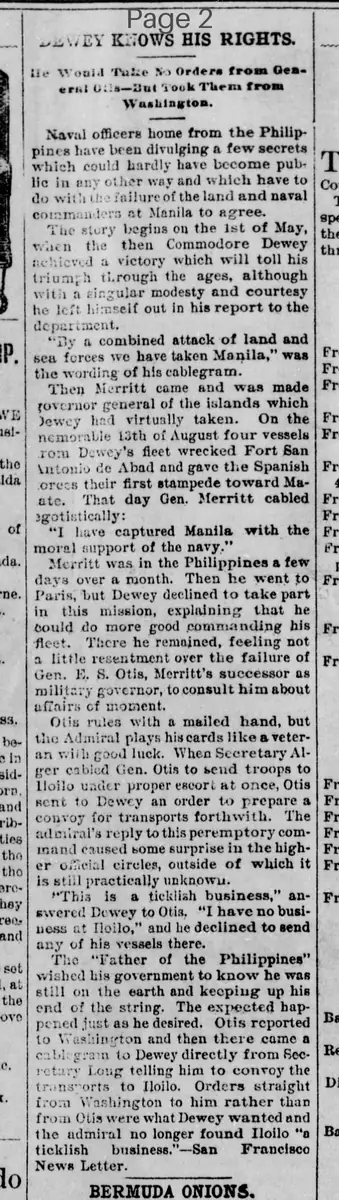
He Would Take No Orders from General Otis--But Took Them from Washington.
Naval officers home from the Philippines have been divulging a few secrets which could hardly have become public in any other way and which have to do with the failure of the land and naval commanders at Manila to agree.
The story begins on the 1st of May, when the then Commodore Dewey achieved a victory which will tell his triumph through the ages, although with a singular modesty and courtesy he left himself out in his report to the department.
"By a combined attack of land and sea forces we have taken Manila," was the wording of his cablegram.
Then Merritt came and was made governor general of the islands which Dewey had virtually taken. On the memorable 13th of August four vessels from Dewey's fleet wrecked Fort San Antonio de Abad and gave the Spanish forces their first stampede toward Manila. That day Gen. Merritt cabled egotistically:
"I have captured Manila with the moral support of the navy."
Merritt was in the Philippines a few days over a month. Then he went to Paris, but Dewey declined to take part in this mission, explaining that he could do more good commanding his fleet. There he remained, feeling not a little resentment over the failure of Gen. E. S. Otis, Merritt's successor as military governor, to consult him about affairs of moment.
Otis rules with a mailed hand, but the Admiral plays his cards like a veteran with good luck. When Secretary Alger cabled Gen. Otis to send troops to Iloilo under proper escort at once, Otis sent to Dewey an order to prepare a convoy for transports forthwith. The admiral's reply to this peremptory command caused some surprise in the higher official circles, outside of which it is still practically unknown.
"This is a ticklish business," answered Dewey to Otis. "I have no business at Iloilo," and he declined to send any of his vessels there.
The "Father of the Philippines" wished his government to know he was still on the earth and keeping up his end of the string. The expected happened just as he desired. Otis reported to Washington and then there came a cablegram to Dewey directly from Secretary Long telling him to convoy the transports to Iloilo. Orders straight from Washington to him rather than from Otis were what Dewey wanted and the admiral no longer found Iloilo "a ticklish business."--San Francisco News Letter.
What sub-type of article is it?
What keywords are associated?
What entities or persons were involved?
Where did it happen?
Foreign News Details
Primary Location
Philippines
Event Date
1st Of May And 13th Of August
Key Persons
Outcome
manila captured by combined forces; dewey refuses otis's order for iloilo convoy but complies with direct washington order.
Event Details
Dewey achieved victory at Manila on May 1, reporting combined land and sea attack. Merritt became governor and claimed capture of Manila on August 13 with naval support. Dewey resented Otis's lack of consultation and refused his order to convoy to Iloilo, but obeyed direct cable from Secretary Long.