Thank you for visiting SNEWPapers!
Sign up free
Story
October 29, 1938
United Automobile Worker
Detroit, Wayne County, Michigan
What is this article about?
Edward J. Fry, Democratic chairman, charges that sit-down strikes originated under Gov. Frank Fitzgerald's 1935-1936 administration in Michigan, leaving unresolved issues for Gov. Frank Murphy in 1937, refuting Republican criticisms of Murphy's labor policies.
Clipping
OCR Quality
98%
Excellent
Full Text
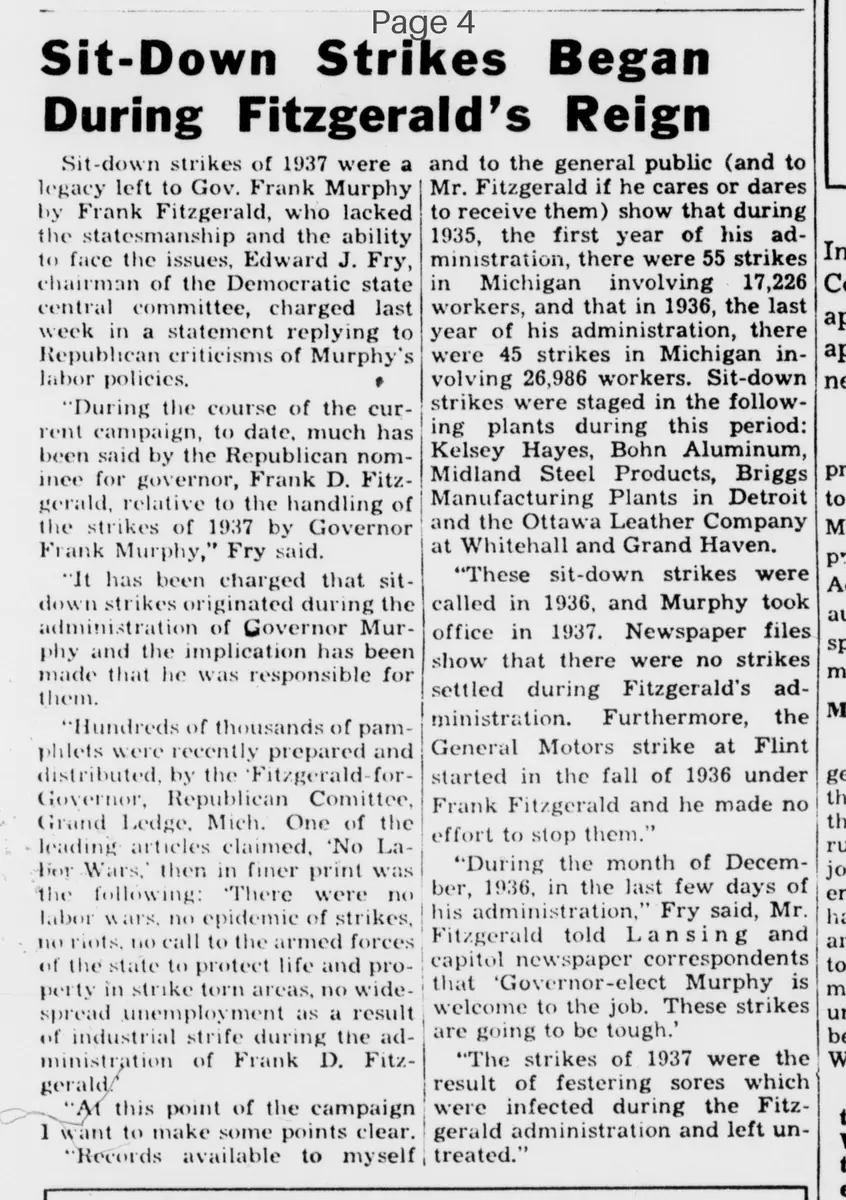
Sit-Down Strikes Began During Fitzgerald's Reign
Sit-down strikes of 1937 were a legacy left to Gov. Frank Murphy by Frank Fitzgerald, who lacked the statesmanship and the ability to face the issues, Edward J. Fry, chairman of the Democratic state central committee, charged last week in a statement replying to Republican criticisms of Murphy's labor policies.
"During the course of the current campaign, to date, much has been said by the Republican nominee for governor, Frank D. Fitzgerald, relative to the handling of the strikes of 1937 by Governor Frank Murphy," Fry said.
It has been charged that sit-down strikes originated during the administration of Governor Murphy and the implication has been made that he was responsible for them.
"Hundreds of thousands of pamphlets were recently prepared and distributed, by the 'Fitzgerald-for-Governor, Republican Committee, Grand Ledge, Mch. One of the leading articles claimed, No Labor Wars.' then in finer print was the following: There were no labor wars, no epidemic of strikes, no riots, no call to the armed forces of the state to protect life and property in strike torn areas, no widespread unemployment as a result of industrial strife during the administration of Frank D. Fitzgerald.
"At this point of the campaign I want to make some points clear.
"Records available to myself and to the general public (and to Mr. Fitzgerald if he cares or dares to receive them) show that during 1935, the first year of his administration, there were 55 strikes in Michigan involving 17,226 workers, and that in 1936, the last year of his administration, there were 45 strikes in Michigan involving 26,986 workers. Sit-down strikes were staged in the following plants during this period: Kelsey Hayes, Bohn Aluminum, Midland Steel Products, Briggs Manufacturing Plants in Detroit and the Ottawa Leather Company at Whitehall and Grand Haven.
"These sit-down strikes were called in 1936, and Murphy took office in 1937. Newspaper files show that there were no strikes settled during Fitzgerald's administration. Furthermore, the General Motors strike at Flint started in the fall of 1936 under Frank Fitzgerald and he made no effort to stop them."
"During the month of December, 1936, in the last few days of his administration," Fry said, Mr. Fitzgerald told Lansing and capitol newspaper correspondents that 'Governor-elect Murphy is welcome to the job. These strikes are going to be tough.'
"The strikes of 1937 were the result of festering sores which were infected during the Fitzgerald administration and left untreated."
Sit-down strikes of 1937 were a legacy left to Gov. Frank Murphy by Frank Fitzgerald, who lacked the statesmanship and the ability to face the issues, Edward J. Fry, chairman of the Democratic state central committee, charged last week in a statement replying to Republican criticisms of Murphy's labor policies.
"During the course of the current campaign, to date, much has been said by the Republican nominee for governor, Frank D. Fitzgerald, relative to the handling of the strikes of 1937 by Governor Frank Murphy," Fry said.
It has been charged that sit-down strikes originated during the administration of Governor Murphy and the implication has been made that he was responsible for them.
"Hundreds of thousands of pamphlets were recently prepared and distributed, by the 'Fitzgerald-for-Governor, Republican Committee, Grand Ledge, Mch. One of the leading articles claimed, No Labor Wars.' then in finer print was the following: There were no labor wars, no epidemic of strikes, no riots, no call to the armed forces of the state to protect life and property in strike torn areas, no widespread unemployment as a result of industrial strife during the administration of Frank D. Fitzgerald.
"At this point of the campaign I want to make some points clear.
"Records available to myself and to the general public (and to Mr. Fitzgerald if he cares or dares to receive them) show that during 1935, the first year of his administration, there were 55 strikes in Michigan involving 17,226 workers, and that in 1936, the last year of his administration, there were 45 strikes in Michigan involving 26,986 workers. Sit-down strikes were staged in the following plants during this period: Kelsey Hayes, Bohn Aluminum, Midland Steel Products, Briggs Manufacturing Plants in Detroit and the Ottawa Leather Company at Whitehall and Grand Haven.
"These sit-down strikes were called in 1936, and Murphy took office in 1937. Newspaper files show that there were no strikes settled during Fitzgerald's administration. Furthermore, the General Motors strike at Flint started in the fall of 1936 under Frank Fitzgerald and he made no effort to stop them."
"During the month of December, 1936, in the last few days of his administration," Fry said, Mr. Fitzgerald told Lansing and capitol newspaper correspondents that 'Governor-elect Murphy is welcome to the job. These strikes are going to be tough.'
"The strikes of 1937 were the result of festering sores which were infected during the Fitzgerald administration and left untreated."
What sub-type of article is it?
Historical Event
What themes does it cover?
Justice
Misfortune
What keywords are associated?
Sit Down Strikes
Labor Disputes
Michigan Politics
Fitzgerald Administration
Murphy Administration
General Motors Strike
What entities or persons were involved?
Edward J. Fry
Frank Murphy
Frank Fitzgerald
Where did it happen?
Michigan
Story Details
Key Persons
Edward J. Fry
Frank Murphy
Frank Fitzgerald
Location
Michigan
Event Date
1935 1937
Story Details
Edward J. Fry charges that sit-down strikes began under Gov. Frank Fitzgerald's administration in 1936, involving multiple plants and the GM strike in Flint, leaving unresolved labor issues for incoming Gov. Frank Murphy in 1937, countering Republican claims that strikes originated under Murphy.