Thank you for visiting SNEWPapers!
Sign up free
The Albany Register
Albany, Linn County, Oregon
What is this article about?
Historical account of the James brothers' post-Civil War criminal activities, including multiple bank and train robberies across Missouri, Kentucky, Iowa, and their notorious guerrilla warfare record during the war, marked by massacres and bold exploits.
Clipping
OCR Quality
Full Text
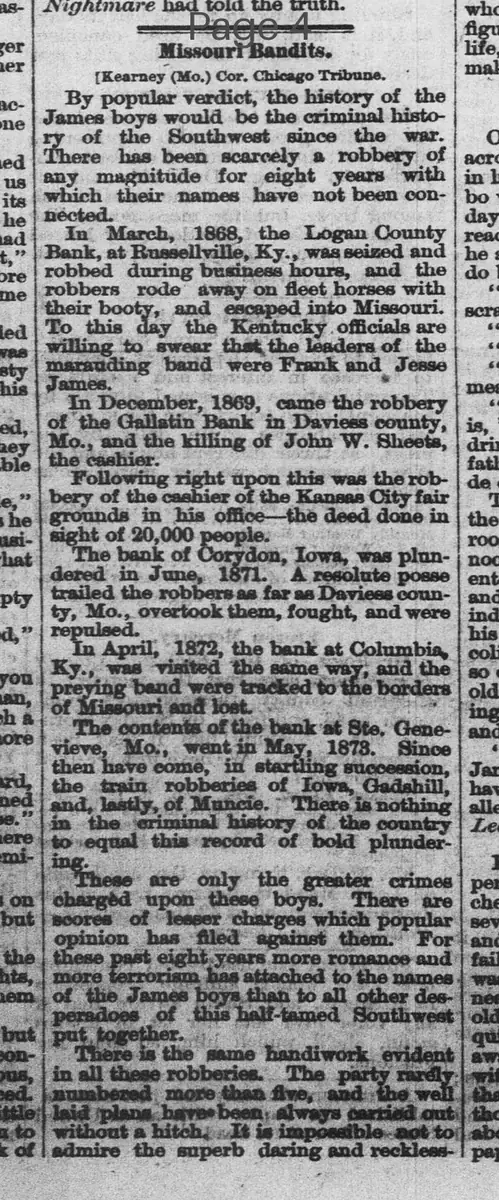
[Kearney (Mo.) Cor. Chicago Tribune.]
By popular verdict, the history of the James boys would be the criminal history of the Southwest since the war. There has been scarcely a robbery of any magnitude for eight years with which their names have not been connected.
In March, 1868, the Logan County Bank, at Russellville, Ky., was seized and robbed during business hours, and the robbers rode away on fleet horses with their booty, and escaped into Missouri. To this day the Kentucky officials are willing to swear that the leaders of the marauding band were Frank and Jesse James.
In December, 1869, came the robbery of the Gallatin Bank in Daviess county, Mo., and the killing of John W. Sheets, the cashier. Following right upon this was the robbery of the cashier of the Kansas City fair grounds in his office--the deed done in sight of 20,000 people.
The bank of Corydon, Iowa, was plundered in June, 1871. A resolute posse trailed the robbers as far as Daviess county, Mo., overtook them, fought, and were repulsed.
In April, 1872, the bank at Columbia, Ky., was visited the same way, and the preying band were tracked to the borders of Missouri and lost.
The contents of the bank at Ste. Genevieve, Mo., went in May, 1873. Since then have come, in startling succession, the train robberies of Iowa, Gadshill and, lastly, of Muncie. There is nothing in the criminal history of the country to equal this record of bold plundering.
These are only the greater crimes charged upon these boys. There are scores of lesser charges which popular opinion has filed against them. For these past eight years more romance and more terrorism has attached to the names of the James boys than to all other desperadoes of this half-tamed Southwest put together.
There is the same handiwork evident in all these robberies. The party rarely numbered more than five and the well laid plans have always been carried out without a hitch. It is impossible not to admire the superb daring and recklessness of these men. They face death with the nonchalance taught by a life's familiarity with it.
The James boys, while never denying their terrible record during the war, have steadily repudiated these charges of bank and train robberies. Each successive Governor of Missouri outlaws them and sets a price on their heads, to which they regularly retort with an offer to give themselves up and face the decisions of the courts if pledged fair treatment.
The father of Jesse and Frank was the Rev. Thomas James, a Baptist preacher, who attained considerable eminence in the State. Clay county was part of the debatable ground in the early troubles of the Jayhawkers and the Border Ruffians, as they were opprobriously termed by their enemies on either side. At the outset of the conflict Frank James joined Quantrell. Jesse, only 16 years of age, remained on the farm. One day a company of militia came to the place and hung Dr. Samuels to a tree three or four times, and left him for dead: Jesse was taken from the plow and dragged about with a rope around his neck, beaten with the flats of sabers, and warned that the punishment would be worse if the family continued to harbor bushwhackers. Mrs. Samuels and her daughter were taken to St. Joseph, and for some weeks held in custody.
Jesse James joined his brother under Quantrell, and from that day to the end of the war the boys were in every massacre and terrible encounter in the guerrilla warfare up and down the Missouri Kansas and Arkansas border. They served under those most noted desperadoes, Quantrell, Todd, Anderson and Taylor, out of whom the only one now living is Taylor, and he is a cripple, with one arm shot away, a shattered right lung, and a terrible scar on his thigh.
The James boys were prominent in the sack of Lawrence, and afterward it was a party of twenty-seven men under their leadership who fell upon a detachment of Jennison's famous 15th Kansas cavalry on Cabin Creek, in the Cherokee Nation, and slaughtered twenty-nine out of the thirty-two. With his own hand in this meeting, Jesse James killed Capt. Goss, and also the Rev. U. P. Gardner, of the 13th Kansas.
They were with Bill Anderson at Centralia, Mo., when a train of soldiers, some armed and some helpless, was stopped. A few shots were fired, and then the Union soldiers surrendered, only to be taken from the cars and shot down until not a man was left. Then the town was sacked. The train was set on fire, the engine turned loose with a full head of steam, and sent plunging away at a fearful rate of speed toward Sturgeon. When the place had been laid waste, Anderson and his men retreated to the brush.
From Paris, in Monroe county, a detachment of Federal cavalry 300 strong, under Maj. Johnson, came down to avenge the outrage. Anderson's men lured the troopers into their trap, and swooped down on them. Out of the 300, barely twenty got back to tell of the massacre. There were no prisoners taken. Jesse James killed Maj. Johnson and seven others. Frank James killed as many more. The blood that rests on these two men's heads is something so terrible that their old companions in arms shudder when they tell of them.
The war record of these men would fill books, but this is enough to show the character of their lives.
What sub-type of article is it?
What keywords are associated?
What entities or persons were involved?
Where did it happen?
Domestic News Details
Primary Location
Missouri
Event Date
1868 1873
Key Persons
Outcome
multiple bank and train robberies successful; numerous deaths in guerrilla actions including massacres at lawrence, cabin creek (29 killed), centralia (all union soldiers killed), and monroe county (280 killed); family assaulted during war.
Event Details
The James brothers are linked to a series of bold bank robberies from 1868 to 1873 in Kentucky, Missouri, and Iowa, and train robberies; they deny post-war crimes but acknowledge guerrilla warfare under Quantrell and others, participating in massacres and raids along the Missouri-Kansas border during the Civil War.