Thank you for visiting SNEWPapers!
Sign up free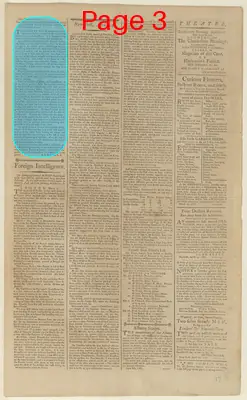
Letter to Editor
April 19, 1787
The New York Journal, And Weekly Register
New York, New York County, New York
What is this article about?
A letter describes an insect pest, likely introduced from German wheat, that has destroyed wheat crops on Long Island since around the end of the war. It details the insect's life cycle and recommends resistant 'white bearded' wheat from Mr. Underhill, lime manure, and late September sowing to prevent damage.
Clipping
OCR Quality
95%
Excellent
Full Text
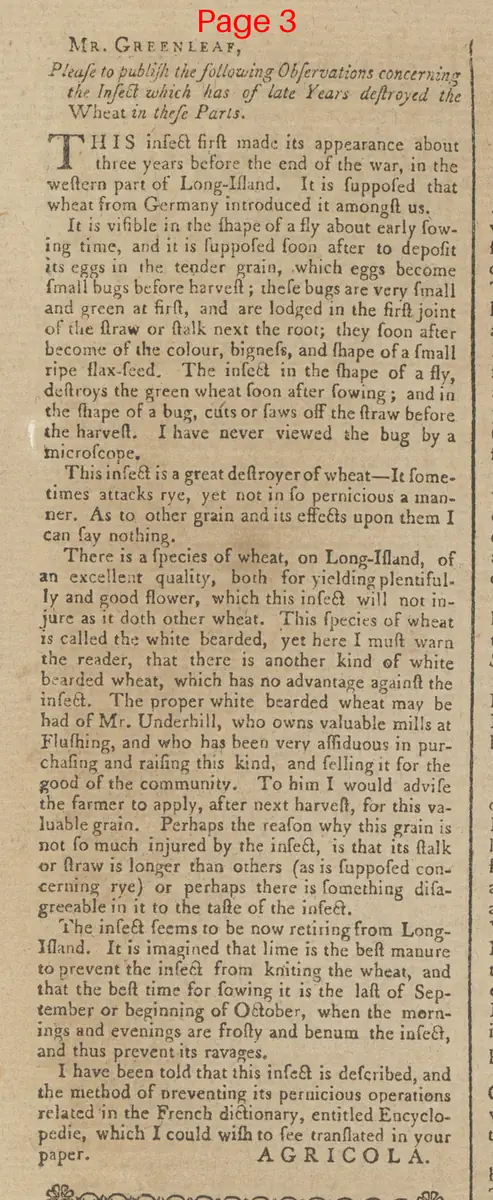
MR. GREENLEAF,
Please to publish the following Observations concerning the Insect which has of late Years destroyed the Wheat in these Parts.
It is insect first made its appearance about three years before the end of the war, in the western part of Long-Island. It is supposed that wheat from Germany introduced it amongst us.
It is visible in the shape of a fly about early sowing time, and it is supposed soon after to deposit its eggs in the tender grain, which eggs become small bugs before harvest; these bugs are very small and green at first, and are lodged in the first joint of the straw or stalk next the root; they soon after become of the colour, bigness, and shape of a small ripe flax-seed. The insect in the shape of a fly, destroys the green wheat soon after sowing; and in the shape of a bug, cuts or saws off the straw before the harvest. I have never viewed the bug by a microscope.
This insect is a great destroyer of wheat. It sometimes attacks rye, yet not in so pernicious a manner. As to other grain and its effects upon them I can say nothing.
There is a species of wheat, on Long-Island, of an excellent quality, both for yielding plentifully and good flour, which this insect will not injure as it doth other wheat. This species of wheat is called the white bearded, yet here I must warn the reader, that there is another kind of white bearded wheat, which has no advantage against the insect. The proper white bearded wheat may be had of Mr. Underhill, who owns valuable mills at Flushing, and who has been very assiduous in purchasing and raising this kind, and selling it for the good of the community. To him I would advise the farmer to apply, after next harvest, for this valuable grain. Perhaps the reason why this grain is not so much injured by the insect, is that its stalk or straw is longer than others (as is supposed concerning rye) or perhaps there is something disagreeable in it to the taste of the insect.
The insect seems to be now retiring from Long-Island. It is imagined that lime is the best manure to prevent the insect from hitting the wheat, and that the best time for sowing it is the last of September or beginning of October, when the mornings and evenings are frosty and benumb the insect, and thus prevent its ravages.
I have been told that this insect is described, and the method of preventing its pernicious operations related in the French dictionary, entitled Encyclopédie, which I could wish to see translated in your paper.
AGRICOLE.
Please to publish the following Observations concerning the Insect which has of late Years destroyed the Wheat in these Parts.
It is insect first made its appearance about three years before the end of the war, in the western part of Long-Island. It is supposed that wheat from Germany introduced it amongst us.
It is visible in the shape of a fly about early sowing time, and it is supposed soon after to deposit its eggs in the tender grain, which eggs become small bugs before harvest; these bugs are very small and green at first, and are lodged in the first joint of the straw or stalk next the root; they soon after become of the colour, bigness, and shape of a small ripe flax-seed. The insect in the shape of a fly, destroys the green wheat soon after sowing; and in the shape of a bug, cuts or saws off the straw before the harvest. I have never viewed the bug by a microscope.
This insect is a great destroyer of wheat. It sometimes attacks rye, yet not in so pernicious a manner. As to other grain and its effects upon them I can say nothing.
There is a species of wheat, on Long-Island, of an excellent quality, both for yielding plentifully and good flour, which this insect will not injure as it doth other wheat. This species of wheat is called the white bearded, yet here I must warn the reader, that there is another kind of white bearded wheat, which has no advantage against the insect. The proper white bearded wheat may be had of Mr. Underhill, who owns valuable mills at Flushing, and who has been very assiduous in purchasing and raising this kind, and selling it for the good of the community. To him I would advise the farmer to apply, after next harvest, for this valuable grain. Perhaps the reason why this grain is not so much injured by the insect, is that its stalk or straw is longer than others (as is supposed concerning rye) or perhaps there is something disagreeable in it to the taste of the insect.
The insect seems to be now retiring from Long-Island. It is imagined that lime is the best manure to prevent the insect from hitting the wheat, and that the best time for sowing it is the last of September or beginning of October, when the mornings and evenings are frosty and benumb the insect, and thus prevent its ravages.
I have been told that this insect is described, and the method of preventing its pernicious operations related in the French dictionary, entitled Encyclopédie, which I could wish to see translated in your paper.
AGRICOLE.
What sub-type of article is it?
Informative
Persuasive
What themes does it cover?
Agriculture
What keywords are associated?
Wheat Insect
Long Island
Pest Control
Resistant Wheat
Lime Manure
Late Sowing
German Origin
What entities or persons were involved?
Agricole.
Mr. Greenleaf
Letter to Editor Details
Author
Agricole.
Recipient
Mr. Greenleaf
Main Argument
the letter details the life cycle and impact of a wheat-destroying insect on long island, likely introduced from germany, and advises farmers to use resistant 'white bearded' wheat from mr. underhill, lime as manure, and late sowing in september/october to prevent its damage.
Notable Details
Insect Appeared Three Years Before War's End In Western Long Island
Fly Deposits Eggs Becoming Green Bugs Like Flax Seed
Resistant White Bearded Wheat Available From Mr. Underhill At Flushing Mills
Lime Manure And Frosty Late Sowing Prevent Ravages
Described In French Encyclopédie