Thank you for visiting SNEWPapers!
Sign up free
Editorial
April 18, 1896
The Freeman
Indianapolis, Marion County, Indiana
What is this article about?
Editorial praises the African Methodist Episcopal Church's influence and upcoming General Conference in Wilmington, NC, for electing bishops and officers. Ranks current bishops led by Abram Grant and Henry M. Turner, and predicts elections of Levi J. Coppin, W. B. Darrick, J. H. Armstrong, and J. C. Embry. Emphasizes church's role in racial advancement.
Clipping
OCR Quality
98%
Excellent
Full Text
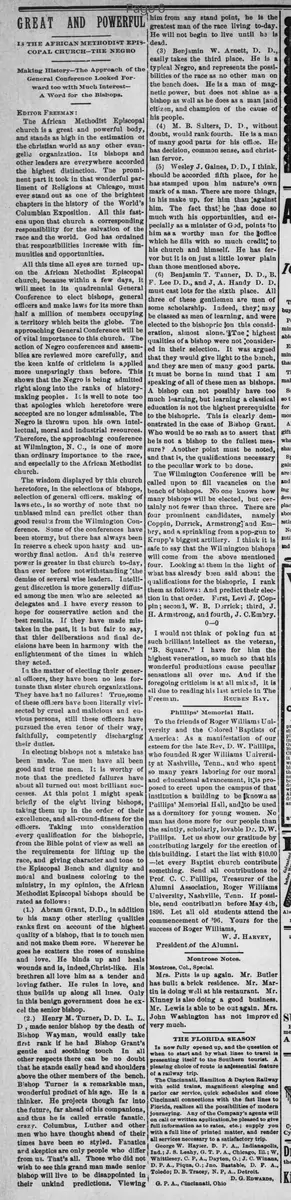
IN THE AFRICAN METHODIST EPISCOPAL CHURCH
Making History—The Approach of the General Conference Looked Forward to with Much Interest—A Word for the Bishops.
Editor Freeman:
The African Methodist Episcopal church is a great and powerful body, and stands as high in the estimation of the christian world as any other evangelical organization. Its bishops and other leaders are everywhere accorded the highest distinction. The prominent part it took in that wonderful parliament of Religions at Chicago, must ever stand out as one of the brightest chapters in the history of the World's Columbian Exposition. All this fastens upon that church a corresponding responsibility for the salvation of the race and the world. God has ordained that responsibilities increase with immunities and opportunities.
All this time all eyes are turned upon the African Methodist Episcopal church, because within a few days, it will meet in its quadrennial General Conference to elect bishops, general officers and make laws for its more than half a million of members occupying a territory which belts the globe. The approaching General Conference will be of vital importance to this church. The action of Negro conferences and assemblies are reviewed more carefully, and the keen knife of criticism is applied more unsparingly than before. This shows that the Negro is being admitted right along into the ranks of history-making peoples. It is well to note too that apologies which heretofore were accepted are no longer admissible. The Negro is thrown upon his own intellectual, moral and industrial resources. Therefore, the approaching conference at Wilmington, N. C., is one of more than ordinary importance to the race, and especially to the African Methodist church.
The wisdom displayed by this church heretofore, in the selections of bishops, selection of general officers, making of laws etc., is so worthy of note that no unbiased mind can predict other than good results from the Wilmington Conference. Some of the conferences have been stormy, but there has always been in reserve a check upon hasty and unworthy final action. And this reserve power is greater in that church to-day than ever before notwithstanding the demise of several wise leaders. Intelligent discretion is more generally diffused among the men who are selected as delegates and I have every reason to hope for conservative action and the best results. If they have made mistakes in the past, it is but fair to say, that their deliberations and final decisions have been in harmony with the enlightenment of the times in which they acted.
In the matter of electing their general officers, they have been no less fortunate than sister church organizations. They have had no failures! True, some of these officers have been literally vivisected by cruel and malicious and envious persons, still these officers have pursued the even tenor of their way, faithfully, competently discharging their duties.
In electing bishops not a mistake has been made. The men have all been good and true men. It is worthy of note that the predicted failures have about all turned out most brilliant successes. At this point I might speak briefly of the eight living bishops, taking them up in the order of their excellence, and all-round-fitness for the office. Taking into consideration every qualification for the bishopric, from the Bible point of view as well as the requirements for lifting up the race, and giving character and tone to the Episcopal Bench and dignity and moral and business coloring to the ministry, in my opinion, the African Methodist Episcopal bishops should be rated as follows:
(1.) Abram Grant, D.D., in addition to his many other sterling qualities ranks first on account of the highest quality of a bishop, that is to touch men and not make them sore. Wherever he goes he scatters the roses of sunshine and love. He binds up and heals wounds and is, indeed, Christ-like. His brethren all love him as a tender and loving father. He rules in love, and thus builds up along all lines. Only in this benign government does he excel the senior bishop.
(2.) Henry M. Turner, D. D. L. L. D., made senior bishop by the death of Bishop Wayman, would easily take first rank if he had Bishop Grant's gentle and soothing touch. In all other respects there can be no doubt that he stands easily head and shoulders above the other members of the bench. Bishop Turner is a remarkable man, wonderful product of his age. He is a thinker. He projects though far into the future, far ahead of his companions, and thus he is called erratic fanatic, crazy. Columbus, Luther and other men who have thought ahead of their times have been so styled. Fanatics and skeptics are only people who differ from us. That's all. Those who did not wish to see this grand man made senior bishop will live to be disappointed in their unkind predictions. Viewing him from any stand point, he is the greatest man of the race living to-day. He will not begin to live until he is dead.
(3) Benjamin W. Arnett, D. D., easily takes the third place. He is a typical Negro, and represents the possibilities of the race as no other man on the bench does. He is a man of magnetic power, but does not shine as a bishop as well as he does as a man and citizen, and champion of the cause of his people.
(4) M. B. Salters. D. D., without doubt, would rank fourth. He is a man of many good parts for his office. He has decision, common sense, and christian fervor.
(5) Wesley J. Gaines, D. D., I think, should be accorded fifth place, for he has stamped upon him nature's own mark of a man. There are more things in his make up, for him than 'against him. The fact that he has done so much with his opportunities, and especially as a minister of God, points to him as a worthy man for the office which he fills with so much credit to his church and himself. He has fervor but it is on just a little lower plain than those mentioned above.
(6) Benjamin T. Tanner, D. D., B. F. Lee D.D., and J. A. Handy D. D. must cast lots for the sixth place. All three of these gentlemen are men of some scholarship. Indeed, they may be classed as men of learning, and were elected to the bishopric for this consideration, almost alone. The highest qualities of a bishop were not considered in their selection. It was argued that they would give light to the bench, and they are men of many good parts. It must be borne in mind that I am speaking of all of these men as bishops. A bishop can not possibly have too much learning, but learning a classical education is not the highest prerequisite to the bishopric. This is clearly demonstrated in the case of Bishop Grant. Who would be so rash as to assert that he is not a bishop to the fullest measure? Another point must be noted, and that is, the qualifications necessary to the peculiar work to be done.
The Wilmington Conference will be called upon to fill vacancies on the bench of bishops. No one knows how many bishops will be elected, but certainly not fewer than three. There are four prominent candidates, namely Coppin, Derrick, Armstrong and Embry, and a sprinkling from pop-gun to Krupp's biggest artillery. I think it is safe to say that the Wilmington bishops will come from the above mentioned four. Looking at them in the light of what has already been said about the qualifications for the bishopric, I rank them as follows: And predict their election in that order. First, Levi J. Coppin; second, W. B. Darrick; third, J. H. Armstrong, and fourth, J. C. Embry.
0-0
I would not think of poking fun at such brilliant intellect as the veteran, "B. Square." I have for him the highest veneration, so much so that his wonderful productions cause peculiar sensations all over me. And if the foregoing criticism is at all mixed, it is all due to reading his last article in The Freeman.
Reuben Ray.
Making History—The Approach of the General Conference Looked Forward to with Much Interest—A Word for the Bishops.
Editor Freeman:
The African Methodist Episcopal church is a great and powerful body, and stands as high in the estimation of the christian world as any other evangelical organization. Its bishops and other leaders are everywhere accorded the highest distinction. The prominent part it took in that wonderful parliament of Religions at Chicago, must ever stand out as one of the brightest chapters in the history of the World's Columbian Exposition. All this fastens upon that church a corresponding responsibility for the salvation of the race and the world. God has ordained that responsibilities increase with immunities and opportunities.
All this time all eyes are turned upon the African Methodist Episcopal church, because within a few days, it will meet in its quadrennial General Conference to elect bishops, general officers and make laws for its more than half a million of members occupying a territory which belts the globe. The approaching General Conference will be of vital importance to this church. The action of Negro conferences and assemblies are reviewed more carefully, and the keen knife of criticism is applied more unsparingly than before. This shows that the Negro is being admitted right along into the ranks of history-making peoples. It is well to note too that apologies which heretofore were accepted are no longer admissible. The Negro is thrown upon his own intellectual, moral and industrial resources. Therefore, the approaching conference at Wilmington, N. C., is one of more than ordinary importance to the race, and especially to the African Methodist church.
The wisdom displayed by this church heretofore, in the selections of bishops, selection of general officers, making of laws etc., is so worthy of note that no unbiased mind can predict other than good results from the Wilmington Conference. Some of the conferences have been stormy, but there has always been in reserve a check upon hasty and unworthy final action. And this reserve power is greater in that church to-day than ever before notwithstanding the demise of several wise leaders. Intelligent discretion is more generally diffused among the men who are selected as delegates and I have every reason to hope for conservative action and the best results. If they have made mistakes in the past, it is but fair to say, that their deliberations and final decisions have been in harmony with the enlightenment of the times in which they acted.
In the matter of electing their general officers, they have been no less fortunate than sister church organizations. They have had no failures! True, some of these officers have been literally vivisected by cruel and malicious and envious persons, still these officers have pursued the even tenor of their way, faithfully, competently discharging their duties.
In electing bishops not a mistake has been made. The men have all been good and true men. It is worthy of note that the predicted failures have about all turned out most brilliant successes. At this point I might speak briefly of the eight living bishops, taking them up in the order of their excellence, and all-round-fitness for the office. Taking into consideration every qualification for the bishopric, from the Bible point of view as well as the requirements for lifting up the race, and giving character and tone to the Episcopal Bench and dignity and moral and business coloring to the ministry, in my opinion, the African Methodist Episcopal bishops should be rated as follows:
(1.) Abram Grant, D.D., in addition to his many other sterling qualities ranks first on account of the highest quality of a bishop, that is to touch men and not make them sore. Wherever he goes he scatters the roses of sunshine and love. He binds up and heals wounds and is, indeed, Christ-like. His brethren all love him as a tender and loving father. He rules in love, and thus builds up along all lines. Only in this benign government does he excel the senior bishop.
(2.) Henry M. Turner, D. D. L. L. D., made senior bishop by the death of Bishop Wayman, would easily take first rank if he had Bishop Grant's gentle and soothing touch. In all other respects there can be no doubt that he stands easily head and shoulders above the other members of the bench. Bishop Turner is a remarkable man, wonderful product of his age. He is a thinker. He projects though far into the future, far ahead of his companions, and thus he is called erratic fanatic, crazy. Columbus, Luther and other men who have thought ahead of their times have been so styled. Fanatics and skeptics are only people who differ from us. That's all. Those who did not wish to see this grand man made senior bishop will live to be disappointed in their unkind predictions. Viewing him from any stand point, he is the greatest man of the race living to-day. He will not begin to live until he is dead.
(3) Benjamin W. Arnett, D. D., easily takes the third place. He is a typical Negro, and represents the possibilities of the race as no other man on the bench does. He is a man of magnetic power, but does not shine as a bishop as well as he does as a man and citizen, and champion of the cause of his people.
(4) M. B. Salters. D. D., without doubt, would rank fourth. He is a man of many good parts for his office. He has decision, common sense, and christian fervor.
(5) Wesley J. Gaines, D. D., I think, should be accorded fifth place, for he has stamped upon him nature's own mark of a man. There are more things in his make up, for him than 'against him. The fact that he has done so much with his opportunities, and especially as a minister of God, points to him as a worthy man for the office which he fills with so much credit to his church and himself. He has fervor but it is on just a little lower plain than those mentioned above.
(6) Benjamin T. Tanner, D. D., B. F. Lee D.D., and J. A. Handy D. D. must cast lots for the sixth place. All three of these gentlemen are men of some scholarship. Indeed, they may be classed as men of learning, and were elected to the bishopric for this consideration, almost alone. The highest qualities of a bishop were not considered in their selection. It was argued that they would give light to the bench, and they are men of many good parts. It must be borne in mind that I am speaking of all of these men as bishops. A bishop can not possibly have too much learning, but learning a classical education is not the highest prerequisite to the bishopric. This is clearly demonstrated in the case of Bishop Grant. Who would be so rash as to assert that he is not a bishop to the fullest measure? Another point must be noted, and that is, the qualifications necessary to the peculiar work to be done.
The Wilmington Conference will be called upon to fill vacancies on the bench of bishops. No one knows how many bishops will be elected, but certainly not fewer than three. There are four prominent candidates, namely Coppin, Derrick, Armstrong and Embry, and a sprinkling from pop-gun to Krupp's biggest artillery. I think it is safe to say that the Wilmington bishops will come from the above mentioned four. Looking at them in the light of what has already been said about the qualifications for the bishopric, I rank them as follows: And predict their election in that order. First, Levi J. Coppin; second, W. B. Darrick; third, J. H. Armstrong, and fourth, J. C. Embry.
0-0
I would not think of poking fun at such brilliant intellect as the veteran, "B. Square." I have for him the highest veneration, so much so that his wonderful productions cause peculiar sensations all over me. And if the foregoing criticism is at all mixed, it is all due to reading his last article in The Freeman.
Reuben Ray.
What sub-type of article is it?
Moral Or Religious
Social Reform
What keywords are associated?
Ame Church
General Conference
Bishop Elections
Negro Race
Wilmington Nc
Church Leadership
Racial Advancement
What entities or persons were involved?
African Methodist Episcopal Church
Abram Grant
Henry M. Turner
Benjamin W. Arnett
M. B. Salters
Wesley J. Gaines
Benjamin T. Tanner
B. F. Lee
J. A. Handy
Levi J. Coppin
W. B. Darrick
J. H. Armstrong
J. C. Embry
Reuben Ray
Editorial Details
Primary Topic
Upcoming Ame General Conference And Bishop Elections
Stance / Tone
Optimistic And Supportive Of Church Leadership
Key Figures
African Methodist Episcopal Church
Abram Grant
Henry M. Turner
Benjamin W. Arnett
M. B. Salters
Wesley J. Gaines
Benjamin T. Tanner
B. F. Lee
J. A. Handy
Levi J. Coppin
W. B. Darrick
J. H. Armstrong
J. C. Embry
Reuben Ray
Key Arguments
Ame Church Is A Powerful Evangelical Body With Global Influence And Responsibility For Racial Salvation
General Conference In Wilmington, Nc, Is Vital For Electing Bishops And Officers Amid Heightened Scrutiny
Past Selections Of Leaders Have Been Wise And Successful Despite Criticisms
Ranking Of Current Bishops Prioritizes Qualities Like Love, Foresight, And Racial Uplift
Predicted Election Order Of New Bishops: Coppin, Darrick, Armstrong, Embry