Thank you for visiting SNEWPapers!
Sign up free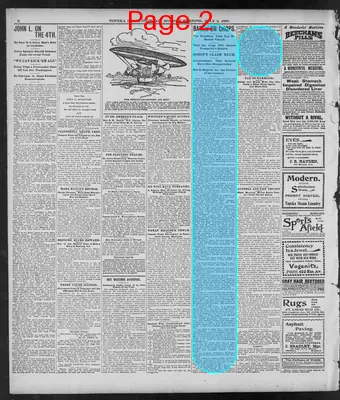
Story
July 5, 1897
The Topeka State Journal
Topeka, Shawnee County, Kansas
What is this article about?
Eva McDonald Valesch interviews President McKinley at the White House on economic issues. He acknowledges disappointing returns but hopes good western crops will hasten prosperity's return, supports protective tariffs, and discusses immigration restrictions.
Clipping
OCR Quality
98%
Excellent
Full Text
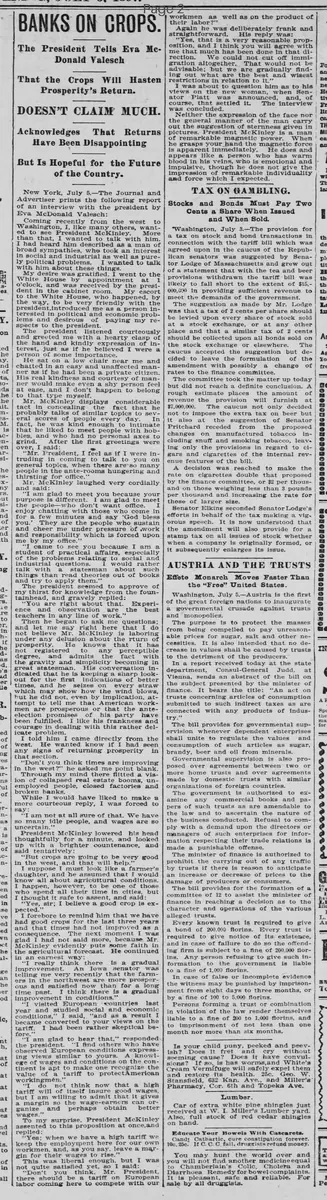
BANKS ON CROPS.
The President Tells Eva McDonald Valesch That the Crops Will Hasten Prosperity's Return.
DOESN'T CLAIM MUCH.
Acknowledges That Returns Have Been Disappointing But Is Hopeful for the Future of the Country.
New York, July 5.-The Journal and Advertiser prints the following report of an interview with the president by Eva McDonald Valesch:
Coming recently from the west to Washington, I, like many others, wanted to see President McKinley. More than that, I wanted to talk with him.
I had heard him described as a man of broad sympathies, who took an interest in social and industrial as well as purely political problems. I wanted to talk with him about these things.
My desire was gratified. I went to the White House by appointment at 1 o'clock, and was received by the president in the cabinet room. My escort to the White House, who happened, by the way, to be very friendly with the president, introduced me as a person interested in political and economic problems and desirous of paying my respects to the president.
The president listened courteously and greeted me with a hearty clasp of the hand and kindly expression of interest, just as if he believed I were a person of some importance.
He sat on a low chair near me and chatted in an easy and unaffected manner as if he had been a private citizen.
His real kindness and courtesy of manner would make even a shy person feel at ease, and I don't happen to belong to that type myself.
Mr. McKinley displays considerable tact in concealing the fact that he probably talks of similar topics to several scores of people every day. In fact, he was kind enough to intimate that he liked to meet people with hobbies, and who had no personal axes to grind. After the first greetings were over, I said:
"Mr. President, I feel as if I were intruding in coming to talk to you on general topics, when there are so many people in the ante-rooms hungering and thirsting for office."
Mr. McKinley laughed very cordially and said:
"I am glad to meet you because your purpose is different, I am glad to meet the people who don't want office. I enjoy chatting with those who come in for a few minutes and say God bless you.' They are the people who sustain and cheer me under pressure of work and responsibility which is forced upon me by my office."
"I came to see you because I am a student of practical affairs, especially of the problems relating to social and industrial questions.
I would rather talk with a statesman about such things than read theories out of books and try to apply them."
The president seemed to approve of my thirst for knowledge from the fountainhead, and gravely replied:
"You are right about that. Experience and observation are the best teachers in any line of work."
Then he began to ask me questions; and let me say right here that I do not believe Mr. McKinley is laboring under any delusion about the return of prosperity. He knows that it has not registered to any perceptible degree, and admits the fact with the gravity and simplicity becoming in great statesman. His conversation indicated that he is keeping a sharp look-out for the first indications of better times, and he seizes on every straw which may show how the wind blows, but he did not, even by implication, attempt to tell me that American workmen are prosperous or that the ante-election promises of his party have been fulfilled. I like his frankness and courage in dealing with this rather delicate problem.
I told him I came directly from the west. He wanted know if I had seen any signs of returning prosperity in that section.
"Don't you think times are improving in the west?" he asked me point blank.
Through my mind there flitted a vision of collapsed real estate booms, unemployed people, closed factories and broken banks.
While I would have liked to make a more courteous reply, I was forced to say:
"I am not at all sure of that. We have so many idle people, and wages are so uncertain."
President McKinley lowered his head thoughtfully for a minute, and looked up with a brighter countenance, and said tentatively:
"But crops are going to be very good in the west, and that will help."
I suppose I must look like a farmer's daughter, and he assumed that I would know all about agricultural conditions. I happen, however, to be one of those who spend all their time in cities, but I thought it safe to assent, and said:
"Yes, sir; I believe a good crop is expected."
I forebore to remind him that we have had good crops for the last three years and that times had not improved as a consequence. The next moment I was glad I had not said more, because Mr. McKinley evidently puts some faith in the agricultural forecast. He continued in an earnest way:
"I really think there is a gradual improvement. An Iowa senator was telling me very recently that the farmers in the northwest are more prosperous and satisfied now than for a long time past. I think there is a gradual improvement in conditions."
"I visited European countries last year and studied social and economic conditions," I said, "and as a result I became converted to your views on the tariff. I had been rather skeptical before."
"I am glad to hear that," responded the president. "I find others who have observed European conditions expressing views similar to yours. A knowledge of wages and conditions on the continent is apt to make one recognize the value of a tariff to protect American workingmen."
"I do not think now that a high tariff will of itself insure good wages, but I am willing to admit that it gives a margin so the wage-earners can organize and perhaps obtain better wages."
To my surprise, President McKinley assented to this proposition at once, and replied:
"Yes; when we have a high tariff we keep the employment here for our own workmen, and, as you say, leave a margin for their wages to rise."
This was liberal enough, but I was not quite satisfied yet, so I said:
"Don't you think, Mr. President, there should be a tariff on European labor coming here to compete with our workmen as well as on the product of their labor?"
Again he was deliberately frank and straightforward. His reply was:
"Yes, that is a very reasonable proposition, and I think you will agree with me that much has been done in that direction.
We could not cut off immigration altogether. That would not be advisable; but we are gradually finding out what are the best and wisest restrictions in relation to it."
I was about to question him as to his views on the new woman, when Senator Platt was announced, and, of course, that settled it. The interview was concluded.
Neither the expression of the face nor the general manner of the man carry out the suggestion of sternness given in pictures. President McKinley is a man of remarkable magnetic power. When he grasps your hand the magnetic force is apparent immediately. He does and appears like a person who has warm blood in his veins, who is emotional and impulsive, though he does not give the impression of remarkable individuality and force which I expected.
The President Tells Eva McDonald Valesch That the Crops Will Hasten Prosperity's Return.
DOESN'T CLAIM MUCH.
Acknowledges That Returns Have Been Disappointing But Is Hopeful for the Future of the Country.
New York, July 5.-The Journal and Advertiser prints the following report of an interview with the president by Eva McDonald Valesch:
Coming recently from the west to Washington, I, like many others, wanted to see President McKinley. More than that, I wanted to talk with him.
I had heard him described as a man of broad sympathies, who took an interest in social and industrial as well as purely political problems. I wanted to talk with him about these things.
My desire was gratified. I went to the White House by appointment at 1 o'clock, and was received by the president in the cabinet room. My escort to the White House, who happened, by the way, to be very friendly with the president, introduced me as a person interested in political and economic problems and desirous of paying my respects to the president.
The president listened courteously and greeted me with a hearty clasp of the hand and kindly expression of interest, just as if he believed I were a person of some importance.
He sat on a low chair near me and chatted in an easy and unaffected manner as if he had been a private citizen.
His real kindness and courtesy of manner would make even a shy person feel at ease, and I don't happen to belong to that type myself.
Mr. McKinley displays considerable tact in concealing the fact that he probably talks of similar topics to several scores of people every day. In fact, he was kind enough to intimate that he liked to meet people with hobbies, and who had no personal axes to grind. After the first greetings were over, I said:
"Mr. President, I feel as if I were intruding in coming to talk to you on general topics, when there are so many people in the ante-rooms hungering and thirsting for office."
Mr. McKinley laughed very cordially and said:
"I am glad to meet you because your purpose is different, I am glad to meet the people who don't want office. I enjoy chatting with those who come in for a few minutes and say God bless you.' They are the people who sustain and cheer me under pressure of work and responsibility which is forced upon me by my office."
"I came to see you because I am a student of practical affairs, especially of the problems relating to social and industrial questions.
I would rather talk with a statesman about such things than read theories out of books and try to apply them."
The president seemed to approve of my thirst for knowledge from the fountainhead, and gravely replied:
"You are right about that. Experience and observation are the best teachers in any line of work."
Then he began to ask me questions; and let me say right here that I do not believe Mr. McKinley is laboring under any delusion about the return of prosperity. He knows that it has not registered to any perceptible degree, and admits the fact with the gravity and simplicity becoming in great statesman. His conversation indicated that he is keeping a sharp look-out for the first indications of better times, and he seizes on every straw which may show how the wind blows, but he did not, even by implication, attempt to tell me that American workmen are prosperous or that the ante-election promises of his party have been fulfilled. I like his frankness and courage in dealing with this rather delicate problem.
I told him I came directly from the west. He wanted know if I had seen any signs of returning prosperity in that section.
"Don't you think times are improving in the west?" he asked me point blank.
Through my mind there flitted a vision of collapsed real estate booms, unemployed people, closed factories and broken banks.
While I would have liked to make a more courteous reply, I was forced to say:
"I am not at all sure of that. We have so many idle people, and wages are so uncertain."
President McKinley lowered his head thoughtfully for a minute, and looked up with a brighter countenance, and said tentatively:
"But crops are going to be very good in the west, and that will help."
I suppose I must look like a farmer's daughter, and he assumed that I would know all about agricultural conditions. I happen, however, to be one of those who spend all their time in cities, but I thought it safe to assent, and said:
"Yes, sir; I believe a good crop is expected."
I forebore to remind him that we have had good crops for the last three years and that times had not improved as a consequence. The next moment I was glad I had not said more, because Mr. McKinley evidently puts some faith in the agricultural forecast. He continued in an earnest way:
"I really think there is a gradual improvement. An Iowa senator was telling me very recently that the farmers in the northwest are more prosperous and satisfied now than for a long time past. I think there is a gradual improvement in conditions."
"I visited European countries last year and studied social and economic conditions," I said, "and as a result I became converted to your views on the tariff. I had been rather skeptical before."
"I am glad to hear that," responded the president. "I find others who have observed European conditions expressing views similar to yours. A knowledge of wages and conditions on the continent is apt to make one recognize the value of a tariff to protect American workingmen."
"I do not think now that a high tariff will of itself insure good wages, but I am willing to admit that it gives a margin so the wage-earners can organize and perhaps obtain better wages."
To my surprise, President McKinley assented to this proposition at once, and replied:
"Yes; when we have a high tariff we keep the employment here for our own workmen, and, as you say, leave a margin for their wages to rise."
This was liberal enough, but I was not quite satisfied yet, so I said:
"Don't you think, Mr. President, there should be a tariff on European labor coming here to compete with our workmen as well as on the product of their labor?"
Again he was deliberately frank and straightforward. His reply was:
"Yes, that is a very reasonable proposition, and I think you will agree with me that much has been done in that direction.
We could not cut off immigration altogether. That would not be advisable; but we are gradually finding out what are the best and wisest restrictions in relation to it."
I was about to question him as to his views on the new woman, when Senator Platt was announced, and, of course, that settled it. The interview was concluded.
Neither the expression of the face nor the general manner of the man carry out the suggestion of sternness given in pictures. President McKinley is a man of remarkable magnetic power. When he grasps your hand the magnetic force is apparent immediately. He does and appears like a person who has warm blood in his veins, who is emotional and impulsive, though he does not give the impression of remarkable individuality and force which I expected.
What sub-type of article is it?
Biography
Historical Event
What themes does it cover?
Misfortune
Triumph
What keywords are associated?
President Mckinley
Interview
Prosperity
Crops
Tariff
Immigration
Economic Conditions
What entities or persons were involved?
President Mckinley
Eva Mcdonald Valesch
Senator Platt
Where did it happen?
White House, Washington
Story Details
Key Persons
President Mckinley
Eva Mcdonald Valesch
Senator Platt
Location
White House, Washington
Event Date
July 5
Story Details
Journalist Eva McDonald Valesch interviews President McKinley on economic conditions, where he admits current disappointments but expresses hope for improvement through good western crops and protective tariffs, while discussing immigration restrictions.