Thank you for visiting SNEWPapers!
Sign up free
Alexandria Daily Advertiser
Alexandria, Virginia
What is this article about?
Diplomatic correspondence in September 1807 between U.S. Minister James Monroe and British Foreign Secretary George Canning regarding the Chesapeake-Leopard incident, discussing reparation, impressment of seamen, and a U.S. presidential proclamation excluding British warships.
Clipping
OCR Quality
Full Text
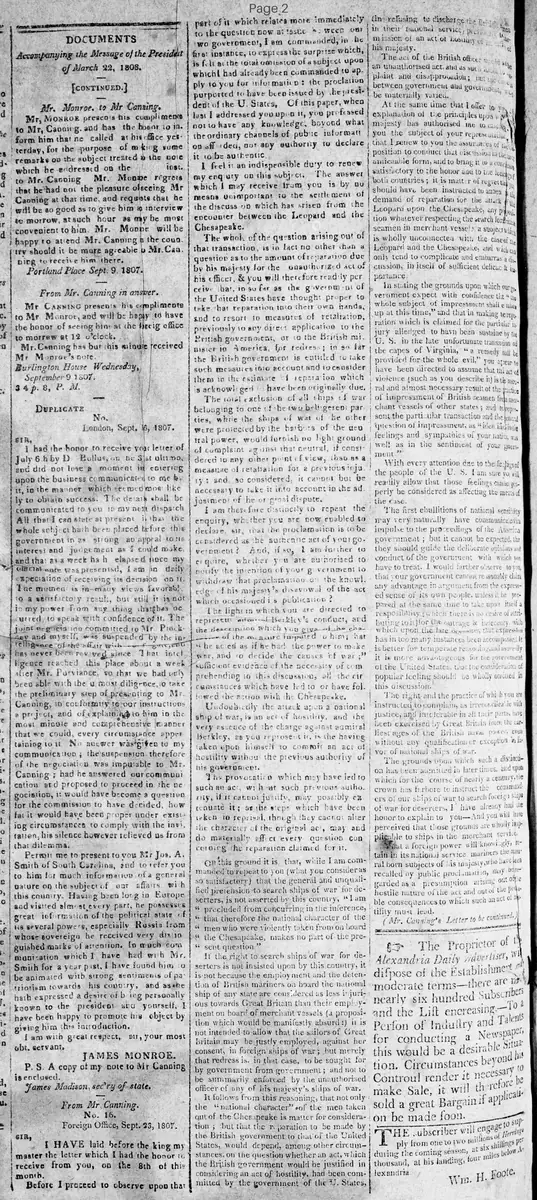
Accompanying the Message of the President
of March 22, 1808.
[CONTINUED.]
Mr. Monroe to Mr. Canning.
Mr. Monroe presents his compliments to Mr. Canning, and has the honor to inform him that he called at his office yesterday, for the purpose of making some remarks on the subject treated in the note which he addressed on the 1st instant to Mr. Canning. Mr. Monroe regrets that he had not the pleasure of seeing Mr. Canning at that time, and requests that he will be so good as to give him an interview tomorrow, at such hour as may be most convenient to him. Mr. Monroe will be happy to attend Mr. Canning in the country, should it be more agreeable to Mr. Canning to receive him there.
Portland Place Sept. 9. 1807.
From Mr. Canning in answer.
Mr. Canning presents his compliments to Mr. Monroe, and will be happy to have the honor of seeing him at the Foreign Office tomorrow at 12 o'clock.
Mr. Canning has but this minute received Mr. Monroe's note.
Burlington House Wednesday,
September 9 1807.
34 p. 8, P. M.
No.
London, Sept. 6, 1807.
SIR,
I had the honor to receive your letter of July 6th by D. Bollus, on the 31st ultimo, and did not lose a moment in entering upon the business communicated to me by it, in the manner which seemed most likely to obtain success. The details shall be communicated to you in my next dispatch. All that I can state at present is that the whole subject has been placed before this government in as strong an appeal to its interest and judgment as I could make, and that as a week has elapsed since my dispatch was presented, I am in daily expectation of receiving its decision on it. The moment is in many views favorable to a satisfactory result, but still it is not in my power from anything that has occurred, to speak with confidence of it. The joint deputation committed to Mr. Pinkney and myself, was suspended by the intelligence of the affair with -anf, and has never been revived since. I had intelligence reached this place about a week after Mr. Purviance, so that we had only been able with the utmost diligence, to take the preliminary step of presenting to Mr. Canning, in conformity to your instructions a project, and of explaining to him in the most minute and comprehensive manner that we could, every circumstance appertaining to it. No answer was given to my communication; the suspension therefore of the negotiation was imputable to Mr. Canning; had he answered our communication and proposed to proceed in the negotiation, it would have become a question for the commission to have decided, how far it would have been proper under existing circumstances to comply with the invitation, his silence however relieved us from that dilemma.
Permit me to present to you Mr. Joa. A. Smith of South Carolina, and to refer you to him for much information of a general nature on the subject of our affairs with this country. Having been long in Europe and visited almost every part, he possesses great information of the political state of its several powers, especially Russia from whose sovereign he received very distinguished marks of attention. In much communication which I have had with Mr. Smith for a year past, I have found him to be animated with strong sentiments of patriotism towards his country, and as he has expressed a desire of being personally known to the President and yourself, I have been happy to promote his object by giving him this introduction.
I am with great respect, Sir, your most obt. servant.
JAMES MONROE.
P. S. A copy of my note to Mr. Canning is enclosed.
James Madison, Secretary of State.
From Mr. Canning.
No. 16.
Foreign Office, Sept. 23, 1807.
SIR,
I HAVE laid before the King my master the letter which I had the honor to receive from you, on the 8th of this month.
Before I proceed to observe upon that part of it which relates more immediately to the question now at issue between our two governments, I am commanded, in the first instance, to express the surprise which is felt at the total omission of a subject upon which I had already been commanded to apply to you for information: the proclamation purported to have been issued by the President of the U. States. Of this paper, when last I addressed you upon it, you professed not to have any knowledge beyond what the ordinary channels of public information afforded, nor any authority to declare it to be authentic.
I feel it an indispensable duty to renew my enquiry on this subject. The answer which I may receive from you is by no means unimportant to the settlement of the discussion which has arisen from the encounter between the Leopard and the Chesapeake.
The whole of the question arising out of that transaction, is in fact no other than a question as to the amount of reparation due by His Majesty for the unauthorized act of his officer, & you will therefore readily perceive that, in so far as the Government of the United States have thought proper to take that reparation into their own hands, and to resort to measures of retaliation, previously to any direct application to the British Government, or to the British Minister in America, for redress; in so far the British Government is entitled to take such measures into account and to consider them in that estimate of reparation which is acknowledged to have been originally due.
The total exclusion of all ships of war belonging to one of the two belligerent parties, while the ships of war of the other were protected by the harbors of the neutral power, would furnish no high ground of complaint against that neutral, if considered to any other point of view, than as a measure of retaliation for a previous injury: and, so considered, it cannot but be necessary to take it into account in the adjustment of the original dispute.
I am therefore distinctly to repeat the enquiry, whether you are now enabled to declare, Sir, that the proclamation is to be considered as the authentic act of your Government? And, if so, I am further to enquire, whether you are authorized to signify the intention of your Government to withdraw that proclamation on the knowledge of His Majesty's disavowal of the act which occasioned its publication?
The light in which you are directed to represent Admiral Berkeley's conduct, and the declaration which you give of the charge imputed to him; that "he acted as if he had the power to make war, and to decide the causes of war:" sufficient evidence of the necessity of comprehending in this discussion, all the circumstances which have led to or have followed the action with the Chesapeake.
Undoubtedly the attack upon a national ship of war, is an act of hostility, and the very essence of the charge against Admiral Berkeley, as you represent it, is the having taken upon himself to commit an act of hostility without the previous authority of his government.
No provocation which may have led to such an act, without such previous authority, if it cannot justify, may possibly extenuate it; as the steps which have been taken in reprisal, though they cannot alter the character of the original act, may and do materially affect every question concerning the reparation claimed for it.
On this ground it is that, while I am commanded to repeat to you (what you consider as so satisfactory) that the general and unqualified pretension to search ships of war for deserters, is not asserted by this country, I am "precluded from concurring in the inference, that therefore the national character of the men who were violently taken from on board the Chesapeake, makes no part of the present question."
If the right to search ships of war for deserters is not insisted upon by this country, it is not because the employment and the detention of British mariners on board the national ship of any state are considered as less injurious towards Great Britain than their employment on board of merchant vessels (a proposition which would be manifestly absurd:) it is not intended to allow that the sailors of Great Britain may be justly employed, against her consent, in foreign ships of war; but merely that redress is, in that case, to be sought for by government from government; and not to be summarily enforced by the unauthorized officer of any of His Majesty's ships of war.
It follows from this reasoning, that not only the "national character" of the men taken out of the Chesapeake is matter for consideration; but that the reparation to be made by the British Government to that of the United States, would depend, among other circumstances, on the question whether an act, which the British Government would be justified in considering an act of hostility, had been committed by the Government of the U. States, (in refusing to discharge the British seamen in their national service previous to the admission of an act of hostility on his Majesty's part).
The act of the British officer would stand disavowed and reprobated as unauthorized, but such disapprobation as would be applicable between government and government, might be materially varied.
At the same time that I offer to you this explanation of the principles upon which His Majesty has authorized me to discharge you the subject of your representation, I renew to you the assurances of the disposition to conduct that discussion in the most amicable form, and to bring it to a conclusion satisfactory to the honor and to the feelings of both countries; it is matter of regret that you should have been instructed to annex the demand of reparation for the attack of the Leopard upon the Chesapeake, any proposition whatever respecting the search for British seamen in merchant vessels: a subject which is wholly unconnected with the case of the Leopard and the Chesapeake, and which can only tend to complicate and embarrass a discussion, in itself of sufficient delicacy & importance.
In stating the grounds upon which your Government expect with confidence that "the whole subject of impressment shall be taken up at this time," and that in making reparation which is claimed for the particular injury alleged to have been sustained by the U. S. in the late unfortunate transaction of the capes of Virginia, "a remedy shall be provided for the whole evil," you appear to have been directed to assume that this act of violence (such as you describe it) is the natural and almost necessary result of the practice of impressment of British seamen from merchant vessels of other states; and to represent the particular transaction and the general question of impressment, as "identified in the feelings and sympathies of your nation, as well as in the sentiment of your government."
With every attention due to the feelings of the people of the U. S. I am sure you will readily allow that those feelings cannot properly be considered as affecting the merits of the case.
The first ebullitions of national sensibility may very naturally have communicated an impulse to the proceedings of the American Government; but it cannot be expected, that they should guide the deliberate opinions and conduct of the Government with which you have to treat. I would farther observe to you, that your Government cannot reasonably claim any advantage in argument from the expressed sense of its own people, unless it be prepared at the same time to take upon itself a responsibility (which there is no desire of attributing to it) for the outrage & indecency, with which upon the late occasion, that expression has in too many instances been accompanied. It is better for temperate reasoning, and assuredly it is more advantageous for the Government of the United States, that the consideration of popular feeling should be wholly omitted in this discussion.
The right and the practice of which you are instructed to complain, as irreconcilable with justice, and intolerable in all their parts, have been exercised by Great Britain from the earliest ages of the British naval power, even without any qualification or exception in favor of national ships of war.
The grounds upon which such a distinction has been admitted in later times, and upon which for the course of nearly a century, the Crown has forbore to instruct the commanders of our ships of war to search foreign ships of war for deserters, I have already had the honor to explain to you--And you will have perceived that those grounds are wholly inapplicable to ships in the merchant service.
That a foreign power will knowingly, retain in its national service mariners the natural born subjects of His Majesty, who have been recalled by public proclamation, may be regarded as a presumption arising out of the hostile nature of the act and out of the probable consequences to which such an act of hostility must lead.
(Mr. Canning's Letter to be continued.)
What sub-type of article is it?
What keywords are associated?
What entities or persons were involved?
Where did it happen?
Foreign News Details
Primary Location
London
Event Date
September 1807
Key Persons
Outcome
ongoing negotiations for reparation and disavowal of the unauthorized attack by hms leopard on uss chesapeake; discussion of u.s. proclamation excluding british warships and impressment practices.
Event Details
Exchange of letters between U.S. Minister Monroe and British Foreign Secretary Canning addressing the Chesapeake-Leopard incident, including requests for meetings, inquiries about the authenticity of a U.S. presidential proclamation, arguments on reparation, retaliation measures, search rights for deserters, and the broader issue of impressment from merchant vessels.