Thank you for visiting SNEWPapers!
Sign up free
Literary
October 2, 1926
Richmond Planet
Richmond, Virginia
What is this article about?
In this serialized story installment, widower John Brooke's adult children—Constance, Billy, and Alice—confront efficiency engineer H. Hedge, who has taken charge of their household. He halves their monthly allowances and insists on daily payments to optimize finances, leading to protests but eventual reluctant acceptance due to their financial dependence.
Clipping
OCR Quality
95%
Excellent
Full Text
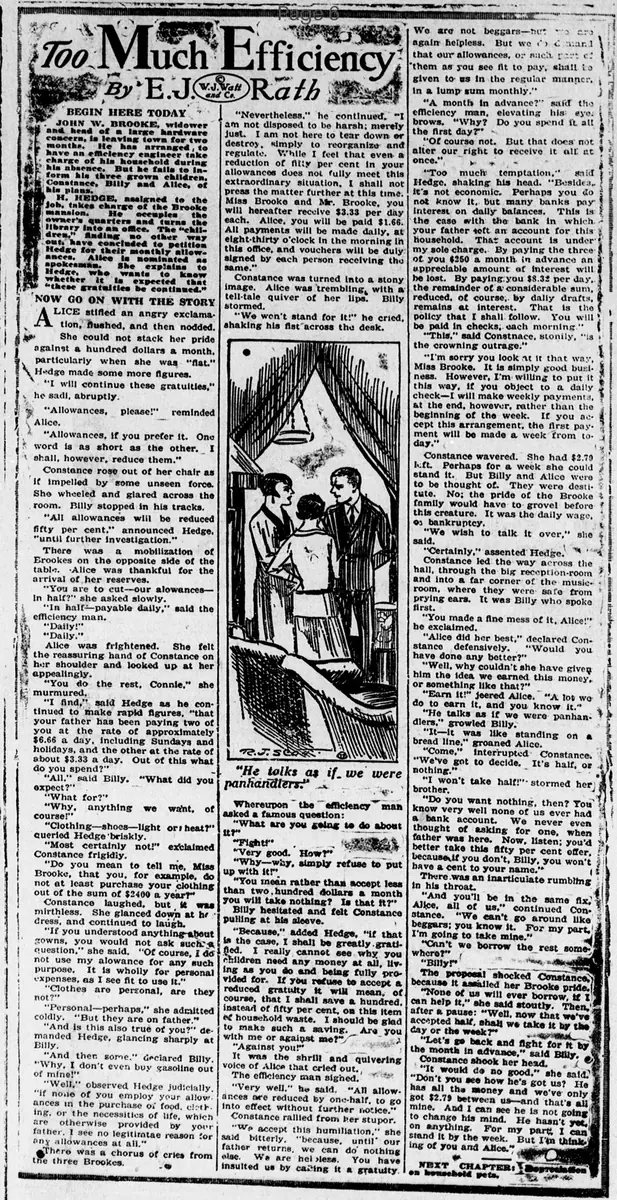
Too Much Efficiency
By E.J. Rath
BEGIN HERE TODAY,
JOHN BROOKE, widower and head of a large wardrobe concern, leaving town for two months.
He has arranged to have an efficiency engineer take charge of his household during his absence, But he fails to inform his three grown children, Constance, Billy and Alice, of his plans.
H. HEDGE, assigned to the job, takes charge of the Brooke mansion.
He occupies the owner's quarters and turns the library into an office, The "children," finding no other way out, have concluded to petition Hedge for their monthly allowances, Alice is nominated as spokeswoman. She explains to Hedge, who wants to know whether it is expected that "these gratuities be continued."
NOW GO ON WITH THE STORY
ALICE stifled an angry exclamation, flushed, and then nodded.
She could not stack her pride against a hundred dollars a month, particularly when she was "flat."
Hedge made some more figures.
"I will continue these gratuities," he said, abruptly.
"Allowances, please!" reminded Alice.
"Allowances, if you prefer it. One word is as short as the other. I shall, however, reduce them."
Constance rose out of her chair as if impelled by some unseen force.
She wheeled and glared across the room. Billy stopped in his tracks.
"All allowances will be reduced fifty per cent.," announced Hedge, "until further investigation."
There was a mobilization of Brookes on the opposite side of the table. Alice was thankful for the arrival of her reserves.
"You are to cut our allowances in half?" she asked slowly.
"In half-payable daily," said the efficiency man.
"Daily!"
Alice was frightened.
She felt the reassuring hand of Constance on her shoulder and looked up at her appealingly.
"You do the rest, Connie," she murmured.
"I find," said Hedge as he continued to make rapid figures, "that your father has been paying two of you at the rate of approximately $6.66 a day, including Sundays and holidays, and the other at the rate of about $3.33 a day.
Out of this what do you spend?
"All," said Billy. "What did you expect?"
"What for?"
"Why, anything we want, of course!"
"Clothing-shoes-light or heat?" queried Hedge briskly.
"Most certainly not!" exclaimed Constance frigidly.
"Do you mean to tell me, Miss Brooke, that you, for example, do not at least purchase your clothing out of the sum of $2400 a year?"
Constance laughed, but was mirthless. She glanced down at her dress, and continued to laugh.
"If you understood anything about gowns, you would not ask such a question," she said. "Of course, I do not use my allowance for any such purpose. It is wholly for personal expenses, as I see fit to use it."
"Clothes are personal, are they not?"
"Personal-perhaps," she admitted coldly. "But they are on father."
"And is this also true of you?" demanded Hedge, glancing sharply at Billy.
"And then some," declared Billy. "Why, I don't even buy gasoline out of mine!"
"Well," observed Hedge judicially, "if none of you employ your allowances in the purchase of food, clothing, or the necessities of life, which are otherwise provided by your father, I see no legitimate reason for any allowances at all."
There was a chorus of cries from the three Brookes.
Nevertheless, he continued, I am not disposed to be harsh; merely just. I am not here to tear down or destroy, simply to reorganize and regulate. While I feel that even a reduction of fifty per cent in your allowances does not fully meet this extraordinary situation, I shall not press the matter further at this time.
Miss Brooke and Mr. Brooke, you will hereafter receive $3.33 per day each. Alice, you will be paid $1.66. All payments will be made daily, at eight-thirty o'clock in the morning in this office, and vouchers will be duly signed by each person receiving the same.
Constance was turned into a stony image. Alice was trembling, with a tell-tale quiver of her lips. Billy stormed.
"We won't stand for it!" he cried, shaking his fist across the desk.
"He talks as if we were panhandlers. Whereupon the "efficiency man" asked a famous question: "What are you going to do about it?"
"Fight!"
"Very good. How?"
"Why-why, simply refuse to put up with it!"
"You mean rather than accept less than two hundred dollars a month you will take nothing? Is that it?"
Billy hesitated and felt Constance pulling at his sleeve.
"Because," added Hedge, "if that is the case, I shall be greatly gratified. I really cannot see why, you children need any money at all, living as you do and being fully provided for. If you refuse to accept a reduced gratuity it will mean, of course, that I shall save a hundred, instead of fifty per cent, on this item of household waste. I should be glad to make such a saving. Are you with me or against me?"
"Against you!"
It was the shrill and quivering voice of Alice that cried out.
The efficiency man sighed.
"Very well," he said. "All allowances are reduced by one-half, to go into effect without further notice."
Constance rallied from her stupor.
"We accept this humiliation," she said bitterly, "because, until our father returns, we can do nothing else.
We are helpless. You have insulted us by calling it a gratuity.
We are not beggars-nor are we again helpless. But we demand that our allowances, or such part of them as you see fit to pay, shall be given to us in the regular manner, in a lump sum monthly."
"A month in advance?" said the efficiency man, elevating his eyebrows.
"Why? Do you spend it all the first day?"
"Of course not. But that does not alter our right to receive it all, at once."
"Too much temptation," said Hedge, shaking his head. "Besides, it's not economic.
Perhaps you do not know it, but many banks pay interest on daily balances. This is the case with the bank in which your father left an account for this household. That account is under my sole charge. By paying the three of you $250 a month, in advance an appreciable amount of interest will be lost. By paying you $8.33 per day, the remainder of a considerable sum, reduced, of course, by daily drafts, remains at interest. That is the policy that I shall follow. You will be paid in checks; each morning."
This, said Constance, stonily, "is the crowning outrage."
"I'm sorry you look at it that way, Miss Brooke. It is simply good business. However, I'm willing to put it this way, if you object to a daily check-I will make weekly payments, at the end, however, rather than the beginning of the week. If you accept this arrangement, the first payment will be made a week from today."
Constance wavered. She had $2.79 left. Perhaps for a week she could stand it. But Billy and Alice were to be thought of. They were destitute. No; the pride of the Brooke family would have to grovel before this creature. It was the daily wage of bankruptcy.
"We wish to talk it over," she said.
"Certainly," assented Hedge.
Constance led the way across the hall, through the big reception-room and into a far corner of the music-room, where they were safe from prying ears. It was Billy who spoke first.
"You made a fine mess of it, Alice!" he exclaimed.
"Alice did her best," declared Constance defensively.
"Would you have done any better?"
"Well, why couldn't she have given him the idea we earned this money, or something like that?"
"Earn it!" jeered Alice. "A lot we do to earn it, and you know it."
"He talks as if we were panhandlers," growled Billy.
"It-it was like standing on bread line," groaned Alice.
"Come," interrupted Constance. "We've got to decide. It's half, or nothing."
"I won't take half!" stormed her brother.
"Do you want nothing, then? You know very well none of us ever had a bank account.
We never even thought of asking for one, when father was here. Now, listen; you'd better take this fifty per cent offer, because if you don't, Billy, you won't have a cent to your name.
And you'll be in the same fix, Alice, all of us," continued Constance. "We can't go around like beggars; you know it. For my part, I'm going to take mine."
"Can't we borrow the rest somewhere?"
"Billy!"
The proposal shocked Constance, because it assailed her Brooke pride.
"None of us will ever borrow, if I can help it," she said stoutly. Then, after a pause: "Well, now that we've accepted half, shall we take it by the day or the week?"
"Let's go back and fight for it by the month in advance," said Billy.
Constance shook her head.
"It would do no good," she said. "Don't you see how he's got us? He has all the money and we've only got $2.79 between us--and that's all mine. And I can see he is not going to change his mind. He hasn't yet, on anything. For my part, I can stand it by the week. But I'm thinking of you and Alice."
NEXT CHAPTER ON household yet,
(TO BE CONTINUED)
By E.J. Rath
BEGIN HERE TODAY,
JOHN BROOKE, widower and head of a large wardrobe concern, leaving town for two months.
He has arranged to have an efficiency engineer take charge of his household during his absence, But he fails to inform his three grown children, Constance, Billy and Alice, of his plans.
H. HEDGE, assigned to the job, takes charge of the Brooke mansion.
He occupies the owner's quarters and turns the library into an office, The "children," finding no other way out, have concluded to petition Hedge for their monthly allowances, Alice is nominated as spokeswoman. She explains to Hedge, who wants to know whether it is expected that "these gratuities be continued."
NOW GO ON WITH THE STORY
ALICE stifled an angry exclamation, flushed, and then nodded.
She could not stack her pride against a hundred dollars a month, particularly when she was "flat."
Hedge made some more figures.
"I will continue these gratuities," he said, abruptly.
"Allowances, please!" reminded Alice.
"Allowances, if you prefer it. One word is as short as the other. I shall, however, reduce them."
Constance rose out of her chair as if impelled by some unseen force.
She wheeled and glared across the room. Billy stopped in his tracks.
"All allowances will be reduced fifty per cent.," announced Hedge, "until further investigation."
There was a mobilization of Brookes on the opposite side of the table. Alice was thankful for the arrival of her reserves.
"You are to cut our allowances in half?" she asked slowly.
"In half-payable daily," said the efficiency man.
"Daily!"
Alice was frightened.
She felt the reassuring hand of Constance on her shoulder and looked up at her appealingly.
"You do the rest, Connie," she murmured.
"I find," said Hedge as he continued to make rapid figures, "that your father has been paying two of you at the rate of approximately $6.66 a day, including Sundays and holidays, and the other at the rate of about $3.33 a day.
Out of this what do you spend?
"All," said Billy. "What did you expect?"
"What for?"
"Why, anything we want, of course!"
"Clothing-shoes-light or heat?" queried Hedge briskly.
"Most certainly not!" exclaimed Constance frigidly.
"Do you mean to tell me, Miss Brooke, that you, for example, do not at least purchase your clothing out of the sum of $2400 a year?"
Constance laughed, but was mirthless. She glanced down at her dress, and continued to laugh.
"If you understood anything about gowns, you would not ask such a question," she said. "Of course, I do not use my allowance for any such purpose. It is wholly for personal expenses, as I see fit to use it."
"Clothes are personal, are they not?"
"Personal-perhaps," she admitted coldly. "But they are on father."
"And is this also true of you?" demanded Hedge, glancing sharply at Billy.
"And then some," declared Billy. "Why, I don't even buy gasoline out of mine!"
"Well," observed Hedge judicially, "if none of you employ your allowances in the purchase of food, clothing, or the necessities of life, which are otherwise provided by your father, I see no legitimate reason for any allowances at all."
There was a chorus of cries from the three Brookes.
Nevertheless, he continued, I am not disposed to be harsh; merely just. I am not here to tear down or destroy, simply to reorganize and regulate. While I feel that even a reduction of fifty per cent in your allowances does not fully meet this extraordinary situation, I shall not press the matter further at this time.
Miss Brooke and Mr. Brooke, you will hereafter receive $3.33 per day each. Alice, you will be paid $1.66. All payments will be made daily, at eight-thirty o'clock in the morning in this office, and vouchers will be duly signed by each person receiving the same.
Constance was turned into a stony image. Alice was trembling, with a tell-tale quiver of her lips. Billy stormed.
"We won't stand for it!" he cried, shaking his fist across the desk.
"He talks as if we were panhandlers. Whereupon the "efficiency man" asked a famous question: "What are you going to do about it?"
"Fight!"
"Very good. How?"
"Why-why, simply refuse to put up with it!"
"You mean rather than accept less than two hundred dollars a month you will take nothing? Is that it?"
Billy hesitated and felt Constance pulling at his sleeve.
"Because," added Hedge, "if that is the case, I shall be greatly gratified. I really cannot see why, you children need any money at all, living as you do and being fully provided for. If you refuse to accept a reduced gratuity it will mean, of course, that I shall save a hundred, instead of fifty per cent, on this item of household waste. I should be glad to make such a saving. Are you with me or against me?"
"Against you!"
It was the shrill and quivering voice of Alice that cried out.
The efficiency man sighed.
"Very well," he said. "All allowances are reduced by one-half, to go into effect without further notice."
Constance rallied from her stupor.
"We accept this humiliation," she said bitterly, "because, until our father returns, we can do nothing else.
We are helpless. You have insulted us by calling it a gratuity.
We are not beggars-nor are we again helpless. But we demand that our allowances, or such part of them as you see fit to pay, shall be given to us in the regular manner, in a lump sum monthly."
"A month in advance?" said the efficiency man, elevating his eyebrows.
"Why? Do you spend it all the first day?"
"Of course not. But that does not alter our right to receive it all, at once."
"Too much temptation," said Hedge, shaking his head. "Besides, it's not economic.
Perhaps you do not know it, but many banks pay interest on daily balances. This is the case with the bank in which your father left an account for this household. That account is under my sole charge. By paying the three of you $250 a month, in advance an appreciable amount of interest will be lost. By paying you $8.33 per day, the remainder of a considerable sum, reduced, of course, by daily drafts, remains at interest. That is the policy that I shall follow. You will be paid in checks; each morning."
This, said Constance, stonily, "is the crowning outrage."
"I'm sorry you look at it that way, Miss Brooke. It is simply good business. However, I'm willing to put it this way, if you object to a daily check-I will make weekly payments, at the end, however, rather than the beginning of the week. If you accept this arrangement, the first payment will be made a week from today."
Constance wavered. She had $2.79 left. Perhaps for a week she could stand it. But Billy and Alice were to be thought of. They were destitute. No; the pride of the Brooke family would have to grovel before this creature. It was the daily wage of bankruptcy.
"We wish to talk it over," she said.
"Certainly," assented Hedge.
Constance led the way across the hall, through the big reception-room and into a far corner of the music-room, where they were safe from prying ears. It was Billy who spoke first.
"You made a fine mess of it, Alice!" he exclaimed.
"Alice did her best," declared Constance defensively.
"Would you have done any better?"
"Well, why couldn't she have given him the idea we earned this money, or something like that?"
"Earn it!" jeered Alice. "A lot we do to earn it, and you know it."
"He talks as if we were panhandlers," growled Billy.
"It-it was like standing on bread line," groaned Alice.
"Come," interrupted Constance. "We've got to decide. It's half, or nothing."
"I won't take half!" stormed her brother.
"Do you want nothing, then? You know very well none of us ever had a bank account.
We never even thought of asking for one, when father was here. Now, listen; you'd better take this fifty per cent offer, because if you don't, Billy, you won't have a cent to your name.
And you'll be in the same fix, Alice, all of us," continued Constance. "We can't go around like beggars; you know it. For my part, I'm going to take mine."
"Can't we borrow the rest somewhere?"
"Billy!"
The proposal shocked Constance, because it assailed her Brooke pride.
"None of us will ever borrow, if I can help it," she said stoutly. Then, after a pause: "Well, now that we've accepted half, shall we take it by the day or the week?"
"Let's go back and fight for it by the month in advance," said Billy.
Constance shook her head.
"It would do no good," she said. "Don't you see how he's got us? He has all the money and we've only got $2.79 between us--and that's all mine. And I can see he is not going to change his mind. He hasn't yet, on anything. For my part, I can stand it by the week. But I'm thinking of you and Alice."
NEXT CHAPTER ON household yet,
(TO BE CONTINUED)
What sub-type of article is it?
Prose Fiction
Satire
What themes does it cover?
Social Manners
Commerce Trade
What keywords are associated?
Efficiency Engineer
Family Allowances
Household Management
Reduced Spending
Satirical Narrative
What entities or persons were involved?
By E.J. Rath
Literary Details
Title
Too Much Efficiency
Author
By E.J. Rath
Key Lines
"What Are You Going To Do About It?"
"I Really Cannot See Why, You Children Need Any Money At All, Living As You Do And Being Fully Provided For."
"This Is The Crowning Outrage."
"It It Was Like Standing On Bread Line," Groaned Alice.
"The Daily Wage Of Bankruptcy."