Thank you for visiting SNEWPapers!
Sign up free
Morning Star
Limerick, York County, Maine
What is this article about?
Extract from Charles Finney's Lecture 1 on revivals of religion, based on Habakkuk 3:2. Discusses what a revival is not (not a miracle), what it is (church awakening, conviction, repentance, leading to sinner salvation), agencies involved (God, man, sinner, truth), and remarks on past misconceptions and call to action for promoting revivals.
Merged-components note: Clear continuation of Mr. Finney's Lecture 1 on revivals across pages; relabeled to literary as it fits essays/lectures, overriding the editorial label on the second part.
Clippings
1 of 2
OCR Quality
Full Text
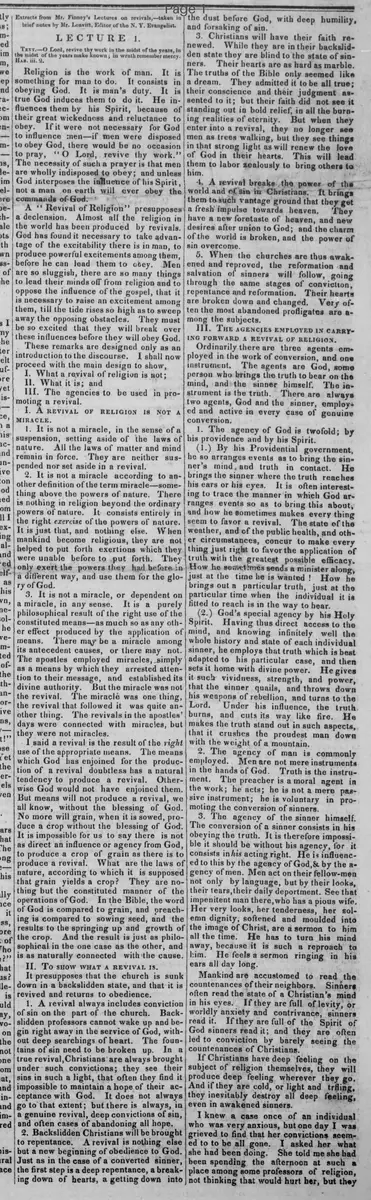
LECTURE 1.
Text.--O Lord, revive thy work in the midst of the years, in the midst of the years make known; in wrath remember mercy. Hab. iii. 2.
Religion is the work of man. It is something for man to do. It consists in obeying God. It is man's duty. It is true God induces them to do it. He influences them by his Spirit, because of their great wickedness and reluctance to obey. If it were not necessary or God to influence men--if men were disposed to obey God, there would be no occasion to pray, "O Lord, revive thy work." The necessity of such a prayer is that men are wholly indisposed to obey; and unless God interposes the influence of his Spirit, not a man on earth will ever obey the commands of God.
A "Revival of Religion" presupposes a declension. Almost all the religion in the world has been produced by revivals. God has found it necessary to take advantage of the excitability there is in man, to produce powerful excitements among them, before he can lead them to obey. Men are so sluggish, there are so many things to lead their minds off from religion and to oppose the influence of the gospel, that it is necessary to raise an excitement among them, till the tide rises so high as to sweep away the opposing obstacles. They must be so excited that they will break over these influences before they will obey God. These remarks are designed only as an introduction to the discourse. I shall now proceed with the main design to show,
I. What a revival of religion is not;
II. What it is; and
III. The agencies to be used in promoting a revival.
I. A REVIVAL OF RELIGION IS NOT A MIRACLE.
1. It is not a miracle, in the sense of a suspension, setting aside of the laws of nature. All the laws of matter and mind remain in force. They are neither suspended nor set aside in a revival.
2. It is not a miracle according to another definition of the term miracle--something above the powers of nature. There is nothing in religion beyond the ordinary powers of nature. It consists entirely in the right exercise of the powers of nature. It is just that, and nothing else. When mankind become religious, they are not helped to put forth exertions which they were unable before to put forth. They only exert the powers they had before in a different way, and use them for the glory of God.
3. It is not a miracle, or dependent on a miracle, in any sense. It is a purely philosophical result of the right use of the constituted means--as much so as any other effect produced by the application of means. There may be a miracle among its antecedent causes, or there may not. The apostles employed miracles, simply as a means by which they arrested attention to their message, and established its divine authority. But the miracle was not the revival. The miracle was one thing, the revival that followed it was quite another thing. The revivals in the apostles days were connected with miracles, but they were not miracles.
I said a revival is the result of the right use of the appropriate means. The means which God has enjoined for the production of a revival doubtless has a natural tendency to produce a revival. Otherwise God would not have enjoined them. But means will not produce a revival, we all know, without the blessing of God. No more will grain, when it is sowed, produce a crop without the blessing of God. It is impossible for us to say there is not as direct an influence or agency from God, to produce a crop of grain as there is to produce a revival. What are the laws of nature, according to which it is supposed that grain yields a crop? They are nothing but the constituted manner of the operations of God. In the Bible, the word of God is compared to grain, and preaching is compared to sowing seed, and the results to the springing up and growth of the crop. And the result is just as philosophical in the one case as the other, and is as naturally connected with the cause.
II. TO SHOW WHAT A REVIVAL IS.
It presupposes that the church is sunk down in a backslidden state, and that it is revived and returns to obedience.
1. A revival always includes conviction of sin on the part of the church. Backslidden professors cannot wake up and begin right away in the service of God, without deep searchings of heart. The fountains of sin need to be broken up. In a true revival, Christians are always brought under such convictions; they see their sins in such a light, that often they find it impossible to maintain a hope of their acceptance with God. It does not always go to that extent; but there is always, in a genuine revival, deep convictions of sin, and often cases of abandoning all hope.
2. Backslidden Christians will be brought to repentance. A revival is nothing else but a new beginning of obedience to God. Just as in the case of a converted sinner, the first step is a deep repentance, a breaking down of hearts, a getting down into the dust before God, with deep humility, and forsaking of sin.
3. Christians will have their faith renewed. While they are in their backslidden state they are blind to the state of sinners. Their hearts are as hard as marble. The truths of the Bible only seemed like a dream. They admitted it to be all true; their conscience and their judgment assented to it; but their faith did not see it standing out in bold relief, in all the burning realities of eternity. But when they enter into a revival, they no longer see men as trees walking, but they see things in that strong light as will renew the love of God in their hearts. This will lead them to labor zealously to bring others to him.
4. A revival breaks the power of the world and of sin in Christians. It brings them to such vantage ground that they get a fresh impulse towards heaven. They have a new foretaste of heaven, and new desires after union to God; and the charm of the world is broken, and the power of sin overcome.
5. When the churches are thus awakened and reformed, the reformation and salvation of sinners will follow, going through the same stages of conviction, repentance and reformation. Their hearts are broken down and changed. Very often the most abandoned profligates are among the subjects.
III. THE AGENCIES EMPLOYED IN CARRYING FORWARD A REVIVAL OF RELIGION.
Ordinarily there are three agents employed in the work of conversion, and one instrument. The agents are God, some person who brings the truth to bear on the mind, and the sinner himself. The instrument is the truth. There are always two agents, God and the sinner, employed and active in every case of genuine conversion.
1. The agency of God is twofold; by his providence and by his Spirit.
(i.) By his Providential government, he so arranges events as to bring the sinner's mind and truth in contact. He brings the sinner where the truth reaches his ears or his eyes. It is often interesting to trace the manner in which God arranges events so as to bring this about, and how he sometimes makes every thing seem to favor a revival. The state of the weather, and of the public health, and other circumstances, concur to make every thing just right to favor the application of truth with the greatest possible efficacy. How he sometimes sends a minister along, just at the time he is wanted! How he brings out a particular truth, just at the particular time when the individual it is fitted to reach is in the way to hear.
(2.) God's special agency by his Holy Spirit. Having thus direct access to the mind, and knowing infinitely well the whole history and state of each individual sinner, he employs that truth which is best adapted to his particular case, and then sets it home with divine power. He gives it such vividness, strength, and power, that the sinner quails, and throws down his weapons of rebellion, and turns to the Lord. Under his influence, the truth burns, and cuts its way like fire. He makes the truth stand out in such aspects, that it crushes the proudest man down with the weight of a mountain.
2. The agency of man is commonly employed. Men are not mere instruments in the hands of God. Truth is the instrument. The preacher is a moral agent in the work: he acts; he is not a mere passive instrument; he is voluntary in promoting the conversion of sinners.
3. The agency of the sinner himself. The conversion of a sinner consists in his obeying the truth. It is therefore impossible it should be without his agency, for it consists in his acting right. He is influenced to this by the agency of God, & by the agency of men. Men act on their fellow-men not only by language, but by their looks, their tears, their daily deportment. See that impenitent man there, who has a pious wife. Her very looks, her tenderness, her solemn dignity, softened and moulded into the image of Christ, are a sermon to him all the time. He has to turn his mind away, because it is such a reproach to him. He feels a sermon ringing in his ears all day long.
Mankind are accustomed to read the countenances of their neighbors. Sinners often read the state of a Christian's mind in his eyes. If they are full of levity, or worldly anxiety and contrivance, sinners read it. If they are full of the Spirit of God sinners read it; and they are often led to conviction by barely seeing the countenances of Christians.
If Christians have deep feeling on the subject of religion themselves, they will produce deep feeling wherever they go. And if they are cold, or light and trifling, they inevitably destroy all deep feeling, even in awakened sinners.
I knew a case once of an individual who was very anxious, but one day I was grieved to find that her convictions seemed to be all gone. I asked her what she had been doing. She told me she had been spending the afternoon at such a place among some professors of religion, not thinking that would hurt her, but they
were trifling and vain, and thus her convictions were lost. And no doubt those professors of religion, by their folly destroyed a soul. for her convictions did not return.
The church is required to use the means for the conversion of sinners. Sinners cannot properly be said to use the means for their own conversion. The church uses the means. Sinners submit to the truth or resist it. It is a mistake of sinners, to think they are using means for their own conversion. The whole drift of a revival, and every thing about it, is to present the truth to your mind, for your obedience or resistance.
REMARKS.
Rem. 1. Revivals were formerly regarded as miracles.
It used to be so many years ago. And it has been so by some even in our day. And others have ideas on the subject so loose and unsatisfactory, that if they would only think, they would see their absurdity. For a long time, it was supposed by the church that a revival was a miracle, an interposition of Divine power which they had nothing to do with, and which they had no more power to produce than they had to produce thunder, or a storm of hail, or an earthquake. It is only within a few years that ministers generally have supposed revivals were to be promoted, by the use of means designed and adapted specially to that object. Even in New England, it has been supposed that revivals came just as showers do, sometimes in one town, and sometimes in another, that ministers and churches can do nothing more to produce them, than they can to make showers of rain to come on their own town when they are falling on a neighboring town.
It used to be supposed that a revival would come about once in 15 years, and all would be converted that God intended to save, and then they must wait until another crop came forward on the stage of life. Finally the time got shortened down to five years, and they supposed there might be a revival about as often as that.
There was a revival in the congregation of one of these pastors, who supposed revivals might come about once in five years. The next year, there was a revival in a neighboring congregation and he went there to preach, and stayed several days, till he got his soul all engaged in the work. He went home on Saturday, and went into his study to prepare for the Sabbath. And his soul was in agony. He thought how many adult persons there were in his congregation at enmity with God-so many still unconverted-so many die yearly-such a portion of them unconverted-if a revival does not come under five years so many adult heads of families will be in hell. He put down his calculations on paper and embodied them in his sermon the next day with his heart bleeding at the dreadful picture. As I understood it he did not do this with any expectation of a revival-but he felt deeply, and poured out his heart to his people. And that sermon awakened forty heads of families, and a powerful revival followed; and so his theory about a revival once in five years was all exploded.
Thus God has overthrown generally the theory that revivals are miracles.
Rem. 2. Mistaken notions concerning the sovereignty of God, have greatly hindered revivals.
Many people have supposed God's sovereignty to be something very different from what it is. They have supposed it to be such an arbitrary disposal of events, and particularly the gift of his Spirit, as precluded a rational employment of means for promoting a revival of religion. But there is no evidence from the Bible, that God exercises any such sovereignty as that. There are no facts to prove it. But every thing goes to show, that God has connected means with the end through all the departments of his government- in nature and in grace.
And yet some people are terribly alarmed at all direct efforts to promote a revival, and they cry out, "You are trying to get up a revival in your own strength. Take care, you are interfering with the sovereignty of God. Better keep along in the usual course, and let God give a revival. God is a sovereign, and it is very wrong for you to attempt to get up a revival just because you think a revival is needed." This is just such preaching as the devil wants. And men can't do the devil's work more effectually, than by preaching up the sovereignty of God, as a reason why we should not put forth efforts to produce a revival.
Finally—I have a proposal to make to you who are here present. I have not commenced this course of Lectures on revivals to get up a curious theory of my own on the subject. I would not spend my time and strength merely to give you instruction, to gratify your curiosity, and furnish you something to talk about. I have no idea of preaching about revivals. It is not my design to preach so as to have you able to say at the close, "We understand all about revivals now," while you do nothing. But I wish to ask you a question. What do you hear lectures on revivals for? Do you mean that whenever you are convinced what your duty is in promoting a revival, to go to work and practise it?
Will you follow the instructions I shall give you from the word of God, and put them in practice upon your own hearts. your families, your acquaintance, neighbors, and through the city? Or will you spend the winter in learning about revivals, and do nothing for them? I want you as fast as you learn any thing on the subject of revivals to put it in practice, and go to work and see if you cannot promote a revival among sinners here. If you will not do this I wish you to let me know at the beginning so that I need not waste my strength. You ought to decide now whether you will do this or not. You know we call sinners to decide on the spot whether they will obey the gospel. And we have no more authority to let you take time to deliberate whether you will obey God, than we have to let sinners do so.
We call on you to unite now in a solemn pledge to God that you will do your duty as fast as you learn what it is, and to pray that He will pour out his Spirit upon this church and upon all the city this winter.
What sub-type of article is it?
What themes does it cover?
What keywords are associated?
What entities or persons were involved?
Literary Details
Title
Lecture 1.
Author
Mr. Finney (Notes By Mr. Leavitt, Editor Of The N. Y. Evangelist)
Subject
On Revivals Of Religion (Hab. Iii. 2)
Key Lines