Thank you for visiting SNEWPapers!
Sign up free
Literary
February 14, 1952
The Prison Mirror
Stillwater, Washington County, Minnesota
What is this article about?
Essay by Henry J. Nitzsche praising ancient Greece's cultural legacy through great minds like Demosthenes, the greatest orator, emphasizing his morality, intelligence, and expressive style as a model for modern public affairs and personal conduct.
Clipping
OCR Quality
98%
Excellent
Full Text
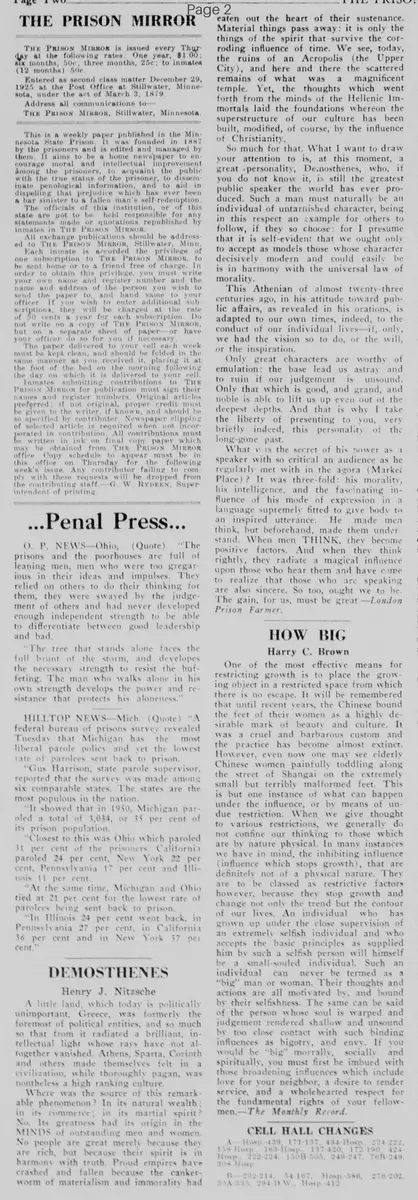
DEMOSTHENES
Henry J. Nitzsche
A little land, which today is politically unimportant, Greece, was formerly the foremost of political entities, and so much so that from it radiated a brilliant, intellectual light whose rays have not altogether vanished. Athens, Sparta, Corinth and others made themselves felt in a civilization, while thoroughly pagan, was nonetheless a high ranking culture.
Where was the source of this remarkable phenomenon? In its natural wealth; in its commerce; in its martial spirit? No. Its greatness had its origin in the MINDS of outstanding men and women.
No people are great merely because they are rich, but because their spirit is in harmony with truth. Proud empires have crashed and fallen because the canker-worm of materialism and immorality had eaten out the heart of their sustenance.
Material things pass away: it is only the things of the spirit that survive the corroding influence of time. We see, today, the ruins of an Acropolis (the Upper City), and here and there the scattered remains of what was a magnificent temple. Yet, the thoughts which went forth from the minds of the Hellenic Immortals laid the foundations whereon the superstructure of our culture has been built, modified, of course, by the influence of Christianity.
So much for that. What I want to draw your attention to is, at this moment, a great personality, Demosthenes, who, if you do not know it, is still the greatest public speaker the world has ever produced. Such a man must naturally be an individual of untarnished character, being in this respect an example for others to follow, if they so choose: for I presume that it is self-evident that we ought only to accept as models those whose character is in harmony with the universal law of morality.
This Athenian of almost twenty-three centuries ago, in his attitude toward public affairs, as revealed in his orations, is adapted to our own times, indeed, to the conduct of our individual lives--if, only, we had the vision so to do, or the will, or the inspiration.
Only great characters are worthy of emulation: the base lead us astray and to ruin if our judgement is unsound. Only that which is good, and grand, and noble is able to lift us up even out of the deepest depths. And that is why I take the liberty of presenting to you, very briefly indeed, this personality of the long-gone past.
What was the secret of his power as a speaker with so critical an audience as he regularly met with in the agora (Market Place)? It was three-fold: his morality, his intelligence, and the fascinating influence of his mode of expression in a language supremely fitted to give body to an inspired utterance. He made men think, but beforehand, made them understand. When men THINK, they become positive factors. And when they think rightly, they radiate a magical influence upon those who hear them and have come to realize that those who are speaking are also sincere. So too, ought we to be.
The gain, for us, must be great. --London Prison Farmer.
Henry J. Nitzsche
A little land, which today is politically unimportant, Greece, was formerly the foremost of political entities, and so much so that from it radiated a brilliant, intellectual light whose rays have not altogether vanished. Athens, Sparta, Corinth and others made themselves felt in a civilization, while thoroughly pagan, was nonetheless a high ranking culture.
Where was the source of this remarkable phenomenon? In its natural wealth; in its commerce; in its martial spirit? No. Its greatness had its origin in the MINDS of outstanding men and women.
No people are great merely because they are rich, but because their spirit is in harmony with truth. Proud empires have crashed and fallen because the canker-worm of materialism and immorality had eaten out the heart of their sustenance.
Material things pass away: it is only the things of the spirit that survive the corroding influence of time. We see, today, the ruins of an Acropolis (the Upper City), and here and there the scattered remains of what was a magnificent temple. Yet, the thoughts which went forth from the minds of the Hellenic Immortals laid the foundations whereon the superstructure of our culture has been built, modified, of course, by the influence of Christianity.
So much for that. What I want to draw your attention to is, at this moment, a great personality, Demosthenes, who, if you do not know it, is still the greatest public speaker the world has ever produced. Such a man must naturally be an individual of untarnished character, being in this respect an example for others to follow, if they so choose: for I presume that it is self-evident that we ought only to accept as models those whose character is in harmony with the universal law of morality.
This Athenian of almost twenty-three centuries ago, in his attitude toward public affairs, as revealed in his orations, is adapted to our own times, indeed, to the conduct of our individual lives--if, only, we had the vision so to do, or the will, or the inspiration.
Only great characters are worthy of emulation: the base lead us astray and to ruin if our judgement is unsound. Only that which is good, and grand, and noble is able to lift us up even out of the deepest depths. And that is why I take the liberty of presenting to you, very briefly indeed, this personality of the long-gone past.
What was the secret of his power as a speaker with so critical an audience as he regularly met with in the agora (Market Place)? It was three-fold: his morality, his intelligence, and the fascinating influence of his mode of expression in a language supremely fitted to give body to an inspired utterance. He made men think, but beforehand, made them understand. When men THINK, they become positive factors. And when they think rightly, they radiate a magical influence upon those who hear them and have come to realize that those who are speaking are also sincere. So too, ought we to be.
The gain, for us, must be great. --London Prison Farmer.
What sub-type of article is it?
Essay
What themes does it cover?
Political
Moral Virtue
What keywords are associated?
Demosthenes
Oratory
Morality
Greek Culture
Athens
Public Speaking
Spiritual Legacy
What entities or persons were involved?
Henry J. Nitzsche
Literary Details
Title
Demosthenes
Author
Henry J. Nitzsche
Subject
Demosthenes As The Greatest Orator And Moral Exemplar
Key Lines
Its Greatness Had Its Origin In The Minds Of Outstanding Men And Women.
Demosthenes, Who, If You Do Not Know It, Is Still The Greatest Public Speaker The World Has Ever Produced.
It Was Three Fold: His Morality, His Intelligence, And The Fascinating Influence Of His Mode Of Expression In A Language Supremely Fitted To Give Body To An Inspired Utterance.
He Made Men Think, But Beforehand, Made Them Understand.
When Men Think, They Become Positive Factors.