Thank you for visiting SNEWPapers!
Sign up free
Editorial
July 3, 1802
Rhode Island Republican
Newport, Newport County, Rhode Island
What is this article about?
An anonymous editorial from 'Old South' defends President Jefferson against Federalist attacks, portraying critics as modern Tories undermining Republicanism and the Union. It draws parallels to Revolutionary-era opposition, praises tax repeals and judiciary limits, and urges unity for national prosperity.
Clipping
OCR Quality
95%
Excellent
Full Text
From the Chronicle.
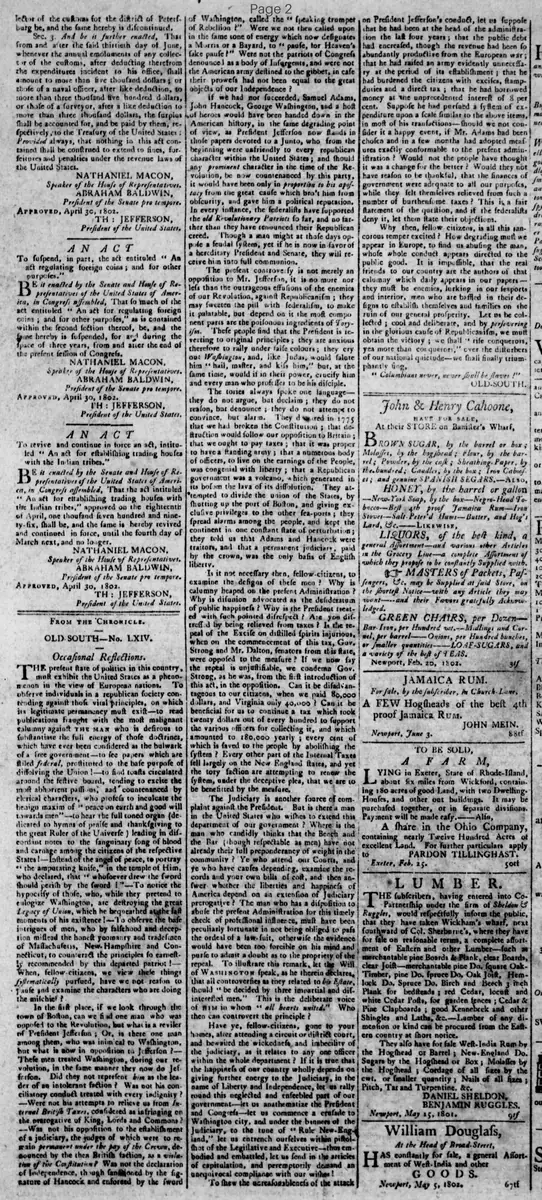
OLD SOUTH—No. LXIV.
Occasional Reflections.
The present phenomenon in the view of European nations. To observe individuals in a republican society contending against those vital principles, on which its legitimate permanency must exist—to read publications fraught with the most malignant calumny against The Man who is desirous to substantiate the full energy of those doctrines, which have ever been considered as the bulwark of a free government—to see papers which are styled federal, prostituted to the base purpose of dissolving the Union!—to find toasts circulated around the festive board, tending to excite the most abhorrent passions, and countenanced by clerical characters, who profess to inculcate the benign maxim of "peace on earth and good will towards men"—to hear the full toned organ (dedicated to hymns of praise and thanksgiving to the great Ruler of the Universe) leading in discordant notes to the sanguinary song of blood and carnage among the citizens of the respective States!—Instead of the angel of peace, to portray "the amputation knife." in the temple of Him, who declared, that "whosoever drew the sword should perish by the sword!"—To notice the hypocrisy of those, who, while they pretend to eulogize Washington, are destroying the great Legacy of Union, which he bequeathed at the last moments of his existence!—To observe the base intrigues of men, who by falsehood and deception mislead the honest yeomanry and tradesmen of Massachusetts, New Hampshire and Connecticut, to counteract the principles of candor. Is recommended by this departed patriot!—
When, fellow-citizens, we view these things systematically pursued, have we not reason to pause and examine the characters who are doing the mischief?.
In the first place, if we look through the town of Boston, can we find one man who was opposed to the Revolution, but what is a reviler of President Jefferson; Or, is there one man among them, who was inimical to Washington, but what is now in opposition to Jefferson?—These men treated Washington, during our revolution, in the same manner they now do Jefferson. Did they not represent him as the leader of an intolerant faction? Was not his conciliatory conduct treated with every indignity?—Were not his attempts to relieve us from Internal British Taxes, considered as infringing on the prerogative of King, Lords and Commons?—Was not his opposition to the establishment of a judiciary, the judges of which were to remain permanent under the pay of the Crown, denounced by the then British faction, as a violation of the Constitution? Was not the declaration of Independence, though sanctioned by the signature of Hancock and enforced by the sword of Washington, called the "speaking trumpet of Rebellion?" Were we not then called upon in the same tone of energy which now delegitimates a Morris or a Bayard, to "pause, for Heaven's sake pause?" Were not the patriots of Congress denounced as a body of Insurgents, and were not the American army destined to the gibbet, in case their prowess had not been equal to the great objects of our Independence?
If we had not succeeded, Samuel Adams, John Hancock, George Washington, and a host of heroes would have been handed down in the American history, in the same degrading point of view, as President Jefferson now stands in those papers devoted to a Junto, who from the beginning were unfriendly to every republican character within the United States: and should any prominent character in the time of the Revolution, be now countenanced by this party, it would have been only in proportion to his apostacy from the great cause which bro't him from obscurity, and gave him a political reputation.
In every instance, the federalists, have supported the old Revolutionary Patriots so far, and no farther than they have renounced their Republican creed. Though a man might at those days oppose a feudal system, yet if he is now in favor of a hereditary President and Senate, they will receive him into full communion.
The present controversy is not merely an opposition to Mr. Jefferson, it is no more nor less than the outrageous effusions of the enemies of our Revolution, against Republicanism; they may sweeten the pill with federalism, to make it palatable, but depend on it the most component parts are the poisonous ingredients of Toryism. These people find that the President is reverting to original principles; they are anxious therefore to rally under false colours; they cry out Washington, and, like Judas, would salute him "hail, master, and kiss him," but, at the same time, would if in their power, crucify him and every man who professes to be his disciple.
The tories always spoke one language—they do not argue, but declaim; they do not reason, but denounce; they do not attempt to convince, but alarm. They divined in 1775 that we had broken the Constitution; that destruction would follow our opposition to Britain; that we ought to pay taxes; that it was proper to have a standing army; that a numerous body of officers, to live on the earnings of the People, was congenial with liberty; that a Republican government was a volcano, which generated in its bosom the lava of its dissolution. They attempted to divide the union of the States, by shutting up the port of Boston, and giving exclusive privileges to the other sea-ports; they spread alarms among the people, and kept the continent in one constant state of perturbation; they told us that Adams and Hancock were traitors, and that a permanent judiciary, paid by the crown, was the only basis of English liberty.
Is it not necessary then, fellow-citizens, to examine the designs of these men? Why is calumny heaped on the present Administration? Why is disunion advocated as the desideratum of public happiness? Why is the President treated with such pointed disrespect? Are you distressed by being relieved from taxes? Is the repeal of the Excise on distilled spirits injurious, when on the commencement of this tax, Gov. Strong and Mr. Dalton, senator from this state, were opposed to the measure? If we now say the repeal is unjustifiable, we condemn Gov. Strong, as he was, from the first introduction of this act, in the opposition. Can it be disadvantageous to our citizens, when we paid 80,000 dollars, and Virginia only 40,000? Can it be beneficial for us to continue a tax which took twenty dollars out of every hundred to support the various officers for collecting it, and which amounted to 280,000 yearly; every cent of which is saved to the people by abolishing the system? Every other part of the Internal Taxes fell largely on the New England states, and yet the tory faction are attempting to renew the system, under the deceptive plea, that we are to be benefitted by the measure.
The Judiciary is another source of complaint against the President. But is there a man in the United States who wishes to extend this department of our government? Where is the man who candidly thinks that the Bench and the Bar (though respectable as men) have not already their full preponderancy of weight in the community? Ye who attend our Courts, and ye who have cases depending, examine the records and your own bills of cost, and then answer whether the liberties and happiness of America depend on an extension of Judiciary prerogative? The man who has a disposition to abuse the present Administration for this timely check of professional influence, must have been peculiarly fortunate in not being obliged to pass the ordeal of a law-suit, otherwise the evidence would have been too forcible on his mind and purse to admit a doubt as to the propriety of the repeal. To illustrate this remark, let the Will of Washington speak, as he therein declares, that all controversies as they related to his Estate, should "be decided by three impartial and disinterested men." This is the deliberate voice of him in whom "all hearts united." Who then can controvert the principle?
Have ye, fellow-citizens, gone to your homes, after attending a circuit or district court, and bewailed the wickedness and imbecility of the judiciary, as it relates to any one officer within the whole department? If it is true that the happiness of our country wholly depends on giving further energy to the Judiciary. in the name of Liberty and Independence, let us rally round this neglected and enfeebled part of our government—let us anathematize the President and Congress—let us commence a crusade to Washington city, and under the banner of the Judiciary, to the tune of "Rule New England," let us entrench ourselves within pistol-shot of the Legislative and Executive—thus embodied and embattled, let us end in the articles of capitulation, and peremptorily demand an unequivocal compliance with our wishes!
To shew the unreasonableness of the attack on President Jefferson's conduct, let us suppose that he had been at the head of the administration the last four years; that the public debt had increased, though the revenue had been so abundantly productive from the European war; that he had raised an army evidently unnecessary at the period of its establishment; that he had burdened the citizens with excises, stamp duties and a direct tax; that he had borrowed money at the unprecedented interest of 8 per cent. Suppose he had pursued a system of expenditure upon a scale similar to the above items, in most of his transactions—should we not consider it a happy event, if Mr. Adams had been chosen and in a few months had adopted measures exactly conformable to the present administration? Would not the people have thought it was a change for the better? Would they not have reason to be thankful, that the finances of government were adequate to all our purposes, while they felt themselves relieved from such a number of burdensome taxes? This is a fair statement of the question, and if the federalists deny it, let them state their objections.
Why then, fellow citizens, is all this rancorous temper excited? How degrading must we appear in Europe, to find us abusing the man, whose whole conduct appears directed to the public good. It is impossible, that the real friends to our country are the authors of that calumny which daily appears in our papers—they must be enemies, lurking in our seaports and interior, men who are baffled in their designs to establish themselves and families on the ruin of our general prosperity. Let us be collected: cool and deliberate, and by persevering in the glorious cause of Republicanism, we must obtain the victory; we shall "rise conquerors, yea more than conquerors," over the disturbers of our national quietude—we shall finally triumphantly sing,
"Columbians never, never shall be slaves!"
OLD SOUTH.
OLD SOUTH—No. LXIV.
Occasional Reflections.
The present phenomenon in the view of European nations. To observe individuals in a republican society contending against those vital principles, on which its legitimate permanency must exist—to read publications fraught with the most malignant calumny against The Man who is desirous to substantiate the full energy of those doctrines, which have ever been considered as the bulwark of a free government—to see papers which are styled federal, prostituted to the base purpose of dissolving the Union!—to find toasts circulated around the festive board, tending to excite the most abhorrent passions, and countenanced by clerical characters, who profess to inculcate the benign maxim of "peace on earth and good will towards men"—to hear the full toned organ (dedicated to hymns of praise and thanksgiving to the great Ruler of the Universe) leading in discordant notes to the sanguinary song of blood and carnage among the citizens of the respective States!—Instead of the angel of peace, to portray "the amputation knife." in the temple of Him, who declared, that "whosoever drew the sword should perish by the sword!"—To notice the hypocrisy of those, who, while they pretend to eulogize Washington, are destroying the great Legacy of Union, which he bequeathed at the last moments of his existence!—To observe the base intrigues of men, who by falsehood and deception mislead the honest yeomanry and tradesmen of Massachusetts, New Hampshire and Connecticut, to counteract the principles of candor. Is recommended by this departed patriot!—
When, fellow-citizens, we view these things systematically pursued, have we not reason to pause and examine the characters who are doing the mischief?.
In the first place, if we look through the town of Boston, can we find one man who was opposed to the Revolution, but what is a reviler of President Jefferson; Or, is there one man among them, who was inimical to Washington, but what is now in opposition to Jefferson?—These men treated Washington, during our revolution, in the same manner they now do Jefferson. Did they not represent him as the leader of an intolerant faction? Was not his conciliatory conduct treated with every indignity?—Were not his attempts to relieve us from Internal British Taxes, considered as infringing on the prerogative of King, Lords and Commons?—Was not his opposition to the establishment of a judiciary, the judges of which were to remain permanent under the pay of the Crown, denounced by the then British faction, as a violation of the Constitution? Was not the declaration of Independence, though sanctioned by the signature of Hancock and enforced by the sword of Washington, called the "speaking trumpet of Rebellion?" Were we not then called upon in the same tone of energy which now delegitimates a Morris or a Bayard, to "pause, for Heaven's sake pause?" Were not the patriots of Congress denounced as a body of Insurgents, and were not the American army destined to the gibbet, in case their prowess had not been equal to the great objects of our Independence?
If we had not succeeded, Samuel Adams, John Hancock, George Washington, and a host of heroes would have been handed down in the American history, in the same degrading point of view, as President Jefferson now stands in those papers devoted to a Junto, who from the beginning were unfriendly to every republican character within the United States: and should any prominent character in the time of the Revolution, be now countenanced by this party, it would have been only in proportion to his apostacy from the great cause which bro't him from obscurity, and gave him a political reputation.
In every instance, the federalists, have supported the old Revolutionary Patriots so far, and no farther than they have renounced their Republican creed. Though a man might at those days oppose a feudal system, yet if he is now in favor of a hereditary President and Senate, they will receive him into full communion.
The present controversy is not merely an opposition to Mr. Jefferson, it is no more nor less than the outrageous effusions of the enemies of our Revolution, against Republicanism; they may sweeten the pill with federalism, to make it palatable, but depend on it the most component parts are the poisonous ingredients of Toryism. These people find that the President is reverting to original principles; they are anxious therefore to rally under false colours; they cry out Washington, and, like Judas, would salute him "hail, master, and kiss him," but, at the same time, would if in their power, crucify him and every man who professes to be his disciple.
The tories always spoke one language—they do not argue, but declaim; they do not reason, but denounce; they do not attempt to convince, but alarm. They divined in 1775 that we had broken the Constitution; that destruction would follow our opposition to Britain; that we ought to pay taxes; that it was proper to have a standing army; that a numerous body of officers, to live on the earnings of the People, was congenial with liberty; that a Republican government was a volcano, which generated in its bosom the lava of its dissolution. They attempted to divide the union of the States, by shutting up the port of Boston, and giving exclusive privileges to the other sea-ports; they spread alarms among the people, and kept the continent in one constant state of perturbation; they told us that Adams and Hancock were traitors, and that a permanent judiciary, paid by the crown, was the only basis of English liberty.
Is it not necessary then, fellow-citizens, to examine the designs of these men? Why is calumny heaped on the present Administration? Why is disunion advocated as the desideratum of public happiness? Why is the President treated with such pointed disrespect? Are you distressed by being relieved from taxes? Is the repeal of the Excise on distilled spirits injurious, when on the commencement of this tax, Gov. Strong and Mr. Dalton, senator from this state, were opposed to the measure? If we now say the repeal is unjustifiable, we condemn Gov. Strong, as he was, from the first introduction of this act, in the opposition. Can it be disadvantageous to our citizens, when we paid 80,000 dollars, and Virginia only 40,000? Can it be beneficial for us to continue a tax which took twenty dollars out of every hundred to support the various officers for collecting it, and which amounted to 280,000 yearly; every cent of which is saved to the people by abolishing the system? Every other part of the Internal Taxes fell largely on the New England states, and yet the tory faction are attempting to renew the system, under the deceptive plea, that we are to be benefitted by the measure.
The Judiciary is another source of complaint against the President. But is there a man in the United States who wishes to extend this department of our government? Where is the man who candidly thinks that the Bench and the Bar (though respectable as men) have not already their full preponderancy of weight in the community? Ye who attend our Courts, and ye who have cases depending, examine the records and your own bills of cost, and then answer whether the liberties and happiness of America depend on an extension of Judiciary prerogative? The man who has a disposition to abuse the present Administration for this timely check of professional influence, must have been peculiarly fortunate in not being obliged to pass the ordeal of a law-suit, otherwise the evidence would have been too forcible on his mind and purse to admit a doubt as to the propriety of the repeal. To illustrate this remark, let the Will of Washington speak, as he therein declares, that all controversies as they related to his Estate, should "be decided by three impartial and disinterested men." This is the deliberate voice of him in whom "all hearts united." Who then can controvert the principle?
Have ye, fellow-citizens, gone to your homes, after attending a circuit or district court, and bewailed the wickedness and imbecility of the judiciary, as it relates to any one officer within the whole department? If it is true that the happiness of our country wholly depends on giving further energy to the Judiciary. in the name of Liberty and Independence, let us rally round this neglected and enfeebled part of our government—let us anathematize the President and Congress—let us commence a crusade to Washington city, and under the banner of the Judiciary, to the tune of "Rule New England," let us entrench ourselves within pistol-shot of the Legislative and Executive—thus embodied and embattled, let us end in the articles of capitulation, and peremptorily demand an unequivocal compliance with our wishes!
To shew the unreasonableness of the attack on President Jefferson's conduct, let us suppose that he had been at the head of the administration the last four years; that the public debt had increased, though the revenue had been so abundantly productive from the European war; that he had raised an army evidently unnecessary at the period of its establishment; that he had burdened the citizens with excises, stamp duties and a direct tax; that he had borrowed money at the unprecedented interest of 8 per cent. Suppose he had pursued a system of expenditure upon a scale similar to the above items, in most of his transactions—should we not consider it a happy event, if Mr. Adams had been chosen and in a few months had adopted measures exactly conformable to the present administration? Would not the people have thought it was a change for the better? Would they not have reason to be thankful, that the finances of government were adequate to all our purposes, while they felt themselves relieved from such a number of burdensome taxes? This is a fair statement of the question, and if the federalists deny it, let them state their objections.
Why then, fellow citizens, is all this rancorous temper excited? How degrading must we appear in Europe, to find us abusing the man, whose whole conduct appears directed to the public good. It is impossible, that the real friends to our country are the authors of that calumny which daily appears in our papers—they must be enemies, lurking in our seaports and interior, men who are baffled in their designs to establish themselves and families on the ruin of our general prosperity. Let us be collected: cool and deliberate, and by persevering in the glorious cause of Republicanism, we must obtain the victory; we shall "rise conquerors, yea more than conquerors," over the disturbers of our national quietude—we shall finally triumphantly sing,
"Columbians never, never shall be slaves!"
OLD SOUTH.
What sub-type of article is it?
Partisan Politics
Economic Policy
Legal Reform
What keywords are associated?
Jefferson Defense
Federalist Calumny
Republicanism
Tax Repeal
Judiciary Reform
Union Preservation
Tory Opposition
What entities or persons were involved?
President Jefferson
George Washington
Federalists
Tories
Samuel Adams
John Hancock
Gov. Strong
Mr. Dalton
Morris
Bayard
Editorial Details
Primary Topic
Defense Of Jefferson Against Federalist And Tory Like Opposition
Stance / Tone
Strongly Pro Republican And Pro Jefferson, Anti Federalist
Key Figures
President Jefferson
George Washington
Federalists
Tories
Samuel Adams
John Hancock
Gov. Strong
Mr. Dalton
Morris
Bayard
Key Arguments
Federalist Critics Are Modern Tories Undermining The Union And Republican Principles
Opposition To Jefferson Mirrors Treatment Of Washington During The Revolution
Repeal Of Excise Taxes Benefits The People, Especially New England, Contrary To Federalist Claims
Judiciary Has Excessive Influence; Jefferson's Checks Are Timely And Supported By Washington's Will
Federalists Support Only Those Who Renounce Republicanism
Critics Declaim And Alarm Rather Than Reason
Jefferson's Policies Relieve Burdensome Taxes And Reduce Debt Compared To Prior Administration